Within Uncanny Algeria
Do Tassili's Strange Figures Show Ancient Aliens?
Tassili n'Ajjer contains genuinely enigmatic prehistoric images, but its alien and psychedelic legends rest on disputed modern readings.
On this page
- What the Tassili paintings actually depict
- How alien and shaman stories developed
- Visiting a remote open air archive
Page outline Jump by section
Introduction
Tassili n’Ajjer in south-eastern Algeria is one of the world’s greatest collections of prehistoric rock art, with more than 15,000 recorded paintings and engravings spread across a vast sandstone plateau. Alongside its genuine archaeological importance, it has also become one of the best-known sources of ancient astronaut speculation. Strange round-headed figures, towering human forms and enigmatic ceremonial scenes have inspired decades of claims that prehistoric artists were depicting extraterrestrials or evidence of lost advanced civilisations. The evidence, however, points in a different direction. While many of the paintings remain difficult to interpret with certainty, archaeologists overwhelmingly regard them as products of prehistoric Saharan societies rather than records of alien encounters. The real fascination lies not in proving modern myths, but in understanding how ambiguous ancient images became some of the most famous “alien” artworks in popular culture.[UNESCO World Heritage Centre]whc.unesco.orgWorld Heritage Centre Tassili n'AjjerUNESCO World Heritage CentreTassili n'Ajjer - UNESCO World Heritage Centre…
What the Tassili paintings actually depict
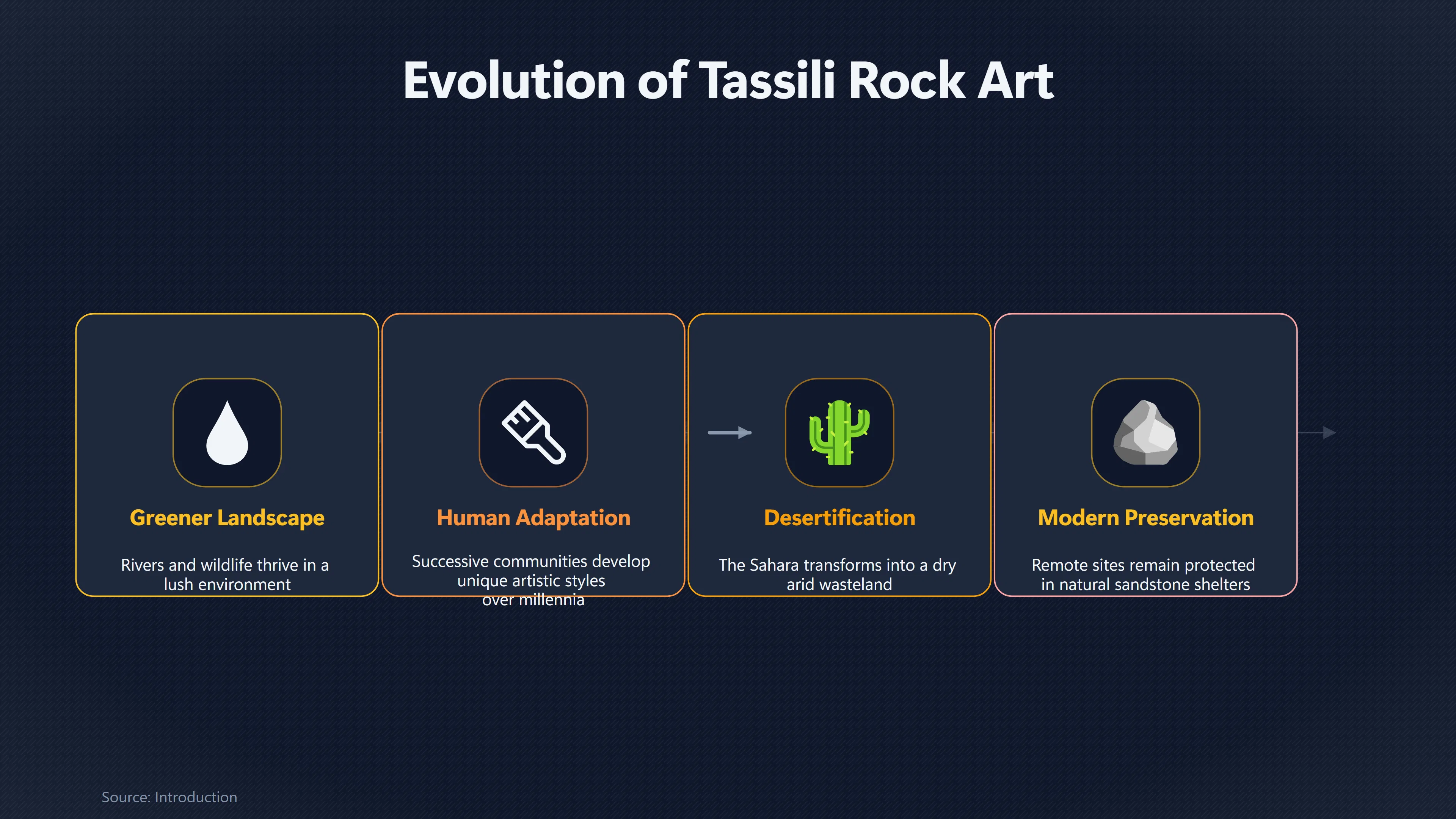
The rock art of Tassili spans thousands of years, documenting dramatic environmental and cultural change as the Sahara transformed from a greener landscape with rivers, wildlife and grazing lands into today’s desert. UNESCO identifies the site as an outstanding record of climate change, animal migrations and human adaptation over roughly 10,000 years. Rather than belonging to a single culture or period, the paintings were created by successive communities whose artistic styles evolved over millennia.[UNESCO World Heritage Centre]whc.unesco.orgWorld Heritage Centre Tassili n'AjjerUNESCO World Heritage CentreTassili n'Ajjer - UNESCO World Heritage Centre…
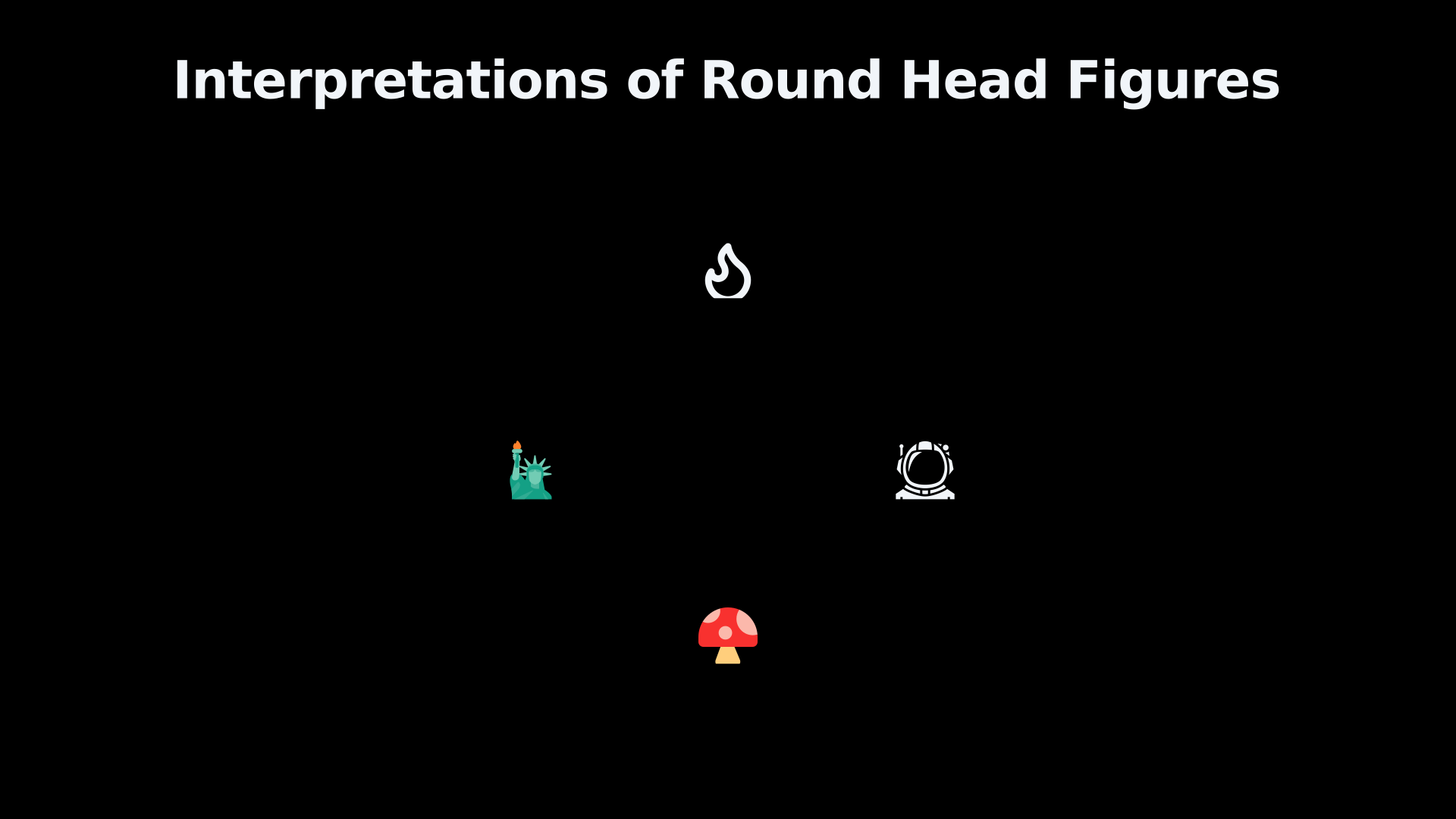
Among the most striking images are the so-called Round Head paintings. These depict human-like figures with oversized circular heads, simplified facial features or no faces at all, elaborate body decoration and unusual postures. Some appear to float, dance or tower over smaller figures. Others wear what resemble masks, costumes or ceremonial clothing.
Because the original artists left no written explanation, the exact meaning of these figures remains uncertain. Archaeologists generally interpret them within the context of ritual activity, symbolic representation or religious practice rather than literal portraits of supernatural beings. UNESCO itself cautiously notes that the Round Head paintings may reflect magic or religious practices, while avoiding more specific conclusions.[UNESCO World Heritage Centre]whc.unesco.orgWorld Heritage Centre Tassili n'AjjerUNESCO World Heritage CentreTassili n'Ajjer - UNESCO World Heritage Centre…
How alien stories developed
The extraterrestrial interpretation did not arise from prehistoric evidence but from twentieth-century popularisation.
French explorer Henri Lhote played a major role in introducing Tassili to international audiences after expeditions during the 1950s and early 1960s. His publications helped establish the site’s worldwide reputation, but he also gave memorable names to several unusual figures. One especially large image became known as the “Great Martian God”, a dramatic label that encouraged readers to imagine astronauts rather than prehistoric ritual specialists.[Wikipedia]WikipediaHenri LhoteHenri Lhote
Those descriptions were later adopted by ancient astronaut writers such as Erich von Däniken, who presented the paintings as evidence that prehistoric people had witnessed extraterrestrial visitors. The combination of simplified heads, bulky bodies and apparently helmet-like outlines fitted neatly into a modern science-fiction imagination.
The problem is that these interpretations depend almost entirely on visual resemblance. No archaeological evidence from Tassili supports the existence of advanced technology, spacecraft or contact with non-human visitors. The paintings exist within a broader corpus showing ordinary activities including hunting, cattle herding, dancing and daily life, making ritual and symbolic explanations far more consistent with the wider archaeological record.[Wikipedia]WikipediaHenri LhoteHenri Lhote
Why the paintings look so modern
Ancient astronaut theories often rely on a psychological tendency known as pattern recognition. Modern viewers naturally compare unfamiliar ancient imagery with objects they already know.
Several features encourage this comparison:
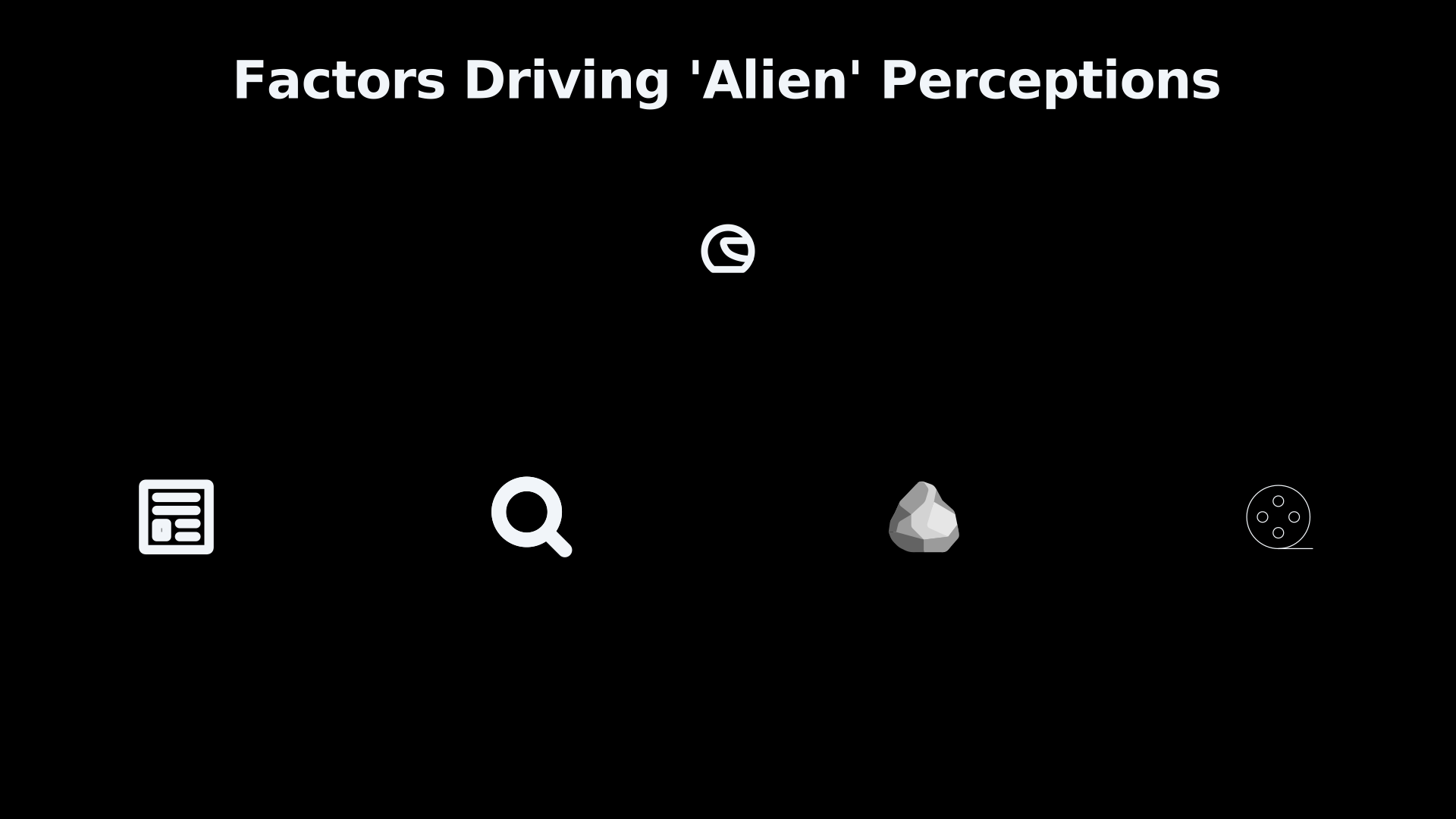
- Large circular heads resemble modern helmets.
- Featureless faces appear mask-like.
- Rounded bodies can suggest pressure suits.
- Floating or elongated poses look unusual to contemporary eyes.
- The weathering of paintings removes fine details, making figures seem even more abstract.
Yet prehistoric art around the world frequently exaggerates body proportions or simplifies human anatomy for symbolic reasons. Similar artistic conventions appear in many rock-art traditions without leading archaeologists to infer advanced technology.
In other words, the paintings look “alien” largely because modern observers already possess a visual vocabulary shaped by twentieth-century space exploration and science fiction rather than prehistoric belief systems.[Smarthistory]smarthistory.org– Running Horned Woman, Tassili n’Ajjer, AlgeriaSmarthistory – Running Horned Woman, Tassili n’Ajjer, AlgeriaApril 30, 2016…
The separate debate about shamans and mushrooms
Alien theories are often mixed together with another controversial interpretation involving psychedelic mushrooms, although they are distinct debates.
A handful of Tassili paintings have been interpreted by ethnobotanists as depicting ritual mushroom use. Some researchers have argued that certain dancing figures appear to hold mushroom-shaped objects connected to the head by parallel lines, suggesting altered states of consciousness or shamanic ceremonies.
These proposals became widely known through psychedelic literature and later internet culture. However, the interpretation remains disputed. Alternative explanations identify the same objects as flowers, tools, paddles, arrows or abstract symbols, while some researchers question whether the reconstructed illustrations accurately represent the damaged originals. Even among specialists interested in prehistoric ritual, there is no consensus that the paintings definitively depict psychoactive fungi.[Wikipedia]WikipediaTassili Mushroom FigureTassili Mushroom Figure
The important distinction is that uncertainty about one interpretation does not support another. A debated shamanic reading is not evidence for extraterrestrials.
Why scholars treat the evidence cautiously
Modern research on Tassili has become increasingly careful about separating what can be observed from what can only be inferred.
Researchers have criticised aspects of Henri Lhote’s methods and interpretations. His expeditions greatly increased international awareness of the site, but later scholarship questioned some reconstructions, argued that certain copies were inaccurate, and criticised the tendency to assign dramatic religious or extraterrestrial meanings to ambiguous images. There have also been documented cases of forged reproductions and damaged paintings associated with early recording efforts, reinforcing the need to rely on the surviving originals rather than popular illustrations.[smarthistory.org]smarthistory.org– Running Horned Woman, Tassili n’Ajjer, AlgeriaSmarthistory – Running Horned Woman, Tassili n’Ajjer, AlgeriaApril 30, 2016…
As a result, current archaeological interpretation generally proceeds more conservatively:
- Describe what the image physically shows before proposing meaning.
- Compare it with surrounding paintings from the same artistic tradition.
- Consider environmental and cultural evidence from the wider archaeological record.
- Avoid explanations that require extraordinary assumptions unsupported elsewhere.
This approach leaves room for mystery without turning uncertainty into proof.
Visiting a remote open-air archive
Unlike a conventional museum, Tassili is an immense protected landscape where the collection remains in its original setting. Visitors encounter paintings within sandstone shelters, natural rock formations and canyons rather than inside galleries. UNESCO recognises both the archaeological importance of the paintings and the remarkable geological landscape, whose eroded “rock forests” contribute to the site’s otherworldly atmosphere.[UNESCO World Heritage Centre]whc.unesco.orgWorld Heritage Centre Tassili n'AjjerUNESCO World Heritage CentreTassili n'Ajjer - UNESCO World Heritage Centre…
Its remoteness is part of its appeal. Reaching many decorated shelters requires organised desert expeditions, often involving multi-day travel with local guides. The isolation has helped preserve much of the rock art but also makes conservation challenging, with weathering and human impact remaining long-term concerns.
For travellers interested in unusual heritage rather than paranormal tourism, Tassili offers something rarer than confirmation of ancient astronaut theories: a genuine prehistoric archive where thousands of images continue to provoke questions that archaeology can investigate but may never answer completely.
Why Tassili remains central to Algeria’s curiosity landscape
Within Algeria’s unusual heritage, Tassili occupies a unique position because it combines authentic archaeological significance with one of the world’s most enduring modern myths. The site demonstrates how prehistoric art can acquire entirely new meanings as later generations project contemporary beliefs onto ancient images.
The alien stories persist because the paintings are genuinely unusual, visually memorable and resistant to simple explanation. Their lasting importance, however, lies in what they reveal about prehistoric Saharan societies, changing environments and the ways modern culture transforms archaeological mysteries into global folklore. The enduring lesson is not that the paintings prove extraterrestrial contact, but that ambiguous evidence can become surprisingly powerful once it enters popular imagination.[unesco.org]whc.unesco.orgWorld Heritage Centre Tassili n'AjjerUNESCO World Heritage CentreTassili n'Ajjer - UNESCO World Heritage Centre…
Amazon book picks
Further Reading
Books and field guides related to Do Tassili's Strange Figures Show Ancient Aliens?. Use these as the next step if you want deeper reading beyond the article.
The Mind in the Cave: Consciousness and the Origins of Art
The art created in the caves of western Europe in the Ice Age provokes awe and wonder. What do these symbols on the walls of Lascaux and...
The Oxford Handbook of the Archaeology and Anthropology of Ro...
Rock art is one of the most visible and geographically widespread of cultural expressions, and it spans much of the period of our species...
Fingerprints of the Gods
Could the story of mankind be far older than we have previously believed? Using tools as varied as archaeo-astronomy, geology, and comput...
eBay marketplace picks
Marketplace Samples
Live-tested eBay searches with available results related to this page.
Selected fromprehistoric art wall decor oneBay.co.uk.



Endnotes
1.
Source: whc.unesco.org
Title: World Heritage Centre Tassili n’Ajjer
Link:https://whc.unesco.org/en/list/179
Source snippet
UNESCO World Heritage CentreTassili n'Ajjer - UNESCO World Heritage Centre...
2.
Source: Wikipedia
Title: Henri Lhote
Link:https://en.wikipedia.org/wiki/Henri_Lhote
3.
Source: Wikipedia
Title: Tassili Mushroom Figure
Link:https://en.wikipedia.org/wiki/Tassili_Mushroom_Figure
4.
Source: smarthistory.org
Title: – Running Horned Woman, Tassili n’Ajjer, Algeria
Link:https://smarthistory.org/running-horned-woman-tassili-najjer-algeria/
Source snippet
Smarthistory – Running Horned Woman, Tassili n’Ajjer, AlgeriaApril 30, 2016...
Published: April 30, 2016
5.
Source: albuga.info
Title: The rock art of Tassili n’Ajjer
Link:https://www.albuga.info/en/culture/art-rupestre-la-tassili-n-ajjer/index.html
6.
Source: Wikipedia
Title: Tassili n’Ajjer
Link:https://en.wikipedia.org/wiki/Tassili_n%27Ajjer
8.
Source: everything.explained.today
Title: Tassili n’Ajjer
Link:https://everything.explained.today/Tassili_n%27Ajjer/
Additional References
9.
Source: africatembelea.com
Title: The Tassili n’Ajjer rock art is not simply decorative. It was creat
Link:https://africatembelea.com/african-culture/the-rock-art-of-tassili-najjer-saharas-ancient-masterpieces/
Source snippet
The Rock Art of Tassili n'Ajjer: Sahara's Ancient Masterpieces - Africa TembeleaJuly 5, 2026 — DECIPHERING THE MEANING: SHAMANS, HUNTERS...
Published: July 5, 2026
10.
Source: handwiki.org
Title: Chemistry:Tassili Mushroom Figure
Link:https://handwiki.org/wiki/Chemistry%3ATassili_Mushroom_Figure
Source snippet
December 31, 2025 — CHEMISTRY:TASSILI MUSHROOM FIGURE From HandWiki [Input] Short description: Neolithic cave art found in Algeri...
Published: December 31, 2025
11.
Source: youtube.com
Title: Out of This World Cave Carvings | Ancient Aliens | History
Link:https://www.youtube.com/watch?v=UrlT8pAsHWA
Source snippet
Ancient Art in Algeria: Imagination or Evidence of Sahara Aliens?...
12.
Source: youtube.com
Title: Ancient Art in Algeria: Imagination or Evidence of Sahara Aliens?
Link:https://www.youtube.com/watch?v=g9UqY1R9e7Y
Source snippet
Ancient Cave Drawings That Seem To Show Alien Visitors...
13.
Source: note.com
Title: File No
Link:https://note.com/bizdoku/n/n13718b66ddf2?hl=en
Source snippet
317: Aliens drawn 8,000 years ago? The truth behind the 'mysterious murals' of Tassili n'Ajjer|Dr.B.Reading/超常現象アナリスト|不思議現象のナビゲーターJune 5...
14.
Source: atlasobscura.com
Link:https://www.atlasobscura.com/articles/psychedelic-mushroom-algeria
Source snippet
In Algeria, Ancient Cave Art May Show Psychedelic Mushroom Use (Updated)June 2, 2022 — IN ALGERIA, ANCIENT CAVE ART MAY SHOW PSYCHEDELIC...
Published: June 2, 2022
15.
Source: khanacademy.org
Link:https://www.khanacademy.org/humanities/ap-art-history/global-prehistory-ap/paleolithic-mesolithic-neolithic-apah/a/running-horned-woman-tassili-najjer
16.
Source: youtube.com
Title: Ancient Cave Drawings That Seem To Show Alien Visitors
Link:https://www.youtube.com/watch?v=0W8kZBuDQJA
Source snippet
The Cave Paintings of Tassili n'Ajjer...
17.
Source: cambridge.org
Title: The theft of Saharan rock-art | Antiquity | Cambridge Core
Link:https://www.cambridge.org/core/journals/antiquity/article/abs/theft-of-saharan-rockart/42AEC8042CAA72FB2675ECB8DC5E6F5D
18.
Source: cvsanten.net
Title: Tassili n’Ajjer Neolithic Rock Paintings
Link:https://cvsanten.net/tassili-najjer-neolithic-rock-paintings/