Within Curious Austria
How Ambras Castle Tried to Collect the World
Ambras Castle preserves a Renaissance attempt to collect the whole world inside one princely chamber.
On this page
- What Ferdinand II collected and why
- How the chamber organised art, nature and technology
- What the collection reveals about power and human difference
Page outline Jump by section
Introduction
Ambras Castle above Innsbruck is one of the most important places in the history of museums because it preserves the only surviving Renaissance chamber of art and wonders still displayed in the building created for it. Rather than collecting paintings alone, Archduke Ferdinand II of Tyrol attempted to assemble a miniature version of the known world. Rare minerals stood beside carved ivory, scientific instruments, exotic imports, portraits of remarkable people, armour, mechanical devices and unusual natural specimens. The result was not simply a treasure room but an ambitious attempt to organise knowledge itself. For anyone interested in Austria’s strange collections, Ambras is less a museum of oddities than the place where the modern idea of the curiosity museum began to take recognisable form.[Schloss Ambras Innsbruck]schlossambras-innsbruck.atOpen source on schlossambras-innsbruck.at.
How Ambras Castle Tried to Collect the World
During the second half of the sixteenth century, Archduke Ferdinand II (1529–1595) transformed the medieval castle into both a princely residence and a purpose-built home for his collections. Unlike many earlier treasuries, the Lower Castle was designed specifically to display objects to visitors in carefully arranged rooms. Armouries, a library and the Chamber of Art and Wonders formed an integrated complex intended to demonstrate both learning and dynastic prestige.[schlossambras-innsbruck.at]schlossambras-innsbruck.atSchloss Ambras Innsbruck The Lower Castle | Schloss Ambras InnsbruckSchloss Ambras Innsbruck The Lower Castle | Schloss Ambras Innsbruck
Many Renaissance rulers collected unusual objects, but Ambras is exceptional because its original architectural setting survives. Other famous cabinets of curiosity in places such as Prague, Munich or Stuttgart were dispersed, rebuilt or looted over later centuries. At Ambras, visitors can still enter the space where Ferdinand intended his collection to be experienced, making it an unusually direct window into Renaissance collecting practices.[schlossambras-innsbruck.at]schlossambras-innsbruck.atSchloss Ambras Innsbruck The Lower Castle | Schloss Ambras InnsbruckSchloss Ambras Innsbruck The Lower Castle | Schloss Ambras Innsbruck
The display visible today is not entirely untouched by history. Following extensive research into sixteenth-century inventories, the Chamber of Art and Wonders was reorganised in 1974 to reflect Ferdinand’s original arrangement as closely as possible. This reconstruction is based on surviving documentary evidence rather than modern imagination, allowing visitors to understand how a Renaissance collector classified his world.[schlossambras-innsbruck.at]schlossambras-innsbruck.atOpen source on schlossambras-innsbruck.at.
What Ferdinand II Collected and Why
Ferdinand’s collecting philosophy was encyclopaedic rather than specialised. He sought extraordinary examples from every category of existence, believing that exceptional objects revealed the richness and order of creation.
His collection included:
- Precious works in gold, silver, crystal and carved ivory.
- Scientific, mathematical and musical instruments.
- Weapons and ceremonial armour.[khm.at]khm.atImperial Armoury – Armor & ceremonial weaponsImperial Armoury – Armor & ceremonial weapons
- Rare minerals, shells, coral and unusual animal specimens.
- Imported objects from Asia, Africa and the Americas.
- Mechanical devices and intricate turned woodwork.
- Portraits of people regarded during the period as exceptional or extraordinary.[schlossambras-innsbruck.at]schlossambras-innsbruck.atOpen source on schlossambras-innsbruck.at.
To modern eyes these categories seem unrelated, yet Renaissance collectors did not separate art, science and natural history in the way modern museums do. A beautifully engineered clock, an unusual shell, an astronomical instrument and a carved rhinoceros-horn cup could all belong within the same intellectual framework because each demonstrated some aspect of human ingenuity or the marvels of nature. The collection therefore functioned as a physical model of universal knowledge rather than as an art gallery.[schlossambras-innsbruck.at]schlossambras-innsbruck.atOpen source on schlossambras-innsbruck.at.
The collection also reflected Ferdinand’s international connections. Diplomatic gifts, luxury trade and expanding European contact with distant regions brought unfamiliar materials and objects to Tyrol. These “exotica” were prized not merely because they were foreign but because rarity itself carried intellectual and political value. Owning the unusual suggested access to the wider world and the ability to comprehend it.[Schloss Ambras Innsbruck]schlossambras-innsbruck.atOpen source on schlossambras-innsbruck.at.
How the Chamber Organised Art, Nature and Technology
The Chamber of Art and Wonders illustrates a way of thinking that predates modern museum disciplines. Instead of separating collections into archaeology, zoology, anthropology or decorative arts, Renaissance collectors grouped objects according to wonder, craftsmanship and intellectual interest.
Broadly, the collection combined several overlapping categories:
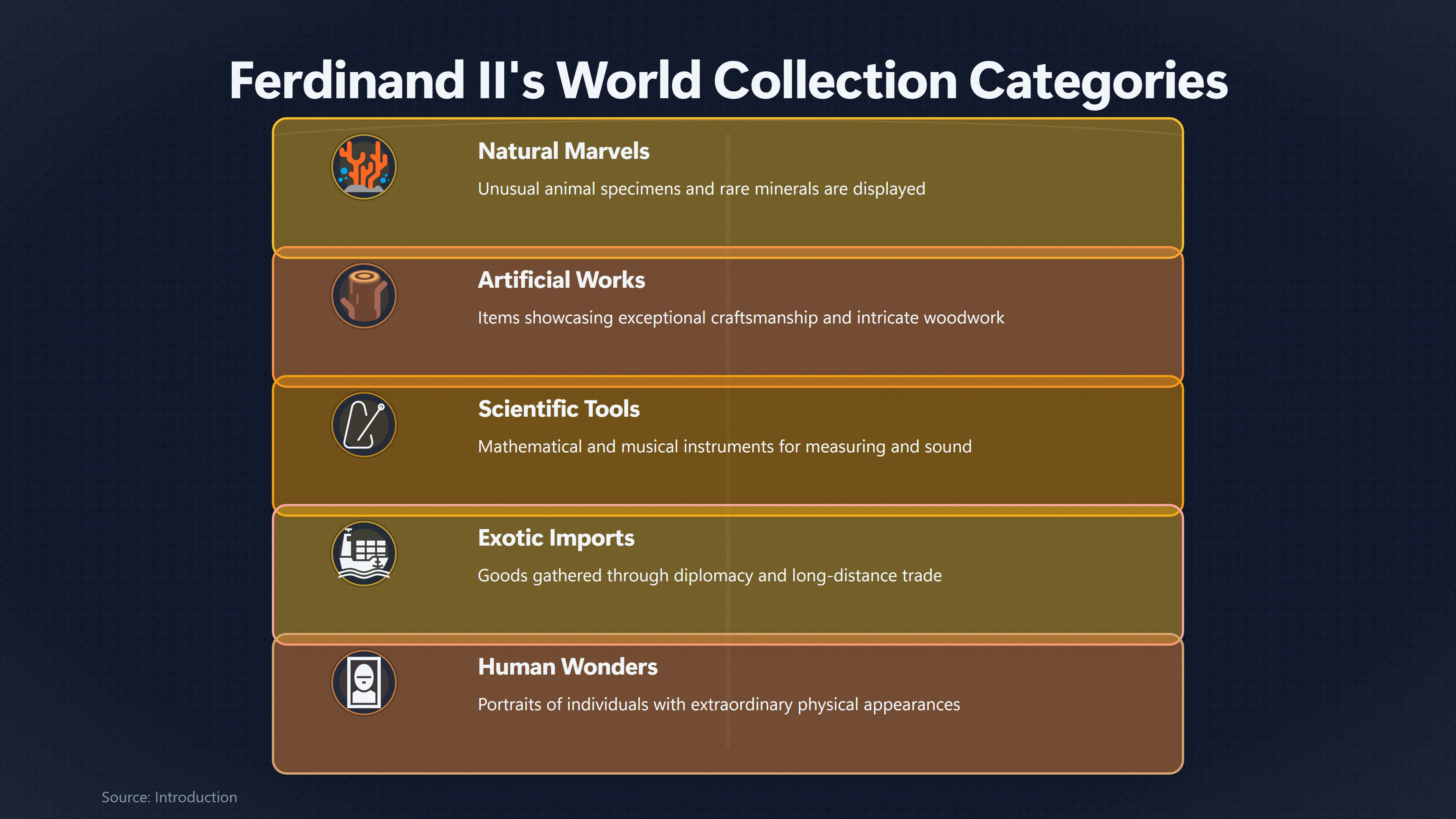
- Natural marvels such as unusual animals, minerals or organic specimens.
- Artificial works demonstrating exceptional craftsmanship.
- Scientific objects including measuring and musical instruments.
- Exotic imports gathered through diplomacy and long-distance trade.
- Curiosities whose rarity made them worthy of contemplation rather than everyday use.[wikipedia.org]WikipediaAmbras CastleAmbras Castle
This approach encouraged comparison rather than strict classification. A visitor might move directly from a coral specimen to a mechanical device or from an engraved gemstone to a mathematical instrument. The intended lesson was that both nature and human creativity revealed the complexity of God’s creation and the breadth of princely knowledge.
In this sense Ambras represents an important transitional moment between medieval treasuries, which primarily displayed wealth, and Enlightenment museums, which increasingly organised collections according to scientific taxonomy. It captures an earlier worldview in which wonder itself served as a legitimate organising principle.[uni-heidelberg.de]books.ub.uni-heidelberg.deOpen source on uni-heidelberg.de.

What the Collection Reveals About Power and Human Difference
One of the most striking aspects of the Ambras collection is its inclusion of portraits of people who were presented as “wonders of nature”. These included individuals with unusual physical appearances, exceptional height or rare medical conditions. Today these portraits can feel uncomfortable because they blur the line between portraiture and specimen.
However, the paintings also preserve the identities of people who might otherwise have disappeared from the historical record. Modern scholarship increasingly examines these works from two perspectives simultaneously: they document genuine individuals while also revealing how Renaissance elites classified and displayed human difference.[Die Welt der Habsburger]habsburger.netDie Welt der Habsburger The Ambras Kunstkammer | Die Welt der HabsburgerDie Welt der Habsburger The Ambras Kunstkammer | Die Welt der Habsburger
The collection therefore raises broader questions about who had the authority to define what counted as extraordinary. Objects and people entered the chamber through networks of diplomacy, commerce and political power. Some arrived as prestigious gifts; others reflected expanding European engagement with distant societies during an age of imperial expansion. Modern interpretation acknowledges that these collecting practices were shaped by unequal relationships as well as genuine scholarly curiosity.[khm.at]press.khm.atat TH E KUNSTKAMMER WIENKUNSTKAMMER WIEN…
Rather than hiding this history, the castle now presents the Chamber of Art and Wonders as evidence of how museums themselves evolved. Visitors encounter not only remarkable objects but also the intellectual assumptions that determined why those objects were collected in the first place.[Schloss Ambras Innsbruck]schlossambras-innsbruck.atOpen source on schlossambras-innsbruck.at.
Why Ambras Matters in Austria’s Curiosity Culture
Among Austria’s unusual collections, Ambras occupies a distinctive position because it is neither a novelty attraction nor simply an art museum. Its importance lies in preserving an entire system of Renaissance thought.
Many later curiosity museums focus on a single theme—medical anomalies, folklore, witchcraft or unusual inventions. Ambras instead attempts something much more ambitious: it presents the world itself as a collection of interconnected marvels. That vision influenced later princely collections across Europe and helped shape the evolution of museums into institutions devoted to preserving, organising and interpreting knowledge.[habsburger.net]habsburger.netDie Welt der Habsburger The Ambras Kunstkammer | Die Welt der HabsburgerDie Welt der Habsburger The Ambras Kunstkammer | Die Welt der Habsburger
For visitors exploring Austria’s stranger heritage, Ambras provides the historical foundation that makes many later collections easier to understand. The impulse to gather the rare, the mysterious and the exceptional did not begin with modern niche museums. It began with Renaissance collectors like Ferdinand II, whose castle still demonstrates how curiosity itself became something worthy of permanent display.[Schloss Ambras Innsbruck]schlossambras-innsbruck.atOpen source on schlossambras-innsbruck.at.
Amazon book picks
Further Reading
Books and field guides related to How Ambras Castle Tried to Collect the World. Use these as the next step if you want deeper reading beyond the article.
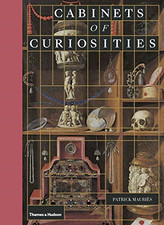
Cabinets of Curiosities
"Maurie`s' tour of strange objects is entertaining and fascinating." --Antiques And The Arts Weekly

The Lure of Antiquity and the Cult of the Machine
First published 1995. Subjects: Art museums, Art and technology, History, Museums, Machinery in art.
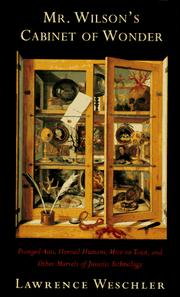
Mr. Wilson's Cabinet of Wonder
First published 1995. Subjects: Collectors and collecting, History, Museum of Jurassic Technology, Museums, Philosophy.
eBay marketplace picks
Marketplace Samples
Live-tested eBay searches with available results related to this page.
Selected fromcabinet of curiosities decor oneBay.co.uk.
Endnotes
1.
Source: habsburger.net
Title: Die Welt der Habsburger The Ambras Kunstkammer | Die Welt der Habsburger
Link:https://www.habsburger.net/en/chapter/ambras-kunstkammer
2.
Source: Wikipedia
Title: Ambras Castle
Link:https://en.wikipedia.org/wiki/Ambras_Castle
3.
Source: repository.khm.at
Title: Kunsthistorisches Museum Wien Das Nachlassinventar Erzherzog Ferdinands II
Link:https://repository.khm.at/viewer/Nachlassinventar/Ferdinand/1596/
Source snippet
Kunsthistorisches Museum WienDas Nachlassinventar Erzherzog Ferdinands II. - Kunsthistorisches Museum Wien...
4.
Source: press.khm.at
Title: at TH E KUNSTKAMMER WIEN
Link:https://press.khm.at/fileadmin/_migrated/downloads/Gallery_Themes_and_Focal_Works.pdf
Source snippet
KUNSTKAMMER WIEN...
5.
Source: khm.at
Title: Donnerstagabend im Museum: Looking Allowed?
Link:https://www.khm.at/en/digital/videos/looking-allowed-diversity-from-the-16th-to-the-18th-century
Source snippet
Diversity from the 16th to the 18th century - KHM.atOctober 28, 2024 — Donnerstagabend im Museum LOOKING ALLOWED? DIVERSITY FROM THE 16TH...
Published: October 28, 2024
6.
Source: khm.at
Title: Kunstkammer – a world of beauty and splendour
Link:https://www.khm.at/en/exhibitions/kunstkammer
7.
Source: khm.at
Title: Imperial Armoury – Armor & ceremonial weapons
Link:https://www.khm.at/en/visit/collections/imperial-armoury/history-of-the-collection
8.
Source: austria.info
Link:https://www.austria.info/en-gb/locations/ambras-castle/
9.
Source: habsburger.net
Link:https://www.habsburger.net/en/media/schloss-ambras
10.
Source: schlossambras-innsbruck.at
Link:https://www.schlossambras-innsbruck.at/en/exhibitions/the-chamber-of-art-and-wonders
11.
Source: schlossambras-innsbruck.at
Title: Schloss Ambras Innsbruck The Lower Castle | Schloss Ambras Innsbruck
Link:https://www.schlossambras-innsbruck.at/en/discovering-the-castle/sites-in-the-castle/the-lower-castle
12.
Source: kunstkammer.com
Title: news grid item
Link:https://www.kunstkammer.com/index.php/en/news-grid-item-kunstkammer-of-grand-duke-ferdinand-of-the-tyrol-ambras-castle-collections
Source snippet
news grid item - Kunstkammer of Grand Duke Ferdinand of the Tyrol Ambras Castle Collections - Kunstkammer Georg Laue...
13.
Source: books.ub.uni-heidelberg.de
Link:https://books.ub.uni-heidelberg.de/propylaeum/catalog/view/745/1225/91651
14.
Source: schlossambras-innsbruck.at
Title: Kunst- und Wunderkammer | Schloss Ambras InnsbruckÖffnungszeiten Täglich von 10
Link:https://www.schlossambras-innsbruck.at/ausstellungen/wunderkammer
15.
Source: schlossambras-innsbruck.at
Link:https://www.schlossambras-innsbruck.at/en/das-schloss-entdecken/orte-im-schloss/the-upper-castle
16.
Source: schlossambras-innsbruck.at
Link:https://www.schlossambras-innsbruck.at/en/exhibitions/habsburg-portrait-gallery
17.
Source: schlossambras-innsbruck.at
Link:https://www.schlossambras-innsbruck.at/en/collection-research
18.
Source: museumaargau.ch
Link:https://www.museumaargau.ch/en/habsburg-castle/collection
19.
Source: digi.ub.uni-heidelberg.de
Link:https://digi.ub.uni-heidelberg.de/diglit/sacken1855bd1/0017
20.
Source: digi.ub.uni-heidelberg.de
Link:https://digi.ub.uni-heidelberg.de/diglit/sacken1855bd1/0047/text_ocr
Additional References
21.
Source: germanhistory-intersections.org
Title: Ambras Castle, the Archduke’s Pleasure Palace near Innsbruck (c
Link:https://germanhistory-intersections.org/en/knowledge-and-education/ghis%3Aimage-44
Source snippet
1700) | German History IntersectionsMarch 20, 2026 — AMBRAS CASTLE, THE ARCHDUKE’S PLEASURE PALACE NEAR INNSBRUCK (C. 1700) ABSTRACT This...
Published: March 20, 2026
22.
Source: youtube.com
Link:https://www.youtube.com/watch?v=RFXmxWitdOg
Source snippet
WALKING TOUR | Ambras Castle in Innsbruck - Tirol | Austria 2020 | Iam_Pingkit...
23.
Source: youtube.com
Title: The Secret Life of Ambras Castle A Forbidden Love
Link:https://www.youtube.com/watch?v=QyNPfNpcB8c
Source snippet
The Power of Collecting. The Kunst- und Wunderkammer of Archduke Ferdinand II at Ambras Castle...
24.
Source: degruyterbrill.com
Link:https://www.degruyterbrill.com/document/doi/10.1515/9789048554041-008/html?lang=en
25.
Source: public-disabilityhistory.org
Title: The Portrait of a Sixteenth-Century Disabled Man ~ Public Disability History
Link:https://www.public-disabilityhistory.org/2016/04/the-portrait-of-sixteenth-century.html?m=0
26.
Source: youtube.com
Title: WALKING TOUR | Ambras Castle in Innsbruck
Link:https://www.youtube.com/watch?v=9AUNrqtEZ0U
Source snippet
Ambras Castle Innsbruck...
27.
Source: flickr.com
Title: Chamber of Art and Wonders / Kunst- und Wunderkammer, Schl… | Flickr
Link:https://www.flickr.com/photos/128242713%40N07/46493755804/
28.
Source: daru.org.au
Title: The Painting of a Disabled Man from the 16th Century
Link:https://daru.org.au/resource/the-painting-of-a-disabled-man-from-the-16th-century/
29.
Source: ots.at
Title: Jubiläumsausstellung auf Schloss Ambras Innsbruck
Link:https://www.ots.at/presseaussendung/OTS_20170518_OTS0195/jubilaeumsausstellung-auf-schloss-ambras-innsbruck
30.
Source: smarthistory.org
Title: – Portrait of Vlad III Dracula (Ambras Portrait)
Link:https://smarthistory.org/portrait-vlad-iii-dracula/