Within Equatorial Guinea Curiosities
Can You Visit Malabo's Claretian Curiosity Cabinet?
Malabo's Claretian collection may be the country's closest thing to a cabinet of curiosity, but reliable visitor information remains scarce.
On this page
- What the Claretian collection contains
- How missionary collecting changed object meanings
- What is known about present day access
Page outline Jump by section
Introduction
For travellers interested in unusual collections, the Claretian Mission Museum in Malabo is arguably the closest thing Equatorial Guinea has to a traditional cabinet of curiosity. Rather than presenting sensational exhibits, it preserves archaeological finds and ethnographic objects gathered by Claretian missionaries during decades of missionary work on Bioko and the mainland. Its fascination lies as much in the history of collecting as in the objects themselves.
The difficulty is that reliable information about the museum is remarkably scarce. Modern catalogues are limited, official visitor information is largely absent, and recent surveys of Equatorial Guinea’s museums have been unable to confirm whether the museum operates as a regular public institution. For anyone researching the country’s unusual heritage, the museum is therefore significant both for what it contains and for the uncertainty surrounding access.[africaknows.eu]africaknows.euKnowledge institutions in Africa and their development 1960-2020: Equatorial GuineaDecember 5, 2025…
Can You Visit Malabo’s Claretian Curiosity Cabinet?
The honest answer is: perhaps, but visitors should not assume that it functions as a conventional public museum.
Unlike major national museums elsewhere, the Claretian collection has almost no dependable public-facing information about opening hours, admission procedures or permanent exhibitions. A 2024 survey of knowledge institutions in Equatorial Guinea identified the Claretian Mission Ethnological Museum as one of only two museums consistently mentioned in available sources, yet concluded that it could not establish whether the museum was operational or fully accessible to the public.[africaknows.eu]africaknows.euKnowledge institutions in Africa and their development 1960-2020: Equatorial GuineaDecember 5, 2025…
This uncertainty contrasts with travel websites that sometimes reproduce opening hours or visitor advice without identifying a primary source. Because neither the Claretian Missionaries nor any Equatoguinean cultural authority currently publishes comprehensive visitor guidance, those listings should be treated cautiously.
For researchers or determined visitors, access may depend on direct contact with the Claretian community in Malabo rather than expecting a staffed museum with regular opening times. The Claretian order continues to maintain an active presence in Equatorial Guinea, but that does not necessarily mean the museum itself operates as a public attraction.[Claretian Missionaries]claret.orgian Missionaries Conferences and Organisms | Claretian Missionariesian MissionariesConferences and Organisms | Claretian MissionariesJanuary 23, 2024…
What the Claretian Collection Contains
Although no complete modern online catalogue is available, academic research into the museum provides a reasonably clear picture of its character.
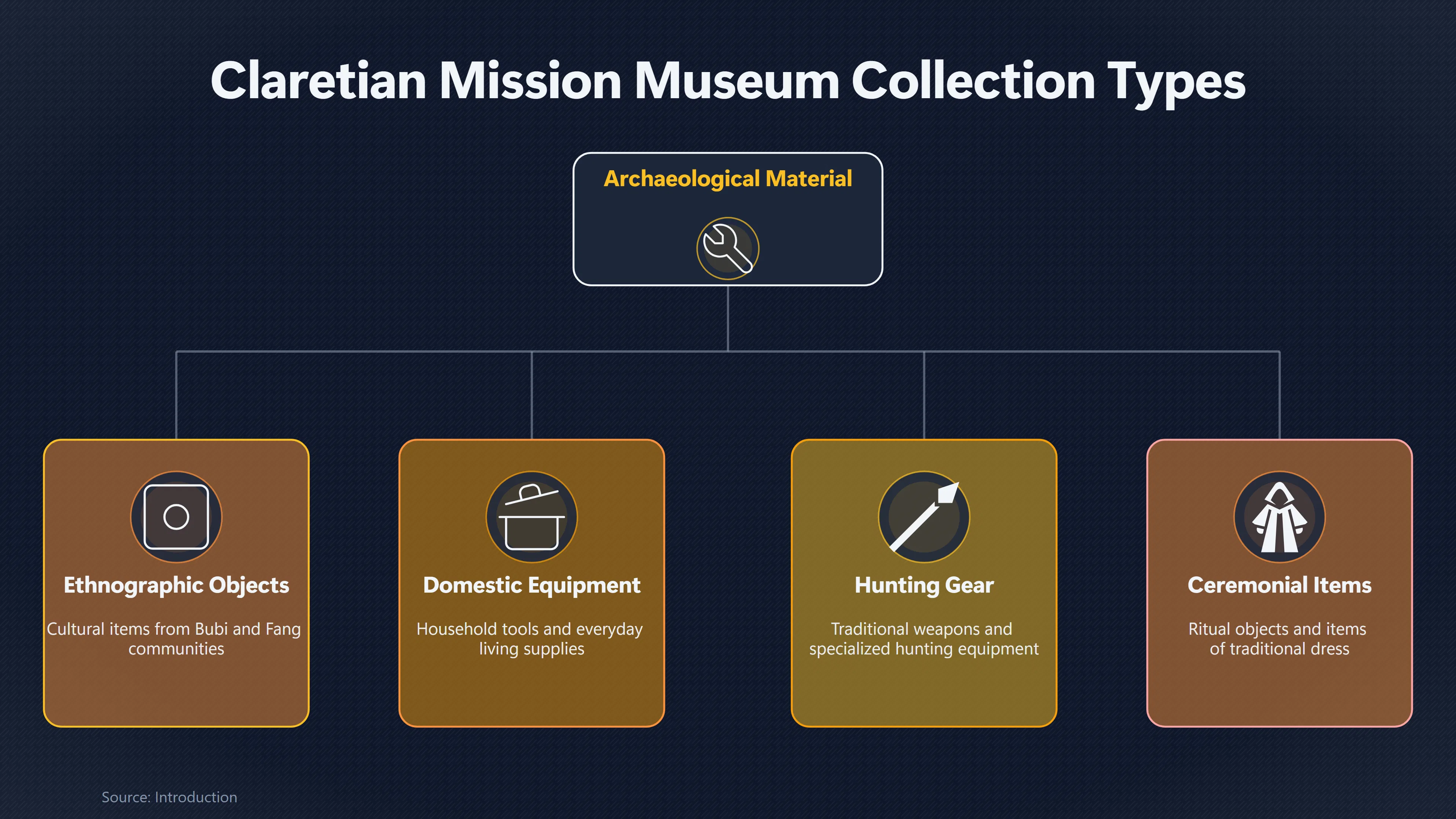
The collection was assembled by Claretian missionaries working in what was then Spanish Guinea. Rather than focusing on fine art, it brought together material intended to document local societies, their history and everyday life. Published descriptions identify collections including:
- archaeological material from Bioko and mainland Equatorial Guinea;
- ethnographic objects associated with Bubi, Fang and other communities;
- domestic tools and household equipment;
- weapons and hunting equipment;
- ornaments and items of dress;
- ritual and ceremonial objects;
- documentary material linked to missionary activity.
The museum was historically associated with a specialist library devoted to Africa and Equatorial Guinea, reinforcing its role as both a missionary archive and an educational institution rather than simply a display space.[Repositório Iscte]repositorio.iscte-iul.ptRepositório IscteRepositório do Iscte – Instituto Universitário de Lisboa: Colecciones etnográficas e historia: el Museo Claretiano de Ma…
Its importance therefore comes less from spectacular individual artefacts than from the breadth of material assembled over many decades by missionaries living across the territory.
How Missionary Collecting Changed Object Meanings
The museum’s greatest historical interest lies in understanding how missionary collecting reshaped the meaning of cultural objects.
Many items originally existed within living religious or social traditions. Figures, ceremonial objects or ritual implements could have been associated with ancestor veneration, healing practices, protection or community authority. Once collected by missionaries, however, they were frequently reinterpreted through a different lens.
Instead of functioning within local belief systems, they became evidence of:
- customs that missionaries hoped to replace through Christian conversion;
- cultures regarded as disappearing under colonial change;
- educational examples for missionary training;
- ethnographic specimens illustrating the peoples among whom the Claretians worked.
This transformation reflects a wider pattern seen across nineteenth- and twentieth-century missionary museums worldwide. Objects that originally carried spiritual or communal significance were reframed as historical evidence, teaching collections or illustrations of missionary progress.
That shift does not necessarily diminish their value. Instead, it makes the museum an important record of colonial-era collecting practices as well as of Equatorial Guinea’s own cultural history. Modern researchers increasingly examine both the artefacts themselves and the circumstances under which they entered missionary collections.[Repositório Iscte]repositorio.iscte-iul.ptRepositório IscteRepositório do Iscte – Instituto Universitário de Lisboa: Colecciones etnográficas e historia: el Museo Claretiano de Ma…
Why So Little Is Known Today?
One reason the museum attracts curiosity is precisely because so little reliable documentation survives in public view.
A detailed academic study presented in 2011 described the museum as having spent many years “in the shadows”. The researcher argued that numerous valuable pieces had already been lost and proposed recovering, cataloguing and reintroducing the collection to public attention. That work included an on-site inventory and interviews with one of the museum’s founders, indicating that the institution still existed physically even if its public profile had diminished considerably.[Repositório Iscte]repositorio.iscte-iul.ptRepositório IscteRepositório do Iscte – Instituto Universitário de Lisboa: Colecciones etnográficas e historia: el Museo Claretiano de Ma…
The absence of an accessible digital catalogue also means that scholars frequently rely on older inventories, missionary publications and archival research instead of consulting an online database. Compared with many African museums that have gradually digitised parts of their collections, the Claretian Museum remains relatively invisible.
For readers interested in unusual museums, that obscurity becomes part of the story. It represents a collection whose historical importance appears greater than its contemporary public visibility.
Why It Matters Within Equatorial Guinea’s Curiosity Landscape
Equatorial Guinea has very few documented museums, and even fewer devoted to archaeology or ethnography. Within that limited landscape, the Claretian Museum occupies a distinctive place.
It preserves material that connects visitors with:
- pre-colonial societies on Bioko and the mainland;
- the history of Catholic missionary activity;
- colonial collecting practices;
- changing interpretations of ritual and everyday objects.
Unlike commercial curiosity museums built around spectacle, its appeal comes from historical layers. A carved figure, ceremonial object or archaeological fragment is interesting not only because of what it originally meant, but because it also reveals how missionaries, colonial authorities and later researchers interpreted it over time.
For anyone exploring Equatorial Guinea’s unusual heritage, the Claretian Mission Museum is therefore best understood not as a guaranteed tourist stop but as an elusive historical collection whose significance exceeds its current public accessibility. Its uncertain status serves as a reminder that some of the country’s most intriguing cultural collections remain difficult to document, difficult to visit and still awaiting fuller preservation and interpretation.[africaknows.eu]africaknows.euKnowledge institutions in Africa and their development 1960-2020: Equatorial GuineaDecember 5, 2025…
Amazon book picks
Further Reading
Books and field guides related to Can You Visit Malabo's Claretian Curiosity Cabinet?. Use these as the next step if you want deeper reading beyond the article.
Colonial Collecting and Display: Encounters with Material Cul...
In the late-nineteenth century, British travelers to the Andaman and Nicobar Islands compiled wide-ranging collections of material cultur...
The Missionary's Curse and Other Tales from a Chinese Catholi...
The Missionary’s Curse tells the story of a Chinese village that has been Catholic since the seventeenth century, drawing direct connecti...
Entangled Objects: Exchange, Material Culture, and Colonialis...
Thomas takes up issues central to modern anthropology: the cultural and political dynamics of colonial encounters, the nature of Western...
Hunting the Gatherers: Ethnographic Collectors, Agents and Ag...
Between the 1870s and the 1930s competing European powers carved out and consolidated colonies in Melanesia, the most culturally diverse...
eBay marketplace picks
Marketplace Samples
Live-tested eBay searches with available results related to this page.
Selected frommuseum collectible oneBay.co.uk.



Endnotes
1.
Source: africaknows.eu
Link:https://www.africaknows.eu/pdfs/copr15.pdf
Source snippet
Knowledge institutions in Africa and their development 1960-2020: Equatorial GuineaDecember 5, 2025...
Published: December 5, 2025
2.
Source: repositorio.iscte-iul.pt
Link:https://repositorio.iscte-iul.pt/handle/10071/2197
Source snippet
Repositório IscteRepositório do Iscte – Instituto Universitário de Lisboa: Colecciones etnográficas e historia: el Museo Claretiano de Ma...
3.
Source: claret.org
Title: ian Missionaries Conferences and Organisms | Claretian Missionaries
Link:https://www.claret.org/conferences-and-organisms/
Source snippet
ian MissionariesConferences and Organisms | Claretian MissionariesJanuary 23, 2024...
Published: January 23, 2024
4.
Source: claret.org
Link:https://www.claret.org/interculturality-course-empowers-claretian-missionaries-in-equatorial-guinea/
Source snippet
ian MissionariesInterculturality Course Empowers Claretian Missionaries in Equatorial Guinea | Claretian Missionaries...
5.
Source: claret.org
Title: the 2026 ordinary assembly of acla concludes in riaba
Link:https://www.claret.org/the-2026-ordinary-assembly-of-acla-concludes-in-riaba/
Source snippet
ian MissionariesFebruary 18, 2026 — THE 2026 ORDINARY ASSEMBLY OF ACLA CONCLUDES IN RIABA Feb 18, 2026 | ACLA Image: [2026-02-14] M...
Published: February 14, 2026
6.
Source: opentravelguide.com
Link:https://opentravelguide.com/equatorial-guinea/history/
Source snippet
Museum CASA VERDE (GREEN HOUSE CULTURAL CENTER) Located in a restored colonial building in central Malabo, the Casa Verde serves as...
7.
Source: claret.org
Title: ian family day celebration in equatorial guinea
Link:https://www.claret.org/claretian-family-day-celebration-in-equatorial-guinea/
Source snippet
ian MissionariesMay 14, 2024 — CLARETIAN FAMILY DAY CELEBRATION IN EQUATORIAL GUINEA May 14, 2024 | Claretian Family, Padre Xifre I...
Published: May 14, 2024
8.
Source: claret.org
Title: Conferenze e Organismi | Missionari Clarettiani
Link:https://www.claret.org/it/conferenze-e-organismi/
9.
Source: claret.org
Title: Preparing the IV Claretian Family Educators Congress | Claretian Missionaries
Link:https://www.claret.org/preparing-the-iv-claretian-family-educators-congress/
10.
Source: claret.org
Link:https://www.claret.org/canonical-erection-of-padre-xifre-independent-delegation/
11.
Source: claret.org
Link:https://www.claret.org/category/acla/padre-xifre/
12.
Source: cultura.gob.es
Link:https://www.cultura.gob.es/mnantropologia/en/visita/exposicion-permanente/salas/africa.html
Additional References
13.
Source: researchgate.net
Link:https://www.researchgate.net/publication/293199690_Nouvelles_donnees_archeologiques_sur_l%27histoire_ancienne_de_la_Guinee-Equatoriale_New_archaeological_data_on_the_ancient_history_of_Equatorial_Guinea
Source snippet
ResearchGate(PDF) Nouvelles données archéologiques sur l'histoire ancienne de la Guinée-Equatoriale / New archaeological data on the anci...
14.
Source: claretwestng.org
Title: REP. OF THE CONGO CZECH REPUBLIC COSTA RICA CUBA DOMINIC
Link:https://claretwestng.org/the-claretians/where-we-are/
Source snippet
Where we are - Claretian MissionariesMay 26, 2026 — WHERE WE ARE ANGOLA ARGENTINA AUSTRALIA AUSTRIA BELARUS BOLIVIA BRAZIL BURKINA FASO C...
Published: May 26, 2026
15.
Source: youtube.com
Link:https://www.youtube.com/watch?v=1KYgat8QcAo
Source snippet
Spanish Cultural Centre Malabo / Equatorial Guinea...
16.
Source: youtube.com
Title: Equatorial Guinea History in 3 Minutes
Link:https://www.youtube.com/watch?v=751OeMPlE8g
Source snippet
Episode - 4 | The First Great Expansion (1868 - 1899) | Claretian Missionaries...
17.
Source: youtube.com
Title: Top 10 Attractions in Malabo, Equatorial Guinea
Link:https://www.youtube.com/watch?v=oCAwd5kkplU
Source snippet
The STRANGEST city in West Africa: Malabo, Equatorial Guinea...
18.
Source: claretianformation.com
Link:https://www.claretianformation.com/?page_id=31
19.
Source: kids.kiddle.co
Link:https://kids.kiddle.co/List_of_museums_in_Equatorial_Guinea
20.
Source: persee.fr
Link:https://www.persee.fr/doc/gazar_0016-5522_2019_num
21.
Source: youtube.com
Title: The STRANGEST city in West Africa: Malabo, Equatorial Guinea
Link:https://www.youtube.com/watch?v=ARUM8z48SDg
Source snippet
Equatorial Guinea History in 3 Minutes...
22.
Source: museokordilyera.upb.edu.ph
Link:https://museokordilyera.upb.edu.ph/about-the-museum/