Where Poland Keeps Its Strangest Stories
Poland’s strangest collections are not concentrated in one grand museum of the uncanny. They are scattered across bone chapels, medical universities, folk museums, underground wartime complexes, private hobby collections and highly specific attractions devoted to frogs, soap, bicycles, matches or neon signs.
Page outline Jump by section
Introduction
The most rewarding places do more than display something odd. The Skull Chapel at Czermna places human remains within Catholic ideas of death and resurrection. Kraków’s Pharmacy Museum shows how medicine once overlapped with alchemy, superstition and exotic ingredients. The tunnels of Project Riese demonstrate how unfinished wartime structures can attract both careful historical interpretation and unsupported tales of secret weapons. Elsewhere, collections of dirt, bicycles and Cold War signs show how apparently trivial objects can preserve social history. The important distinction is between documented artefact, devotional object, folklore, commercial theatre and later legend.
Where Poland’s curiosity culture is strongest
Poland’s unusual museums tend to fall into four overlapping groups. The first consists of historic or academic collections that were never designed simply to entertain: anatomical preparations, pharmaceutical equipment, archaeological burials and ethnographic objects. Their strangeness comes from the unfamiliarity of older systems of knowledge rather than from deliberate sensationalism.
The second group preserves physical places connected with death, imprisonment or war. Ossuaries, cells and underground complexes can feel more powerful than conventional exhibitions because the building itself is part of the evidence. The third comprises private or specialist museums built around one collector’s obsession, from unconventional cycles to thousands of frog-related objects. Finally, there are contemporary visitor attractions whose appeal depends on participation, nostalgia or theatrical presentation.
This mixture explains why the label “strange museum” needs care. A chapel containing bones is still a consecrated religious space. A university anatomy collection is primarily a teaching resource. An underground Nazi construction site is evidence of forced labour and mass violence, even when its modern publicity borrows the language of mystery. A collection devoted to soap or pinball machines is much closer to leisure tourism.
The Skull Chapel: death displayed as devotion
The Skull Chapel in Czermna, now part of Kudowa-Zdrój, is Poland’s clearest example of a historic collection that appears macabre to modern visitors but was created for religious contemplation. Built in the late eighteenth century, its walls and ceiling are covered with thousands of human skulls and bones. Many more remains lie beneath the floor. They are associated with victims of warfare, epidemics, disease and hunger in the surrounding region.[wikipedia.org]WikipediaSkull ChapelSkull Chapel
The chapel is not a modern horror attraction. Its arrangement belongs to the European ossuary tradition, in which human remains were gathered, ordered and displayed as reminders of mortality, judgement and resurrection. The bones are therefore both physical remains and devotional objects. Visitors enter a compact sacred interior rather than a spacious museum gallery, and the experience can be unsettling precisely because the display does not separate religion, history and the dead.
Its credibility is comparatively straightforward. The remains are real, the chapel is historic, and its broad origins are well documented. Some exact totals vary between accounts, which is common at old ossuaries where underground deposits cannot be counted neatly. The responsible interpretation is not to fixate on a dramatic number, but to understand the chapel as a collective burial site shaped by regional catastrophe and Catholic belief.
The chapel also illustrates an important Polish pattern. Death is often preserved not only through state museums but through churches, cemeteries, relics and local memorial practices. These sites may be publicly accessible, yet they retain devotional meanings that ordinary tourist behaviour should respect.
Medicine before modern medicine
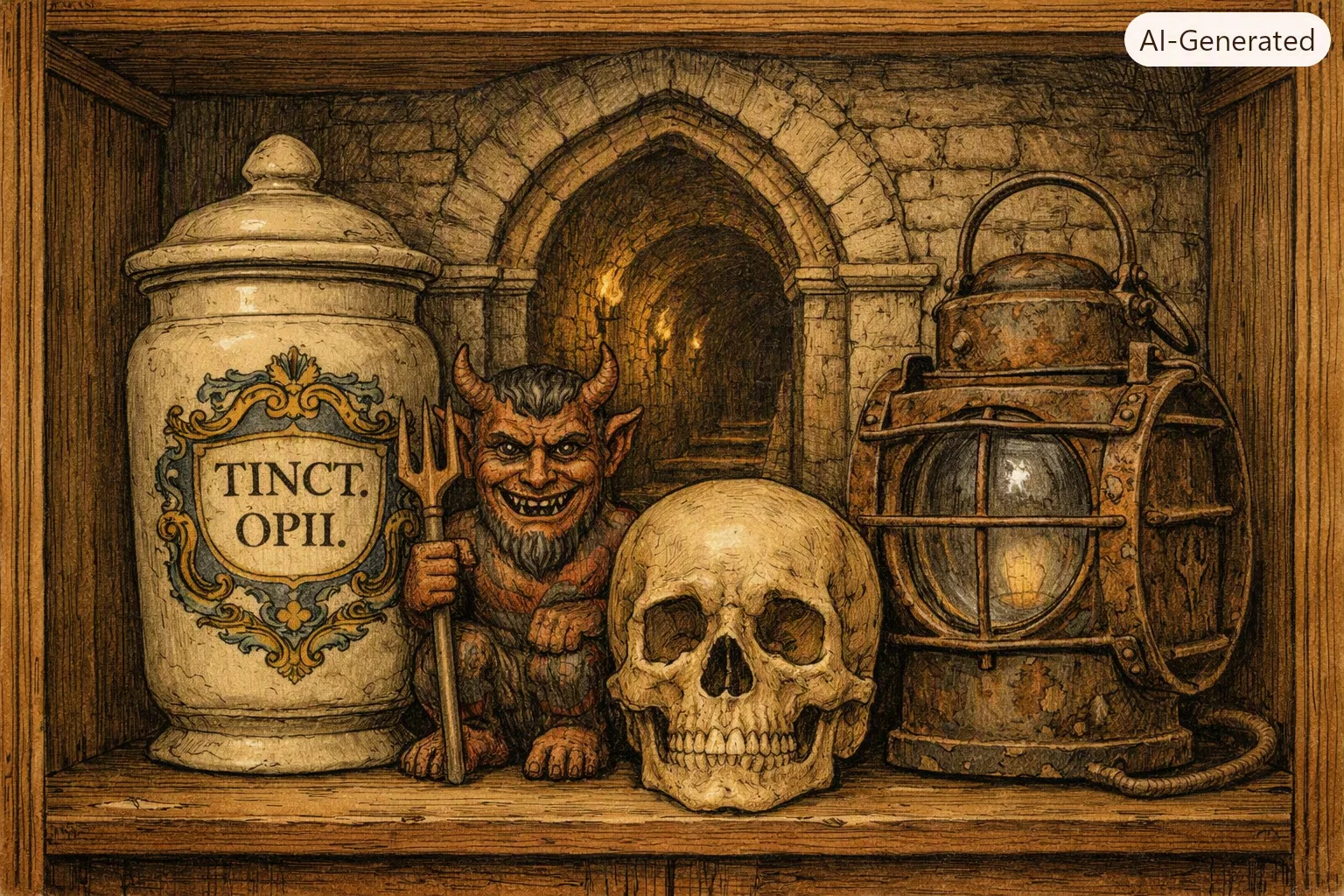
Kraków’s Pharmacy Museum, operated by the Jagiellonian University, is among Poland’s richest places for understanding the borderland between medicine, chemistry, craft and belief. Its collections occupy a historic building from cellar to attic and include old dispensary furnishings, vessels, instruments, pharmaceutical materials and objects associated with preparing remedies.[Muzeum Farmacji]muzeumfarmacji.uj.edu.plAnd finally, a collection of modern paintings clearly inspired by the Museum’s prized artefacts…
What makes the museum unusual is not simply the age of the equipment. Older pharmacies dealt in substances and theories that now seem closer to magical practice: elaborate mixtures, animal and mineral ingredients, symbolic containers and procedures inherited from periods when alchemy and medicine were not yet cleanly separated. The exhibits help explain why the early pharmacist could appear simultaneously as scientist, artisan and keeper of secret knowledge.
The museum is academically curated rather than staged as an occult attraction. Its objects document changing medical practice, including ideas that were once regarded as rational but were later abandoned. That distinction matters. A jar labelled with a strange ingredient is evidence of historical treatment, not proof that the treatment worked.
Poland’s university medical collections contain still more challenging material. The Medical University of Warsaw maintains a publicly accessible museum of medical history, while collections associated with Kraków, Wrocław and Białystok include historical surgical instruments, anatomical models, pathology preparations and former teaching specimens. Access varies greatly: some displays are open to ordinary visitors, while anatomy and forensic collections may admit only organised groups or open for special events such as museum nights.[edu.pl]muzeum.wum.edu.plIt meets the expectations of several generations of doctors, and also the requirements of the general public…
This restricted access is not accidental. Human remains and pathological specimens raise ethical questions about consent, dignity and educational purpose. The strongest Polish medical museums increasingly frame such objects as evidence of how doctors learned, how patients were treated and how views of the body changed, rather than presenting them merely as grotesque curiosities.
Folk belief without a single “witchcraft museum”
Poland does not have one internationally dominant national museum devoted solely to witchcraft or magic. Instead, evidence for supernatural belief is dispersed through ethnographic museums, regional collections, castles, churches and archives.
The Ethnographic Museum in Kraków, founded in 1911, preserves folk art, domestic objects, crafts and material connected with rural life and belief. Such collections are essential for understanding protective practices, sacred images, seasonal customs and representations of supernatural beings within everyday culture. They do not usually isolate “the occult” as a separate spectacle; magical and religious ideas appear as part of work, illness, family life and the agricultural year.[etnomuzeum.eu]etnomuzeum.euOpen source on etnomuzeum.eu.
This dispersed approach is historically appropriate. Polish folk belief developed through interaction between pre-Christian traditions, Catholic teaching, local legends and practical attempts to manage misfortune. Objects that later tourists might call magical could once have functioned as household protection, healing aids, devotional items or warnings about improper behaviour.
Museums also have to navigate the popular image of the witch. Polish castles and towns sometimes market alleged trials, prisons or execution stories, but the documentation behind individual legends can be uneven. The most responsible displays distinguish surviving legal records from later storytelling. They also avoid treating every accused person as a practising magician: European witch trials were judicial and social persecutions, not reliable investigations of supernatural activity.
The figure of the devil is similarly common in Polish folk sculpture and storytelling, but often in a form very different from the absolute evil of formal theology. In legends, devils may be foolish, greedy, tricked by villagers or tied to a particular bridge, rock or ruined building. Ethnographic collections preserve this local imagination more effectively than a modern horror display would.
Project Riese: real tunnels, speculative stories
Few Polish heritage landscapes demonstrate the conflict between evidence and mystery marketing as clearly as Project Riese in Lower Silesia. Beginning in 1943, Nazi Germany constructed a network of underground works in the Owl Mountains and at Książ Castle. The complexes were left incomplete, and their final intended functions remain partly uncertain. Several sections, including Włodarz, now operate as underground visitor routes.[wikipedia.org]WikipediaProject RieseProject Riese
The documented story is already extraordinary. Vast quantities of labour and material were committed to excavating tunnels under wartime conditions. Prisoners and forced labourers were used, and many suffered or died. Unfinished chambers, rails, flooded passages and raw rock faces create the atmosphere of a mystery without requiring any supernatural explanation.
Because surviving documentation is incomplete, Riese has also accumulated stories about hidden gold, flying discs, experimental energy devices and a supposed secret weapon called “the Bell”. One concrete structure near Ludwikowice Kłodzkie, commonly nicknamed the Flytrap, is repeatedly presented in popular culture as part of these stories. Yet the more spectacular claims rely heavily on later testimony, inference and repetition rather than securely traceable wartime documentation. Even specialist descriptions of the site acknowledge that the structure’s original function and official name are uncertain.[wikipedia.org]WikipediaDie Glocke (conspiracy theoryDie Glocke (conspiracy theory
For visitors, the best approach is to separate three layers:
- Established history: the tunnel systems exist, construction began during the war, and forced labour was central to the project.
- Reasonable uncertainty: not every structure’s intended purpose is known, and the project was incomplete.
- Speculative mythology: claims involving antigravity, time travel or operational flying saucers have not been supported by persuasive primary evidence.
Riese matters within Poland’s strange-history landscape because it shows how genuine archival gaps become commercial assets. Mystery can encourage preservation and tourism, but it can also draw attention away from the prisoners who built the complexes.
Emilcin and Poland’s UFO folklore
The village of Emilcin became the centre of Poland’s best-known alleged alien encounter after farmer Jan Wolski reported an extraordinary experience in May 1978. He claimed to have met unfamiliar beings, entered a hovering craft and undergone an examination. A memorial erected in 2005 commemorates the reported incident.[culture.pl]culture.plthe emilcin incident a polish encounter of the fourth kindthe emilcin incident a polish encounter of the fourth kind
Emilcin is better understood as a folklore and memory site than as a scientific museum. There is no verified alien artefact on display and no physical evidence establishing an extraterrestrial encounter. The preserved material is instead a story: testimony, interviews, illustrations, media retellings and the later monument.
That does not make the site culturally meaningless. UFO reports often acquire power because they combine personal sincerity, unexplained experience, modern technology and older storytelling patterns. Emilcin’s rural setting also helped create a compelling contrast between an ordinary farmer and an event described in the language of science fiction.
The memorial effectively turns a contested claim into a public heritage object. It records that a story became important, not that the story’s extraterrestrial explanation was proved. This is a useful distinction for any visitor to UFO sites: monuments authenticate remembrance, not necessarily the event being remembered.
Poland has no major public cryptid museum comparable with commercial monster museums elsewhere. Strange creatures are more commonly encountered in regional legends, ethnographic collections, sculpture trails and tourist storytelling. The strongest material tends to concern traditional demons, dragons and uncanny animals rather than modern zoological claims supported by specimens.

Small museums built from private obsessions
Some of Poland’s most memorable collections are deliberately narrow. Their appeal lies not in national importance but in what happens when one subject is pursued far beyond ordinary enthusiasm.
The Frog Museum in Kudowa-Zdrój has been described as containing thousands of frog-related objects from many countries, including figurines, containers, ornaments and preserved specimens. It belongs to the classic collector-led museum tradition: repetition transforms an everyday animal into a taxonomy of taste, humour and popular design.[Culture.pl]culture.pl7 strange museums to visit in poland7 strange museums to visit in poland
At Gołąb, the Museum of Unusual Bicycles allows visitors to encounter machines designed to be ridden in unconventional ways. Its collection has been associated with a wider private display devoted to intoxication and temperance. The experience is participatory and personal rather than academically detached, reflecting the character of its founder and the traditions of roadside or village museums. The museum maintains its own visitor information, but small private attractions can change schedules more readily than state institutions.[muzeumrowerow.pl]muzeumrowerow.plOpen source on muzeumrowerow.pl.
Bydgoszcz’s Museum of Soap and the History of Dirt turns hygiene into social history. Founded in 2012, it combines displays about washing, household cleanliness and soap production with practical demonstrations and workshops. The premise is playful, but the subject reveals changing attitudes towards the body, disease, privacy, labour and respectability.[Muzeum Mydła i Historii Brudu]muzeummydla.plOpen source on muzeummydla.pl.
Częstochowa’s Museum of Match Manufacturing preserves an industrial site dating from the late nineteenth century, together with machinery, packaging and match-related artworks. Its oddity is rooted in survival: a tiny disposable object becomes a way to read factory labour, advertising and mechanised production.[Poland Travel (EN)]poland.travelTravel (EN)HomeTravel (EN)Home
These museums are generally credible about the objects they hold, but their interpretation may be informal, nostalgic or strongly shaped by an individual collector. That is part of their value. They preserve subjects that larger institutions might consider too ordinary, too repetitive or too difficult to fit into a conventional art-historical narrative.
Neon, pinball and the afterlife of modern objects
Not all curiosity collections are ancient, macabre or folkloric. Warsaw’s Neon Museum preserves signs from the post-war period, especially the 1960s and 1970s, when illuminated lettering and animated designs helped reshape the appearance of Polish cities. The collection grew from efforts to rescue signs that were being removed or destroyed after the political and economic changes of the late twentieth century.[neonmuzeum.org]neonmuzeum.orgOpen source on neonmuzeum.org.
The museum is unusual because its objects sit between advertising, graphic design, architecture and urban archaeology. A neon shop sign was once a functional piece of the street. Inside a darkened museum, it becomes both sculpture and historical evidence. The institution has also participated in restoring signs to public locations, so its work extends beyond collecting into the recovery of a lost cityscape.
Arcade and pinball museums in Warsaw and Kraków occupy another border between collection and entertainment. Machines are normally maintained in playable condition, which means visitors experience sound, movement and mechanical wear rather than merely viewing an inert object. Kraków’s collection includes classic arcade titles as well as pinball machines, presenting technological nostalgia as a hands-on attraction.[Krakow Pinball Museum]krakpin.comOpen source on krakpin.com.
These institutions are often privately operated and commercially oriented, but that does not make them inauthentic. Their strongest form of preservation is functional: the artefact remains understandable because it can still be used.
Archaeological objects that resist simple explanation
Poland’s archaeological museums contain many objects that can appear mysterious without being anomalous in the pseudoscientific sense. The Archaeological Museum in Poznań, for example, displays an ancient Egyptian obelisk, funerary material and distinctive face-shaped urns from prehistoric communities in what is now Poland.[Visit Poznań]visitpoznan.plVisit PoznańArchaeological MuseumVisit PoznańArchaeological Museum
Face urns are a useful example of how archaeology differs from mystery entertainment. Their human features invite speculation, but interpretation depends on burial context, comparison and material analysis. Archaeologists may disagree about symbolism or social meaning while still agreeing on the object’s age and cultural setting.
Polish museums also hold mummies, reliquaries, grave goods and objects excavated beyond present-day Poland. Such displays can carry older collecting assumptions, including the treatment of human remains as exotic spectacle. Modern interpretation increasingly asks how objects were acquired, whether the dead are represented respectfully and what is lost when burial material is separated from its original context.
The most interesting archaeological “mysteries” are therefore rarely impossible artefacts or evidence of vanished super-civilisations. They are ordinary scholarly uncertainties: who was represented, why a ritual form changed, how an object travelled or what an image meant to the people who made it.
Prisons, bunkers and the limits of dark tourism
Poland has many museums and memorial sites connected with occupation, political imprisonment and state violence. Their relevance to strange travel comes from their preserved environments: cells, interrogation corridors, shelters and bunkers create an immediate physical encounter with systems of confinement.
Warsaw’s Museum of Cursed Soldiers and Political Prisoners occupies a former detention and investigation site. Its displays include cells, correspondence, personal religious objects and evidence of coercive interrogation during the Stalinist period. These are not “oddities” in a playful sense, and presenting them that way would diminish the people imprisoned or killed there.[Go To Warsaw]go2warsaw.plOpen source on go2warsaw.pl.
The same caution applies to wartime bunkers and underground routes. Their architecture can be fascinating, and uncertainty about their use can be genuinely compelling. But theatrical lighting, rumours of secret technology and souvenir culture should not erase forced labour, torture or execution.
A useful test is whether a site directs attention towards evidence and victims or mainly sells the thrill of entering a forbidden place. The strongest Polish dark-heritage museums allow atmosphere to support historical understanding rather than replace it.
How to judge an unusual Polish museum
Poland’s strange collections vary from university institutions to one-person passion projects, so visitors should not expect identical standards of access or interpretation.
Check whether the site is active. Small private museums may open seasonally, require telephone booking or close when the owner is unavailable. University collections may restrict entry to groups or special public events.
Identify the institution’s purpose. A religious chapel, medical teaching collection, historical memorial and entertainment attraction use objects differently. Behaviour appropriate in a pinball museum may be disrespectful in an ossuary or prison cell.
Look for a separation between evidence and legend. Good interpretation marks the difference between an excavated object, an oral tradition, an alleged encounter and a modern marketing claim.
Treat precise superlatives cautiously. Statements such as “the only one in Europe”, “the largest in the world” or “the last witch burned in Poland” are often repeated without consistent definitions. The object or place may still be worth visiting even when the promotional wording is uncertain.
Expect uneven English-language provision. Major institutions usually offer English information, while local museums may depend on guided tours, printed summaries or Polish-only displays.
Why these collections matter
Poland’s curiosity culture is especially revealing because it does not divide neatly into the rational and irrational. A pharmacy museum preserves obsolete science alongside practices now associated with alchemy. An ethnographic museum records beliefs that were simultaneously religious, practical and magical. A UFO memorial gives physical form to an unverified claim. A Nazi tunnel complex is both archaeological evidence and fertile ground for conspiracy stories.
The best unusual collections make those boundaries visible. They show how societies decide which objects deserve preservation, how private obsession becomes public heritage and how entertainment can either illuminate history or distort it. Poland’s strangest museums are therefore not simply places to see bizarre things. They are places where bones become sermons, dirt becomes social history, machines become nostalgia, ruins become legends and uncertainty itself becomes part of the display.
Amazon book picks
Further Reading
Books and field guides related to Where Poland Keeps Its Strangest Stories. Use these as the next step if you want deeper reading beyond the article.
The Past Is a Foreign Country
A completely updated new edition of David Lowenthal's classic account of how we reshape the past to serve present needs.
The Lost Art of Finding Our Way
Long before GPS, Google Earth, and global transit, humans traveled vast distances using only environmental clues and simple instruments....
eBay marketplace picks
Marketplace Samples
Live-tested eBay searches with available results related to this page.
Selected fromPoland art print oneBay.co.uk.
Endnotes
1.
Source: Wikipedia
Title: Skull Chapel
Link:https://en.wikipedia.org/wiki/Skull_Chapel
2.
Source: cm-uj.krakow.pl
Title: Jagiellonian University
Link:https://cm-uj.krakow.pl/museums/
Source snippet
In its historical prime, the museum boasted a collection of over 5000 anatomopathological specimens obtained from surgical procedures car...
3.
Source: etnomuzeum.eu
Link:https://etnomuzeum.eu/history
4.
Source: Wikipedia
Title: Project Riese
Link:https://en.wikipedia.org/wiki/Project_Riese
5.
Source: Wikipedia
Title: Die Glocke (conspiracy theory)
Link:https://en.wikipedia.org/wiki/Die_Glocke_%28conspiracy_theory%29
6.
Source: culture.pl
Title: the emilcin incident a polish encounter of the fourth kind
Link:https://culture.pl/en/article/the-emilcin-incident-a-polish-encounter-of-the-fourth-kind
7.
Source: Wikipedia
Title: Emilcin Abduction
Link:https://en.wikipedia.org/wiki/Emilcin_Abduction
8.
Source: culture.pl
Title: 7 strange museums to visit in poland
Link:https://culture.pl/en/article/7-strange-museums-to-visit-in-poland
9.
Source: polska.travel
Title: Travel (PL)Muzeum Nietypowych Rowerów w Gołębiu
Link:https://www.polska.travel/rit/muzeum-nietypowych-rowerow-w-golebiu/
10.
Source: poland.travel
Title: Travel (EN)Home
Link:https://www.poland.travel/ru/muzei/museum-of-match-production-in-czestochowa
11.
Source: neonmuzeum.org
Link:https://www.neonmuzeum.org/about-us
12.
Source: en.um.warszawa.pl
Title: Um.warszawa Neon lights already shine in the new location
Link:https://en.um.warszawa.pl/-/neon-lights-already-shine-in-the-new-location
13.
Source: poland.travel
Title: Gory Stołowe National Park
Link:https://www.poland.travel/en/gory-stolowe-national-park/
14.
Source: culture.pl
Link:https://culture.pl/en/article/vampire-blood-devilish-owls-old-polish-death-customs-superstitions
15.
Source: culture.pl
Title: 7 Weird Polish Funeral Customs | Article | Culture.pl
Link:https://culture.pl/en/article/7-weird-polish-funeral-customs
16.
Source: neonmuzeum.org
Link:https://www.neonmuzeum.org/english
17.
Source: neonmuzeum.org
Link:https://www.neonmuzeum.org/visit-museum
18.
Source: neonmuzeum.org
Title: events latest news
Link:https://www.neonmuzeum.org/events-latest-news
19.
Source: culture.pl
Link:https://culture.pl/en/article/the-frog-museum
20.
Source: culture.pl
Title: excerpts from the history of the polish devil
Link:https://culture.pl/en/article/excerpts-from-the-history-of-the-polish-devil
21.
Source: poland.travel
Link:https://www.poland.travel/ja/%E8%A8%98%E5%BF%B5%E7%89%A9/museum-of-match-production-in-czestochowa
22.
Source: polska.travel
Title: Muzeum Nietypowych Rowerów
Link:https://www.polska.travel/rit/muzeum-nietypowych-rowerow/
23.
Source: Wikipedia
Title: Die Glocke (Pseudowissenschaft)
Link:https://de.wikipedia.org/wiki/Die_Glocke_%28Pseudowissenschaft%29
24.
Source: youtube.com
Title: Museum of Soap and History of Dirt
Link:https://www.youtube.com/watch?v=7gc1aVLJoUI
Source snippet
Pharmacy Museum - Krakow...
25.
Source: youtube.com
Title: Pharmacy Museum
Link:https://www.youtube.com/watch?v=cJ24YEIZI8M
26.
Source: polandsoultravel.com
Link:https://polandsoultravel.com/en/die-totenkopfkapelle-in-czermna/
Source snippet
Poland Soul TravelSkull Chapel in CzermnaA small chapel in one of the districts of the town of Kudowa-Zdrój hides a gruesome secret – it...
27.
Source: muzeumfarmacji.uj.edu.pl
Link:https://muzeumfarmacji.uj.edu.pl/en/exhibition/
Source snippet
And finally, a collection of modern paintings clearly inspired by the Museum’s prized artefacts...
28.
Source: muzeum.wum.edu.pl
Link:https://muzeum.wum.edu.pl/en/about-museum/
Source snippet
It meets the expectations of several generations of doctors, and also the requirements of the general public...
29.
Source: en.umw.edu.pl
Title: museum night 2026 at umw
Link:https://en.umw.edu.pl/museum-night-2026-at-umw/
Source snippet
the Anatomy Museum, Wroclaw Medical University,– the Forensic Medicine Museum, Wroclaw Medical University.... It is a unique venue hou...
30.
Source: umb.edu.pl
Link:https://www.umb.edu.pl/en/muzeum_historii_medycyny_i_farmacji
31.
Source: muzea.malopolska.pl
Link:https://muzea.malopolska.pl/en/museums/32932
32.
Source: historicalsites.se
Title: Historical Sites Anlage Riese (Poland)
Link:https://www.historicalsites.se/countries/poland/anlage-riese/
33.
Source: wlodarz.pl
Link:https://wlodarz.pl/
34.
Source: wlodarz.pl
Link:https://wlodarz.pl/homepage/
35.
Source: subbrit.org.uk
Link:https://www.subbrit.org.uk/sites/die-klocke-ludwikowice-klodzkie/
36.
Source: muzeumrowerow.pl
Link:https://www.muzeumrowerow.pl/
37.
Source: muzeummydla.pl
Link:https://muzeummydla.pl/
38.
Source: czestochowa.pl
Title: Museum of Match Manufacturing
Link:https://www.czestochowa.pl/museums?p=845
39.
Source: muzea.waw.pl
Title: neon museum
Link:https://muzea.waw.pl/en/museums/neon-museum/
40.
Source: krakpin.com
Link:https://krakpin.com/index_en.html
41.
Source: visitpoznan.pl
Title: Visit PoznańArchaeological Museum
Link:https://visitpoznan.pl/en/archaeological-museum/
42.
Source: go2warsaw.pl
Link:https://go2warsaw.pl/en/museum-of-cursed-soldiers-and-political-prisoners-of-the-polish-peoples-republic/
43.
Source: en.umw.edu.pl
Link:https://en.umw.edu.pl/ways-of-looking-at-the-body-visit-to-the-museum-of-anatomy/
45.
Source: muzeum.wum.edu.pl
Title: wum.edu.pl Museum of the History of Medicine – Medical Uniwersity of Warsaw
Link:https://muzeum.wum.edu.pl/en/
46.
Source: wum.edu.pl
Title: Discover the secrets of the human body | Medical University of Warsaw
Link:https://www.wum.edu.pl/en/node/16295
47.
Source: atlasobscura.com
Title: krakow pinball museum
Link:https://www.atlasobscura.com/places/krakow-pinball-museum
48.
Source: facebook.com
Title: Krakow Pinball Museum Kraków Pinball Museum
Link:https://www.facebook.com/polandtravelgb/posts/-krakow-pinball-museum-this-old-school-pinball-arcade-is-concealed-in-a-courtyar/4751822824857511/
49.
Source: go2warsaw.pl
Link:https://go2warsaw.pl/en/neon-museum/
50.
Source: teatranatomiczny.wum.edu.pl
Link:https://teatranatomiczny.wum.edu.pl/
51.
Source: muzeauczelniane.pl
Title: museum of the history of medicine
Link:https://muzeauczelniane.pl/en/museum-of-the-history-of-medicine/
52.
Source: muzeumwarszawy.pl
Link:https://muzeumwarszawy.pl/en/the-collection/
53.
Source: czestochowa.pl
Link:https://www.czestochowa.pl/museums
54.
Source: czestochowa.pl
Title: Independent museums
Link:https://www.czestochowa.pl/museums?c=33
55.
Source: czestochowa.pl
Link:https://www.czestochowa.pl/page_id%3D1?lang_id=2
57.
Source: muzeumrowerow.pl
Title: Muzeum Rowerów
Link:https://muzeumrowerow.pl/kontakt.html
58.
Source: tripadvisor.com
Title: Ethnographic Museum
Link:https://www.tripadvisor.com/Attraction_Review-g274772-d276739-Reviews-Ethnographic_Museum-Krakow_Lesser_Poland_Province_Southern_Poland.html
59.
Source: muzeumfarmacji.uj.edu.pl
Link:https://muzeumfarmacji.uj.edu.pl/en/contact-us/
60.
Source: muzeumfarmacji.uj.edu.pl
Link:https://muzeumfarmacji.uj.edu.pl/en/touring-info/
61.
Source: muzeumfarmacji.uj.edu.pl
Link:https://muzeumfarmacji.uj.edu.pl/en/strona-glowna-english/
62.
Source: muzeumfarmacji.uj.edu.pl
Link:https://muzeumfarmacji.uj.edu.pl/pl/ekspozycja/
63.
Source: muzeumfarmacji.uj.edu.pl
Link:https://muzeumfarmacji.uj.edu.pl/en/aktualnosci/
64.
Source: muzeumfarmacji.uj.edu.pl
Link:https://muzeumfarmacji.uj.edu.pl/pl/author/muzeum/
65.
Source: muzeumfarmacji.uj.edu.pl
Link:https://muzeumfarmacji.uj.edu.pl/pl/kontakt/
66.
Source: muzeumfarmacji.uj.edu.pl
Link:https://muzeumfarmacji.uj.edu.pl/pl/
67.
Source: muzeumfarmacji.uj.edu.pl
Link:https://muzeumfarmacji.uj.edu.pl/pl/muzeum-farmacji-collegium-medicum-uniwersytetu-jagiellonskiego-partnerem-merytorycznym-projektu-wystawy-apteka-pod-gwiazda-mgr-stanislawa-mietusa-w-rabce/
68.
Source: inyourpocket.com
Link:https://www.inyourpocket.com/poland/krakow/venues/ethnographic-museum
69.
Source: chido-fajny.com
Title: The Skull Chapel in Czermna
Link:https://www.chido-fajny.com/2016/05/skull-chapel-czermna.html
70.
Source: tripadvisor.de
Title: Krakow Pinball Museum
Link:https://www.tripadvisor.de/Attraction_Review-g274772-d9769262-Reviews-Krakow_Pinball_Museum-Krakow_Lesser_Poland_Province_Southern_Poland.html
71.
Source: pelago.com
Title: Krakow Pinball Museum
Link:https://www.pelago.com/en/krakow/krakow-pinball-museum-c1780/
72.
Source: excursionmania.com
Title: Krakow Pinball Museum
Link:https://www.excursionmania.com/ttd/4294/pinball-museum-blg-4294?srsltid=AfmBOopT7_0iYoaZRIuiHxkAgR5H6__3Q8kzY3Xzlj_jVooK_USSWHCO
Additional References
73.
Source: its-poland.com
Title: skull chapel czermna
Link:https://its-poland.com/attraction/skull-chapel-czermna
Source snippet
ITS PolandSkull Chapel CzermnaIt was created between 1776-1804 when the local parish priest by accident found a mass grave. It is the onl...
74.
Source: youtube.com
Title: THE LAST NAZI SECRET
Link:https://www.youtube.com/watch?v=fiJbChQU82E
Source snippet
MUST-SEE NEON MUSEUM (Warsaw Poland Travel Vlog)...
75.
Source: youtube.com
Title: Czermna Skull Chapel, 30,000 People
Link:https://www.youtube.com/watch?v=s_J0hz5MqlU
Source snippet
THE LAST NAZI SECRET - PROJECT RIESE THE CASTLES NUCLEAR CONNECTION WITH GUEST TOMASZ JUREK...
76.
Source: youtube.com
Title: MUST-SEE NEON MUSEUM (Warsaw Poland Travel Vlog)
Link:https://www.youtube.com/watch?v=9Vb48EAQrDk
Source snippet
Museum of Soap and History of Dirt - Bydgoszcz, Poland...
77.
Source: instagram.com
Link:https://www.instagram.com/reel/DZ8cSEajzvb/
78.
Source: facebook.com
Link:https://www.facebook.com/ghumnekijagah.official/posts/-13-witchy-haunts-around-the-world-mystical-history-folklore-from-infamous-witch/934282765788516/
79.
Source: facebook.com
Link:https://www.facebook.com/Esquire/posts/a-deep-dive-into-the-legend-of-die-glocke/10157967576181674/
80.
Source: instagram.com
Link:https://www.instagram.com/reel/DWEsg2yiKbM/
81.
Source: museumofillusions.eu
Link:https://museumofillusions.eu/about/
82.
Source: polin.pl
Link:https://www.polin.pl/en/about-museum