Within Togo Curiosities
The Objects That Tell Togo's Hidden History
The National Museum of Togo preserves objects, photographs, and cultural materials that reveal the country's history, identities, and changing societies.
On this page
- Ethnographic collections and memory
- Colonial encounters and independence
- Everyday objects as cultural evidence
Page outline Jump by section
Introduction
The National Museum of Togo in Lomé is the country’s main historical museum, preserving a mixture of archaeological remains, ethnographic objects, photographs, documents and everyday artefacts that show how Togolese societies changed over time. Unlike the more visually dramatic living collections associated with spiritual markets or ritual practice, the museum’s importance lies in its role as a carefully curated record of identity, memory and historical transition. It brings together objects connected with traditional life, European contact, colonial rule, the struggle for independence and the formation of modern Togo.[Togo Tourisme]togotourisme.tgTogo Tourisme Le Musée nationalTogo TourismeLe Musée national - Togo Tourisme…
For visitors interested in unusual collections, the museum is compelling because many ordinary-looking objects — tools, musical instruments, household vessels, clothing and craft items — become historical evidence. They reveal how people worked, worshipped, traded and adapted to political changes. The collection also reflects a wider question in African museums: how should objects shaped by colonial encounters be preserved and interpreted after independence?[Togo Tourisme]togotourisme.tgTogo Tourisme Le Musée nationalTogo TourismeLe Musée national - Togo Tourisme…
The Objects That Tell Togo’s Hidden History
Ethnographic collections and memory
The National Museum of Togo is an ethnographic and historical museum housed at the Palais des Congrès in Lomé. Its collections include objects from different communities of Togo, presenting material culture rather than isolated “curiosities”. The museum displays items such as traditional crafts, musical instruments, pottery, clothing, woodwork and other objects connected with daily life.[Togo Tourisme]togotourisme.tgTogo Tourisme Le Musée nationalTogo TourismeLe Musée national - Togo Tourisme…
What makes these collections significant is the way they preserve evidence of activities that are often poorly represented in written histories. A carved object, woven item or farming tool can reveal information about skills, local economies and social organisation. A musical instrument can point towards traditions of performance and community gatherings, while household objects can show how people stored food, transported water or organised domestic life.[Wikipedia]WikipediaTogo National MuseumTogo National Museum
Among the better-known categories are:
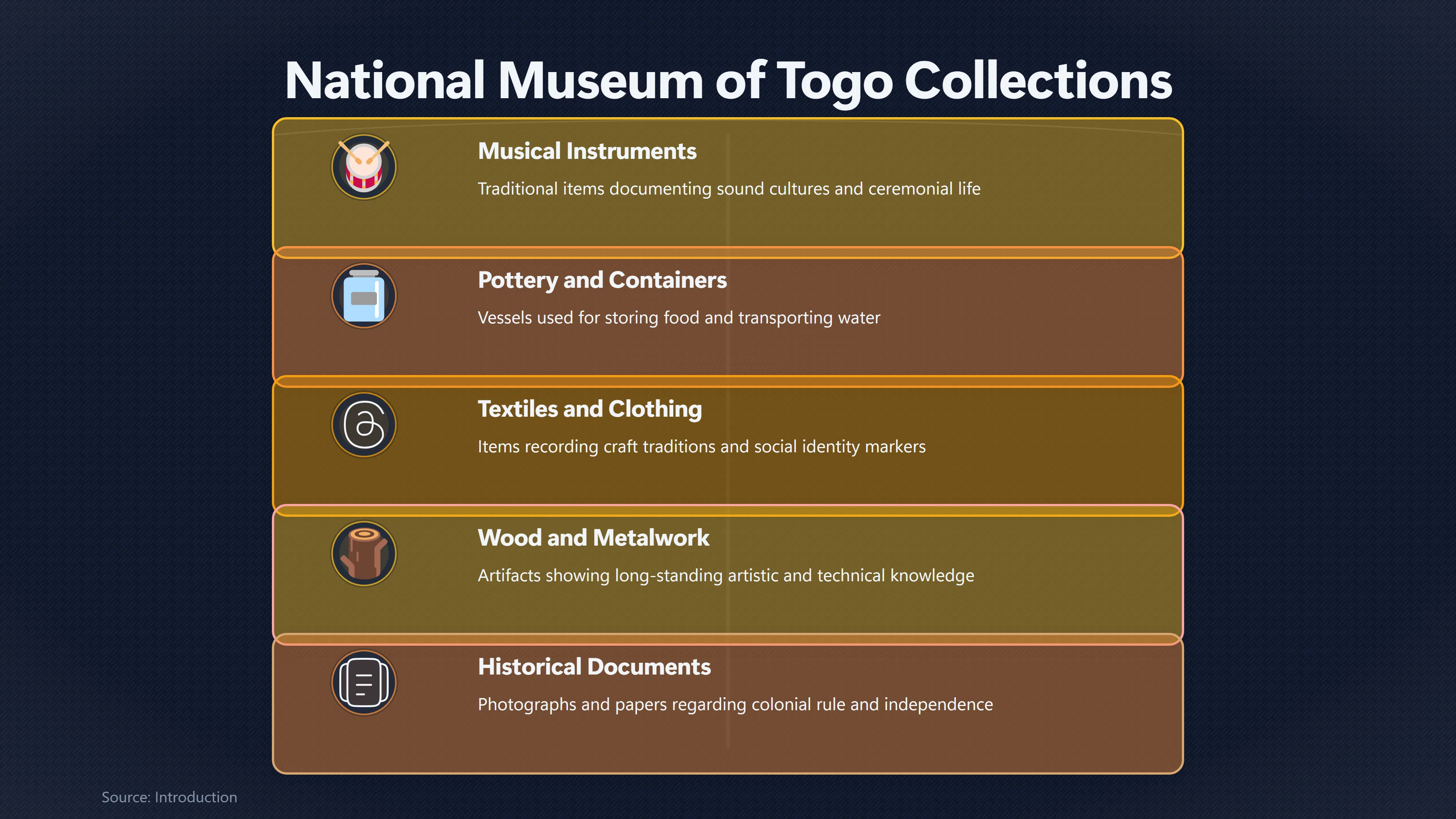
- Musical instruments, including traditional instruments that document sound cultures and ceremonial life.[Wikipedia]WikipediaTogo National MuseumTogo National Museum
- Pottery and containers, including vessels used for practical purposes such as storing food and water.[Wikipedia]WikipediaTogo National MuseumTogo National Museum
- Textiles, clothing and decorative objects, which record craft traditions and social identity.[Wikipedia]WikipediaTogo National MuseumTogo National Museum
- Wood carvings and metalwork, showing long-standing artistic and technical knowledge.[Wikipedia]WikipediaTogo National MuseumTogo National Museum
These objects are not “mysteries” in the sense of unexplained artefacts. Their curiosity comes from their ability to preserve vanished routines and forgotten forms of knowledge. A visitor seeing a simple tool or vessel is effectively seeing a fragment of a much larger social history.
The museum’s collections also sit alongside Togo’s wider heritage of spiritual and ritual objects. International ethnographic collections contain objects from Togo connected with ritual practices, including items made from materials such as shells, cloth, gourds and leather. These collections demonstrate the importance of interpreting objects within their original cultural settings rather than treating them only as exotic displays.[Horniman Museum and Gardens]horniman.ac.ukHorniman Museum and Gardensritual object; fetish objectHorniman Museum and Gardens…
Colonial encounters and independence
The National Museum’s historical collections are unusual because they do not stop at traditional culture. They also preserve evidence of the dramatic political changes that shaped modern Togo. The museum includes documents and photographs connected with early European contact, colonial rule, the independence movement and the leaders of independent Togo.[Togo Tourisme]togotourisme.tgTogo Tourisme Le Musée nationalTogo TourismeLe Musée national - Togo Tourisme…
This makes the museum a place where different layers of history meet. A traditional object may represent centuries of local knowledge, while a colonial-era photograph may reveal how outsiders attempted to classify and govern the same societies. The contrast is important because colonial records were often created from European viewpoints, sometimes reflecting the assumptions and priorities of colonial administrations rather than local communities. Research projects examining colonial-era images of Togo have highlighted the need to reinterpret such material through local perspectives.[Kolonialfotografie]kolonialfotografie.comStartseite…
The museum’s historical section also includes material relating to the slave trade on the Gulf of Guinea and Togo’s colonial experience. These items connect local history with wider Atlantic and regional networks of forced migration, commerce and political power.[Togo Tourisme]togotourisme.tgTogo Tourisme Le Musée nationalTogo TourismeLe Musée national - Togo Tourisme…
The colonial legacy also affects museums beyond Togo’s borders. Research into German colonial-era collections in European museums has examined hundreds of objects and photographs from the period when Togo was under German colonial rule between 1884 and 1916. Such research has increased attention on provenance — the question of where objects came from, how they were acquired and whether communities of origin should have a greater role in their interpretation.[Proveana]proveana.deProvenance of colonial-era collections from Togo in the Museum für Völkerkunde Dresden and the GRASSI Museum für Völkerkunde zu L…
For the National Museum of Togo, this history gives the collection an important role: it is not simply preserving old objects, but helping create a national narrative after colonial rule.

Everyday objects as cultural evidence
The most memorable aspect of the museum’s collections is that many objects are not spectacular in appearance. Their importance comes from the stories attached to them.
A carved wooden item, a woven basket or a musical instrument may appear modest compared with royal treasures or famous archaeological discoveries, but these objects preserve the practical knowledge of communities. They show how people adapted to their environment, passed skills between generations and expressed identity through craftsmanship.
This approach creates a useful contrast with Togo’s living spiritual and marketplace traditions. Places such as ritual markets present objects that remain active within belief systems, while the National Museum places objects into a historical framework. One preserves continuing practice; the other preserves memory and interpretation. Together, they show two different ways that unusual collections can exist: as living cultural systems and as carefully arranged historical records.
The museum’s strength is therefore not based on rarity alone. Its collection matters because it turns everyday materials into evidence of larger historical changes — migration, trade, colonialism, independence and cultural continuity.
Why the collection matters in Togo’s unusual heritage landscape
The National Museum of Togo occupies a distinctive position among the country’s heritage sites. It does not present a cabinet of curiosities filled with strange objects removed from their context. Instead, it shows why ordinary objects can become extraordinary when their histories are understood.
For travellers interested in unusual museums, the attraction is the connection between object and story. A pot, photograph or instrument becomes a clue to a wider world: how communities organised life before colonial rule, how foreign powers reshaped the region, and how independent Togo chose to remember its past.[Togo Tourisme]togotourisme.tgTogo Tourisme Le Musée nationalTogo TourismeLe Musée national - Togo Tourisme…
Its collections also demonstrate a broader shift in museum practice across Africa. Historical museums are increasingly viewed not just as storage places for old artefacts, but as spaces where questions of identity, ownership, memory and interpretation are debated. The National Museum of Togo is therefore both a collection of objects and a collection of historical viewpoints — a place where the material remains of the past are used to explain how the present was made.

Amazon book picks
Further Reading
Books and field guides related to The Objects That Tell Togo's Hidden History. Use these as the next step if you want deeper reading beyond the article.
African Art
"An indispensable part of the history of the skills and ideas of mankind." Scientific American.
The Colonizer and the Colonized
Albert Memmi's classic work stands as one of the most powerful and psychologically penetrating studies of colonial oppression ever writte...
Things Fall Apart
First published in 1958, this novel tells the story of Okonkwo, the leader of an Igbo (Ibo) community who is banished for accidentally ki...
A History of Africa
A History of Africa is a thorough narrative history of the continent from its beginnings to the twenty-first century. Long established at...
eBay marketplace picks
Marketplace Samples
Live-tested eBay searches with available results related to this page.
Selected fromAfrican art oneBay.co.uk.




Endnotes
1.
Source: proveana.de
Link:https://www.proveana.de/en/project/provenance-colonial-era-collections-togo-museum-fur-volkerkunde-dresden-and-grassi-museum
Source snippet
Provenance of colonial-era collections from Togo in the Museum für Völkerkunde Dresden and the GRASSI Museum für Völkerkunde zu L...
2.
Source: Wikipedia
Title: Togo National Museum
Link:https://en.wikipedia.org/wiki/Togo_National_Museum
3.
Source: kolonialfotografie.com
Link:https://kolonialfotografie.com/en/
Source snippet
Startseite...
4.
Source: africa.com
Title: museums of togo
Link:https://africa.com/museums-of-togo/
Source snippet
TogoAugust 1, 2022 — TOGO Image: Museums of Togo * Editor * Museums * August 1, 2022 TOGO NATIONAL MUSEUM It is situated in Lomé, Togo’s...
Published: August 1, 2022
5.
Source: togotourisme.tg
Title: Togo Tourisme Le Musée national
Link:https://togotourisme.tg/site/le-musee-national/
Source snippet
Togo TourismeLe Musée national - Togo Tourisme...
6.
Source: horniman.ac.uk
Title: Horniman Museum and Gardensritual object; fetish object
Link:https://www.horniman.ac.uk/object/nn3899/
Source snippet
Horniman Museum and Gardens...
7.
Source: horniman.ac.uk
Title: Horniman Museum and Gardensritual object; fetish object
Link:https://www.horniman.ac.uk/object/nn3901/
Source snippet
Horniman Museum and Gardens...
8.
Source: horniman.ac.uk
Title: ritual object; fetish object
Link:https://www.horniman.ac.uk/object/nn3909/
9.
Source: horniman.ac.uk
Title: ritual object; fetish object
Link:https://www.horniman.ac.uk/object/nn3903/
10.
Source: horniman.ac.uk
Title: ritual object; fetish object
Link:https://www.horniman.ac.uk/object/nn3910/
11.
Source: horniman.ac.uk
Title: ritual object; fetish object
Link:https://www.horniman.ac.uk/object/nn3911/
12.
Source: horniman.ac.uk
Link:https://www.horniman.ac.uk/object/1998.174.4/
13.
Source: horniman.ac.uk
Link:https://www.horniman.ac.uk/object/object-213895/
14.
Source: togotourisme.tg
Link:https://togotourisme.tg/un-patrimoine-historique/
15.
Source: nma.gov.au
Link:https://www.nma.gov.au/explore/features/cook_forster/background/the_collection
16.
Source: musee-foaa.com
Link:https://www.musee-foaa.com/togo/
Additional References
17.
Source: restitutionmatters.org
Link:https://restitutionmatters.org/event/colonial-collections-from-togo-and-ghana-in-the-berlin-museums/
Source snippet
June 28, 2026 — COLONIAL COLLECTIONS FROM TOGO AND GHANA IN THE BERLIN MUSEUMS * Research project * 17 Jun 2026 * Germany, Togo, Ghana *...
Published: June 28, 2026
18.
Source: tourisme.gouv.tg
Title: tg Noël au musée enchanté, douzième édition
Link:https://tourisme.gouv.tg/noel-au-musee-enchante-douzieme-edition/
Source snippet
gouv.tgNoël au musée enchanté, douzième édition - Ministère du Tourisme, de la Culture et des ArtsDecember 22, 2022 — NOËL AU MUSÉE ENCHA...
Published: December 22, 2022
19.
Source: youtube.com
Link:https://www.youtube.com/watch?v=kQ8DDt7ceO4
Source snippet
TOGO cultures & traditions at National Museum Lomé | The Arts of traditional pottery explained...
20.
Source: youtube.com
Link:https://www.youtube.com/watch?v=0_C4k2GLHDg
Source snippet
The 5 Minute Essential Travel Guide! Bienvenue à Lomé, voici votre guide en 5 mins...
21.
Source: youtube.com
Link:https://www.youtube.com/watch?v=bkQJVkLIek0
Source snippet
TOGO VLOG: A MUST VISIT IN LOMÉ, TOGO | PALAIS DE LOME...
22.
Source: youtube.com
Title: TOGO VLOG: A MUST VISIT IN LOMÉ, TOGO | PALAIS DE LOME
Link:https://www.youtube.com/watch?v=8u_F0B4OAYE
Source snippet
Uncovering the history of Togo at the Berlin Museum...
23.
Source: theguardian.com
Link:https://www.theguardian.com/artanddesign/2021/jan/19/togo-free-long-lost-photographs-newly-liberated-african-nations-todd-webb
24.
Source: togoarchives.com
Link:https://www.togoarchives.com/collection/colonial-photography/
25.
Source: smb.museum
Link:https://www.smb.museum/en/museums-institutions/ethnologisches-museum/collection-research/research/colonial-holdings-from-togo-and-ghana-at-berlins-museums/
26.
Source: fr-academic.com
Link:https://fr-academic.com/dic.nsf/frwiki/1205436/