Where Bolivia Keeps Its Strangest Objects
Bolivia does not have a single famous “museum of the bizarre”.
Page outline Jump by section
Introduction
The most important distinction is between living practice and staged curiosity. Bolivia’s ritual markets and festivals are not historical reconstructions created for visitors. They remain connected to active systems of healing, exchange, protection and devotion. Formal museums, meanwhile, range from state-backed research institutions to small private attractions and academic collections with limited public access. The result is a country where unusual objects are rarely just “oddities”: they often sit at the disputed boundary between heritage, religion, science, tourism and commerce.
Where Bolivia’s strangest collections are found
For travellers interested in unusual museums, La Paz and neighbouring El Alto form the clearest starting point. The old centre of La Paz brings the Witches’ Market, the Coca Museum and the National Museum of Ethnography and Folklore into a relatively compact area. The city’s municipal cemetery becomes another kind of public display space during the annual festival of decorated skulls. El Alto has larger and less tourist-oriented ritual markets, while Oruro’s anthropological museum provides the strongest formal collection of carnival demons, masks and highland funerary material.
Farther south, Sucre has an anatomy museum associated with medical education, while archaeological collections in La Paz, Oruro and around Tiwanaku preserve mummies, skulls and objects recovered from ancient burials. Evidence about opening arrangements is uneven, especially for university collections and smaller museums. Visitors should therefore treat published hours as provisional rather than assume every institution operates like a large national museum.
The Witches’ Market is a living ritual marketplace
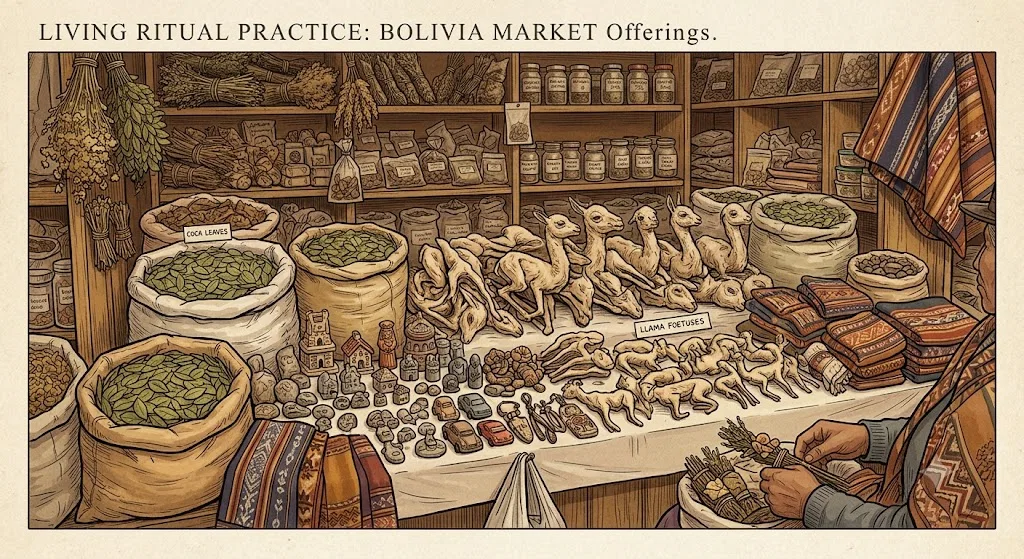
La Paz’s Witches’ Market is often described as though it were a cabinet of curiosities spread across several streets. Shopfronts display dried animals, medicinal plants, powders, miniature objects, charms and bundles intended for ritual offerings. The best-known items are dried llama foetuses, commonly associated with offerings connected to new buildings, prosperity and protection. Other goods may be intended for love, health, luck, business success or the removal of misfortune.[floratheexplorer.com]floratheexplorer.comFlora The ExplorerThe Witches of El Alto, Bolivia: Traditions & Superstitions at…February 15, 2019 — 15 Feb 2019 — But this is where y…
What makes the market unusual is not simply the appearance of the merchandise. Many objects belong to continuing highland religious and medical traditions rather than to an extinct folklore collected behind glass. Specialist vendors and ritual practitioners may advise customers, prepare offerings or interpret coca leaves. Some shops increasingly sell souvenirs to international visitors, but it would be misleading to dismiss the whole area as a tourist performance. Commercialisation and genuine ritual use coexist, sometimes within the same stall.[floratheexplorer.com]floratheexplorer.comFlora The ExplorerThe Witches of El Alto, Bolivia: Traditions & Superstitions at…February 15, 2019 — 15 Feb 2019 — But this is where y…
The name “Witches’ Market” also needs care. It is a visitor-friendly label that compresses several different forms of Indigenous ritual expertise into a familiar Western category. The market is better understood as a functioning trade in ritual, medicinal and devotional materials. The strange-travel appeal is real, but the objects are not props and should not be handled, mocked or photographed without permission.
El Alto has related ritual-shopping streets that are often described as larger and less polished for tourists than the central La Paz market. Reports from the area describe sacks of coca leaves, stone or sugar figures, medicinal ingredients and prepared offerings. This makes El Alto especially revealing for readers interested in the difference between a tourist landmark and a working ritual economy.[Flora The Explorer]floratheexplorer.comFlora The ExplorerThe Witches of El Alto, Bolivia: Traditions & Superstitions at…February 15, 2019 — 15 Feb 2019 — But this is where y…
The Coca Museum challenges a familiar drug story
The Coca Museum in La Paz is one of Bolivia’s clearest examples of a small private institution built around a single controversial object. Founded in 1996, it interprets the coca leaf through Indigenous history, ritual use, medicine, colonial exploitation, industrial products and the development of cocaine. It is close to the Witches’ Market, making the two places a useful pairing: the market shows coca within everyday ritual commerce, while the museum tries to explain the political and historical arguments surrounding it.[Wikipedia]WikipediaCoca MuseumCoca Museum
The museum is unusual because its subject has been repeatedly stripped of context. Outside the Andes, coca is commonly reduced to its role as the raw material from which cocaine can be produced. The museum presents a broader case, separating a culturally important leaf from the concentrated narcotic derived through chemical processing. Displays reportedly cover traditional chewing, ceremonial use, European pharmaceutical interest, commercial drinks, prohibition and the international drug trade. A reconstructed or explanatory cocaine-production display has also been part of the visitor experience.[Antipode]antipode-bolivia.comAntipode Coca leaves MuseumAntipodeCoca leaves Museum - Antipode BoliviaOpening hours: From Monday to Saturday, from 10 am to 6 pm. Facebook. Linked In. Twitter. Wh…
This is not a large, neutral national institution. It is a compact, argument-led museum with an identifiable interpretive position: coca should be understood as more than a prohibited-drug ingredient. That does not make it unreliable, but readers should recognise the difference between advocacy and detached encyclopaedic presentation. Its strength lies in showing why coca occupies several incompatible categories at once — sacred plant, mild stimulant, medicine, commodity, political symbol and controlled raw material.
Recent visitor reports still describe it as open, small and information-heavy, with English-language material available, although published opening hours vary between sources. Travellers should check locally rather than rely on a single timetable.[tripadvisor.co.uk]tripadvisor.co.ukTripadvisor MUSEO DE COCAMUSEO DE COCA - All You SHOULD Know Before…Duration: 4–5 hours Free … small museum with lots of information on the history…
Carnival devils become museum objects in Oruro
The Eduardo López Rivas National Anthropological Museum in Oruro is perhaps Bolivia’s strongest conventional museum for readers interested in demons, monsters and ritual disguise. Its collections cover archaeology, ethnography, music and folklore, but the most memorable material is associated with the Carnival of Oruro: elaborate masks, costumes and characters representing devils, supernatural beings, animals, sins and Christian figures.[wikipedia.org]WikipediaMuseo Nacional Antropológico Eduardo López RivasMuseo Nacional Antropológico Eduardo López Rivas
These masks are not simply examples of “scary folk art”. They belong to dance traditions shaped by Indigenous cosmology, colonial Christianity, mining culture and urban craft. Devil figures can carry several meanings at once: danger, temptation, underground power, theatrical spectacle and submission to sacred authority. Museum display freezes objects that were designed to move, flash and transform a dancer’s identity, so photographs rarely convey their scale or visual force.
The Oruro museum is especially useful because it places carnival material beside highland archaeology and funerary evidence. Reported displays include ancient ceramics, stone figures, burial structures, deliberately shaped skulls and examples of trepanation, the practice of cutting or scraping an opening into the skull. The combination can feel like an old-fashioned curiosity museum, but it also reveals long continuities in how bodies, ancestors, supernatural beings and ritual performance are interpreted in the high Andes.[Wikipedia]WikipediaMuseo Nacional Antropológico Eduardo López RivasMuseo Nacional Antropológico Eduardo López Rivas
Credibility is stronger here than at a commercial attraction. The museum is a long-established anthropological institution rather than a themed entertainment venue. Even so, the meaning of carnival objects cannot be fully understood from labels alone. Their significance depends on dance fraternities, annual performance, religious devotion and the makers who continually redesign them.
Bolivia’s national folklore museum is stranger than its name suggests
The National Museum of Ethnography and Folklore in La Paz is not marketed as a museum of magic, yet it may be the best place to understand why ritual objects and masked beings matter. The institution combines exhibitions with research, archives, publications and conservation, and its work covers Bolivia’s living cultural traditions rather than treating folklore as a vanished rural past. Museo Nacional de Etnografía y Folklore[musef.gob.bo]musef.gob.boOpen source on gob.bo.
Its collections and publications include masks, textiles, metalwork, basketry, wooden objects, musical instruments, photographs and ritual material. For an offbeat-museum visitor, the masks are the most obvious attraction, but the deeper interest lies in the museum’s treatment of objects as parts of social systems. A mask may be simultaneously a crafted artwork, a temporary supernatural identity, an emblem of a dance group and a commodity commissioned for public celebration. Museo Nacional de Etnografía y Folklore+3Museo Nacional de Etnografía y Folklore+3Museo Nacional de Etnografía y Folklore[musef.gob.bo]musef.gob.boOpen source on gob.bo.
This makes the museum a useful corrective to sensational accounts of Bolivia’s “mysticism”. Rather than presenting ritual objects as mysterious relics, it connects them to labour, community, materials, historical change and present-day use. Its official status and research role give it a stronger curatorial foundation than most tourist-facing descriptions of the same traditions.
Decorated skulls and the festival of the dead
One of Bolivia’s most striking public collections is not owned by a museum. During the annual skull festival at La Paz’s municipal cemetery, devotees bring human skulls that they keep in homes or other private settings. The skulls are decorated with flowers, hats, sunglasses, cigarettes and coca leaves, and may be placed in glass cases, boxes or miniature shrine-like containers. Owners ask them for protection, health, money, love or help with personal difficulties.[AP News]apnews.comOpen source on apnews.com.
From a museum perspective, the festival resembles a temporary exhibition of private reliquaries. Each skull has an individual identity, story and relationship with its keeper. Yet it is not an art installation or organised heritage display. The objects are human remains participating in devotional life.
Accounts commonly describe the tradition as a mixture of Andean ideas about ancestors and death with elements of Catholic observance. The Catholic Church does not formally recognise the practice, but that institutional distance has not prevented it from developing a strong public presence. Anthropological explanations emphasise that death in Andean thought is not always a complete break from life: the dead may remain connected to households, land, fertility and protection.[AP News]apnews.comOpen source on apnews.com.
Visitors should avoid treating the event as a macabre photo opportunity. The skulls may look theatrical when dressed in sunglasses or surrounded by flowers, but their keepers often approach them as powerful companions or guardians. The most important question is not whether outsiders find them eerie, but how human remains can move between archaeological object, family possession, sacred presence and public spectacle.

Anatomy collections are public only at certain times
Bolivia also has medical collections that fit the older meaning of a museum as a teaching repository. The anatomy museum in Sucre has been described as containing human bones, skeletons, preserved organs and foetuses, tissue samples, wax models of skin diseases and historical surgical instruments. It is associated with medical study rather than designed primarily as an entertainment attraction.[BoliviaBella]boliviabella.comOpen source on boliviabella.com.
La Paz has a Museum of Human Anatomy linked to the medical faculty of the Higher University of San Andrés. Recent reporting from the city’s annual Long Night of Museums showed visitors viewing anatomical specimens and skeletal remains there in July 2026. The same coverage described it as a collection normally used for medical training that had been opened to the wider public for the event.[Instagram]instagram.comLA PAZ, BOLIVIA –LA PAZ, BOLIVIA –
This distinction matters for practical planning. A university collection may be real, substantial and carefully maintained without operating as a walk-in museum throughout the year. Older travel pages sometimes give regular hours for anatomy collections, but access can depend on teaching schedules, institutional permission or special cultural events. Anyone travelling specifically to see one should confirm access directly.
Medical collections also require a different ethical lens from novelty museums. Preserved human material was often acquired under standards very different from those now expected around consent, dignity and cultural affiliation. The absence of detailed public provenance information does not mean the specimens are fraudulent, but it limits what a casual visitor can know about who the individuals were and how their remains entered the collection.
Mummies, burial towers and altered skulls
Bolivia’s archaeological museums preserve some of the country’s most visually unusual objects: naturally mummified bodies, funerary textiles, skulls shaped during infancy, trepanned crania and material recovered from highland burial structures. Collections associated with Oruro, La Paz and Tiwanaku are commonly described as including mummies or human remains, though displays can change and older guidebook claims should not be treated as guarantees of what is currently exhibited.[wikipedia.org]WikipediaMuseo Nacional Antropológico Eduardo López RivasMuseo Nacional Antropológico Eduardo López Rivas
The apparent strangeness of elongated skulls has encouraged pseudo-archaeological stories, including claims about non-human beings or lost advanced civilisations. The established explanation is deliberate cranial modification: an infant’s developing head was bound or shaped over time according to social and cultural practices. Trepanation likewise has a documented human history and does not require an exotic explanation. A recent study of a mummified head taken from Bolivia in the nineteenth century found evidence of both cranial shaping and an incomplete trepanation, while also correcting an old museum label that had identified the person too broadly as Inca.[Live Science]livescience.comLive Science350-year-old mummified head from Bolivia isn't what it seemsLive Science350-year-old mummified head from Bolivia isn't what it seems
That case is important even though the head is held in Switzerland and is not on public display. It demonstrates how “mystery objects” are often created by weak provenance and colonial collecting habits rather than by anything inexplicable about the remains themselves. Modern researchers used non-invasive methods and stressed that the head represented an individual with a local history, not merely an anatomical specimen. Questions of repatriation, consent and community authority now sit beside scientific curiosity.[Live Science]livescience.comLive Science350-year-old mummified head from Bolivia isn't what it seemsLive Science350-year-old mummified head from Bolivia isn't what it seems
Bolivian mummies also continue to produce genuine scientific surprises. Research on a long-neglected museum specimen recovered a centuries-old bacterial genome, showing how collections assembled for archaeology can later become evidence for the history of disease. Such findings are more compelling than sensational claims because they emerge from testable laboratory work while also raising difficult questions about sampling human remains.[Research Communities by Springer Nature]communities.springernature.comOpen source on springernature.com.
Archaeological “mysteries” need careful interpretation
Tiwanaku and the nearby stone complex commonly called Puma Punku are magnets for claims about impossible engineering, vanished technologies and extraterrestrial intervention. Their large cut stones and monumental architecture certainly belong in Bolivia’s curiosity landscape, and museums around the site help place sculpture, ceramics and architectural fragments in archaeological context. What they do not provide is evidence for alien builders.
The strongest interpretation treats these monuments as products of an Indigenous civilisation with sophisticated stone-working, transport, political organisation and ritual architecture. The sense of impossibility often comes from looking at isolated blocks without considering unfinished pieces, quarry evidence, tool marks, repeated construction techniques or the long period over which the ceremonial centre developed. Tourist language frequently exaggerates genuine uncertainty into total mystery.
This is a recurring problem in Bolivia’s unusual-heritage tourism. Objects with incomplete histories — a shaped skull, an eroded statue or a massive stone block — are easily detached from archaeological context and recirculated as “anomalies”. Formal museums are most useful when they restore the missing relationships between an object, its excavation site, cultural period and known manufacturing practices.
What is genuinely unusual, and what is tourist packaging?
Bolivia’s strange collections fall into several overlapping types, and knowing the difference changes what a visitor should expect.
- Living ritual commerce: The Witches’ Market and related streets sell materials that may still be used for offerings, healing and divination. Tourism has altered presentation, but the practices are not merely reconstructed.
- Private interpretive museum: The Coca Museum is small, visitor-facing and built around a clear argument about a misunderstood plant.
- Research and heritage institution: The national folklore museum and Oruro’s anthropological museum preserve major collections with stronger documentation, conservation and scholarly context.
- Academic teaching collection: Anatomy museums may contain the most startling specimens but can have limited or event-based public access.
- Temporary devotional display: The festival of decorated skulls turns privately kept human remains into a public gathering without converting them into museum exhibits.
- Archaeological collection: Mummies and modified skulls are authentic cultural remains, but their interpretation depends heavily on provenance, ethical display and resistance to pseudo-archaeological marketing.
The weakest material in Bolivia’s oddity landscape tends to come from travel retellings that repeat claims without checking whether a collection still exists, is regularly open or contains the exhibits described. Specific opening hours, ticket prices and display lists are particularly vulnerable to becoming outdated.
How to visit responsibly
The unusual nature of these collections does not remove ordinary standards of respect. At ritual markets, ask before taking close photographs, especially of vendors, private ceremonies or sensitive animal material. Avoid buying wildlife products whose legality, species or origin cannot be established. Objects presented as ancient artefacts should never be purchased without clear legal documentation.
At festivals involving human remains, remember that the skulls are not anonymous Halloween decorations. Their keepers may regard them as named persons or protective presences. Photography may be welcomed in some circumstances, but participation should be guided by local permission rather than by the assumption that a public event makes everything available for unrestricted use.
Museum information should also be checked shortly before travelling. Larger institutions such as the National Museum of Ethnography and Folklore maintain official channels, but smaller private and university museums may change their schedules or open only for special programmes. Current British travel advice should be consulted as well, since transport disruption and regional warnings can affect access within Bolivia. Museo Nacional de Etnografía y Folklore[musef.gob.bo]musef.gob.boOpen source on gob.bo.
Why Bolivia’s curiosity culture matters
Bolivia’s most unusual collections resist a clean division between museum object and living belief. A devil mask may move from workshop to dancer to museum case. Coca can be a sacred leaf, commercial product, political emblem and source material for an illegal drug. A human skull can be archaeological evidence in one setting and an active guardian in another. A preserved body can shift from unnamed museum specimen to a person whose cultural identity and right to respectful treatment are being reconsidered.
That movement is what makes Bolivia distinctive. The country’s strange-history landscape is not dominated by hoax museums or theatrical horror attractions. Its strongest material comes from serious encounters between Indigenous tradition, colonial history, modern tourism, science and public display. Visitors looking only for the macabre will find striking objects, but those who pay attention to how the objects are used, named and contested will find the more unusual story: collections that are not entirely separated from the worlds of belief and obligation that produced them.
Amazon book picks
Further Reading
Books and field guides related to Where Bolivia Keeps Its Strangest Objects. Use these as the next step if you want deeper reading beyond the article.
Lonely Planet Bolivia
Lonely Planet: The world's number one travel guide publisher* Lonely Planet's Bolivia is your passport to the most relevant, up-to-date a...
The Hold Life Has: Coca and Cultural Identity in an Andean Co...
This second edition of Catherine J. Allen's distinctive ethnography of the Quechua-speaking people of the Andes brings their story into t...
eBay marketplace picks
Marketplace Samples
Live-tested eBay searches with available results related to this page.
Selected fromAndean art print oneBay.co.uk.

Endnotes
1.
Source: logistur.travel
Link:https://www.logistur.travel/us/blog-post/witches-market-bolivia
Source snippet
The Mythical Witches Market in La Paz, BoliviaOne of the most unusual markets in the world attracts your customers with talismans, amulet...
2.
Source: Wikipedia
Title: The Witches’ Market
Link:https://en.wikipedia.org/wiki/The_Witches%27_Market
3.
Source: Wikipedia
Title: Coca Museum
Link:https://en.wikipedia.org/wiki/Coca_Museum
4.
Source: Wikipedia
Title: Museo de la Coca
Link:https://es.wikipedia.org/wiki/Museo_de_la_Coca
5.
Source: kupi.com
Link:https://www.kupi.com/en/explore/bolivia/la-paz/coca-museum
6.
Source: Wikipedia
Title: Museo Nacional Antropológico Eduardo López Rivas
Link:https://es.wikipedia.org/wiki/Museo_Nacional_Antropol%C3%B3gico_Eduardo_L%C3%B3pez_Rivas
7.
Source: boliviabella.com
Link:https://www.boliviabella.com/anatomy-museum.html
8.
Source: instagram.com
Title: LA PAZ, BOLIVIA –
Link:https://www.instagram.com/p/DauN2cUDQPj/
9.
Source: Wikipedia
Title: National Museum of Archaeology, Bolivia
Link:https://en.wikipedia.org/wiki/National_Museum_of_Archaeology%2C_Bolivia
10.
Source: Wikipedia
Title: Museum of Witchcraft and Magic
Link:https://en.wikipedia.org/wiki/Museum_of_Witchcraft_and_Magic
11.
Source: Wikipedia
Link:https://en.wikipedia.org/wiki/Bolivia
12.
Source: Wikipedia
Title: Museo Nacional de Etnografía y Folklore
Link:https://es.wikipedia.org/wiki/Museo_Nacional_de_Etnograf%C3%ADa_y_Folklore
13.
Source: floratheexplorer.com
Link:https://floratheexplorer.com/el-alto-bolivia-traditions-witches-market/
Source snippet
Flora The ExplorerThe Witches of El Alto, Bolivia: Traditions & Superstitions at...February 15, 2019 — 15 Feb 2019 — But this is where y...
Published: February 15, 2019
14.
Source: hobletsonthego.com
Title: witches street
Link:https://hobletsonthego.com/where-weve-been/south-america/bolivia/witches-street/
Source snippet
Hoblets On The GoWitches' Street in El Alto, Bolivia – Traditions, Rituals &...19 Aug 2025 — Discover the enchanting Witches Street in E...
15.
Source: antipode-bolivia.com
Title: Antipode Coca leaves Museum
Link:https://antipode-bolivia.com/en-map-coca-leaves-museum
Source snippet
AntipodeCoca leaves Museum - Antipode BoliviaOpening hours: From Monday to Saturday, from 10 am to 6 pm. Facebook. Linked In. Twitter. Wh...
16.
Source: tripadvisor.co.uk
Title: Tripadvisor MUSEO DE COCA
Link:https://www.tripadvisor.co.uk/Attraction_Review-g294072-d317327-Reviews-Museo_de_Coca-La_Paz_La_Paz_Department.html
Source snippet
MUSEO DE COCA - All You SHOULD Know Before...Duration: 4–5 hours Free … small museum with lots of information on the history...
17.
Source: expedia.co.in
Link:https://www.expedia.co.in/Coca-Museum-La-Paz.d6098808.Attraction
18.
Source: boliviaesturismo.com
Title: Bolivia es turismo Eduardo López Rivas National Anthropological Museum
Link:https://boliviaesturismo.com/en/museo-nacional-antropologico-eduardo-lopez-rivas-oruro-boliviaesturismo/
19.
Source: musef.gob.bo
Link:https://musef.gob.bo/
20.
Source: musef.gob.bo
Link:https://musef.gob.bo/musef-catalogo-editorial
21.
Source: musef.gob.bo
Link:https://musef.gob.bo/pdf/catalogos/mayores/2013_Tejiendo_la_Vida_Ingles.pdf
22.
Source: musef.gob.bo
Link:https://musef.gob.bo/pdf/catalogos/menores/2014_Mascaras.pdf
23.
Source: musef.gob.bo
Title: 2016 Alianzas de Metal
Link:https://musef.gob.bo/pdf/catalogos/mayores/2016_Alianzas_de_Metal.pdf
24.
Source: musef.gob.bo
Link:https://musef.gob.bo/pdf/catalogos/menores/2015_Realidades_Solapadas.pdf
25.
Source: apnews.com
Link:https://apnews.com/article/52046eeddb3db2ddd2604f03721cb5f5
26.
Source: amateurtraveler.com
Link:https://amateurtraveler.com/things-to-do-in-la-paz-bolivia/
27.
Source: livescience.com
Title: Live Science350-year-old mummified head from Bolivia isn’t what it seems
Link:https://www.livescience.com/archaeology/350-year-old-mummified-head-from-bolivia-isnt-what-it-seems
28.
Source: communities.springernature.com
Link:https://communities.springernature.com/posts/a-surprise-in-a-museum-storeroom-a-700-year-old-secret-hidden-in-a-bolivian-mummy
29.
Source: GOV.UK
Link:https://www.gov.uk/foreign-travel-advice/bolivia
30.
Source: musef.gob.bo
Title: La rebelión de los objetos
Link:https://www.musef.gob.bo/pdf/anales/RAE2017.pdf
31.
Source: musef.gob.bo
Title: 2018 Bordados
Link:https://musef.gob.bo/pdf/catalogos/menores/2018_Bordados.pdf
32.
Source: musef.gob.bo
Title: musef exposiciones permanentes sucre
Link:https://musef.gob.bo/musef-exposiciones-permanentes-sucre
33.
Source: musef.gob.bo
Link:https://musef.gob.bo/pdf/anales/RAE2015.pdf
34.
Source: musef.gob.bo
Title: musef 360
Link:https://musef.gob.bo/musef-360
35.
Source: musef.gob.bo
Link:https://musef.gob.bo/musef-sistema-de-archivo
36.
Source: tripadvisor.co.uk
Link:https://www.tripadvisor.co.uk/Attractions-g294072-Activities-c49-La_Paz_La_Paz_Department.html
37.
Source: lata.travel
Link:https://www.lata.travel/destinations/bolivia/
Additional References
38.
Source: youtube.com
Link:https://www.youtube.com/watch?v=FSIopcoruww
Source snippet
WITCHES' MARKET | WITCH DOCTORS | DRIED LLAMA FETUS | LA PAZ | BOLIVIA...
39.
Source: youtube.com
Title: Bolivians observe ‘natitas’ mass with skulls of deceased family members
Link:https://www.youtube.com/watch?v=WDgQFQM-QeU
Source snippet
Bolivia Discover the mysteries of the Witches’ Market in South America's intriguing city...
40.
Source: youtube.com
Title: Skulls rite closes feast of the dead in Bolivia
Link:https://www.youtube.com/watch?v=cxPRZm594Lc
Source snippet
Natitas festival Bolivia skull Bolivia's Healers Use Human Skulls To Help The Living AJ+...
41.
Source: youtube.com
Title: WITCHES’ MARKET | WITCH DOCTORS | DRIED LLAMA FETUS | LA PAZ | BOLIVIA
Link:https://www.youtube.com/watch?v=XpdS-9zqcZ0
Source snippet
Skulls rite closes feast of the dead in Bolivia...
42.
Source: youtube.com
Title: Bolivia’s Healers Use Human Skulls To Help The Living
Link:https://www.youtube.com/watch?v=ZpiWNSPOpnQ
Source snippet
Bolivians observe 'natitas' mass with skulls of deceased family members...
43.
Source: viancathatvagabond.com
Link:https://viancathatvagabond.com/the-witches-market/
44.
Source: atlasobscura.com
Link:https://www.atlasobscura.com/things-to-do/bolivia
45.
Source: theguardian.com
Link:https://www.theguardian.com/world/bolivia
46.
Source: boliviaentusmanos.com
Link:https://www.boliviaentusmanos.com/turismo/atractivos/museo-nacional-antropologico-eduardo-lopez-rivas.html
47.
Source: facebook.com
Link:https://www.facebook.com/groups/EncounterOverland/posts/10162059101497738/