Within Strange Bolivia
Why Bolivia's Coca Museum Rewrites a Drug Story
La Paz's Coca Museum separates the sacred and everyday coca leaf from the concentrated narcotic that dominates its global reputation.
On this page
- Coca before cocaine
- Ritual use, medicine and colonial trade
- Advocacy, interpretation and visitor expectations
Page outline Jump by section
Introduction
The Coca Museum in La Paz is one of Bolivia’s smallest museums, but it tackles one of the country’s biggest misconceptions. Rather than celebrating or denying the existence of cocaine, it asks visitors to separate the ancient coca leaf from the highly processed narcotic derived from it. This distinction lies at the heart of the museum’s mission. Through historical displays, illustrations and multilingual guides, it argues that thousands of years of Indigenous, medicinal and ritual use should not be reduced to the global history of cocaine trafficking. That position is not without controversy, but it explains why the museum has become an unusual stop for travellers seeking to understand Bolivia beyond familiar drug-war narratives.[La Paz Life]lapazlife.comLa Paz Life Museo de CocaLa Paz LifeMuseo de Coca - La Paz Bolivia…

Coca before cocaine
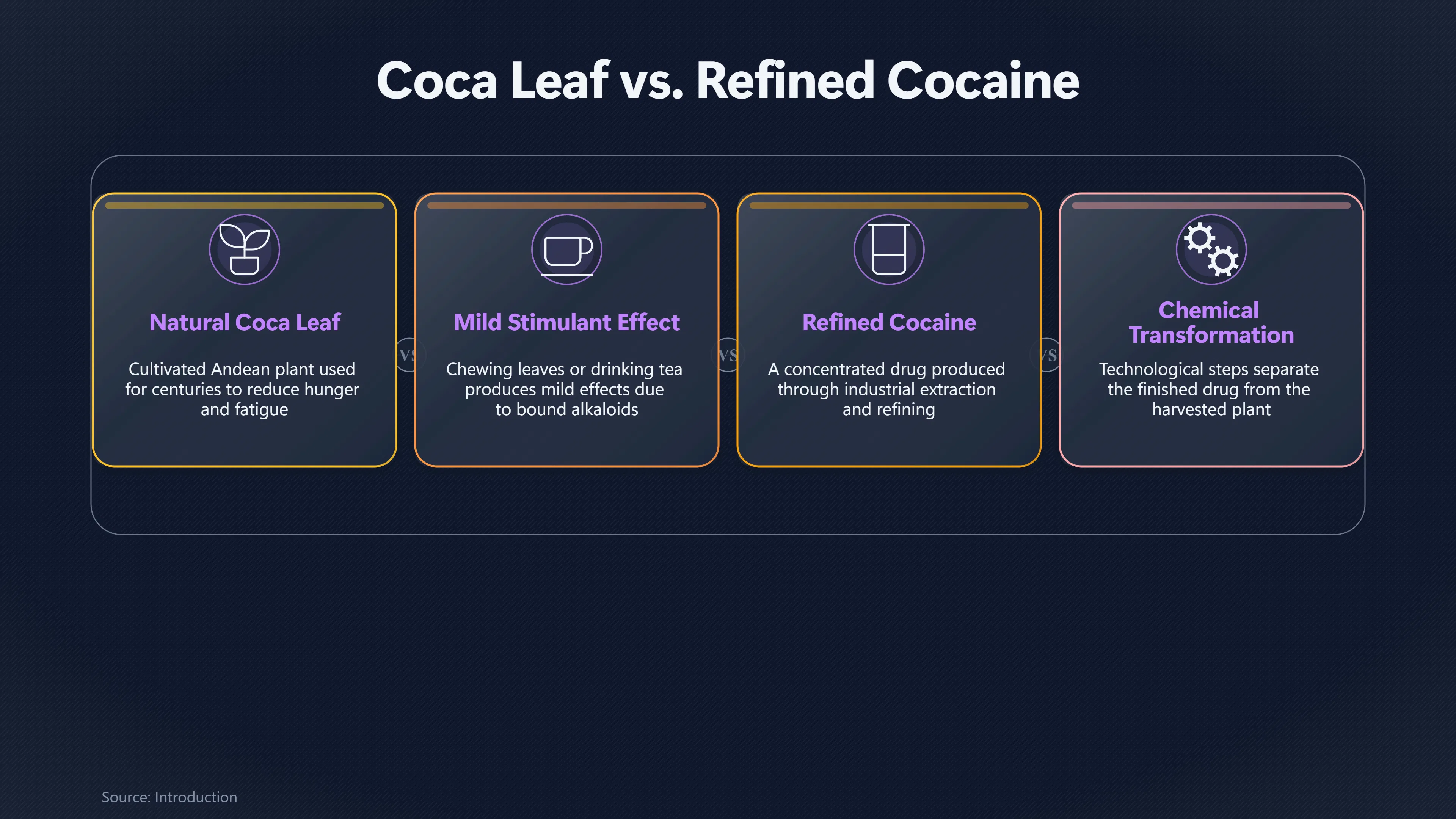
The museum’s central argument is simple: coca and cocaine are not the same thing.[atthemuseum.org]atthemuseum.orgCoca MuseumCoca Museum
Visitors are introduced to coca as a cultivated Andean plant whose leaves have been used for centuries to reduce hunger and fatigue, ease the effects of high altitude, accompany religious ceremonies and support social exchange. The exhibits stress that chewing coca leaves or drinking coca tea produces only a mild stimulant effect because the leaf naturally contains small amounts of alkaloids bound within plant material. Producing cocaine requires an industrial extraction and refining process that fundamentally transforms the leaf into a concentrated drug.[OUP Academic]academic.oup.comOUP AcademicThe Coca Leaf in Bolivian History | Oxford Research Encyclopedia of Latin American History | Oxford Academic…
This distinction matters because international media often use “coca” and “cocaine” almost interchangeably. The museum deliberately challenges that habit, presenting the leaf as an agricultural and cultural object first, while acknowledging that it also provides the raw material from which cocaine can be manufactured. It therefore does not deny the relationship between the two; instead, it argues that treating them as identical erases much of Andean history.[OUP Academic]academic.oup.comOUP AcademicCoca and Cocaine in Latin American History | Oxford Research Encyclopedia of Latin American History | Oxford Academic…
Ritual use, medicine and colonial trade
The museum places coca within a much longer historical timeline than most visitors expect.[atthemuseum.org]atthemuseum.orgCoca MuseumCoca Museum
Its displays explain that coca was valued in pre-Columbian societies for practical and ceremonial purposes. Leaves were offered during religious observances, carried by travellers crossing the Andes and used in social exchanges that reinforced community ties. Coca also became part of traditional healing practices, with preparations intended to relieve digestive discomfort, headaches and altitude-related symptoms. Although some of these traditional uses remain culturally important, the museum generally presents them as historical and ethnographic practices rather than making modern medical claims.[OUP Academic]academic.oup.comOUP AcademicThe Coca Leaf in Bolivian History | Oxford Research Encyclopedia of Latin American History | Oxford Academic…
The colonial period receives particular attention because it complicates simple stories about prohibition. Spanish authorities initially viewed coca with suspicion because of its association with Indigenous religious practice. However, colonial administrators soon recognised that miners and labourers working in the silver mines of Potosí consumed coca to endure long hours at high altitude. Colonial authorities therefore tolerated and taxed its trade, turning coca into a profitable commodity while simultaneously condemning aspects of Indigenous belief. The museum uses this contradiction to show that coca has long occupied an uneasy position between spiritual tradition, labour, commerce and political control.[OUP Academic]academic.oup.comOUP AcademicThe Coca Leaf in Bolivian History | Oxford Research Encyclopedia of Latin American History | Oxford Academic…
Advocacy through interpretation
Unlike a conventional natural history museum, the Coca Museum openly advances an interpretive argument.
Its exhibitions seek to persuade visitors that international drug policy has encouraged an oversimplified understanding of coca by treating the natural leaf primarily through the lens of cocaine. Historical timelines trace the nineteenth-century isolation of cocaine from coca and the subsequent rise of global narcotics controls, showing how the leaf’s reputation changed outside the Andes. Displays also explain how cocaine is manufactured, not to glorify the process but to demonstrate the technological and chemical steps separating the finished drug from the harvested plant.[La Paz Life]lapazlife.comLa Paz Life Museo de CocaLa Paz LifeMuseo de Coca - La Paz Bolivia…
This advocacy reflects a wider Bolivian political and cultural debate. Bolivia has repeatedly argued internationally that the coca leaf in its natural state should be distinguished from cocaine and that traditional consumption deserves recognition under international law. The museum’s narrative broadly aligns with this national position, although it remains a private visitor attraction rather than an official state museum.[Coca Ciencia]cocaciencia.gob.boCoca Ciencia Coca leafCoca Ciencia Coca leaf
What visitors should expect
The museum is modest in size and relies more on explanation than spectacle.
Instead of displaying rare artefacts or dramatic installations, it uses photographs, diagrams, historical documents and illustrated panels accompanied by multilingual guidebooks. Visitors encounter information on different coca varieties, traditional chewing methods, nutritional discussions, ritual practices and the scientific distinction between coca leaves and refined cocaine. The emphasis is educational rather than immersive, making it closer to a specialised interpretation centre than a conventional museum filled with objects.[La Paz Life]lapazlife.comLa Paz Life Museo de CocaLa Paz LifeMuseo de Coca - La Paz Bolivia…
For travellers expecting either anti-drug campaigning or romantic celebration of coca, the experience can be surprising. The museum criticises common myths while also acknowledging the destructive impact of cocaine trafficking. Its purpose is not to argue that coca is beyond criticism, but to persuade visitors that an ancient cultural plant deserves to be understood on its own terms before discussions turn to narcotics policy.[La Paz Life]lapazlife.comLa Paz Life Museo de CocaLa Paz LifeMuseo de Coca - La Paz Bolivia…

Why it matters in Bolivia’s landscape of unusual museums
Among Bolivia’s more unusual visitor attractions, the Coca Museum stands out because its curiosity lies in interpretation rather than bizarre artefacts.
Elsewhere in the country, travellers encounter ritual markets, decorated skull festivals and collections of carnival masks that surprise through their objects. The Coca Museum instead challenges assumptions. Its exhibits invite visitors to reconsider how museums can influence debates about identity, colonial history, Indigenous rights and international drug policy through the presentation of a single plant.
That makes it a distinctive stop within Bolivia’s culture of unusual collections. Rather than displaying something mysterious or macabre, it asks a provocative historical question: how did a sacred and everyday leaf become known around the world almost exclusively through one of its processed derivatives? By centring that question, the museum transforms a familiar global symbol into a case study in how culture, politics and science shape public understanding.[OUP Academic]academic.oup.comOUP AcademicThe Coca Leaf in Bolivian History | Oxford Research Encyclopedia of Latin American History | Oxford Academic…
Amazon book picks
Further Reading
Books and field guides related to Why Bolivia's Coca Museum Rewrites a Drug Story. Use these as the next step if you want deeper reading beyond the article.
The Hold Life Has: Coca and Cultural Identity in an Andean Co...
This second edition of Catherine J. Allen's distinctive ethnography of the Quechua-speaking people of the Andes brings their story into t...
One River
From the author of INTO THE SILENCE, winner of the Samuel Johnson Prize for Non-Fiction In 1941, Richard Evans Schultes took a leave of a...
Lonely Planet Bolivia
Lonely Planet: The world's number one travel guide publisher* Lonely Planet's Bolivia is your passport to the most relevant, up-to-date a...
eBay marketplace picks
Marketplace Samples
Live-tested eBay searches with available results related to this page.
Selected fromAndean poster oneBay.co.uk.


Endnotes
1.
Source: academic.oup.com
Link:https://academic.oup.com/edited-volume/61800/chapter-abstract/546373030
Source snippet
OUP AcademicThe Coca Leaf in Bolivian History | Oxford Research Encyclopedia of Latin American History | Oxford Academic...
2.
Source: academic.oup.com
Link:https://academic.oup.com/edited-volume/61800/chapter-abstract/546435211
Source snippet
OUP AcademicCoca and Cocaine in Latin American History | Oxford Research Encyclopedia of Latin American History | Oxford Academic...
3.
Source: academic.oup.com
Link:https://academic.oup.com/sysbio/article/70/1/1/5912027
Source snippet
of Coca: Museum Genomics Reveals Multiple Independent Domestications from Progenitor Erythroxylum gracilipes | Systematic Biology | Oxfor...
4.
Source: academic.oup.com
Link:https://academic.oup.com/sysbio/article-abstract/70/1/1/5912027
Source snippet
of Coca: Museum Genomics Reveals Multiple Independent Domestications from Progenitor Erythroxylum gracilipes | Systematic Biology | Oxfor...
5.
Source: lapazlife.com
Title: La Paz Life Museo de Coca
Link:https://www.lapazlife.com/places/museo-de-coca/
Source snippet
La Paz LifeMuseo de Coca - La Paz Bolivia...
6.
Source: cocaciencia.gob.bo
Title: Coca Ciencia Coca leaf
Link:https://www.cocaciencia.gob.bo/en/
7.
Source: petitfute.co.uk
Title: C A MUSEUM
Link:https://www.petitfute.co.uk/v37255-la-paz/c1173-visites-points-d-interet/c958-musee/1499330-museo-de-la-coca.html
Source snippet
CA MUSEUM - Museum - La Paz - BolivieMarch 30, 2018 — COCA MUSEUM Museum 4/5 1 review GO THERE AND CONTACT 906, Calle Linares, La Paz...
Published: March 30, 2018
8.
Source: cocaciencia.gob.bo
Link:https://www.cocaciencia.gob.bo/es/
9.
Source: cocaciencia.gob.bo
Link:https://www.cocaciencia.gob.bo/en/repositorio/
10.
Source: cocaciencia.gob.bo
Link:https://cocaciencia.gob.bo/en/repositorio/uso-tradicional
11.
Source: cocaciencia.gob.bo
Link:https://cocaciencia.gob.bo/es/repositorio/uso-tradicional/
12.
Source: museum.dea.gov
Link:https://museum.dea.gov/exhibits/online-exhibits/cannabis-coca-and-poppy-natures-addictive-plants/coca
13.
Source: atthemuseum.org
Title: Coca Museum
Link:https://atthemuseum.org/museums/coca-museum
Additional References
14.
Source: cambridge.org
Link:https://www.cambridge.org/core/journals/journal-of-latin-american-studies/article/turning-over-a-new-leaf-a-subnational-analysis-of-coca-yes-cocaine-no-in-bolivia/C8B6C224DE890A7957F2DD3765FCF8F1
Source snippet
June 16, 2021 — KEYWORDS Boliviadrug policycocacocaleroeradicationBoliviapolítica hacia las drogascocacocaleroerradicaciónBolíviapolítica...
Published: June 16, 2021
15.
Source: atlasobscura.com
Title: Museo de la Coca in La Paz
Link:https://www.atlasobscura.com/places/museo-de-la-coca
Source snippet
LA PAZ, BOLIVIA Added By Alex Timian ABOUT The Coca leaf generally gets a bad rap. When coca comes up in conversation in the U...
16.
Source: youtube.com
Title: The Many Benefits of Coca — The “Divine Leaf” with 8,000+ Years of Use
Link:https://www.youtube.com/watch?v=gL48mHH6ul8
Source snippet
Museo de la Coca (La Paz) - Esencia Cultural...
17.
Source: sciencedirect.com
Link:https://www.sciencedirect.com/science/article/abs/pii/S0378874197000305
18.
Source: museodelacoca.wixsite.com
Link:https://museodelacoca.wixsite.com/cusco/about-us
19.
Source: pure.umsa.bo
Link:https://pure.umsa.bo/en/publications/a-study-of-the-chemical-composition-of-erythroxylum-coca-var-coca/
20.
Source: pure.umsa.bo
Link:https://pure.umsa.bo/es/publications/a-study-of-the-chemical-composition-of-erythroxylum-coca-var-coca/
21.
Source: youtube.com
Title: Museo de la Coca (La Paz)
Link:https://www.youtube.com/watch?v=tJs0I8me2WE
Source snippet
Mama Coca | How the Drug War Destroys Indigenous Lives...
22.
Source: youtube.com
Title: Wade Davis: Coca is not Cocaine
Link:https://www.youtube.com/watch?v=SoX9BPtvRIY
Source snippet
The Many Benefits of Coca — The “Divine Leaf” with 8,000+ Years of Use...
23.
Source: boliviatravelsite.com
Link:https://boliviatravelsite.com/tourist-attraction?attraction=Coca+Museum