Within Strange Costa Rica
What Do Costa Rica's Stone Spheres Mean?
The Diquis spheres are genuinely mysterious, but archaeology tells a richer story than claims of aliens or vanished super-civilisations.
On this page
- What Archaeologists Know About the Spheres
- Finca 6 and the Importance of Original Context
- Popular Myths, Uncertainty and Responsible Interpretation
Page outline Jump by section
Introduction
Costa Rica’s Diquís stone spheres are among the world’s most recognisable archaeological mysteries, but they are not mysterious in the way popular culture often suggests. Archaeologists have identified who made them in broad terms, when they were produced, and the kinds of settlements where they belonged. What remains uncertain is their precise symbolic purpose within those communities. That distinction matters because it separates genuine unanswered questions from unsupported claims about lost super-civilisations, Atlantis or extraterrestrial visitors.
For anyone interested in Costa Rica’s unusual heritage, the stone spheres are fascinating precisely because they demonstrate how careful archaeology can replace sensational myths with a richer understanding of Indigenous history. The greatest discoveries have come not from isolated spheres displayed in parks or gardens, but from examples preserved in their original archaeological settings.
What Archaeologists Know About the Spheres
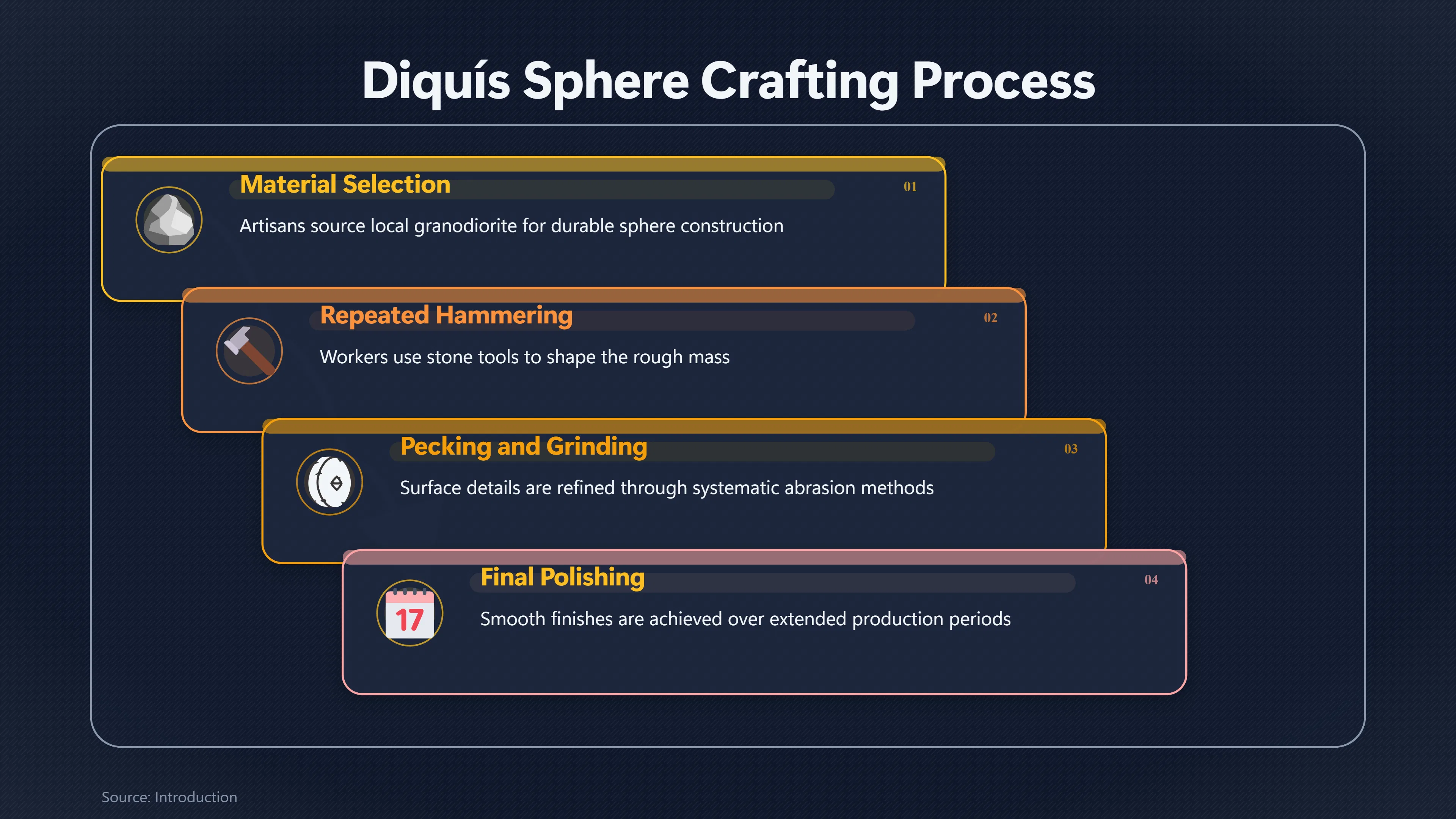
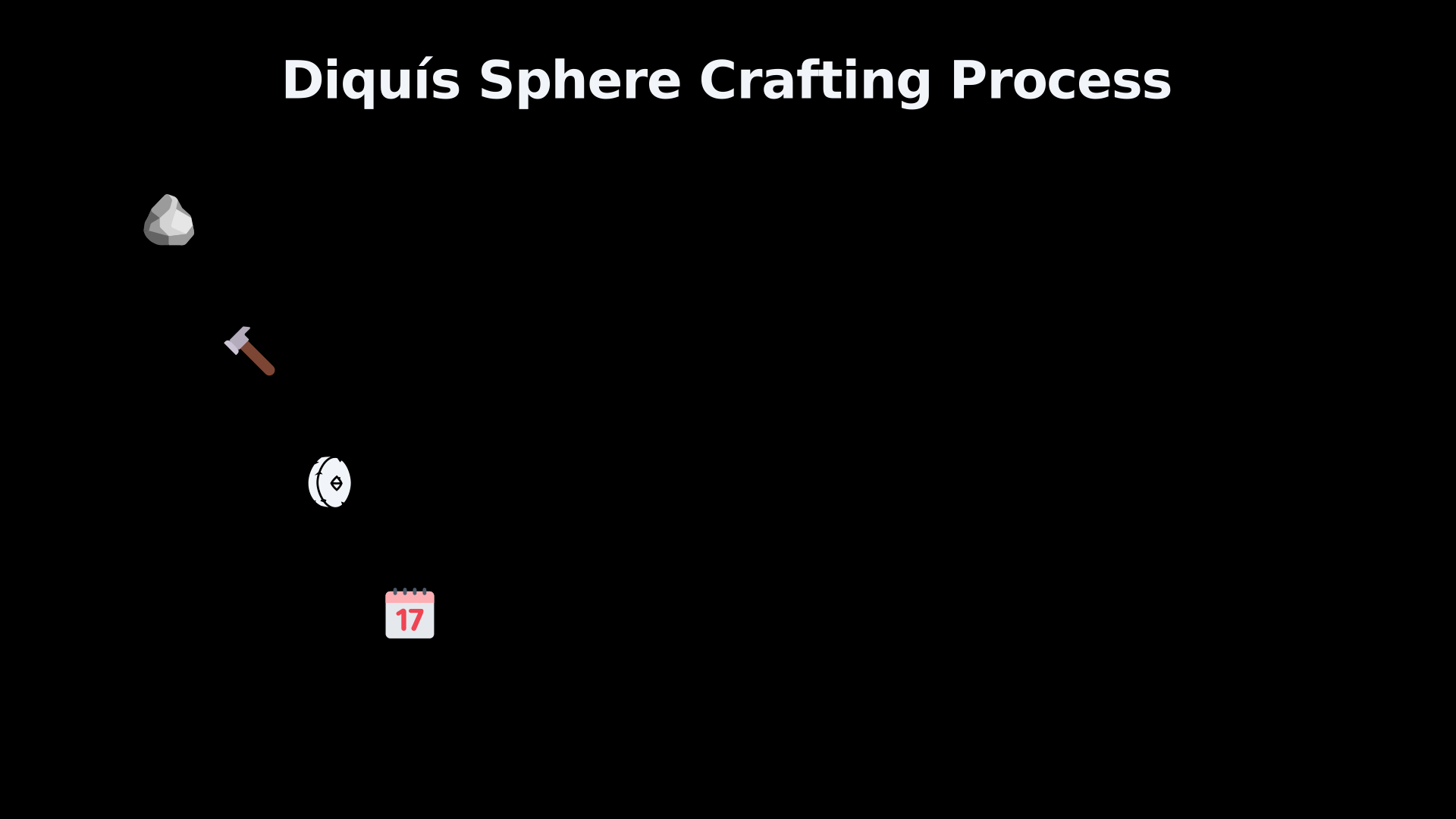
The Diquís stone spheres were created by Indigenous societies that flourished in southern Costa Rica between roughly AD 500 and 1500, although some examples may have earlier origins. More than 300 spheres have been documented, most carved from local granodiorite, with sizes ranging from under a metre to more than 2.5 metres in diameter. Their remarkable craftsmanship remains impressive even today, but there is no evidence that advanced lost technologies were required to produce them. Archaeologists conclude they were shaped through repeated hammering, pecking, grinding and polishing using stone tools over extended periods.[UNESCO World Heritage Centre]whc.unesco.orgUNESCO World Heritage CentrePrecolumbian Chiefdom Settlements with Stone Spheres of the Diquís - UNESCO World Heritage CentreJune 25, 2014…
The spheres did not exist in isolation. Excavations consistently associate them with complex chiefdom societies that built artificial mounds, paved plazas, burial areas and carefully organised settlements across the Diquís Delta. Rather than representing an unknown civilisation, the spheres form part of a broader archaeological landscape showing sophisticated political organisation and skilled stone-working traditions.[UNESCO World Heritage Centre]whc.unesco.orgUNESCO World Heritage CentrePrecolumbian Chiefdom Settlements with Stone Spheres of the Diquís - UNESCO World Heritage CentreJune 25, 2014…
Researchers remain cautious about assigning a single function because the spheres appear in different settings and sizes. Current interpretations suggest they probably acted as symbols of authority, prestige and political power, helping define important buildings, ceremonial areas or elite residences. Some may also have marked routes, entrances or public gathering places. None of these explanations excludes ritual or symbolic meanings, but no single interpretation has been demonstrated beyond doubt.[diquis.go.cr]diquis.go.crTerritorio de Esferas: Finca 6Territorio de Esferas: Finca 6
Finca 6 and the Importance of Original Context
The most important place for understanding the stone spheres is the archaeological site of Finca 6 in southern Costa Rica. Unlike many examples that were removed during twentieth-century agricultural development, several spheres here remain exactly where their creators placed them centuries ago.
This original context changes what archaeologists can learn. At Finca 6, spheres occur alongside artificial mounds, plazas and access routes rather than appearing as isolated sculptures. Two parallel alignments of spheres occupy a public space beside major residential platforms, while additional spheres frame entrances to important structures. Their positions strongly suggest deliberate planning connected to social hierarchy and public ceremony rather than random decoration.[diquis.go.cr]diquis.go.crTerritorio de Esferas: Finca 6Territorio de Esferas: Finca 6
Because the surrounding settlement survives, researchers can study relationships between architecture, movement through the site and the placement of monuments. This contextual evidence is far more valuable than the spheres alone. A perfectly preserved sphere displayed in a city park is visually striking, but it reveals far less about its original purpose than a weathered example left within its archaeological landscape.
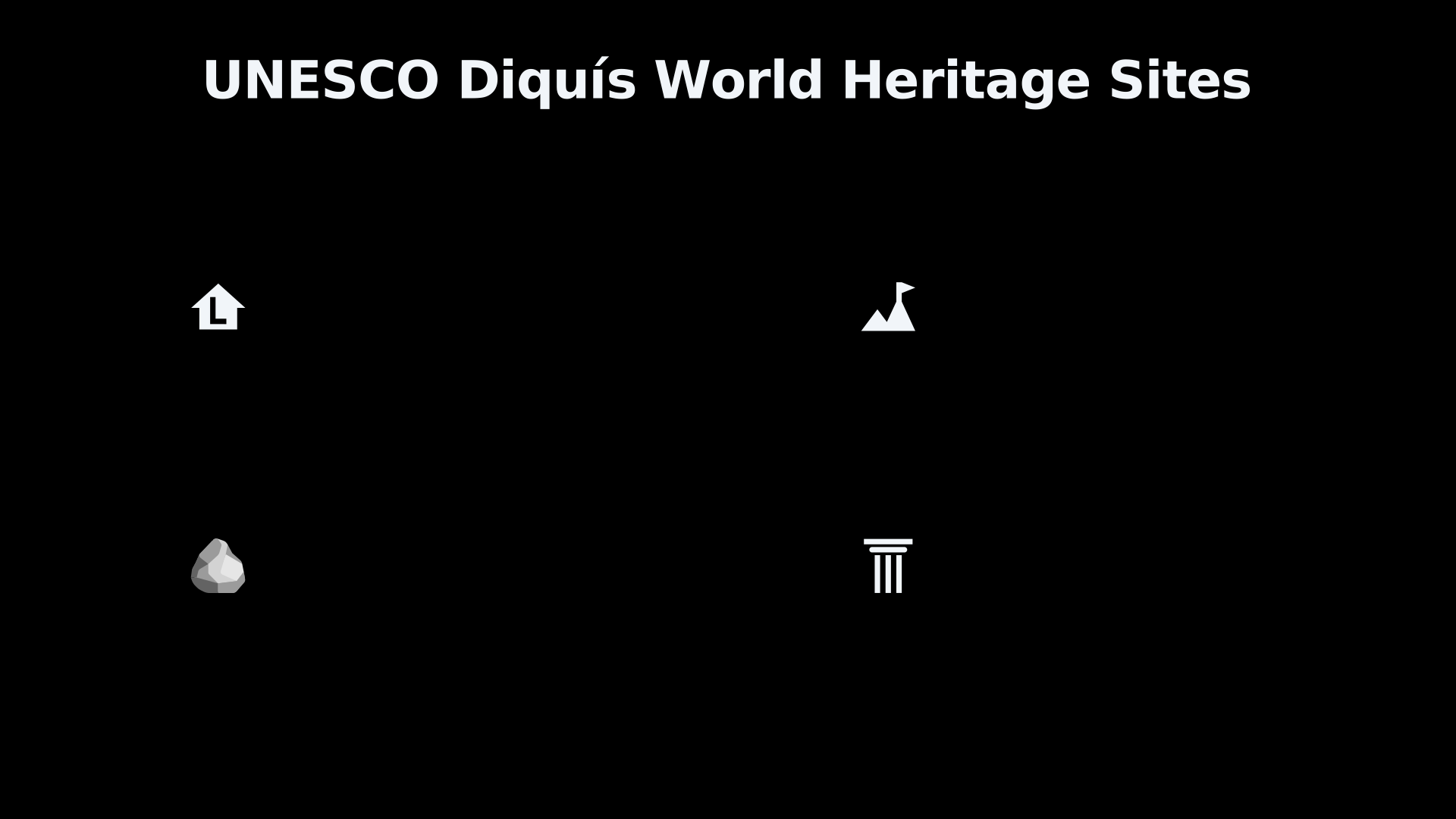
This emphasis on context explains why UNESCO inscribed four Diquís archaeological sites—Finca 6, Batambal, El Silencio and Grijalba-2—as a single World Heritage property in 2014. Together they preserve different aspects of these chiefdom settlements, with Finca 6 retaining the best-known sphere alignments, Batambal occupying a commanding hilltop position, El Silencio containing the largest recorded sphere, and Grijalba-2 illustrating another type of regional centre.[UNESCO World Heritage Centre]whc.unesco.orgUNESCO World Heritage CentrePrecolumbian Chiefdom Settlements with Stone Spheres of the Diquís - UNESCO World Heritage CentreJune 25, 2014…
Popular Myths, Uncertainty and Responsible Interpretation
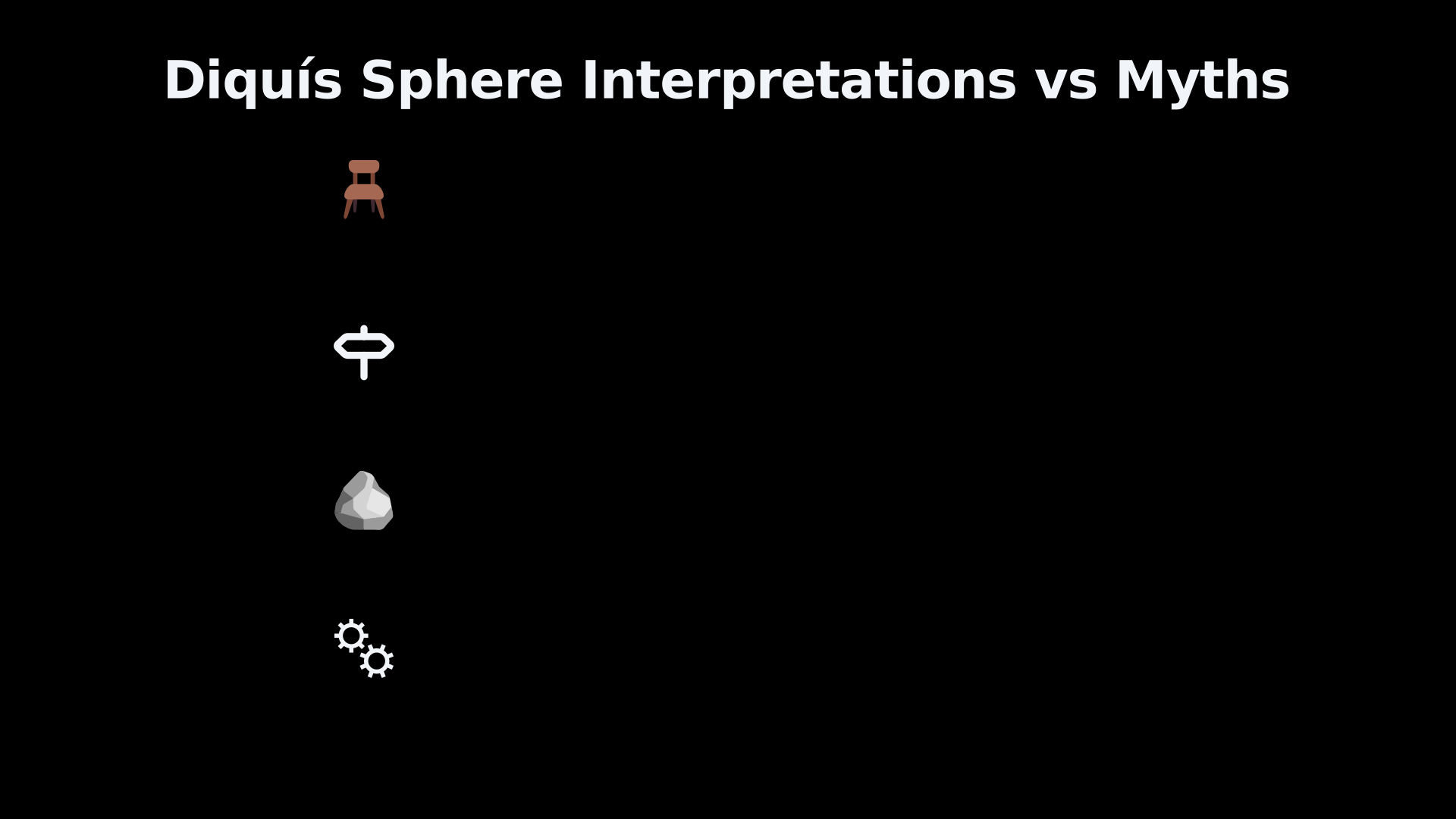
The spheres have inspired decades of extraordinary speculation. Claims regularly attribute them to Atlantis, ancient global civilisations, extraterrestrials or forgotten advanced technologies. These stories spread easily because the spheres are visually unusual and many were discovered without their original archaeological surroundings after being moved during banana plantation development in the twentieth century.
However, none of the popular mystery theories is supported by archaeological evidence. Excavations place the spheres firmly within Indigenous settlements whose pottery, buildings, burials and other artefacts belong to well-documented pre-Columbian societies. Their apparent precision is impressive but not impossible to achieve through patient stone-working, and detailed measurements show that they are not mathematically perfect spheres.[UNESCO World Heritage Centre]whc.unesco.orgUNESCO World Heritage CentrePrecolumbian Chiefdom Settlements with Stone Spheres of the Diquís - UNESCO World Heritage CentreJune 25, 2014…
The genuine uncertainties are more interesting than the sensational alternatives. Archaeologists still debate questions such as:
- Why some settlements contained many spheres while others had relatively few.
- Whether different sizes carried different social or ceremonial meanings.
- Whether alignments reflected processional routes, political display, cosmological symbolism or several purposes at once.
- How meanings changed over the many centuries during which spheres continued to be produced.
These questions remain open largely because many archaeological sites were disturbed before systematic excavation began. During agricultural expansion in the 1930s and later decades, numerous spheres were moved, damaged or relocated to public buildings, private gardens and ornamental landscapes, destroying the relationships that could have explained how they functioned within settlements. UNESCO specifically recognises that surviving in situ examples are therefore exceptionally valuable.[UNESCO World Heritage Centre]whc.unesco.orgUNESCO World Heritage CentrePrecolumbian Chiefdom Settlements with Stone Spheres of the Diquís - UNESCO World Heritage CentreJune 25, 2014…
Why the Archaeology Is More Remarkable Than the Mystery
The enduring appeal of the Diquís stone spheres lies not in proving fantastic theories but in revealing the achievements of the Indigenous societies that created them. Archaeology shows that these communities organised labour on a significant scale, transformed difficult stone into carefully finished monuments and incorporated them into planned political and ceremonial landscapes.
Rather than diminishing the mystery, this evidence sharpens it. The broad historical picture is increasingly well understood, while the specific meanings of individual spheres remain partly hidden because so much original context has been lost. The surviving archaeological sites, especially Finca 6, demonstrate why preserving monuments where they stand is often more valuable than simply preserving the objects themselves.
Within Costa Rica’s landscape of unusual heritage, the Diquís stone spheres therefore occupy a distinctive place. They are neither unsolved supernatural enigmas nor fully decoded archaeological puzzles. They are enduring reminders that careful excavation, landscape archaeology and respect for Indigenous history can produce explanations that are more compelling than myths while still leaving room for genuine historical uncertainty.
Amazon book picks
Further Reading
Books and field guides related to What Do Costa Rica's Stone Spheres Mean?. Use these as the next step if you want deeper reading beyond the article.
The Ancient Americas: Art from Sacred Landscapes
A lavishly illustrated catalog of a traveling exhibition marking the Columbus quincentennial explores the common threads in fourteen pre-...
Lost City of the Monkey God
Since the days of conquistador Hernán Cortés, rumours have circulated about a lost city of immense wealth hidden deep in the Honduran int...
1491: New Revelations of the Americas Before Columbus
Mann shows how a new generation of researchers equipped with novel scientific techniques have come to previously unheard-of conclusions a...
eBay marketplace picks
Marketplace Samples
Live-tested eBay searches with available results related to this page.
Selected fromCosta Rica map print oneBay.co.uk.
Endnotes
1.
Source: whc.unesco.org
Link:https://whc.unesco.org/en/list/1453
Source snippet
UNESCO World Heritage CentrePrecolumbian Chiefdom Settlements with Stone Spheres of the Diquís - UNESCO World Heritage CentreJune 25, 2014...
Published: June 25, 2014
3.
Source: diquis.go.cr
Title: Territorio de Esferas: Finca 6
Link:https://www.diquis.go.cr/en/territorio-de-esferas-finca-6.html
4.
Source: diquis.go.cr
Title: Visite Osa: Sitio Museo Finca 6
Link:https://diquis.go.cr/en/visite-osa-sitio-museo-finca-6.html
5.
Source: whc.unesco.org
Title: World Heritage Centre UNESCO World Heritage Centre
Link:https://whc.unesco.org/en/decisions/6130
Source snippet
UNESCO World Heritage CentreUNESCO World Heritage Centre - Decision - 38 COM 8B.44...
6.
Source: unesco.org
Title: The project ‘Young Leaders of the Diquís’ concludes with the creation
Link:https://www.unesco.org/en/articles/project-young-leaders-diquis-concludes-creation-youth-association
Source snippet
December 22, 2021 — THE PROJECT ‘YOUNG LEADERS OF THE DIQUÍS’ CONCLUDES WITH THE CREATION OF A YOUTH ASSOCIATION Young people from southe...
Published: December 22, 2021
7.
Source: unesco.org
Title: Young people from southern Costa Rica are trained as leaders for World
Link:https://www.unesco.org/en/articles/young-people-southern-costa-rica-are-trained-leaders-world-heritage-protection
Source snippet
June 22, 2021 — YOUNG PEOPLE FROM SOUTHERN COSTA RICA ARE TRAINED AS LEADERS FOR WORLD HERITAGE PROTECTION Image 22 June 2021 Last update...
Published: June 22, 2021
8.
Source: whc.unesco.org
Link:https://whc.unesco.org/en/list/1453/maps/
9.
Source: whc.unesco.org
Link:https://whc.unesco.org/en/list/1453/documents/
10.
Source: whc.unesco.org
Link:https://whc.unesco.org/en/decisions/8221/
11.
Source: diquis.go.cr
Link:https://diquis.go.cr/en/
12.
Source: diquis.go.cr
Link:https://diquis.go.cr/en/territorio-de-esferas.html
13.
Source: diquis.go.cr
Link:https://diquis.go.cr/es/territorio-de-esferas-declaratoria.html
14.
Source: diquis.go.cr
Link:https://diquis.go.cr/en/territorio-de-esferas-objetos-de-poder.html
15.
Source: diquis.go.cr
Link:https://diquis.go.cr/en/linea-de-tiempo.html
Additional References
16.
Source: museocostarica.go.cr
Title: Restauración de esferas Finca 6 « Noticias « Museo Nacional de Costa Rica
Link:https://www.museocostarica.go.cr/novedades/noticias/restauracion-de-esferas-finca-6/
Source snippet
April 2, 2022 — Restauración de esferas Finca 6 AGENDA | NOTICIAS | PRENSA [Select] DOS ESFERAS PRECOLOMBINAS FUERON SOMETIDAS AL PROCESO...
Published: April 2, 2022
17.
Source: museocostarica.go.cr
Title: Diquís « Investigación Arqueología « Museo Nacional de Costa Rica
Link:https://www.museocostarica.go.cr/nuestro-trabajo/investigaciones/arqueologia/diquis/
Source snippet
January 28, 2025 — Diquís 2025-01-28T10:20:25-06:00 CHAGÜITE | LÍNEA VIEJA | VISTAS DEL COCO | DIQUÍS | PENÍNSULA OSA | PECIO MANZANILLO...
Published: January 28, 2025
18.
Source: youtube.com
Title: The Mysterious Stone Spheres of Costa Rica | Ancient Architects
Link:https://www.youtube.com/watch?v=k0Og6vqa6YY
Source snippet
Alien Spheres from Atlantis? Mysterious stones found in Costa Rica! 2 of 2...
19.
Source: youtube.com
Title: Who Made the Giant Stone Spheres of Costa Rica?
Link:https://www.youtube.com/watch?v=4gbdTqhEAm8
Source snippet
The Mysterious Stone Spheres of Costa Rica | Ancient Architects...
20.
Source: youtube.com
Title: Stone Spheres of Costa Rica
Link:https://www.youtube.com/watch?v=eBkFaH9DdyM
Source snippet
The Ancient Stone Spheres That Shouldn't Exist - Who Carved Them Across the World?...
21.
Source: youtube.com
Title: Alien Spheres from Atlantis? Mysterious stones found in Costa Rica! 2 of 2
Link:https://www.youtube.com/watch?v=wd5XRxqNVtQ
Source snippet
Stone Spheres of Costa Rica...
22.
Source: youtube.com
Title: The Ancient Stone Spheres That Shouldn’t Exist
Link:https://www.youtube.com/watch?v=x69Zc-hqZaw