Within Solomon Curiosities
Ancestral Skulls
Ancestral skulls are among the most distinctive and sensitive cultural objects associated with the Solomon Islands. They are unusual not because they were intended as curiosities, but because they were once active parts of religious life, kept in shrines where they represented continuing relationships between the living and important ancestors.
Page outline Jump by section
Introduction
Today, these collections sit at the centre of a wider debate about the treatment of Indigenous human remains. The question is no longer simply how such objects should be displayed, but whether they should remain in foreign museums at all. For the Solomon Islands, the discussion combines issues of cultural heritage, colonial history, museum ethics and the practical realities of repatriation.
Why ancestral skulls are different from ordinary museum objects
In parts of the western Solomon Islands, particularly around the New Georgia group, the skulls of respected ancestors were preserved after death and incorporated into shrine traditions. Some were overmodelled with black vegetable putty, fitted with shell eyes, decorated with fibre hair and placed alongside other sacred objects. They were understood to retain aspects of ancestral power and formed part of the spiritual life of particular descent groups rather than serving as memorial displays.[British Museum]britishmuseum.orgBritish Museumhuman remains | British MuseumBritish Museumhuman remains | British Museum
This cultural role distinguishes them from archaeological skeletons or anonymous historical remains. In many descendant communities, these skulls are still regarded as ancestors rather than artefacts. That distinction has become increasingly important in museum policy, where human remains are now often treated under different ethical standards from other cultural collections.[British Museum]britishmuseum.orgBritish Museum Human remains | British MuseumBritish Museum Human remains | British Museum
Complicating matters further is the uncertainty surrounding some specimens. Museum records acknowledge that while many overmodelled skulls probably belonged to important ancestors, others may have been enemy trophy skulls or objects produced for sale to European collectors after outside demand encouraged a commercial market. This means that not every specimen has an identical history or cultural meaning.[British Museum]britishmuseum.orgBritish Museumhuman remains | British MuseumBritish Museumhuman remains | British Museum
How Solomon Islands skulls entered overseas collections
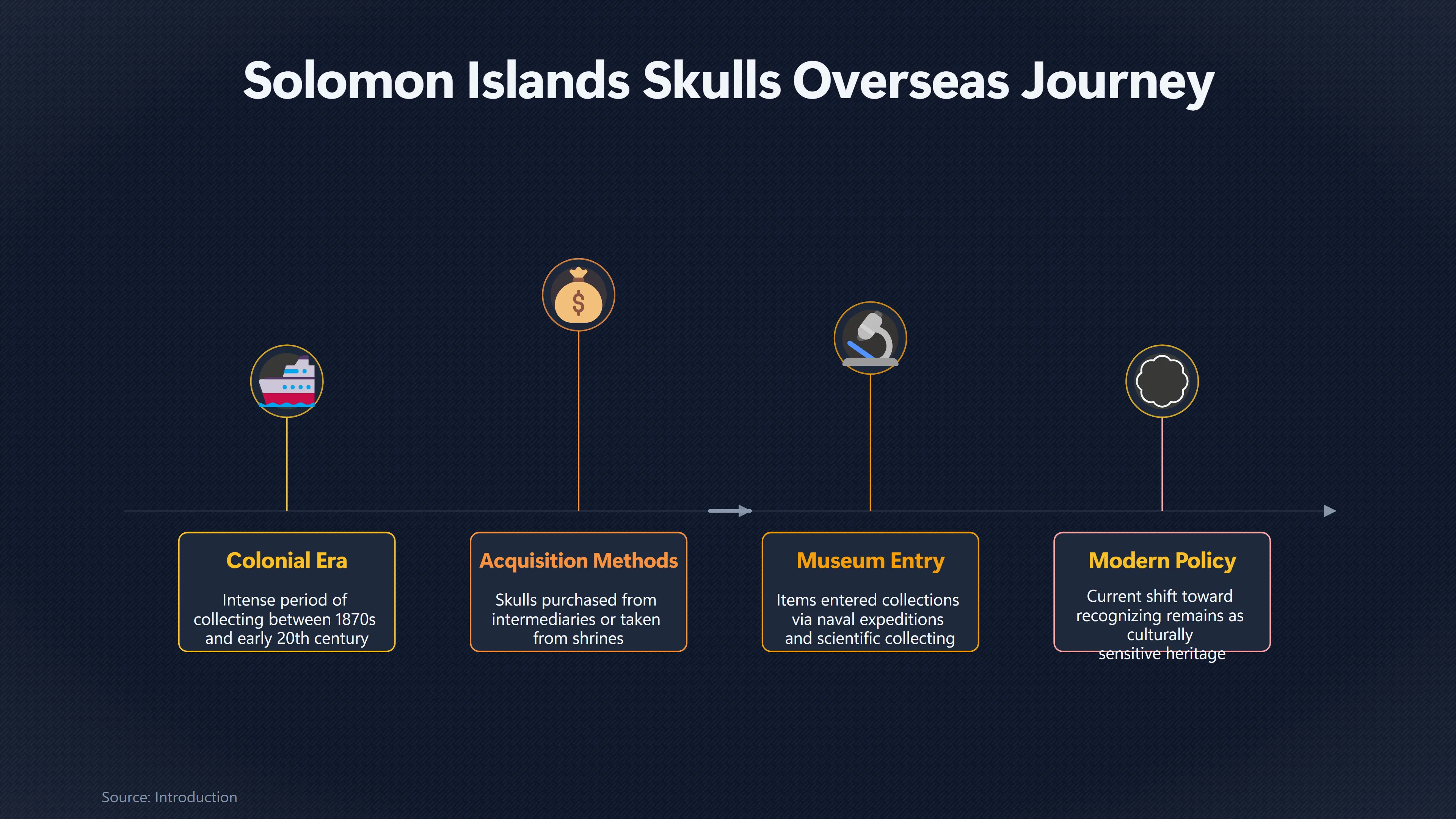
Many ancestral skulls left the Solomon Islands during a period of intense colonial collecting between the 1870s and the early twentieth century.
The circumstances varied considerably:
- Some were purchased from local intermediaries.
- Others were acquired by resident traders.
- Some may have been removed from abandoned or poorly protected shrines.
- Museum documentation occasionally admits that European demand itself encouraged the removal or manufacture of ceremonial objects for export.[British Museum]britishmuseum.orgBritish Museumhuman remains | British MuseumBritish Museumhuman remains | British Museum
One well-documented example in the British Museum is an overmodelled skull from Ranongga Island, donated in 1902 by trader Frank Wickham. Museum records note both its probable ritual significance and scholarly uncertainty over whether comparable skulls in museum collections always originated from recognised ancestral shrines. The object is no longer publicly illustrated online because of contemporary cultural restrictions relating to images of human remains.[British Museum]britishmuseum.orgBritish Museumhuman remains | British MuseumBritish Museumhuman remains | British Museum
Other Solomon Islands human remains entered museums through naval expeditions, scientific collecting and colonial-era acquisitions, including carved coffins containing skulls from islands such as Owaraha (Santa Ana).[British Museum]britishmuseum.orgBritish Museumcoffin; human skeletal remains | British MuseumJune 21, 1904…
What makes repatriation especially complex?
Unlike famous disputes over monumental sculptures or looted paintings, ancestral skulls involve both cultural property and human remains.
That creates several overlapping questions:
- Who has authority to request their return? Modern nation states, provincial governments, customary landowners and descendant clans may all have legitimate interests.
- Can an individual skull be linked to a particular community? Documentation is often incomplete or uses outdated geographical names.
- Were the remains obtained with meaningful consent? Records from the colonial period rarely meet today’s ethical expectations.
- Should all human remains automatically be returned? Museums and governments differ in how they answer this question.[British Museum]britishmuseum.orgBritish Museum Human remains | British MuseumBritish Museum Human remains | British Museum
For the Solomon Islands, identifying the appropriate receiving community can be particularly difficult because collections were assembled over more than a century, sometimes with limited documentation about their original shrine or lineage.
Museum attitudes have changed
The debate today differs markedly from the attitudes that shaped early museum collecting.
During the late nineteenth century, many museums displayed ancestral skulls primarily as ethnographic curiosities or evidence of supposedly “exotic” customs. Their religious importance was often minimised, while headhunting attracted disproportionate attention.
Modern museum practice has shifted significantly. Many institutions now:
- recognise ancestral remains as culturally sensitive;
- restrict photography or online publication;
- remove some human remains from permanent display;[britishmuseum.org]britishmuseum.orgBritish Museum Human remains | British MuseumBritish Museum Human remains | British Museum
- consult descendant communities about appropriate care;
- publish policies explaining how repatriation requests are assessed.[British Museum]britishmuseum.orgBritish Museum Human remains | British MuseumBritish Museum Human remains | British Museum
The British Museum’s current policy, for example, distinguishes human remains from ordinary artefacts and sets out procedures through which communities may seek the transfer of remains that fall within the scope of UK legislation. The museum also continues to research the provenance of its collections, acknowledging that acquisition histories can change as new evidence emerges.[British Museum]britishmuseum.orgBritish Museum Human remains | British MuseumBritish Museum Human remains | British Museum
Has the Solomon Islands sought widespread repatriation?
Compared with countries such as Australia, New Zealand or several Native American nations, the Solomon Islands has not pursued a large, internationally publicised programme focused specifically on ancestral skull repatriation.
That does not necessarily indicate a lack of interest. Instead, several practical factors shape the situation:
- many collections remain incompletely documented;
- customary authority may rest with particular communities rather than the national government alone;
- conservation facilities and museum resources within the Solomon Islands are more limited than in wealthier countries;
- public attention has often focused on broader cultural heritage priorities alongside development needs.
As a result, discussion has tended to remain within wider international debates about Indigenous human remains rather than generating numerous headline legal disputes centred on Solomon Islands collections.[British Museum]britishmuseum.orgBritish Museum Human remains | British MuseumBritish Museum Human remains | British Museum
Why the debate matters beyond ownership
The strongest arguments for repatriation are not primarily financial or nationalistic. Instead, they focus on restoring dignity to ancestors whose remains were collected during unequal colonial relationships.
For many Indigenous communities worldwide, human remains are not historical specimens but family members and spiritual beings whose continued storage overseas interrupts customary obligations. Recent international repatriations—from the Pacific, Africa and elsewhere—have reinforced this broader ethical movement, even though each case depends on its own legal and cultural circumstances.[reuters.com]reuters.comDeputy Secretary of State Kurt Campbell. The relics, including two skulls and three large effigies (rambaramp), were recognized by Vanuat…
Museums, meanwhile, often argue that collections also serve educational and research purposes and that each claim requires careful examination of provenance, legal ownership and the wishes of claimant communities. Modern practice increasingly favours consultation over unilateral decisions, recognising that scientific, educational and spiritual interests must all be weighed together.[British Museum]britishmuseum.orgBritish Museum Human remains | British MuseumBritish Museum Human remains | British Museum
What visitors should understand today
Visitors encountering Solomon Islands ancestral skulls in museums should view them less as macabre curiosities than as evidence of a profound shift in museum ethics.
A century ago they were commonly interpreted through the lens of colonial anthropology and fascination with headhunting. Today they are more likely to be presented as sacred ancestral remains whose removal raises difficult questions about consent, colonial collecting and cultural responsibility.
For anyone exploring the Solomon Islands’ unusual heritage, these skulls illustrate that the country’s most remarkable collections are not simply about strange objects. They are also about changing ideas of respect, ownership and the responsibilities museums owe to the communities whose ancestors became part of their collections.
Amazon book picks
Further Reading
Books and field guides related to Ancestral Skulls. Use these as the next step if you want deeper reading beyond the article.
Oceanic Art
This updated edition of Nicholas Thomas’s authoritative World of Art volume is a comprehensive look at Oceanic art, and includes a new ch...
Loot: The Battle over the Stolen Treasures of the Ancient World
A journey across four continents to the heart of the conflict over who should own the great works of ancient art Why are the Elgin Marble...
The Brutish Museums
New York Times 'Best Art Books' 2020 'Essential' – Sunday Times 'Brilliantly enraged' - New York Review of Books 'A real game-changer'– E...
eBay marketplace picks
Marketplace Samples
Live-tested eBay searches with available results related to this page.
Selected fromPacific art collectible oneBay.co.uk.
Current eBay listing
Pacific Giftware PT Amy Brown Art Original Collectible Figurine

Current eBay listing
Thomas Kinkade Pacific Nocturne Collectible Framed Matted Art Print

Endnotes
1.
Source: reuters.com
Link:https://www.reuters.com/world/asia-pacific/vanuatu-ancestral-relics-trafficked-art-new-york-return-home-with-fbi-escort-2024-08-29/
Source snippet
Deputy Secretary of State Kurt Campbell. The relics, including two skulls and three large effigies (rambaramp), were recognized by Vanuat...
2.
Source: reuters.com
Link:https://www.reuters.com/world/india/indian-tribes-visit-uk-museum-bring-home-ancestors-remains-2025-06-16/
Source snippet
These remains, seized from burial sites and battlefields or looted through violence, were historically displayed in museums as colonial t...
3.
Source: britishmuseum.org
Title: British Museumhuman remains | British Museum
Link:https://www.britishmuseum.org/collection/object/E_Oc1902
4.
Source: britishmuseum.org
Title: British Museum Human remains | British Museum
Link:https://www.britishmuseum.org/our-work/departments/human-remains
5.
Source: britishmuseum.org
Title: British Museumcoffin; human skeletal remains | British Museum
Link:https://www.britishmuseum.org/collection/object/E_Oc1904
Source snippet
June 21, 1904...
Published: June 21, 1904
6.
Source: apnews.com
Link:https://apnews.com/article/07740fcd28e50219f03ccb4295b58bb4
Source snippet
This marks the first application of a 2023 French law governing the return of human remains from colonial times. The skulls, taken during...
7.
Source: britishmuseum.org
Title: Request for Repatriation of Human Remains to New Zealand | British Museum
Link:https://www.britishmuseum.org/our-work/departments/human-remains/request-repatriation-human-remains-new-zealand
8.
Source: britishmuseum.org
Title: Request for Repatriation of Human Remains to Tasmania | British Museum
Link:https://www.britishmuseum.org/our-work/departments/human-remains/request-repatriation-human-remains-tasmania
9.
Source: britishmuseum.org
Link:https://www.britishmuseum.org/collection/object/E_Oc1900
10.
Source: britishmuseum.org
Link:https://www.britishmuseum.org/collection/object/E_Oc1944
11.
Source: britishmuseum.org
Link:https://www.britishmuseum.org/collection/object/E_Oc1937-0415-7?selectedImageId=154991001
12.
Source: britishmuseum.org
Link:https://www.britishmuseum.org/collection/object/E_Oc1913
Additional References
13.
Source: tandfonline.com
Link:https://www.tandfonline.com/doi/full/10.1080/09647775.2015.1022904
Source snippet
Taylor & Francis OnlineUnderstanding human remains repatriation: practice procedures at the British Museum and the Natural History Museum...
14.
Source: cambridge.org
Link:https://www.cambridge.org/core/journals/international-journal-of-cultural-property/article/testing-ethical-disagreement-on-ancestral-human-remains-in-museums/1010E88D6D8E6F0661019D19350ADBA1
Source snippet
February 11, 2026 — INTRODUCTION This paper explores two participative, inclusive, and interactive methods of engaging stakeholders with...
Published: February 11, 2026
15.
Source: tandfonline.com
Link:https://www.tandfonline.com/doi/full/10.1080/13527258.2026.2673358
Source snippet
StewensFaculty of Law, Maastricht University, Maastricht, The Netherlands Correspondence paul.stewens@pm.me h...
16.
Source: youtube.com
Title: Devolving Restitution and the Repatriation of Human Remains
Link:https://www.youtube.com/watch?v=LEfsOkBt3J8
Source snippet
These videos examine the legal, ethical, and cultural debates surrounding the repatriation of ancestral human remains and skulls from maj...
17.
Source: youtube.com
Title: France Returns Colonial-Era Skulls to Madagascar After 128 Years
Link:https://www.youtube.com/watch?v=n-wMgM_E3Nw
Source snippet
Return of Human Remains? Practices, Implications and Ethical Issues...
18.
Source: youtube.com
Title: Return of Human Remains? Practices, Implications and Ethical Issues
Link:https://www.youtube.com/watch?v=vwBseRLVkh0
Source snippet
Moriori Remains Returned From Australia's National Museum...
19.
Source: youtube.com
Title: Moriori Remains Returned From Australia’s National Museum
Link:https://www.youtube.com/watch?v=tbPyRNvN8FE
Source snippet
Naga Group Starts Bringing Home Ancestors' Remains From Oxford Museum...
20.
Source: nma.gov.au
Link:https://www.nma.gov.au/about/publications/repatriation-handbook/chapter-13
21.
Source: nhm.ac.uk
Link:https://www.nhm.ac.uk/our-science/services/collections/palaeontology/human-comparative.html
22.
Source: cambridge.org
Link:https://www.cambridge.org/core/journals/international-journal-of-cultural-property/article/repairing-historic-injustice-the-return-of-indigenous-peoples-ancestral-human-remains-through-transitional-justice/136F57623706B53E131F8334795C3D1A