Within Philippine Curiosities
Are the Kabayan Mummies Exhibits or Ancestors?
The Kabayan mummies are revered ancestors whose conservation raises difficult questions about access, ownership and respectful display.
On this page
- How the mummies were preserved
- Why access and photography are restricted
- Repatriation, conservation and Indigenous authority
Page outline Jump by section
Introduction
The Kabayan mummies of Benguet are unusual not simply because they are naturally preserved human remains, but because they force a difficult question: should they be treated as museum exhibits, archaeological specimens or living ancestors within an Indigenous cultural tradition? The answer increasingly favoured by the Ibaloi community, the National Museum of the Philippines and many conservation specialists is that they are first and foremost ancestors. That principle shapes how the mummies are conserved, photographed, interpreted and, in many cases, deliberately kept away from mass tourism. Rather than presenting them as a macabre attraction, current practice aims to balance public education with respect for Indigenous authority, cultural continuity and the physical survival of the remains.[National Museum of the Philippines]nationalmuseum.gov.phNational Museum of the Philippines Kabayan Burial Caves – National MuseumNational Museum of the Philippines Kabayan Burial Caves – National Museum
Are the Kabayan Mummies Exhibits or Ancestors?
The Kabayan mummies occupy an unusual place within Philippine heritage. Although visitors can see a carefully interpreted example at the National Museum’s Kabayan Site Museum, most of the mummified ancestors remain in burial caves and rock shelters spread across a sacred landscape rather than inside conventional museum galleries. This reflects an important distinction: the burial caves are not simply archaeological sites but part of an ancestral landscape that retains cultural meaning for local Ibaloi communities.[National Museum of the Philippines]nationalmuseum.gov.phNational Museum of the Philippines Kabayan Burial Caves – National MuseumNational Museum of the Philippines Kabayan Burial Caves – National Museum
This approach differs from older museum traditions that often removed human remains from their cultural settings for scientific study or public display. In Kabayan, decades of looting and illegal removal demonstrated how easily ancestral remains could become collectible objects. The establishment of the site museum in the early 1980s followed community efforts to protect the caves after widespread theft, with local government and the National Museum collaborating to recover vulnerable mummies and provide secure storage where necessary.[National Museum of the Philippines]nationalmuseum.gov.phNational Museum of the Philippines Kabayan Burial Caves – National MuseumNational Museum of the Philippines Kabayan Burial Caves – National Museum
As a result, modern interpretation increasingly frames the mummies as members of an ancestral community rather than anonymous specimens. Visitors are encouraged to understand the people, beliefs and burial customs behind the preservation process instead of treating the remains as curiosities.
How the Mummies Were Preserved
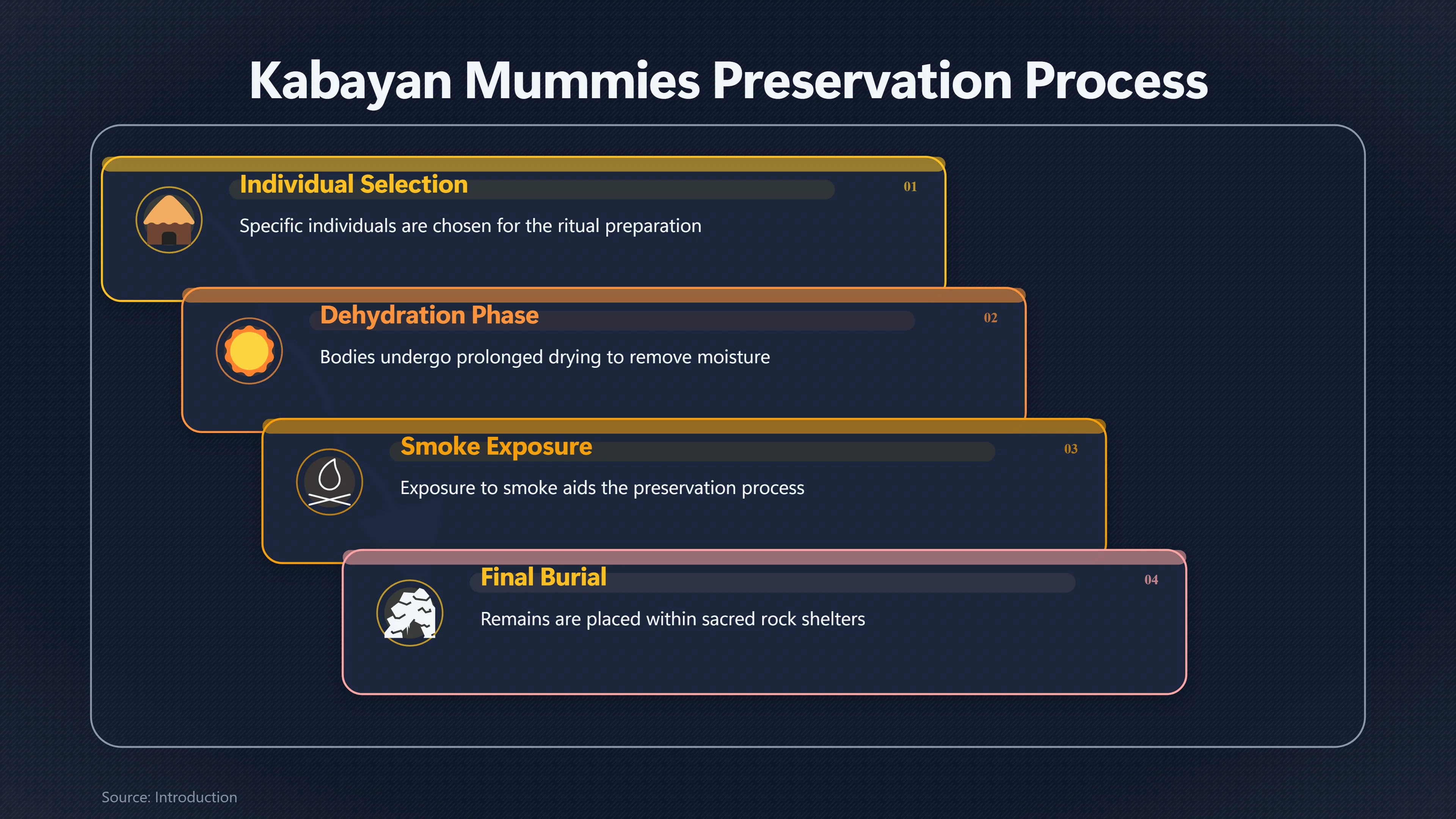
The preservation method itself contributes to the ethical debate because it demonstrates deliberate cultural practice rather than accidental preservation.
Historical accounts, archaeological research and Ibaloi oral traditions describe a lengthy preparation process in which selected individuals underwent careful drying before burial. Researchers generally agree that prolonged dehydration and exposure to smoke played major roles, although the exact sequence of techniques and substances used probably varied over time and remains the subject of scholarly discussion. Simplified tourist descriptions that present a single secret formula or “lost technology” are therefore misleading.[ISPRS Archives]isprs-archives.copernicus.orgISPRS Archives ISPRS-ArchivesISPRS ArchivesISPRS-Archives - Preventive Conservation of the Kabayan Mummies: Surveying and Environmental Monitoring to Save the Mummies…
Understanding the preservation process also changes how the bodies are viewed. They are not simply preserved corpses but the result of intentional mortuary rituals expressing status, memory and continuing relationships between the living and the dead. That cultural meaning explains why many descendants resist treating them as spectacle.
Why Access and Photography Are Restricted
Many visitors expect archaeological sites to encourage photography, but Kabayan operates under a different ethical logic.
Restrictions on access and photography exist for several overlapping reasons:
- Respect for ancestors. For many local people, photographing human remains for entertainment or social media is incompatible with their status as revered ancestors rather than museum objects.
- Physical conservation. Increased visitor traffic affects fragile cave environments through changes in humidity, temperature, dust and accidental contact.
- Security. The burial caves have suffered repeated looting, making controlled access an important protection against theft and vandalism.
- Community authority. Decisions about access increasingly recognise the views of Indigenous custodians alongside those of archaeologists and government agencies.[nationalmuseum.gov.ph]nationalmuseum.gov.phNational Museum of the Philippines Kabayan Burial Caves – National MuseumNational Museum of the Philippines Kabayan Burial Caves – National Museum
These restrictions can surprise tourists accustomed to unrestricted photography at heritage sites. However, they reflect a broader international movement towards treating Indigenous ancestral remains with dignity rather than as unrestricted visual attractions.
The distinction is particularly important in the age of social media. Images shared without context can easily transform culturally significant ancestors into “creepy” internet content, reinforcing stereotypes that local communities and museum professionals have worked to replace with more respectful interpretation.
Repatriation, Conservation and Indigenous Authority
The most important debate today is no longer whether the mummies are scientifically valuable—they clearly are—but who should make decisions about their care.
Recent conservation work has deliberately moved away from purely technical preservation towards collaborative management. Environmental monitoring projects have been carried out in partnership with Ibaloi elders, the National Museum of the Philippines and conservation specialists. Researchers have emphasised that building trust with the community is as important as measuring humidity or temperature because conservation decisions affect living cultural traditions, not simply archaeological material.[ISPRS Archives]isprs-archives.copernicus.orgISPRS Archives ISPRS-ArchivesISPRS ArchivesISPRS-Archives - Preventive Conservation of the Kabayan Mummies: Surveying and Environmental Monitoring to Save the Mummies…
Scientific monitoring has also shown why intervention must be carefully planned. The cave environments experience persistently high and fluctuating humidity, conditions that contribute to the deterioration of the mummies. Conservation therefore involves balancing natural cave conditions, visitor access and minimal intervention while respecting cultural protocols.[ISPRS Archives]isprs-archives.copernicus.orgISPRS Archives ISPRS-ArchivesISPRS ArchivesISPRS-Archives - Preventive Conservation of the Kabayan Mummies: Surveying and Environmental Monitoring to Save the Mummies…
Questions of repatriation are more nuanced than they are for many overseas museum collections because most Kabayan mummies remain within their ancestral region. The ethical issue is less about returning remains from foreign institutions than about ensuring that Indigenous communities retain meaningful authority over how ancestors are stored, interpreted, conserved and displayed. This mirrors wider international museum practice, where increasing emphasis is placed on consultation with descendant communities before displaying or researching human remains.[National Museum of Australia]nma.gov.auOpen source on nma.gov.au.

What the Kabayan Mummies Teach About Heritage
The Kabayan mummies illustrate a broader shift in how unusual collections are understood in the Philippines. Instead of asking whether they make an interesting attraction, heritage managers increasingly ask whether tourism serves the people whose ancestors are involved.
That perspective affects practical decisions about visitor numbers, interpretation, conservation priorities and photography policies. It also explains why the Kabayan Burial Caves feel fundamentally different from commercial mummy exhibitions elsewhere. Their purpose is not to maximise spectacle but to preserve both fragile human remains and an Indigenous cultural landscape whose significance continues into the present.
Within the Philippines’ landscape of unusual heritage, the Kabayan mummies therefore stand apart. Their greatest importance lies not in their rarity as preserved bodies, but in the continuing insistence that they should be understood as ancestors whose dignity shapes every decision about whether, how and by whom they are seen.[ejournals.ph]ejournals.phOpen source on ejournals.ph.
Amazon book picks
Further Reading
Books and field guides related to Are the Kabayan Mummies Exhibits or Ancestors?. Use these as the next step if you want deeper reading beyond the article.
The Archaeology of Death
The archaeology of death and burial is central to our attempts to understand vanished societies. Through the remains of funerary rituals...
András Szántó. Imagining the Future Museum
Following on the widely-read The Future of the Museum: 28 Dialogues, which explored how museums are changing through conversations with t...
The Philippines: a Past Revisited. By Renato Constantino with...
First published 1975. Subjects: History.
The Future of the Museum
First published 2021. Subjects: Art museums, History, Museums, Art museum visitors, Services for.
eBay marketplace picks
Marketplace Samples
Live-tested eBay searches with available results related to this page.
Selected fromAsian cultural art oneBay.co.uk.

Endnotes
1.
Source: nationalmuseum.gov.ph
Title: National Museum of the Philippines Kabayan Burial Caves – National Museum
Link:https://www.nationalmuseum.gov.ph/our-museums/regional-area-and-site-museums/kabayan-burial-caves/
2.
Source: isprs-archives.copernicus.org
Title: ISPRS Archives ISPRS-Archives
Link:https://isprs-archives.copernicus.org/articles/XLVIII-M-9-2025/1281/2025/
Source snippet
ISPRS ArchivesISPRS-Archives - Preventive Conservation of the Kabayan Mummies: Surveying and Environmental Monitoring to Save the Mummies...
3.
Source: ejournals.ph
Link:https://ejournals.ph/article.php?id=11189
4.
Source: nma.gov.au
Link:https://www.nma.gov.au/about/publications/repatriation-handbook/chapter-9
5.
Source: isprs-archives.copernicus.org
Title: isprs archives XLVIII M 9 2025 1281 2025 relations
Link:https://isprs-archives.copernicus.org/articles/XLVIII-M-9-2025/1281/2025/isprs-archives-XLVIII-M-9-2025-1281-2025-relations.html
Source snippet
copernicus.orgISPRS-ARCHIVES - Relations - Preventive Conservation of the Kabayan Mummies: Surveying and Environmental Monitoring to Save...
6.
Source: isprs-archives.copernicus.org
Title: isprs archives XLVIII M 9 2025 1281 2025 metrics
Link:https://isprs-archives.copernicus.org/articles/XLVIII-M-9-2025/1281/2025/isprs-archives-XLVIII-M-9-2025-1281-2025-metrics.html
Source snippet
copernicus.orgISPRS-Archives - Metrics - Preventive Conservation of the Kabayan Mummies: Surveying and Environmental Monitoring to Save t...
7.
Source: nma.gov.au
Link:https://www.nma.gov.au/about/corporate/policies/aboriginal-torres-strait-islander-human-remains
8.
Source: nma.gov.au
Title: Non-Australian indigenous human remains policy | National Museum of Australia
Link:https://www.nma.gov.au/about/corporate/policies/non-australian-indigenous-human-remains
9.
Source: nma.gov.au
Link:https://www.nma.gov.au/about/publications/repatriation-handbook/chapter-5
10.
Source: nma.gov.au
Link:https://www.nma.gov.au/about/publications/repatriation-handbook/chapter-13
11.
Source: nma.gov.au
Link:https://www.nma.gov.au/about/publications/repatriation-handbook/chapter-2
12.
Source: talapamana.ncca.gov.ph
Link:https://talapamana.ncca.gov.ph/index.php/talapamana/cultural-property-database/talapamana
13.
Source: unesco.gov.ph
Link:https://www.unesco.gov.ph/culture/
14.
Source: philmuseum.ueuo.com
Link:https://philmuseum.ueuo.com/nm_museum/nmbranch/kabayan.html
Additional References
15.
Source: researchgate.net
Link:https://www.researchgate.net/publication/396188285_Preventive_Conservation_of_the_Kabayan_Mummies_Surveying_and_Environmental_Monitoring_to_Save_the_Mummies
Source snippet
October 1, 2025 — Article PDF Available PREVENTIVE CONSERVATION OF THE KABAYAN MUMMIES: SURVEYING AND ENVIRONMENTAL MONITORING TO SAVE TH...
Published: October 1, 2025
16.
Source: doaj.org
Link:https://doaj.org/article/dd38ad4ca29c4b7883bf8673b5252e74
Source snippet
Directory of Open Access JournalsPreventive Conservation of the Kabayan Mummies: Surveying and Environmental Monitoring to Save the Mummi...
17.
Source: naturalhistory.si.edu
Link:https://naturalhistory.si.edu/research/anthropology/programs/irdp/resources/policy-international-repatriation-human-remains
Source snippet
Smithsonian Natural History MuseumPolicy for the International Repatriation of Human Remains | Smithsonian National Museum of Natural His...
18.
Source: youtube.com
Title: PHILIPPINES: BENGUET: MUMMIFIED REMAINS OF A PAST LEADER (V)
Link:https://www.youtube.com/watch?v=SR5U4HxPjCg
Source snippet
EP1: Secrets of the Fire Mummies | Philippines' Strangest Mysteries...
19.
Source: youtube.com
Title: EP1: Secrets of the Fire Mummies | Philippines’ Strangest Mysteries
Link:https://www.youtube.com/watch?v=v9_QDo5jOkk
Source snippet
Solving the Mystery of the Philippines' Fire Mummies...
20.
Source: youtube.com
Title: Why Aussie Students are Trying to Save These Ancient Mummies
Link:https://www.youtube.com/watch?v=UfO5pxLseII
Source snippet
PHILIPPINES: BENGUET: MUMMIFIED REMAINS OF A PAST LEADER (V)...
21.
Source: youtube.com
Title: PHILIPPINES: MUMMY RETURNED TO ORIGINAL RESTING PLACE
Link:https://www.youtube.com/watch?v=XXzImT0yljc
Source snippet
Why Aussie Students are Trying to Save These Ancient Mummies...
22.
Source: researchgate.net
Link:https://www.researchgate.net/publication/323705093_A_glimpse_of_the_fire_mummies_of_Kabayan_Benguet_Luzon_Philippines_and_the_role_of_plants_associated_with_the_mummification_process
23.
Source: researchgate.net
Link:https://www.researchgate.net/publication/319879052_Human_mummification_practices_among_the_Ibaloy_of_Kabayan_North_Luzon_the_Philippines
24.
Source: researchgate.net
Link:https://www.researchgate.net/publication/384009077_Fire_Mummies_of_the_Kabayan_Region_of_Benguet_Province_Luzon_the_Philippines