Within Curious South Korea
How Did Jeju's Stones Become Guardians?
Jeju Stone Park shows how volcanic rock becomes architecture, guardian imagery, folklore and a powerful expression of island identity.
On this page
- Volcanic geology as museum material
- Guardian figures, creation stories and island homes
- Heritage interpretation versus tourist mythology
Page outline Jump by section
Introduction
Jeju Stone Park is one of South Korea’s most distinctive heritage attractions because it treats volcanic rock not simply as geology, but as the foundation of an entire culture. Rather than presenting stones as scientific specimens alone, the park combines landscape, folklore, architecture, archaeology and oral tradition to explain how the island’s volcanic environment shaped everyday life and local identity. At its centre is the creation story of the giant grandmother Seolmundae Halmang, whose mythical actions are said to have formed Jeju itself. Visitors therefore encounter a place that functions simultaneously as an open-air museum, a cultural landscape and a carefully curated interpretation of how myth and physical geography became inseparable on Korea’s largest volcanic island.[visitjeju.net]visitjeju.netVisit JejuVisit JejuMay 30, 2016…
How Did Jeju’s Stones Become Guardians?
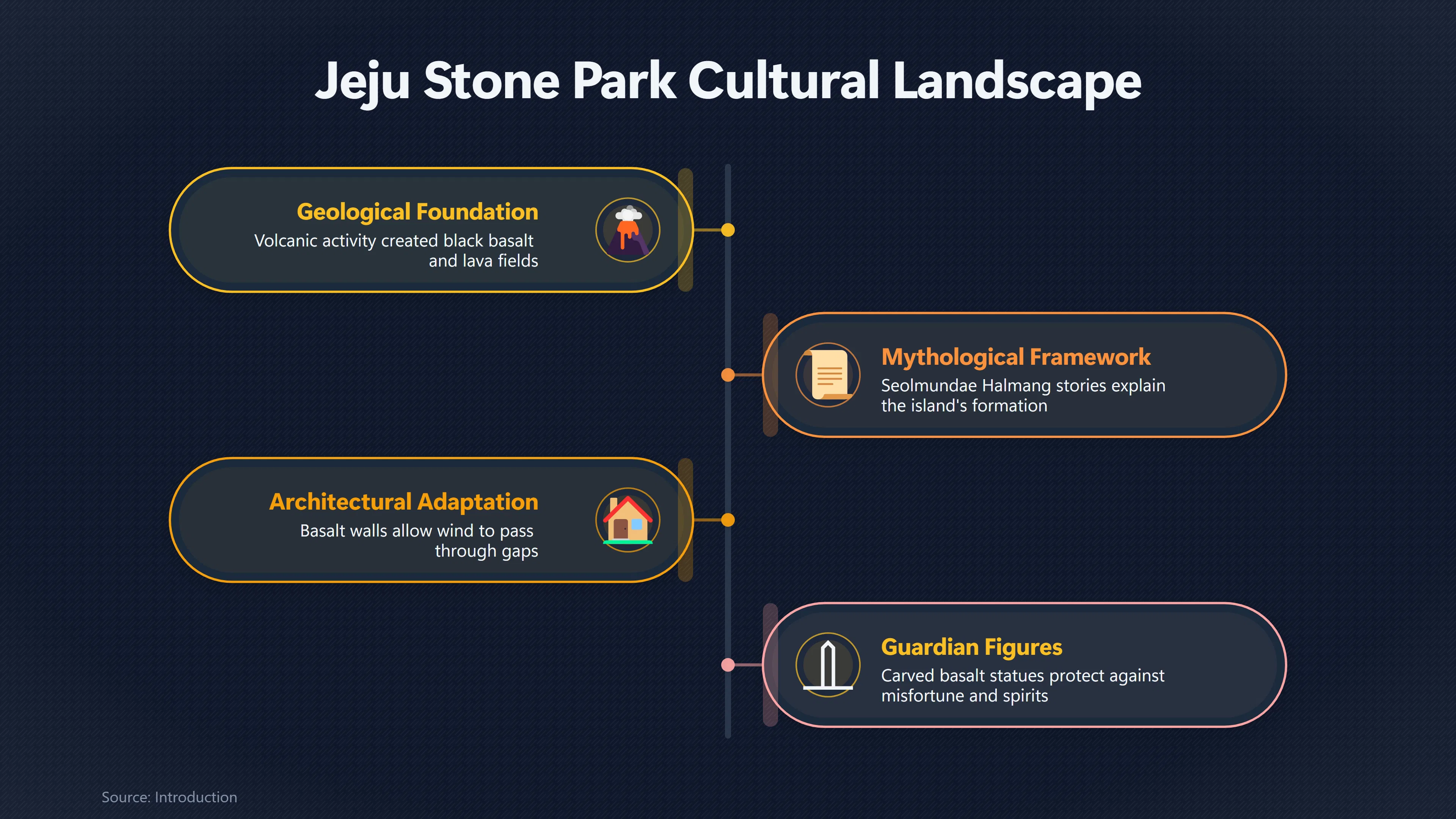
Unlike many museums devoted to folklore, Jeju Stone Park begins with the island itself. Jeju was created by volcanic activity, leaving an environment dominated by black basalt, lava fields and scattered volcanic cones. For centuries, these abundant stones became the islanders’ principal building material because timber was comparatively scarce and powerful coastal winds demanded durable construction. The park presents stone not as a decorative feature but as the material from which homes, walls, shrines, monuments and protective figures emerged.[UNESCO]unesco.orgJeju Island UNESCO Global GeoparkJeju Island UNESCO Global Geopark - International Geoscience and Geoparks Programme…
The museum’s guiding narrative revolves around Seolmundae Halmang, the legendary giant grandmother believed in Jeju tradition to have created the island and its landscape. According to the best-known versions of the story, she also became linked with the Five Hundred Generals, a tragic cycle of myths that explains unusual rock formations and gives emotional meaning to the island’s volcanic terrain. The park adopts these stories as an interpretive framework rather than presenting them as historical fact, allowing visitors to understand how oral tradition helped people explain an extraordinary landscape long before geological science described volcanic island formation.[or.kr]english.visitkorea.or.krImagine Your KoreaJeju Stone Park (제주돌문화공원)- VISITKOREA…
This approach makes the park unusual within South Korea’s museum landscape. Instead of separating natural history from folklore, it deliberately places mythology alongside geology, encouraging visitors to see how each has influenced the island’s identity.
Volcanic Geology as Museum Material
Most geological museums display minerals inside cases. Jeju Stone Park instead turns an entire volcanic landscape into part of the exhibition.
The park occupies a large area of Gotjawal forest, an ecosystem where lava flows created a rugged mixture of exposed rock, woodland and underground water channels. Rather than extensively reshaping the site, planners integrated paths, galleries and outdoor displays into this existing terrain. Around seventy per cent of the park remains natural forest, reinforcing the idea that the surrounding landscape is itself an exhibit rather than merely a setting.[VISITKOREA - Imagine Your Korea]english.visitkorea.or.krImagine Your KoreaJeju Stone Park (제주돌문화공원)- VISITKOREA…
Inside the Stone Museum, exhibitions explain how basalt influenced nearly every aspect of island life, including:
- traditional field walls built by clearing volcanic rocks from farmland;
- household architecture designed around abundant basalt;
- carved monuments and stone sculptures;
- agricultural adaptations to rocky soils;
- the symbolic importance of volcanic stone in local belief and ritual.[Visit Jeju]m.visitjeju.netOpen source on visitjeju.net.
This interpretation reflects the wider UNESCO view of Jeju as a landscape where geological heritage and cultural heritage reinforce one another. Jeju’s volcanic origin produced not only lava tubes, crater cones and dramatic cliffs, but also distinctive farming systems, stone wall networks and iconic carved figures that have become symbols of the island.[UNESCO]unesco.orgJeju Island UNESCO Global GeoparkJeju Island UNESCO Global Geopark - International Geoscience and Geoparks Programme…

Guardian Figures, Creation Stories and Island Homes
Perhaps the best-known objects associated with Jeju are the island’s carved basalt guardian statues, commonly recognised by their rounded hats and calm expressions. These figures, often called grandfather statues in English-language tourism material, have become symbols of Jeju itself.
The park brings together examples of many stone figures from across the island instead of leaving them scattered in their original locations. Seen together, they reveal considerable variation in carving style, size and purpose. Some historically marked village entrances or official sites, while others acquired reputations as protective guardians against misfortune or harmful spirits. Their precise historical origins remain debated, but their cultural importance is unquestioned, and the park presents them within the broader story of Jeju’s stone-working traditions rather than as isolated curiosities.[Visit Jeju]visitjeju.netVisit JejuVisit JejuMay 30, 2016…
Traditional Jeju houses reconstructed within the grounds demonstrate another practical consequence of volcanic geology. Basalt walls enclosed homes, fields and livestock while allowing the island’s powerful winds to pass through gaps between stones instead of toppling the structures. What might appear decorative to outsiders was largely an ingenious environmental adaptation developed over generations.[Visit Jeju]m.visitjeju.netOpen source on visitjeju.net.
Throughout these displays, the recurring message is that Jeju’s mythology emerged from lived experience. The stories do not merely decorate the landscape; they explain why particular rocks, mountains and stone formations mattered to communities whose daily survival depended upon them.
Heritage Interpretation Versus Tourist Mythology
Jeju Stone Park occupies an interesting position between heritage museum and visitor attraction.
Its dramatic sculptures, forest trails and monumental installations can easily be appreciated as a scenic destination, and tourism agencies actively promote the site as one of Jeju’s signature attractions. At the same time, the park has earned repeated recognition through South Korea’s public museum evaluation system and was developed explicitly to preserve Jeju’s stone culture rather than simply entertain visitors.[Visit Jeju]visitjeju.netVisit JejuVisit JejuMay 30, 2016…
The exhibitions also distinguish between folklore and scientific explanation. Geological displays explain the volcanic formation of Jeju using modern earth science, while mythological galleries preserve oral traditions in their own right. Rather than asking visitors to choose between myth and geology, the museum demonstrates that both are valuable: one explains physical processes, the other explains how generations of islanders understood their place within that landscape.[Visit Jeju]m.visitjeju.netOpen source on visitjeju.net.
This balanced presentation avoids treating local legends as either literal history or mere fantasy. Instead, they become cultural evidence—records of how communities interpreted an extraordinary volcanic environment long before formal geological knowledge existed.

Why It Matters Within South Korea’s Curiosity Culture
Among South Korea’s unusual heritage sites, Jeju Stone Park stands apart because its central collection is not simply a group of rare artefacts but an entire relationship between people and landscape. The basalt statues, reconstructed homes, field walls and mythological galleries all illustrate how a volcanic island generated distinctive forms of architecture, storytelling and identity.
For readers interested in strange museums and unusual collections, the park demonstrates that curiosity does not always come from bizarre objects. Sometimes the most revealing collection is one that shows how an everyday material—in this case volcanic stone—became architecture, guardian imagery, sacred narrative and a lasting symbol of regional identity. Rather than commercialising mystery, Jeju Stone Park uses mythology to illuminate the ways natural landscapes become cultural landscapes, making it one of the most thoughtful examples of folklore interpretation in South Korea.[visitjeju.net]visitjeju.netVisit JejuVisit JejuMay 30, 2016…
Amazon book picks
Further Reading
Books and field guides related to How Did Jeju's Stones Become Guardians?. Use these as the next step if you want deeper reading beyond the article.
The Invention of Tradition
Rating: 4.5/5 from 16 Google Books ratings
This book explores examples of this process of invention and addresses the complex interaction of past and present in a fascinating study...
Landscape and Memory
"Opening a radically new and original path into history, Simon Schama explores the scenery of our Western culture, both real landscapes a...
The Anthropology of Landscape: Perspectives on Place and Space
Landscape has long had a submerged presence within anthropology, both as a framing device which informs the way the anthropologist brings...
eBay marketplace picks
Marketplace Samples
Live-tested eBay searches with available results related to this page.
Selected fromKorean decor oneBay.co.uk.
Current eBay listing
Traditional Korean Hahoetal Wooden Mask Wall Decor Wall Art
Current eBay listing
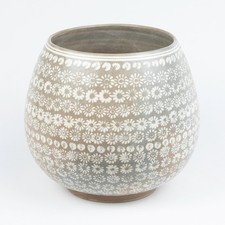
Korean Buncheong Mishima Jar with Stamped Flower Decoration
Endnotes
1.
Source: english.visitkorea.or.kr
Link:https://english.visitkorea.or.kr/svc/whereToGo/locIntrdn/rgnContentsView.do?vcontsId=76736
Source snippet
Imagine Your KoreaJeju Stone Park (제주돌문화공원)- VISITKOREA...
2.
Source: unesco.org
Title: Jeju Island UNESCO Global Geopark
Link:https://www.unesco.org/en/iggp/jeju-island-unesco-global-geopark?hub=67817
Source snippet
Jeju Island UNESCO Global Geopark - International Geoscience and Geoparks Programme...
3.
Source: korea.net
Title: A Walk Through My Hometown: JEJU Ep 1
Link:https://www.korea.net/Events/Overseas/view?articleId=13077
Source snippet
The Grandma ‘Seolmundae’: Korea.net: The official website of the Republic of KoreaFebruary 16, 2021 — A WALK THROUGH MY HOMETOWN: JEJU...
Published: February 16, 2021
4.
Source: unesco.org
Title: Shilin UNESCO Global Geopark
Link:https://www.unesco.org/en/iggp/shilin-unesco-global-geopark?hub=67817
5.
Source: unesco.org
Title: Mt Paektu UNESCO Global Geopark
Link:https://www.unesco.org/en/iggp/mt-paektu-unesco-global-geopark
6.
Source: unesco.org
Title: Cheongsong UNESCO Global Geopark
Link:https://www.unesco.org/en/iggp/cheongsong-unesco-global-geopark
7.
Source: visitjeju.net
Link:https://www.visitjeju.net/en/themtour/view?contentsid=CONT_000000000500547
Source snippet
Visit JejuVisit JejuMay 30, 2016...
Published: May 30, 2016
8.
Source: m.visitjeju.net
Link:https://m.visitjeju.net/en/themtour/view?contentsid=CNTS_200000000012527&menuId=DOM_000001832000000000
9.
Source: m.visitjeju.net
Link:https://m.visitjeju.net/en/detail/view?contentsid=CONT_000000000500547&menuId=DOM_000001817000000004
10.
Source: visitjeju.net
Link:https://visitjeju.net/en/detail/view?contentsid=CONT_000000000500547
11.
Source: m.visitjeju.net
Link:https://m.visitjeju.net/my/detail/view?contentsid=CNTS_000000000022729
12.
Source: visitjeju.net
Title: Visit Jeju
Link:https://www.visitjeju.net/my/detail/view?contentsid=CONT_000000000500547
13.
Source: m.visitjeju.net
Link:https://m.visitjeju.net/my/detail/view?contentsid=CONT_000000000500547
14.
Source: english.visitkorea.or.kr
Link:https://english.visitkorea.or.kr/svc/contents/contentsView.do?vcontsId=76736
15.
Source: english.visitkorea.or.kr
Title: visitkorea.or.kr Jeju Stone Park (제주돌문화공원)- VISITKOREA*
Link:https://english.visitkorea.or.kr/svc/whereToGo/locIntrdn/rgnContentsView.do?menuSn=351&vcontsId=76736
16.
Source: m.visitjeju.net
Link:https://m.visitjeju.net/en/detail/view?contentsid=CONT_000000000500547
19.
Source: m.visitjeju.net
Link:https://m.visitjeju.net/en/themtour/view?contentsid=CONT_000000000500547
20.
Source: visitjeju.net
Link:https://www.visitjeju.net/en/detail/view?contentsid=CONT_000000000500547&menuId=DOM_700000000010774
Additional References
21.
Source: youtube.com
Link:https://www.youtube.com/watch?v=bPYC0ME4wuY
Source snippet
Jeju Stone Park museum mythology Seolmundae Halmang The Island of Stone | Jeju Stone Park: Museum, Myths of Dol Hareubang statues & Sky P...
22.
Source: jkila.org
Title: 한국조경학회지(Journal of the Korean Institute of Landscape Architecture)
Link:https://www.jkila.org/archive/view_article?pid=jkila
Source snippet
"October 31, 2018 — J Korean Inst Landsc Archit 2018; 46(5):93-107 pISSN: 1225-1755, eISSN: 2288-9566 DOI: [https://doi.org/10.9715/KILA.20..."](https://doi.org/10.9715/KILA.20...")...
Published: October 31, 2018
23.
Source: youtube.com
Link:https://www.youtube.com/watch?v=hDvDKKVL0bE
Source snippet
Legend of mystical stones. Walking in Jeju Stone Culture Park Walking Tour & Travel Guide...
24.
Source: youtube.com
Link:https://www.youtube.com/watch?v=-bwHrmZ04Cs
Source snippet
JEJU Stone Park Full Tour Explore History, Legends & Scenic Spots...
25.
Source: kci.go.kr
Title: ci Sere Arti View.kci
Link:https://www.kci.go.kr/kciportal/ci/sereArticleSearch/ciSereArtiView.kci?sereArticleSearchBean.artiId=ART003115624
Source snippet
제주 돌문화 고찰January 1, 2024 — 제주 돌문화 고찰 CONSIDERATIONS OF JEJU’S STONE CULTURE 제주도연구 이 학술지 인용지수 조회 이 학술지 논문 검색 2024, vol.62, 통권 62호 pp...
Published: January 1, 2024
26.
Source: youtube.com
Title: Experience Stone culture of Jeju
Link:https://www.youtube.com/watch?v=6RI8tFlo1Tc
Source snippet
Jeju stone park: The legend of Jeju origin Seolmundae grandmother and her 500 sons tragedy story...
27.
Source: kf.or.kr
Link:https://www.kf.or.kr/kfEng/na/ntt/selectDgtldetailView.do?dgtlSn=6161&dgtlType=A&langTy=KOR&mi=2114
Source snippet
Arts & Media > 상세화면July 13, 2018 — A TRAILBLAZER’S DREAM COME TRUE * 조회수 6692 * 행사기간 Jul 13, 2018 - Jul 13, 2018 * 등록일 Jul 13, 2018 SPECI...
Published: July 13, 2018
28.
Source: projectjeju.kr
Link:https://www.projectjeju.kr/JejuStonePark
29.
Source: kci.go.kr
Link:https://www.kci.go.kr/kciportal/ci/sereArticleSearch/ciSereArtiView.kci?sereArticleSearchBean.artiId=ART002261378
30.
Source: kci.go.kr
Link:https://www.kci.go.kr/kciportal/ci/sereArticleSearch/ciSereArtiView.kci?sereArticleSearchBean.artiId=ART002043134