Where Are South Sudan's Strangest Objects?
South Sudan does not currently offer a well-documented circuit of witchcraft museums, medical oddity collections or commercial cabinets of curiosity. Its strangest heritage story is more fundamental: many of the country’s most remarkable objects are not displayed in South Sudan at all.
Page outline Jump by section
Introduction
That absence does not mean South Sudan lacks curiosity culture. It means that the most compelling “collection” is fragmented between an experimental travelling museum, stored objects and archives in Juba, community memories, politically charged sacred relics and large overseas ethnographic holdings. For visitors and armchair travellers, South Sudan is therefore best understood not as a destination full of eccentric museums, but as a country where the ownership, meaning and visibility of unusual objects remain unusually unsettled.
Is there a national museum to visit?
There is no firmly established, conventional national museum comparable to those in many neighbouring states. Museums serving the former unified Sudan were concentrated in Khartoum, while prolonged warfare and recurring emergencies obstructed museum building and heritage conservation in the south. South Sudanese heritage specialists have consequently debated not merely what a national museum should contain, but whether a central institution in Juba would feel relevant to people living far from the capital.[southsudanmuseumnetwork.files.wordpress.com]southsudanmuseumnetwork.files.wordpress.comssmn juba workshop report 2018ssmn juba workshop report 2018
A national museum initiative did begin in 2014, but in an unusual form. UNESCO and South Sudanese cultural authorities developed a travelling, community-based exhibition intended to gather stories rather than simply remove impressive objects from villages. Its material was to include life histories, photographs, audio and video recordings, and contributed objects. The exhibition was planned to travel through several states so that communities could discuss how they wished to be represented in any future museum.[unesco.org]unesco.orgcommunities south sudan build their national museumCommunities of South Sudan build their National Museum19 Jun 2014 — The future National Museum will be a place where the people of…
This made the project closer to a moving consultation room, oral-history archive and provisional museum than to a building full of labelled cases. That distinction matters. Some communities reportedly regarded institutional collecting with suspicion and found the idea of transferring heritage to a distant museum in Juba alien. Museum planners therefore faced a difficult question: how can endangered objects be preserved without repeating the extractive habits of colonial collectors?[southsudanmuseumnetwork.files.wordpress.com]southsudanmuseumnetwork.files.wordpress.comssmn juba workshop report 2018ssmn juba workshop report 2018
Reliable, current visitor information for a permanent national museum remains scarce. Travellers should not assume that references to the “South Sudan National Museum” describe an ordinary attraction with fixed galleries, advertised opening hours and a stable public collection. The best-documented version remains the participatory travelling initiative and the wider, unfinished ambition to create a national institution.
The hidden collection in Juba
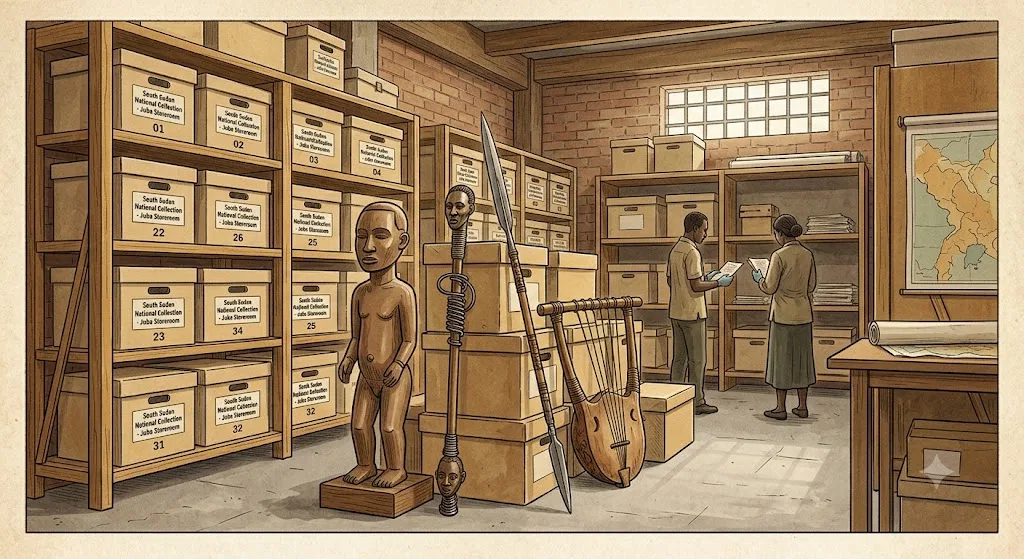
A group of material objects held in Juba has been described as a potential foundation for a future national museum. Reported holdings include spears, headrests, grave posts, paintings and musical instruments. Their importance lies not in conventional rarity alone, but in their ability to represent domestic life, artistic traditions, warfare, spiritual authority and commemoration across South Sudan’s many communities.[riftvalley.net]riftvalley.netnts is intended to form the core of South Sudan's national museum…
These objects are not known as a dependable walk-in attraction. They should be thought of as a stored national collection in waiting: culturally important, institutionally significant and potentially fascinating, but not equivalent to a fully interpreted public museum. Documentation also warns against assuming that an object has one simple ethnic or functional identity. A spear might be a weapon, prestige object, performance prop, inheritance or ritual instrument depending on its history and setting.
The collection’s grave posts are especially relevant to strange-museum enthusiasts. Monumental wooden figures made by Bongo communities in western South Sudan were erected around the graves of notable people. Some examples took simplified human form, while other carved posts recorded animals killed by the deceased, turning a burial place into a sculptural account of reputation and achievement.[The Metropolitan Museum of Art]metmuseum.orgThe Metropolitan Museum of Art Bongo artistThe Metropolitan Museum of Art Bongo artist
Surviving grave figures are now scattered. The British Museum holds a nearly life-sized wooden female figure dated broadly to between 1880 and 1920, while the Metropolitan Museum of Art and Pitt Rivers Museum document related funerary sculpture and photography. These objects may look uncanny when isolated in Western galleries, but they were not originally made as generic “tribal curiosities”. They belonged to specific memorial landscapes and relationships with the dead.[metmuseum.org]metmuseum.orgThe Metropolitan Museum of Art Bongo artistThe Metropolitan Museum of Art Bongo artist
The prophet’s rod: sacred relic or political trophy?
The most striking individual curiosity associated with modern South Sudan is the ceremonial rod of the Nuer prophet Ngundeng Bong. Usually called the prophet’s rod in English-language accounts, it combines the qualities of sacred relic, anti-colonial trophy, political symbol and disputed heritage object. It was taken during the colonial era, later found in private hands in Britain and returned to southern Sudan in 2009 by historian Douglas Johnson.[riftvalley.net]riftvalley.netOpen source on riftvalley.net.
Its return was not staged as an ordinary museum acquisition. It was received in Juba by Riek Machar, then vice-president, amid public celebration and ritual. Accounts describe an ox being slaughtered and the rod being displayed before political and community leaders. Rather than entering a transparent public collection, it was reportedly kept by Machar and disappeared from ordinary public view. Its precise current whereabouts have remained unclear.[riftvalley.net]riftvalley.netOpen source on riftvalley.net.
Beliefs surrounding the rod are inseparable from Ngundeng’s reputation as a prophet credited by followers with supernatural powers and predictions. Modern political narratives have linked the relic to claims that a destined leader would fulfil Ngundeng’s prophecies. Such interpretations are matters of belief and political mobilisation, not verifiable evidence that the object possesses magical powers. Yet the belief itself is historically consequential: a sacred object can shape legitimacy, allegiance and fear whether or not its supernatural reputation is accepted.[Martin Plaut]martinplaut.comMartin Plaut South Sudan: Riek Machar and the prophet's rodMartin Plaut South Sudan: Riek Machar and the prophet's rod
For a museum, the rod would be extraordinarily difficult to display responsibly. Presenting it merely as an ethnographic artefact would flatten its spiritual meaning. Marketing it as a magical object would sensationalise living belief. Treating it only as political propaganda would ignore its older religious history. It is a vivid example of why South Sudan’s unusual heritage cannot always be placed safely behind glass.
The national archive as a cabinet of government memory
The National Archives of South Sudan is not an oddity museum, but it may be the country’s most important surviving collection. Its records span colonial administration, Sudanese independence, regional government and successive civil wars. They include district reports, official correspondence, handover notes, inspection records, administrative diaries and other documents that are sometimes the only detailed evidence of local government activity in particular areas.[riftvalley.net]riftvalley.netnational archive south sudannational archive south sudan
The archive has itself had an unusually precarious history. Records were dispersed, exposed to heat, flooding, insects and neglect, and in some cases destroyed during conflict. Emergency conservation after 2005 involved gathering papers from scattered storage locations, sorting them and placing them in archival boxes. Later projects trained local staff and digitised vulnerable material.[National Geographic]nationalgeographic.comsouth sudan archivessouth sudan archives
Almost half of the documentary holdings have reportedly been digitised through the South Sudan National Archives programme. Online catalogues and the Sudan Memory platform provide a partial route into material that would otherwise be difficult for the public to see. The result is a form of digital curiosity cabinet: not a collection of monsters or occult devices, but a mass of fragile paperwork through which vanished districts, officials, disputes and everyday colonial assumptions become visible.[sudanmemory.org]sudanmemory.orgOpen source on sudanmemory.org.
Access for ordinary visitors should not be taken for granted. National archives are working research institutions, and opening arrangements, permissions and physical conditions can change. Anyone hoping to consult the collection in Juba needs direct confirmation from the relevant ministry or archive staff rather than relying on tourist listings.
South Sudan’s museums are largely overseas
The country’s largest accessible museum resource is outside its borders. The Pitt Rivers Museum in Oxford holds more than 1,300 artefacts and approximately 5,000 historic photographs from the former southern Sudan. Its dedicated online catalogue allows users to explore objects, collectors, locations and photographic records in far greater detail than is presently possible through a public museum in South Sudan.[southernsudan.prm.ox.ac.uk]southernsudan.prm.ox.ac.ukOpen source on ox.ac.uk.
Other substantial holdings exist in institutions including the British Museum, Cambridge’s Museum of Archaeology and Anthropology, Durham University’s Sudan Archive, the Weltmuseum in Vienna and additional collections across Europe, Russia and beyond. A research network was established specifically because these holdings form a large but underused source for South Sudanese history, artistic practice and international connections.[wordpress.com]southsudanmuseumnetwork.wordpress.comOpen source on wordpress.com.
Visitors browsing these collections may encounter:
- carved grave figures and commemorative posts;[southernsudan.prm.ox.ac.uk]southernsudan.prm.ox.ac.ukSource details in endnotes.
- spears, shields and other weapons;
- headrests and household furnishings;
- beadwork, jewellery and clothing;
- drums and other musical instruments;
- ritual or chiefly regalia;
- early photographs of ceremonies, settlements and daily life.
The strangest feature is not any single object but the geography of the collection. South Sudanese people often have to travel abroad, or use foreign museum websites, to see some of the oldest surviving material connected to their own communities. Researchers describe this as a diaspora of objects: heritage detached from its place of origin and preserved within institutions created through European systems of collecting and classification.[sidestone.com]sidestone.comOpen source on sidestone.com.
How credible are the old labels?
Historic ethnographic catalogues are valuable but not neutral. Many South Sudanese objects entered European collections during periods of slave trading, military conquest, missionary expansion and colonial administration. Some were bought or exchanged; others were taken under coercive circumstances or recorded so poorly that their acquisition history remains uncertain.[riftvalley.net]riftvalley.netnts is intended to form the core of South Sudan's national museum…
Old museum descriptions frequently prioritised the collector rather than the maker. Individual African artists were often left unnamed, while objects were assigned broad ethnic labels that made cultures appear static and neatly bounded. Cambridge’s Museum of Archaeology and Anthropology notes how unusual it is for the maker of a nineteenth- or early twentieth-century African object to be recorded at all.[Museum of Archaeology and Anthropology]maa.cam.ac.ukOpen source on cam.ac.uk.
Photographs also require caution. An image may preserve details of a sculpture, shrine or ceremony that no longer survives, but its caption may reflect the assumptions of an anthropologist or colonial official. A catalogue statement such as “ritual object” or “witch doctor’s equipment” should therefore not be repeated uncritically. Good contemporary interpretation asks who supplied the description, whether community knowledge supports it and how the object’s meaning may have changed.
This is particularly important for readers drawn to occult or supernatural material. South Sudanese prophetic objects, divination practices and memorial sculptures are not equivalents of European horror props. Their significance belongs to living religious, political and social histories. The intellectually interesting question is not “Did people really believe this strange thing?” but who regarded it as powerful, how that power was expressed and what happened when the object was collected or removed.
What can a curious visitor realistically see?
South Sudan’s unusual collections are currently more accessible as a research trail than as a conventional tourist itinerary. A visitor should expect fragmented access and verify every institution directly.
In Juba, the National Archives is the most clearly documented heritage institution, although it is principally an archive rather than a museum. The stored object collection intended for a future national museum is culturally important but should not be assumed to be publicly displayed. References to the travelling national museum describe a community project, not necessarily a continuously operating exhibition with a permanent address.[sudanmemory.org]sudanmemory.orgOpen source on sudanmemory.org.
Online, the Pitt Rivers Museum’s Southern Sudan catalogue provides the richest object-by-object experience. The South Sudan Museum Network also directs users towards collections in several countries, while the National Archives catalogue and Sudan Memory platform offer documentary material.[wordpress.com]southsudanmuseumnetwork.wordpress.comOpen source on wordpress.com.
Outside South Sudan, museums in Oxford, London, Cambridge, Durham and Vienna provide opportunities to see original objects, though not all South Sudanese holdings are on permanent display. Online database entries are often more dependable than general gallery descriptions because displays rotate and objects may remain in storage.
Current security and transport conditions must take priority over heritage tourism. Local access can be affected by political tension, institutional resources and sudden changes in public administration. Specialist travel advice and direct institutional confirmation are essential before attempting any visit.
Why the absence matters
South Sudan’s strange-history landscape is defined by a paradox. The country possesses objects with exceptional stories—prophetic relics, monumental grave sculpture, colonial trophies, historic photographs and rescued archival papers—but lacks a stable public system for bringing them together. The resulting gaps are not empty spaces. They reveal how war, colonial collecting, political rivalry and limited infrastructure determine what becomes visible as “heritage”.[sidestone.com]sidestone.comOpen source on sidestone.com.
A future national museum could become far more than a storehouse. South Sudanese heritage discussions have imagined museums as places for education, inter-community dialogue, artistic experimentation and peacebuilding. At the same time, participants have warned that an encyclopaedic display dividing the population into fixed ethnic groups could reproduce colonial categories or deepen arguments over representation.[southsudanmuseumnetwork.files.wordpress.com]southsudanmuseumnetwork.files.wordpress.comssmn juba workshop report 2018ssmn juba workshop report 2018
The most promising model may therefore be distributed rather than monumental: regional displays, travelling exhibitions, digital access, community-controlled documentation and selective loans from overseas collections. Such an approach would fit South Sudan’s geography while allowing objects to be interpreted by the people whose histories they carry.
For enthusiasts of unusual museums, South Sudan offers no easy gallery of curiosities. It offers something rarer: an unfinished national collection whose most evocative objects remain scattered, contested, hidden, sacred or politically dangerous. The curiosity lies as much in their journeys and absences as in the things themselves.
Amazon book picks
Further Reading
Books and field guides related to Where Are South Sudan's Strangest Objects?. Use these as the next step if you want deeper reading beyond the article.
The Brutish Museums: The Benin Bronzes, Colonial Violence and...
New York Times 'Best Art Books' 2020 'Essential' – Sunday Times 'Brilliantly enraged' - New York Review of Books 'A real game-changer'– E...
The Museum of Other People: From Colonial Acquisitions to Cos...
A TLS BEST BOOK OF 2023 'A formidable work' Nigel Barley, author of The Innocent Anthropologist 'Should be required reading' Richard Lamb...
Silencing the Past
Rating: 4.5/5 from 5 Google Books ratings
Silencing the Past is a thought-provoking analysis of historical narrative. Taking examples ranging from the Haitian Revolution to Columb...
The Art of Not Being Governed
From the acclaimed author and scholar James C. Scott, the compelling tale of Asian peoples who until recently have stemmed the vast tide...
eBay marketplace picks
Marketplace Samples
Live-tested eBay searches with available results related to this page.
Selected fromSouth Sudan art print oneBay.co.uk.
Endnotes
1.
Source: unesco.org
Title: communities south sudan build their national museum
Link:https://www.unesco.org/en/articles/communities-south-sudan-build-their-national-museum
Source snippet
Communities of South Sudan build their National Museum19 Jun 2014 — The future National Museum will be a place where the people of...
2.
Source: riftvalley.net
Link:https://riftvalley.net/news/sudan-and-south-sudan/south-sudan-diaspora-objects-and-future-tradition/
Source snippet
nts is intended to form the core of South Sudan's national museum...
3.
Source: sidestone.com
Link:https://www.sidestone.com/openaccess/9789464260120.pdf
4.
Source: southsudanmuseumnetwork.files.wordpress.com
Title: ssmn juba workshop report 2018
Link:https://southsudanmuseumnetwork.files.wordpress.com/2018/12/ssmn-juba-workshop-report-2018.pdf
5.
Source: unmiss.unmissions.org
Title: To date, communities have contributed
Link:https://unmiss.unmissions.org/en/news/mobile-exhibition-create-south-sudan-museum
Source snippet
Mobile exhibition to create South Sudan museum23 Jun 2014 — The collection will consist of videos, audio recordings, life stories, photog...
6.
Source: southsudanmuseumnetwork.files.wordpress.com
Title: ssmn workshop 2 report 20aug 2018
Link:https://southsudanmuseumnetwork.files.wordpress.com/2018/11/ssmn-workshop-2-report-20aug-2018.pdf
Source snippet
Working with South Sudanese museum collections26 Nov 2018 — It was envisaged by UNESCO as an institution that would tell the story of the...
7.
Source: southernsudan.prm.ox.ac.uk
Link:https://southernsudan.prm.ox.ac.uk/details/1998.343.13.2/
8.
Source: southernsudan.prm.ox.ac.uk
Link:https://southernsudan.prm.ox.ac.uk/details/1967.26.198/index.html
9.
Source: riftvalley.net
Link:https://riftvalley.net/news/sudan-and-south-sudan/fate-ngungdengs-dang/
10.
Source: riftvalley.net
Title: national archive south sudan
Link:https://riftvalley.net/projects/sudan-and-south-sudan/national-archive-south-sudan/
11.
Source: sudanmemory.org
Link:https://www.sudanmemory.org/cms/102/
12.
Source: mcmnh.gov.ss
Link:https://mcmnh.gov.ss/
13.
Source: southernsudan.prm.ox.ac.uk
Link:https://southernsudan.prm.ox.ac.uk/
14.
Source: southsudanmuseumnetwork.wordpress.com
Link:https://southsudanmuseumnetwork.wordpress.com/
15.
Source: southsudanmuseumnetwork.wordpress.com
Title: biea 2005 workshop on southern sudan cultural heritage report
Link:https://southsudanmuseumnetwork.wordpress.com/wp-content/uploads/2017/02/biea-2005-workshop-on-southern-sudan-cultural-heritage-report.pdf
16.
Source: southsudanmuseumnetwork.wordpress.com
Link:https://southsudanmuseumnetwork.wordpress.com/blog/
17.
Source: southsudanmuseumnetwork.files.wordpress.com
Link:https://southsudanmuseumnetwork.files.wordpress.com/2019/01/southsudanobjectsv3.pdf
18.
Source: unesco.org
Link:https://www.unesco.org/en/articles/sudan-unesco-raises-alarm-reports-illicit-trafficking-cultural-heritage
19.
Source: unesdoc.unesco.org
Link:https://unesdoc.unesco.org/ark%3A/48223/pf0000011589
20.
Source: unesdoc.unesco.org
Link:https://unesdoc.unesco.org/ark%3A/48223/pf0000071669
21.
Source: unesdoc.unesco.org
Link:https://unesdoc.unesco.org/ark%3A/48223/pf0000395199.locale%3Den
22.
Source: ich.unesco.org
Title: digitization of sudan folklore and traditional music archives 00046
Link:https://ich.unesco.org/en/news/digitization-of-sudan-folklore-and-traditional-music-archives-00046
23.
Source: unesdoc.unesco.org
Link:https://unesdoc.unesco.org/ark%3A/48223/pf0000012419
24.
Source: unesdoc.unesco.org
Link:https://unesdoc.unesco.org/ark%3A/48223/pf0000081783
25.
Source: unesdoc.unesco.org
Link:https://unesdoc.unesco.org/ark%3A/48223/pf0000260771
26.
Source: ich.unesco.org
Title: 00137 EN
Link:https://ich.unesco.org/doc/src/00137-EN.pdf?v=1268152629
27.
Source: unesdoc.unesco.org
Link:https://unesdoc.unesco.org/ark%3A/48223/pf0000084387
28.
Source: unesdoc.unesco.org
Link:https://unesdoc.unesco.org/ark%3A/48223/pf0000048158
29.
Source: unesdoc.unesco.org
Link:https://unesdoc.unesco.org/ark%3A/48223/pf0000016112
30.
Source: unesdoc.unesco.org
Link:https://unesdoc.unesco.org/ark%3A/48223/pf0000036190
31.
Source: unesco.org
Title: renewing commitment sudans national museum
Link:https://www.unesco.org/en/articles/renewing-commitment-sudans-national-museum
32.
Source: mcmnh.gov.ss
Title: stages in the development of the national archives
Link:https://mcmnh.gov.ss/stages-in-the-development-of-the-national-archives/
33.
Source: sudanmemory.org
Link:https://www.sudanmemory.org/collections/
34.
Source: youtube.com
Title: UNESCO and South Sudan National Archives Safeguards South Sudan’s History
Link:https://www.youtube.com/watch?v=kcVOGfI2vrM
Source snippet
Zande Field Recordings in South Sudan by Evans Pritchard 1928 1930 Wax Cylinders...
35.
Source: unesco-hist.org
Link:https://www.unesco-hist.org/index.php?id=691&r=en%2Farticle%2Finfo
Source snippet
The team of local resource people that was...Read more...
36.
Source: metmuseum.org
Title: The Metropolitan Museum of Art Bongo artist
Link:https://www.metmuseum.org/art/collection/search/309909
37.
Source: britishmuseum.org
Link:https://www.britishmuseum.org/collection/object/E_Af1973
38.
Source: martinplaut.com
Title: Martin Plaut South Sudan: Riek Machar and the prophet’s rod
Link:https://martinplaut.com/2014/03/06/south-sudan-riek-machar-and-the-prophets-rod/
39.
Source: nationalgeographic.com
Title: south sudan archives
Link:https://www.nationalgeographic.com/history/article/south-sudan-archives
40.
Source: weltmuseumwien.at
Link:https://www.weltmuseumwien.at/en/research/projects/south-sudan-museums-network
41.
Source: gtr.ukri.org
Link:https://gtr.ukri.org/projects?ref=AH%2FP006914%2F1
42.
Source: maa.cam.ac.uk
Link:https://maa.cam.ac.uk/sudan-and-south-sudan-objects-power-and-contested-power
43.
Source: britishmuseum.org
Link:https://www.britishmuseum.org/collection/galleries/living-and-dying/sudan-conflict-community-care
44.
Source: Wikipedia
Title: South Sudan National Museum
Link:https://en.wikipedia.org/wiki/South_Sudan_National_Museum
45.
Source: Wikipedia
Title: National Archives of South Sudan
Link:https://en.wikipedia.org/wiki/National_Archives_of_South_Sudan
46.
Source: Wikipedia
Title: Ngundeng Bong
Link:https://en.wikipedia.org/wiki/Ngundeng_Bong
47.
Source: metmuseum.org
Title: bongo commemorative post ngya
Link:https://www.metmuseum.org/perspectives/bongo-commemorative-post-ngya
Additional References
48.
Source: apnews.com
Link:https://apnews.com/article/e2300925846a694731e7627bb7a2f04e
Source snippet
The rivalry between Kiir and Machar, rooted in ethnic divisions, sparked a civil war in 2013 that killed an estimated 400,000 people. Alt...
49.
Source: youtube.com
Link:https://www.youtube.com/watch?v=vqF6jH_qp9E
Source snippet
South Sudan National Heritage: Volo Community Fighting for Cultural Preservation...
50.
Source: youtube.com
Title: South Sudan National Heritage: Volo Community Fighting for Cultural Preservation
Link:https://www.youtube.com/watch?v=0TI8adRLRZs
Source snippet
Marlin John Serefino | South Sudan Women's Research Network...
51.
Source: youtube.com
Title: Marlin John Serefino | South Sudan Women’s Research Network
Link:https://www.youtube.com/watch?v=pXdrW_NwUsg
Source snippet
Communities unite in Eastern Equatoria to celebrate South Sudan's cultural diversity...
52.
Source: facebook.com
Link:https://www.facebook.com/UnitedNationsMissionInSouthSudan/posts/southsudan-has-a-rich-unique-heritage-from-the-unmiss-archives-a-cultural-perfor/4216236961785276/
53.
Source: artkhade.com
Link:https://www.artkhade.com/en/object/3BGQOQAA/a-bongo-funerary-post-south-sudan
54.
Source: facebook.com
Link:https://www.facebook.com/groups/1563241777299414/posts/2837708719852707/
55.
Source: bernarddegrunne.com
Link:https://www.bernarddegrunne.com/usr/library/documents/publications1/bongo-bernard-de-grunne-tefaf-2011.pdf
56.
Source: facebook.com
Link:https://www.facebook.com/100088376213424/posts/ministry-of-culture-museums-and-national-heritage-with-support-from-unesco-celeb/421934127429124/
57.
Source: scribd.com
Link:https://www.scribd.com/document/269789926/What-are-the-Prophecies-of-NGUNDENG-BONG-docx