Within Tunisia Curiosities
The Ancient Mysteries Inside Tunisia's Bardo Museum
The Bardo Museum reveals Tunisia's ancient worlds through Punic objects, Roman mosaics, and artefacts linked to forgotten beliefs.
On this page
- Punic masks and protective symbols
- Roman mosaics and mythological worlds
- How archaeology separates fact from legend
Page outline Jump by section
Introduction
The Bardo National Museum in Tunis is not a museum of mysteries in the supernatural sense, but it preserves objects that reveal how ancient people explained danger, protection, the gods, death, and the forces shaping daily life. Its most intriguing artefacts include Punic terracotta masks from Carthage, religious objects connected with ancient North African cults, and Roman mosaics filled with mythological scenes. Together they show a Mediterranean world where art, belief, and identity were closely connected.[Livius]livius.orgTunis, Musée du BardoTunis, Musée du Bardo - LiviusAugust 6, 2020…
For visitors interested in strange history, the Bardo’s appeal lies in the gap between modern impressions and archaeological evidence. A frightening-looking mask may appear like an object of magic or fear, while a huge mosaic of Neptune or Odysseus may seem like decoration alone. Archaeology reveals something more complex: these objects belonged to systems of belief in which images could protect homes, honour gods, express status, and preserve stories about humanity’s place in the universe.[Smithsonian Magazine]smithsonianmag.comSmithsonian Magazine Explore the World's Largest Collection of Roman MosaicsSmithsonian Magazine Explore the World's Largest Collection of Roman Mosaics
Punic masks and protective symbols
Why do the Bardo’s ancient masks look so mysterious?
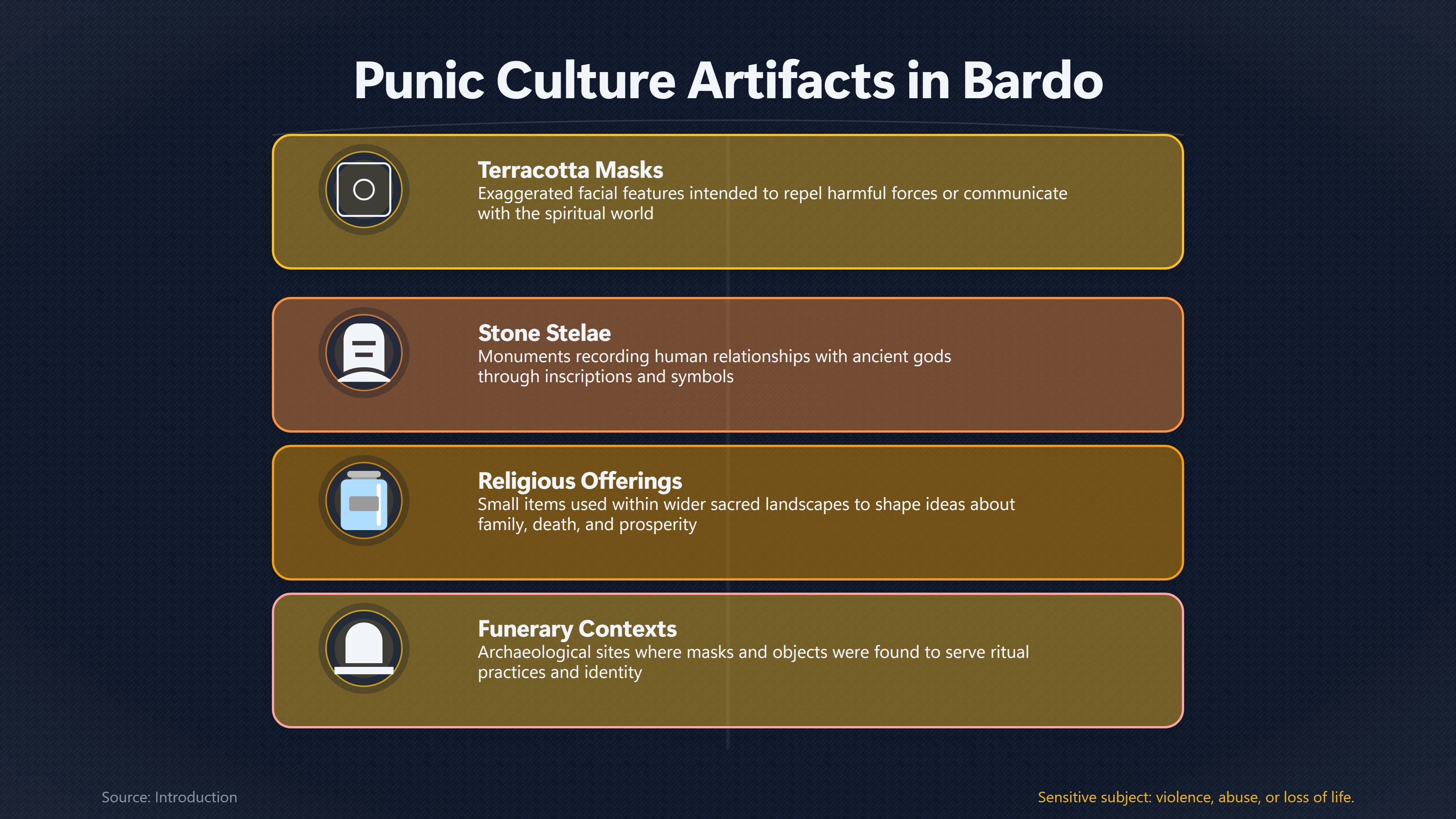
Among the Bardo Museum’s most memorable objects are Punic terracotta masks from the ancient city of Carthage. Their exaggerated expressions — wide eyes, unusual features, and almost theatrical faces — make them some of Tunisia’s most recognisable archaeological objects. They are often described in popular accounts as “mysterious” artefacts because their exact purpose is still debated.[Livius]livius.orgTunis, Musée du BardoTunis, Musée du Bardo - LiviusAugust 6, 2020…
These masks belonged to the Punic culture of Carthage, a civilisation founded by Phoenician settlers that became one of the major powers of the ancient Mediterranean. Archaeologists have found masks in funerary and sacred contexts, and they are generally interpreted as objects connected with ritual practice, identity, and protection. Their strange appearance may have been intended to repel harmful forces or communicate with the spiritual world rather than simply represent realistic human faces.[Man.es]man.esuseum Alaoui / Bardo National MuseumMinisterio de Cultura…
The idea of a protective object was common across the ancient Mediterranean. People did not always separate art, religion, and everyday security in the modern way. An image placed near a burial, sanctuary, or household could carry symbolic power. However, the evidence does not support every dramatic claim made about Punic objects online. Interpretations of ancient religious practices, including controversial subjects such as sacrifice, remain debated among historians and archaeologists rather than being settled by the appearance of a single artefact.[Reddit]reddit.comA punic terracotta mask from Carthage, used to ward off evil spirits. 6th century BC, now on display at the National Museum of Bard…
Stelae, offerings, and forgotten religious worlds
The Bardo also preserves Punic stelae and other objects connected with Carthaginian religious life. These stone monuments are valuable because they show how ancient communities recorded relationships between humans and their gods through inscriptions, symbols, and images.[Man.es]man.esuseum Alaoui / Bardo National MuseumMinisterio de Cultura…
One of the most important themes behind these objects is that ancient belief systems were not only about temples and ceremonies. They shaped ideas about family, death, protection, prosperity, and social identity. A modern visitor may see a small terracotta object or carved stone and wonder why it mattered; the archaeological context shows that such objects were part of a wider religious landscape.
Roman mosaics and mythological worlds
How did Roman art preserve ancient beliefs?
The Bardo Museum is especially famous for its Roman mosaics, among the largest and most important collections of ancient mosaics anywhere in the world. These works were not simply decorative flooring. In wealthy Roman houses and public buildings, mosaics could communicate education, wealth, religious ideas, and knowledge of famous myths.[Smithsonian Magazine]smithsonianmag.comSmithsonian Magazine Explore the World's Largest Collection of Roman MosaicsSmithsonian Magazine Explore the World's Largest Collection of Roman Mosaics
Many Bardo mosaics show gods, heroes, and legendary scenes. A visitor can encounter images connected with Neptune, Venus, Dionysus, hunting traditions, sea creatures, and episodes from Greek mythology adopted into Roman culture. These scenes reveal a world where myths were not distant stories but part of the visual language of elite life.[Smithsonian Magazine]smithsonianmag.comSmithsonian Magazine Explore the World's Largest Collection of Roman MosaicsSmithsonian Magazine Explore the World's Largest Collection of Roman Mosaics
A particularly striking example is the large Neptune and Venus mosaic from Utica. Such images reflected ideas about the power of the sea, fertility, prosperity, and harmony between natural forces and divine figures. Neptune was not simply a character from a story; gods represented aspects of the world that people believed influenced agriculture, travel, weather, and human fortune.[Wikimedia Commons]commons.wikimedia.orgWikimedia CommonsCategory:Triumph of Neptunus and Venus mosaic in the Bardo National Museum - Wikimedia Commons…
The Odyssey and mythology as visual storytelling
Another fascinating group of Roman works at the Bardo uses mythology as a form of storytelling. Scenes from Homer’s Odyssey, including the episode of Odysseus and the Sirens, transformed ancient literature into household imagery. The story of resisting temptation and surviving danger carried moral and cultural meaning as well as artistic appeal.[Reddit]reddit.comA portion of a Roman mosaic depicting Odysseus/Ulysses in the Bardo Museum3 days ago…
The museum’s mosaics therefore act almost like ancient illustrated books. They preserve stories that shaped Mediterranean civilisation while also revealing what Roman North Africans valued: education, heroic examples, divine protection, entertainment, and connection with a wider Mediterranean culture.[Smithsonian Magazine]smithsonianmag.comSmithsonian Magazine Explore the World's Largest Collection of Roman MosaicsSmithsonian Magazine Explore the World's Largest Collection of Roman Mosaics
How archaeology separates fact from legend
Ancient beliefs are real; supernatural claims need evidence
The Bardo Museum attracts curiosity because some objects appear to belong to a world of magic, curses, and forgotten rituals. The archaeological reality is more interesting because it does not require supernatural explanations. A protective symbol tells us that people believed images could influence their relationship with danger and the divine. A mythological mosaic shows how stories shaped identity and imagination.[Livius]livius.orgTunis, Musée du BardoTunis, Musée du Bardo - LiviusAugust 6, 2020…
Museums such as the Bardo work by placing objects within evidence: where they were found, what materials they contain, how they compare with similar objects, and what historical texts or inscriptions reveal. This approach does not dismiss ancient beliefs; instead, it explains how those beliefs operated in their own societies.
Why the Bardo matters in Tunisia’s strange-history landscape
The Bardo’s unusual quality comes from the fact that its “mysteries” are genuine historical puzzles rather than invented curiosities. Visitors are confronted with objects that once carried emotional and spiritual meaning but now survive mainly as archaeological evidence. The challenge is to understand them without turning them into legends detached from their original context.[American Journal of Archaeology]ajaonline.orgreopened bardo national museum tunisiaAmerican Journal of ArchaeologyThe Reopened Bardo National Museum in Tunis, Tunisia | July 2026 (130.3) | American Journal of Archaeology…
The museum’s collections connect several layers of Tunisia’s past: Punic religion, Roman mythology, North African artistic traditions, and the changing beliefs of later periods. Its most fascinating artefacts are not mysterious because they are unexplained; they are fascinating because they reveal how different societies tried to understand life, death, protection, and the unseen forces they believed surrounded them.[Man.es]man.esuseum Alaoui / Bardo National MuseumMinisterio de Cultura…
Amazon book picks
Further Reading
Books and field guides related to The Ancient Mysteries Inside Tunisia's Bardo Museum. Use these as the next step if you want deeper reading beyond the article.
Roman Art
Traditional studies of Roman art have sought to identify an indigenous style distinct from Greek art and in the process have neglected th...
The Oxford History of the Roman World
In less than fifty-three years, Rome subjected most of the known world to its rule. This authoritative and compelling work tells the stor...
The Phoenicians and the West
This updated version of Maria Eugenia Aubet's highly praised book (1993) incorporates the most recent research findings on the ancient ci...
eBay marketplace picks
Marketplace Samples
Live-tested eBay searches with available results related to this page.
Selected fromancient Egypt decor oneBay.co.uk.
Endnotes
1.
Source: livius.org
Title: Tunis, Musée du Bardo
Link:https://www.livius.org/museum/tunis-bardo-museum/
Source snippet
Tunis, Musée du Bardo - LiviusAugust 6, 2020...
Published: August 6, 2020
2.
Source: man.es
Title: useum Alaoui / Bardo National Museum
Link:https://www.man.es/man/en/coleccion/catalogos-tematicos/tunez/monumentosra/mnbardo.html
Source snippet
Ministerio de Cultura...
3.
Source: reddit.com
Link:https://www.reddit.com/r/ArtefactPorn/comments/hln9ij/a_punic_terracotta_mask_from_carthage_used_to/
Source snippet
A punic terracotta mask from Carthage, used to ward off evil spirits. 6th century BC, now on display at the National Museum of Bard...
4.
Source: commons.wikimedia.org
Link:https://commons.wikimedia.org/wiki/Category%3ATriumph_of_Neptunus_and_Venus_mosaic_in_the_Bardo_National_Museum
Source snippet
Wikimedia CommonsCategory:Triumph of Neptunus and Venus mosaic in the Bardo National Museum - Wikimedia Commons...
5.
Source: reddit.com
Link:https://www.reddit.com/r/ancientrome/comments/1v091mt/a_portion_of_a_roman_mosaic_depicting/
Source snippet
A portion of a Roman mosaic depicting Odysseus/Ulysses in the Bardo Museum3 days ago...
6.
Source: commons.wikimedia.org
Title: Category:Ancient Roman mosaics in the Bardo National Museum
Link:https://commons.wikimedia.org/wiki/Category%3AAncient_Roman_mosaics_in_the_Bardo_National_Museum
7.
Source: commons.wikimedia.org
Title: Category:Collections of the Bardo National Museum
Link:https://commons.wikimedia.org/wiki/Category%3ACollections_of_the_Bardo_National_Museum
8.
Source: commons.wikimedia.org
Title: Category:Roman antiquities collections in the Bardo National Museum
Link:https://commons.wikimedia.org/wiki/Category%3ARoman_antiquities_collections_in_the_Bardo_National_Museum
9.
Source: commons.wikimedia.org
Title: Category:Punic masks in the Bardo National Museum
Link:https://commons.wikimedia.org/wiki/Category%3APunic_masks_in_the_Bardo_National_Museum
10.
Source: commons.wikimedia.org
Title: Category:Mosaics in the Bardo National Museum
Link:https://commons.wikimedia.org/wiki/Category%3AMosaics_in_the_Bardo_National_Museum
11.
Source: commons.wikimedia.org
Title: File:A mosaic Bardo Museum (7).JPG
Link:https://commons.wikimedia.org/wiki/File%3AA_mosaic_BardoMuseum_%287%29.JPG
12.
Source: commons.wikimedia.org
Title: File:A mosaic Bardo Museum (8).JPG
Link:https://commons.wikimedia.org/wiki/File%3AA_mosaic_BardoMuseum_%288%29.JPG
13.
Source: smithsonianmag.com
Title: Smithsonian Magazine Explore the World’s Largest Collection of Roman Mosaics
Link:https://www.smithsonianmag.com/sponsored/national-bardo-museum-tunisia-worlds-largest-collection-roman-mosaics-180960204/
14.
Source: ajaonline.org
Title: reopened bardo national museum tunisia
Link:https://ajaonline.org/museum-review/reopened-bardo-national-museum-tunisia/
Source snippet
American Journal of ArchaeologyThe Reopened Bardo National Museum in Tunis, Tunisia | July 2026 (130.3) | American Journal of Archaeology...
Published: July 2026
15.
Source: africa-research.org
Title: Bardo National Museum
Link:https://africa-research.org/musee-bardo/
16.
Source: historyhit.com
Title: The Bardo Museum
Link:https://www.historyhit.com/locations/the-bardo-museum/
17.
Source: penelope.uchicago.edu
Link:https://penelope.uchicago.edu/~grout/encyclopaedia_romana/miscellanea/bardo/bardo.html
Additional References
18.
Source: carthagemagazine.com
Title: Bardo National Museum: A Guide to Tunisia’s Palace of Mosaics
Link:https://carthagemagazine.com/bardo-national-museum/
Source snippet
July 12, 2026 — THE BARDO NATIONAL MUSEUM: AN HONEST GUIDE TO TUNISIA’S PALACE OF MOSAICS By Nadia Ben Hamouda July 12, 2026 By Nadia Ben...
Published: July 12, 2026
19.
Source: youtube.com
Title: 6 reasons why you have to visit Tunisia’s Bardo Museum
Link:https://www.youtube.com/watch?v=OIeDPAaqfqk
Source snippet
BARDO NATIONAL MUSEUM, TUNISIA - TERRORIST ATTACK & ROMAN MOSAICS...
20.
Source: youtube.com
Title: Trial and error: testing out Roman catapults in the field
Link:https://www.youtube.com/watch?v=vklTWaMUdVg
Source snippet
Did Roman catapults knock down the walls of Carthage?...
21.
Source: youtube.com
Title: Did Roman catapults knock down the walls of Carthage?
Link:https://www.youtube.com/watch?v=ey-JNnIqTMo
Source snippet
Trial and error: testing out Roman catapults in the field...
22.
Source: researchgate.net
Link:https://www.researchgate.net/publication/356918861_A_face_from_the_past_death_ritual_in_Punic_Malta
23.
Source: researchgate.net
Link:https://www.researchgate.net/publication/374224110_Across_the_Middle_Sea_the_long_journey_of_Phoenician_and_Punic_masks_Scienze_dell%27Antichita
24.
Source: cassiciaco.it
Link:https://www.cassiciaco.it/navigazione/africa/ago_citta/cartagine/bardo/reperti_maschere.html
25.
Source: cambridge.org
Link:https://www.cambridge.org/core/journals/libyan-studies/article/beyond-culturehistorical-models-reframing-religious-change-in-secondthird-century-ad-north-africa/742042579D4B62585CDBA7CA8222B322
26.
Source: bardomuseum.tn
Link:https://www.bardomuseum.tn/index.php?Itemid=74&catid=42%3Apuniques-&id=112%3Amasque-grimacant&lang=en&option=com_content&view=article
27.
Source: bardomuseum.tn
Link:https://www.bardomuseum.tn/index.php?Itemid=74&catid=42%3Apuniques-&id=111%3Amasques-negroide-grimacant&lang=en&option=com_content&view=article