Within Myanmar Curiosities
Can Myanmar's Amber Fossils Be Viewed Innocently?
Myanmar amber preserves extraordinary Cretaceous life, but every specimen also raises questions about mining, trade and armed conflict.
On this page
- Ancient organisms preserved in Burmese amber
- From scientific specimen to commercial curiosity
- Conflict mining, export rules and research ethics
Page outline Jump by section
Introduction
Myanmar’s amber fossils are among the most remarkable natural curiosities in the world. Formed around 99 million years ago during the mid-Cretaceous period, they preserve insects, spiders, feathers, lizards, flowers and countless other organisms in extraordinary three-dimensional detail. For scientists, they offer an unparalleled window into an ancient tropical forest. For museum visitors, they can appear almost miraculous: tiny creatures seemingly frozen in time.

Yet these fossils cannot easily be separated from their modern history. Much of the world’s fossil-bearing Myanmar amber comes from mines in Kachin State, a region affected by decades of armed conflict. Since the late 2010s, researchers, museums and collectors have increasingly questioned whether specimens entering international collections can be viewed simply as scientific treasures or beautiful curiosities. The debate is no longer only about what the amber contains, but also about how it was mined, traded and exported.[Nature]nature.comEthics, law, and politics in palaeontological research: The case of Myanmar amber | Communications BiologySeptember 29, 2022…
Ancient organisms preserved in Burmese amber
Myanmar amber—often called Burmese amber or burmite—contains one of the richest fossil records ever found in fossilised tree resin. Unlike flattened fossils preserved in rock, amber can trap entire organisms with microscopic detail intact, preserving delicate tissues that would normally decay.
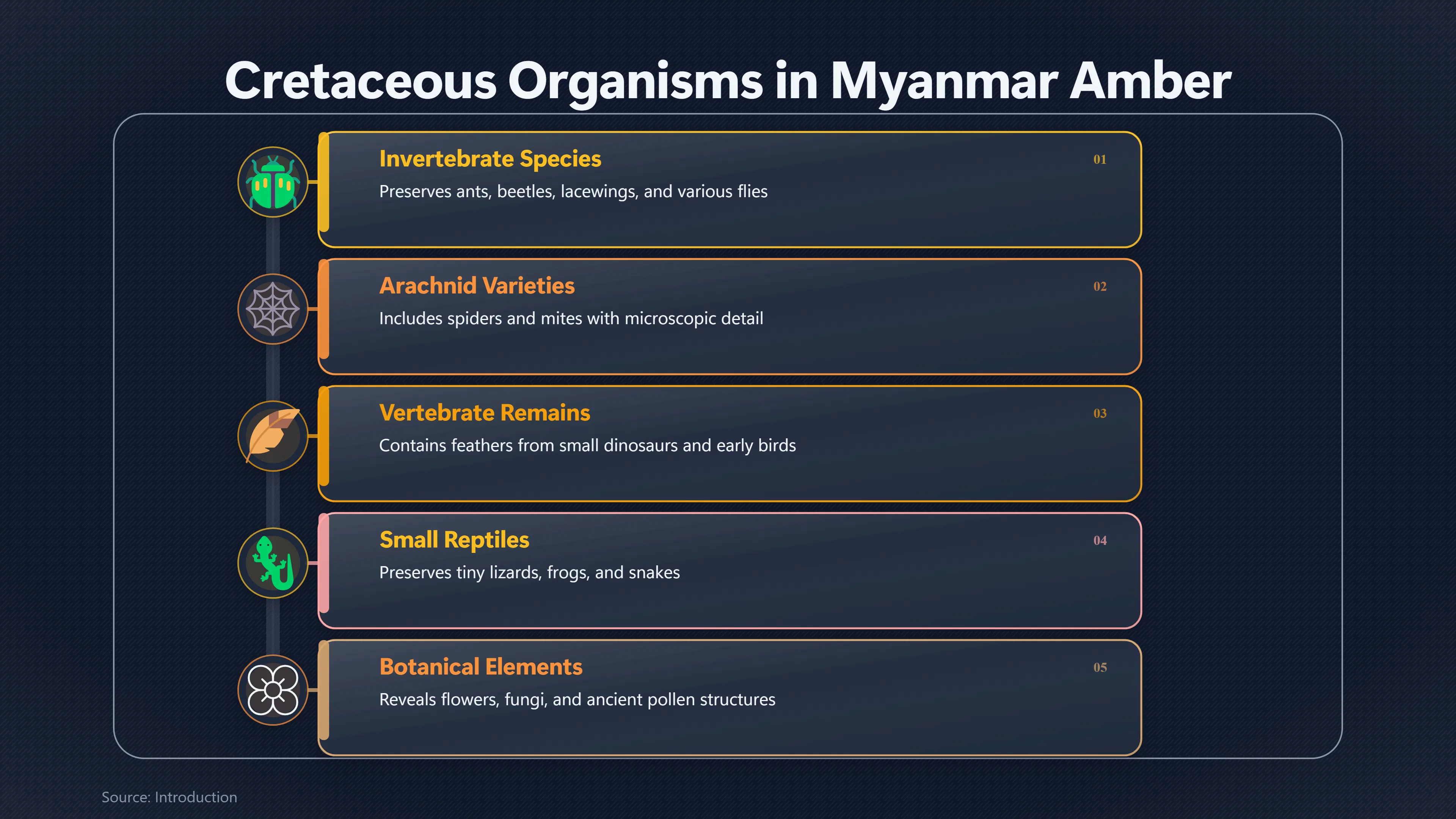
Scientists have identified thousands of species, including:
- Insects ranging from ants and beetles to lacewings and flies.
- Spiders, mites and other arachnids.
- Feathers from small dinosaurs and early birds.
- Tiny lizards, frogs and snakes.
- Flowers, fungi and pollen revealing the structure of an ancient rainforest.
- Parasites, blood-feeding insects and other ecological interactions that rarely survive in the fossil record.
Some discoveries have attracted worldwide attention because they appear almost cinematic: a feather still carrying traces of pigmentation, insects locked in predatory encounters, or a tick preserved beside dinosaur feathers. These specimens have transformed understanding of Cretaceous ecosystems by preserving behaviour as well as anatomy.[Nature]nature.comEthics, law, and politics in palaeontological research: The case of Myanmar amber | Communications BiologySeptember 29, 2022…
For visitors encountering these fossils in museums or commercial displays, the appeal is obvious. Each polished piece of amber functions almost like a tiny natural-history diorama, preserving an individual moment from nearly 100 million years ago.
From scientific specimen to commercial curiosity
Myanmar amber occupies an unusual position because it is simultaneously:
- a gemstone,
- a jewellery material,
- a commercial collectible,
- and a scientifically important fossil deposit.
This overlap creates very different markets. Most amber extracted in northern Myanmar is traded as decorative stone, while only a small proportion contains fossil inclusions valuable to researchers. Nevertheless, scientific discoveries depend upon material entering commercial supply chains, often through dealers rather than archaeological excavations.[Nature]nature.comEthics, law, and politics in palaeontological research: The case of Myanmar amber | Communications BiologySeptember 29, 2022…
This has encouraged a distinctive form of curiosity collecting. Private collectors may value a beautifully preserved insect for its appearance, while researchers may regard the same specimen as an important source of evolutionary evidence. Museums sometimes display amber simultaneously as jewellery, geological material and palaeontological specimen, blurring the boundaries between science, luxury and commerce.
The result is an unusual collecting culture in which the scientific importance of an object can dramatically increase its commercial value, encouraging further searching for fossil-bearing pieces.

Why provenance became the central question
For many years, publications describing Myanmar amber focused almost entirely on the remarkable fossils themselves. Around 2019, attention shifted towards provenance—the documented history of where a specimen came from, how it left Myanmar and who benefited financially from its sale.
Several developments drove this change.
First, journalists and researchers highlighted that many productive amber mines lie within Kachin State, where armed conflict has repeatedly involved the Myanmar military and ethnic armed organisations.
Second, researchers documented that large quantities of amber were transported across the border into China, particularly to markets in Tengchong, before entering international commercial and scientific networks.
Third, scientists increasingly questioned whether publications describing newly acquired amber unintentionally legitimised or stimulated a trade linked to conflict and uncertain legal export.[Nature]nature.comEthics, law, and politics in palaeontological research: The case of Myanmar amber | Communications BiologySeptember 29, 2022…
As a result, provenance became almost as important as the fossil itself.
Conflict mining, export rules and research ethics
The ethical debate is more complicated than simply asking whether amber mining exists in a conflict zone.
Researchers point to three overlapping issues.
Conflict financing. Various reports have argued that control of amber-producing areas has shifted between different armed groups over time, meaning that revenues from mining may contribute to continuing conflict. Scientific organisations became especially concerned about material entering international collections after fighting intensified around major mining districts from 2017 onwards.[Nature]nature.comEthics, law, and politics in palaeontological research: The case of Myanmar amber | Communications BiologySeptember 29, 2022…
Legal uncertainty. Myanmar law treats amber as a gemstone that may be exported under gemstone legislation if the required permissions exist. Fossils, however, are protected under legislation governing antiquities and cultural heritage. Amber containing fossil inclusions falls into a legal grey area because the gemstone and the fossil inside may be governed differently, creating uncertainty over whether exported fossil-bearing specimens comply with all applicable laws.[Nature]nature.comEthics, law, and politics in palaeontological research: The case of Myanmar amber | Communications BiologySeptember 29, 2022…
Research responsibility. Scientists increasingly asked whether publishing spectacular fossils without documenting their legal and ethical acquisition could encourage demand for additional material of uncertain origin. The issue therefore extends beyond museums into academic publishing, fossil dealers and private collections.[Nature]nature.comEthics, law, and politics in palaeontological research: The case of Myanmar amber | Communications BiologySeptember 29, 2022…
How museums and researchers have responded
The controversy has significantly altered professional practice.
Some scientific journals introduced stricter editorial policies requiring authors to explain the provenance of Myanmar amber specimens before publication. The Society of Vertebrate Paleontology initially called for a moratorium on research involving recently acquired Myanmar amber and later replaced this with detailed guidance emphasising legal documentation, ethical acquisition and transparent provenance reporting.[Nature]nature.comEthics, law, and politics in palaeontological research: The case of Myanmar amber | Communications BiologySeptember 29, 2022…
Museums have also become more cautious. Rather than presenting amber solely as a spectacular fossil resource, many institutions now acknowledge the modern circumstances surrounding its extraction. Provenance records, acquisition dates and ownership history have become increasingly important components of exhibition interpretation.
Researchers have likewise criticised “parachute science”—situations where foreign scientists study specimens from Myanmar with limited involvement from Myanmar researchers or institutions. Reviews of the academic literature have found that local scientific participation has often been disproportionately low despite Myanmar being the country of origin for these internationally important fossils.[Nature]nature.comEthics, law, and politics in palaeontological research: The case of Myanmar amber | Communications BiologySeptember 29, 2022…
Can Myanmar’s amber fossils be viewed innocently?
The fossils themselves remain genuine scientific treasures. Their ability to preserve entire ecosystems has transformed knowledge of the Cretaceous world, and many discoveries will continue to shape palaeontology for decades.
What has changed is the context in which they are viewed.
A polished amber specimen containing an ancient insect is no longer seen only as a beautiful natural curiosity. Visitors increasingly ask when it was mined, how it left Myanmar, whether its export complied with national law, whether conflict influenced its supply chain and whether museums or researchers can document its provenance.
Rather than diminishing the scientific value of Myanmar amber, these questions broaden its significance. Each specimen now tells two intertwined stories: one from nearly 100 million years ago, preserved inside fossilised resin, and another unfolding in the present, involving conflict, heritage law, international trade and the ethical responsibilities of museums, collectors and scientists.[Nature]nature.comEthics, law, and politics in palaeontological research: The case of Myanmar amber | Communications BiologySeptember 29, 2022…
Amazon book picks
Further Reading
Books and field guides related to Can Myanmar's Amber Fossils Be Viewed Innocently?. Use these as the next step if you want deeper reading beyond the article.
The Amber Forest: A Reconstruction of a Vanished World
The Poinars are world leaders in the study of amber fossils and have spent years examining the uniquely rich supply that has survived fro...
The Story of Life in 25 Fossils
Every fossil tells a story. Best-selling paleontology author Donald R. Prothero describes twenty-five famous, beautifully preserved fossi...
Dinosaurs of the flaming cliffs
First published 1996. Subjects: Dinosaurs, Paleontology, Cretaceous Geologic Period, Paleontology, asia, Scientific expeditions.
eBay marketplace picks
Marketplace Samples
Live-tested eBay searches with available results related to this page.
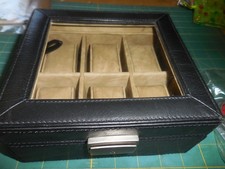
Selected fromfossil display case oneBay.co.uk.
Current eBay listing
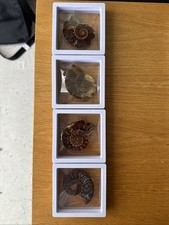
Silurian Eurypterid Sea Scorpion Fossil Pair in Wooden Display Case
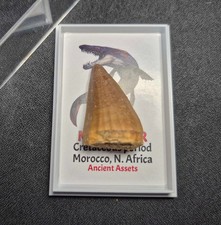
Current eBay listing
MOSASAUR Tooth Teeth Fossil Dinosaur Jurassic World Display Case
Endnotes
1.
Source: nature.com
Link:https://www.nature.com/articles/s42003-022-03847-2
Source snippet
Ethics, law, and politics in palaeontological research: The case of Myanmar amber | Communications BiologySeptember 29, 2022...
Published: September 29, 2022
2.
Source: nature.com
Title: Law, ethics, gems and fossils in Myanmar amber | Nature Ecology & Evolution
Link:https://www.nature.com/articles/s41559-021-01478-0
Source snippet
Law, ethics, gems and fossils in Myanmar amber | Nature Ecology & Evolution...
3.
Source: nature.com
Title: Fossilized ethics | Nature Ecology & Evolution
Link:https://www.nature.com/articles/s41559-021-01493-1
Source snippet
Fossilized ethics | Nature Ecology & Evolution...
4.
Source: nature.com
Title: Tracking amber trends | Nature Ecology & Evolution
Link:https://www.nature.com/articles/s41559-022-01963-0
Source snippet
Tracking amber trends | Nature Ecology & Evolution...
5.
Source: nature.com
Link:https://www.nature.com/articles/s41559-021-01472-6
6.
Source: nature.com
Link:https://www.nature.com/articles/s41559-021-01479-z
7.
Source: nature.com
Title: Myanmar amber fossils: a legal as well as ethical quagmire
Link:https://www.nature.com/articles/d41586-020-03006-9
8.
Source: nature.com
Title: Myanmar: palaeontologists must stop buying conflict amber
Link:https://www.nature.com/articles/d41586-020-02432-z
9.
Source: hrw.org
Link:https://www.hrw.org/world-report/2026/country-chapters/myanmar
Additional References
10.
Source: earthrights.org
Link:https://earthrights.org/media_release/policy-brief-widespread-environmental-and-human-rights-damages-from-rare-earth-mining-in-kachin-state-myanmar-linked-to-green-energy-industry/
Source snippet
ndustry | EarthRights InternationalMay 1, 2025 — POLICY BRIEF: WIDESPREAD ENVIRONMENTAL AND HUMAN RIGHTS DAMAGES FROM RARE EARTH MINING I...
Published: May 1, 2025
11.
Source: hrw.org
Link:https://www.hrw.org/news/2025/02/06/us-lithium-mine-permit-violates-indigenous-peoples-rights
Source snippet
US: Lithium Mine Permit Violates Indigenous Peoples’ Rights | Human Rights WatchFebruary 6, 2025 — US: LITHIUM MINE PERMIT VIOLATES INDIG...
Published: February 6, 2025
12.
Source: spnhc.org
Link:https://spnhc.org/amber-ethics-and-guidelines/
Source snippet
March 24, 2025 — AMBER ETHICS AND GUIDELINES...
Published: March 24, 2025
13.
Source: youtube.com
Link:https://www.youtube.com/watch?v=WbgmsStBkzY
Source snippet
The $600 Dinosaur Tail That Proved Warm-Blooded Dinosaurs...
14.
Source: pmc.ncbi.nlm.nih.gov
Link:https://pmc.ncbi.nlm.nih.gov/articles/PMC7618824/
Source snippet
ethical disagreement on ancestral human remains in museums - PMCFebruary 11, 2026 — > 1.8 Be understanding of different religious, spirit...
Published: February 11, 2026
15.
Source: youtube.com
Title: Illicit Fossils: The Ethical Dilemma in Protecting the World’s Natural History
Link:https://www.youtube.com/watch?v=PnssaLktiXw
Source snippet
A tale of two papers: ethics of Burmese amber...
16.
Source: pmc.ncbi.nlm.nih.gov
Link:https://pmc.ncbi.nlm.nih.gov/articles/PMC9522859/
17.
Source: researchgate.net
Link:https://www.researchgate.net/publication/364039801_Ethics_law_and_politics_in_palaeontological_research_The_case_of_Myanmar_amber
18.
Source: hrw.org
Link:https://www.hrw.org/topic/economic-justice-and-rights/oil-mining-and-natural-resources
19.
Source: youtube.com
Title: Episode 135: Burmese Amber Pt2
Link:https://www.youtube.com/watch?v=ABC736Ron80
Source snippet
Illicit Fossils: The Ethical Dilemma in Protecting the World's Natural History...