Within Ireland Curiosities
The Strange History Of Irish Death Customs
Ireland's death-related heritage collections explore wakes, rituals and preserved remains as evidence of changing attitudes toward memory and the afterlife.
On this page
- The Irish wake tradition
- Burial objects and ancient remains
- Death, memory and community
Page outline Jump by section
Introduction
Ireland’s death heritage is unusual because it preserves not only objects associated with the dead, but also the social rituals that surrounded dying, mourning and remembrance. The country’s most distinctive death-related visitor experience is the Irish Wake Museum in Waterford, which explores the traditions of the wake through historic objects, storytelling and reconstructed settings. Alongside this modern museum are archaeological collections containing ancient human remains, especially the famous Irish bog bodies, which reveal much older beliefs about sacrifice, burial and the relationship between people and the landscape.[Visit Waterford]visitwaterford.comVisit Waterford Irish Wake Museum – Waterford Treasures – Visit WaterfordVisit Waterford Irish Wake Museum – Waterford Treasures – Visit Waterford
Irish death customs are therefore not simply a record of funerals. They show how communities turned death into a shared event involving family, neighbours, religion, folklore and memory. From the household wake to prehistoric burials preserved in peat, Irish collections reveal changing ideas about what happens after death and how the living maintain relationships with those who have gone.[University College Dublin]ucd.ieUniversity College Dublin UNESCO Memory of the WorldUniversity College DublinUNESCO Memory of the World - National Folklore Collection…
The Irish wake tradition
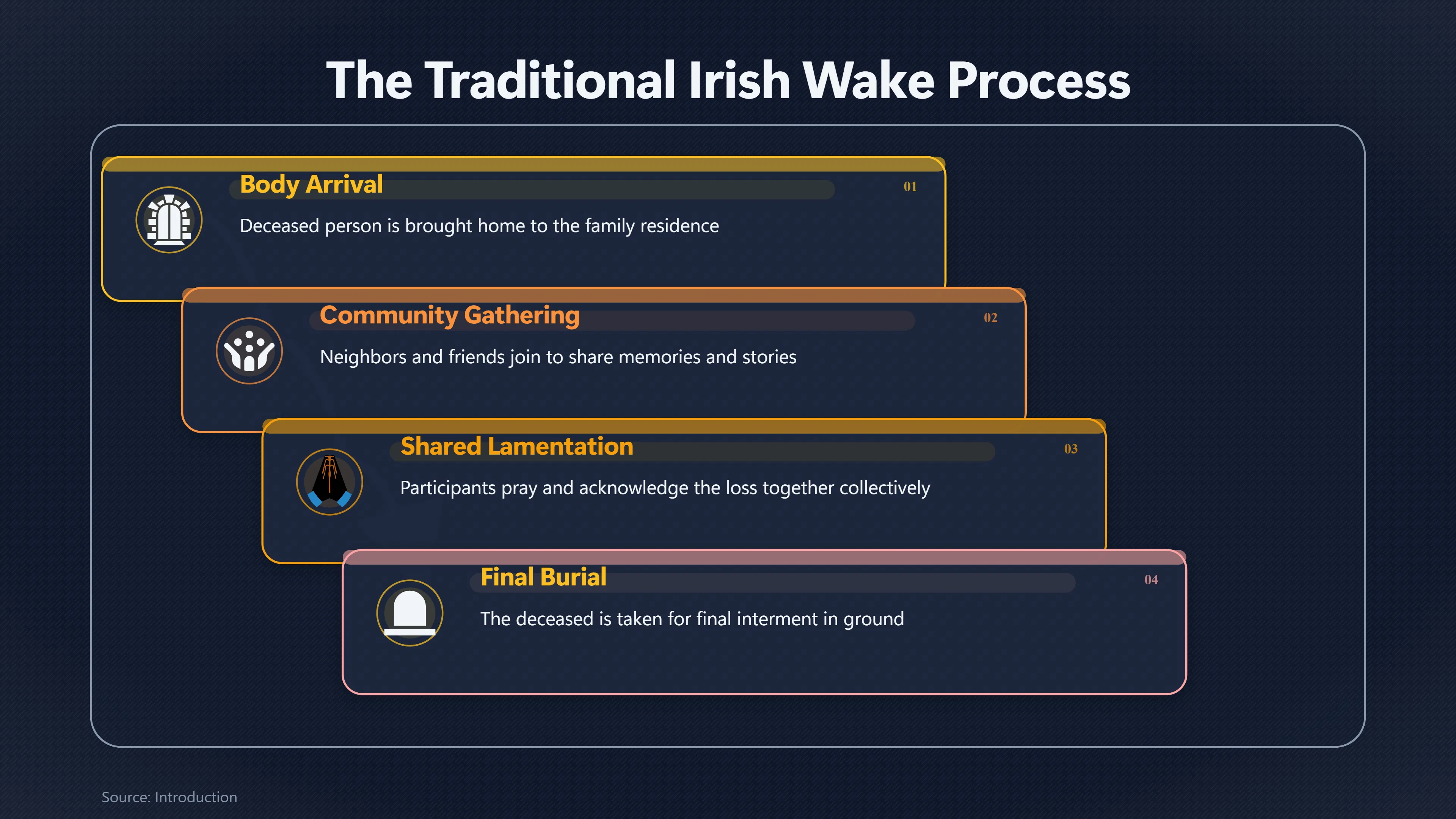
The Irish wake is one of Ireland’s best-known remembrance customs and one of the few death rituals that has become a cultural symbol internationally. Traditionally, a deceased person was brought home and surrounded by relatives, neighbours and friends before burial. The gathering allowed people to pray, tell stories, share memories and acknowledge the loss together rather than leaving grief as a private experience. Accounts preserved in Ireland’s folklore archives describe customs such as keeping watch beside the body, lamenting the deceased and gathering visitors in the home.[Dúchas]duchas.ieDúchas FolkloreDúchasFolklore - Customs at Wakes · An Cheapach · The Schools' Collection | dúchas.ie…
The word “wake” is often explained through the idea of watching over the dead, although the custom developed within a much wider European tradition of communal mourning. In Ireland, the practice became especially associated with rural communities where neighbours played an important role in caring for the bereaved. Food, conversation and storytelling were not separate from mourning; they were part of how communities helped families move through loss.[Dúchas]duchas.ieDúchas FolkloreDúchasFolklore - Customs at Wakes · An Cheapach · The Schools' Collection | dúchas.ie…
Waterford’s Irish Wake Museum
The clearest place to explore this tradition today is the Irish Wake Museum in Waterford. Opened in 2023, it is Ireland’s first museum dedicated specifically to the wake and is housed in a former 15th-century almshouse in Waterford’s historic Viking Triangle. The building itself connects the exhibition to earlier attitudes towards death, charity and prayers for the deceased, as the almshouse was founded on All Souls’ Day and had associations with remembrance of the dead.[Visit Waterford]visitwaterford.comVisit Waterford Irish Wake Museum – Waterford Treasures – Visit WaterfordVisit Waterford Irish Wake Museum – Waterford Treasures – Visit Waterford
Rather than presenting death as a collection of grim objects, the museum focuses on the human experience around dying. Visitors encounter explanations of funeral customs, beliefs and superstitions from early Christian Ireland through to the twentieth century. Its importance within Ireland’s unusual heritage landscape comes from treating a social ritual as a museum subject: the “exhibit” is not only the coffin, mourning object or funeral item, but the network of relationships built around them.[Visit Waterford]visitwaterford.comVisit Waterford Irish Wake Museum – Waterford Treasures – Visit WaterfordVisit Waterford Irish Wake Museum – Waterford Treasures – Visit Waterford
The museum also reflects a modern debate about changing attitudes to death. Some writers and researchers argue that traditional Irish wakes offered a more visible and communal way of experiencing grief, while modern funerals can sometimes separate people from the physical reality of death. Recent interest in reviving wake traditions, including cultural events focused on keening and remembrance, shows that the custom remains a subject of discussion rather than simply a relic of the past.[The Guardian]theguardian.comThis age-old practice is at risk due to the rise of modern, professionalized funeral services featuring mortuaries and closed coffins. Th…
Burial objects and ancient remains
Ireland’s death heritage extends far beyond recent funeral traditions. Archaeological collections preserve evidence of burial practices stretching back thousands of years, including grave goods, ritual deposits and exceptionally preserved human remains. These objects are important because they show that attitudes towards death have always reflected wider beliefs about identity, power, religion and the landscape.
The most striking examples are Ireland’s bog bodies, displayed and interpreted by the National Museum of Ireland. These naturally preserved remains were discovered in peatlands and include individuals such as Clonycavan Man, Oldcroghan Man and Cashel Man. Their preservation allows archaeologists to study aspects of Iron Age life that would normally disappear, including diet, injuries, clothing and possible circumstances of death.[National Museum of Ireland]museum.ieOpen source on museum.ie.
The mystery and evidence behind Irish bog bodies
Bog bodies are sometimes presented in popular culture as mysterious “mummies”, but museums approach them as archaeological evidence rather than supernatural curiosities. Research into remains such as Oldcroghan Man and Clonycavan Man has involved scientific techniques including scanning, pathological analysis and examination of preserved tissues. The National Museum of Ireland’s Bog Bodies Research Project brought together specialists to investigate these discoveries and place them within the wider European tradition of Iron Age bog burials.[National Museum of Ireland]museum.ieOpen source on museum.ie.
The exhibition Kingship and Sacrifice at the National Museum of Ireland in Dublin examines the interpretation that some Irish bog bodies may have been connected with ritual sacrifice and ideas about kingship during the Iron Age. However, these interpretations remain archaeological theories rather than simple answers. The bodies provide evidence of unusual treatment after death, but the precise beliefs and motivations of the people involved cannot always be reconstructed with certainty.[National Museum of Ireland]museum.ieOpen source on museum.ie.
Other burial-related objects also reveal unusual relationships between everyday life and death. Irish archaeological collections contain items from ritual deposits, including objects placed in bogs, which may have had symbolic meaning rather than being ordinary rubbish or lost possessions. The National Museum’s collections include examples such as bog butter, preserved organic materials and other objects that demonstrate how wetlands became places of preservation and ritual activity.[National Museum of Ireland]museum.ieOpen source on museum.ie.
Death, memory and community
Irish remembrance customs show that death has often been understood as a continuing relationship between the living and the dead. This appears in household rituals, graveyard traditions, religious practices and the preservation of stories about ancestors. Death heritage in Ireland is therefore not only about remains or burial sites; it is also about memory itself.
A major source for understanding these traditions is the National Folklore Collection at University College Dublin. Created through decades of collecting oral histories, the archive preserves accounts of local customs, beliefs, songs, stories and everyday practices. Its materials include descriptions of burial traditions and wake customs gathered from communities across Ireland, providing evidence for how ordinary people understood death in their own words.[University College Dublin]ucd.ieUniversity College Dublin UNESCO Memory of the WorldUniversity College DublinUNESCO Memory of the World - National Folklore Collection…
This archive is particularly valuable because many remembrance practices were never recorded in formal historical documents. Details such as how neighbours supported a bereaved household, how communities treated old graveyards or how people interpreted signs connected with death often survived through oral tradition rather than official records.[Dúchas]duchas.ieDúchas FolkloreDúchas Folklore
The continuing interest in Irish death customs also reflects a broader question about modern life: what is lost when death becomes less visible? Museums such as the Irish Wake Museum preserve not only historical facts but also conversations about community, grief and belonging. They show that unusual heritage is not always about strange objects; sometimes the most distinctive collections are those that preserve the customs people use to understand the most universal human experience.[Visit Waterford]visitwaterford.comVisit Waterford Irish Wake Museum – Waterford Treasures – Visit WaterfordVisit Waterford Irish Wake Museum – Waterford Treasures – Visit Waterford
Amazon book picks
Further Reading
Books and field guides related to The Strange History Of Irish Death Customs. Use these as the next step if you want deeper reading beyond the article.
Irish Fairy and Folk Tales
Irish Fairy and Folk Tales is a collection of charming fairy tales and short stories by esteemed Irish writer, W.B. Yeats.
How the Irish Saved Civilization
How Irish scholars preserved Greek and Roman classics, Jewish and Christian writings, and other writings that might have been lost when t...
A History of Ireland in 250 Episodes
"Jonathan Bardon covers all the obvious things: the invasions, battles, development of towns and cities, the Reformation, the Georgian er...
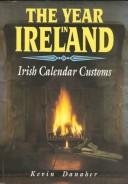
The Year in Ireland: Irish Calendar Customs
First published 1972. Subjects: Folklore, Holidays, Religious life and customs, Social life and customs, Ireland, social life and customs.
eBay marketplace picks
Marketplace Samples
Live-tested eBay searches with available results related to this page.
Selected fromIrish memorial art oneBay.co.uk.
Endnotes
1.
Source: museum.ie
Link:https://www.museum.ie/en-ie/museums/archaeology/exhibitions/kingship-and-sacrifice
2.
Source: museum.ie
Link:https://www.museum.ie/en-ie/collections-research/irish-antiquities-division-collections/collections-list-%281%29/iron-age/bog-bodies-research-project
3.
Source: museum.ie
Title: National Museum of Ireland Cashel Man
Link:https://www.museum.ie/en-IE/Collections-Research/Irish-Antiquities-Division-Collections/Collections-List-%281%29/Iron-Age/Cashel-Man-Ireland-s-Oldest-Bog-Body
Source snippet
National Museum of IrelandCashel Man - Ireland's Oldest Bog Body | National Museum of Ireland...
4.
Source: museum.ie
Link:https://www.museum.ie/en-IE/Museums/Archaeology/Visitor-Information/Top-10-Things-to-See-%281%29
5.
Source: folklore.ie
Title: ie Website
Link:https://folklore.ie/
6.
Source: museum.ie
Link:https://www.museum.ie/en-IE/Collections-Research/Irish-Antiquities-Division-Collections/Collections-List-%281%29/Iron-Age
7.
Source: cms.museum.ie
Link:https://cms.museum.ie/en-ie/museums/archaeology/visitor-information/about-the-museum
8.
Source: museum.ie
Link:https://www.museum.ie/en-IE/Collections-Research/Irish-Antiquities-Division-Collections/Collections-List-%281%29/Stone-Age/Prehistoric-Details
9.
Source: museum.ie
Link:https://www.museum.ie/en-ie/collections-research/folklife-collections/folklife-collections-list-%281%29/religion-and-calendar-customs/hallowe-en-samhain
10.
Source: microsites.museum.ie
Link:https://microsites.museum.ie/bronzeagehandlingbox/bronze-age.html
11.
Source: museum.ie
Title: Death Rituals and Voluntary Gravedigging
Link:https://www.museum.ie/ga-IE/Museums/Country-Life/Events/2026/Q1/Death-Rituals-and-Voluntary-Gravedigging
12.
Source: cms.museum.ie
Link:https://cms.museum.ie/en-ie/museums/archaeology
13.
Source: museum.ie
Link:https://www.museum.ie/collections/collections-and-research/irish-folk-life/
14.
Source: museum.ie
Link:https://www.museum.ie/en-IE/Collections-Research/Folklife-Collections/Folklife-Collections-List-%281%29/Religion-and-Calendar-Customs/Straw-costumes-and-objects
15.
Source: youtube.com
Title: The Irish Wake Museum
Link:https://www.youtube.com/watch?v=s9sKk1J7F1Q
Source snippet
Exploring Ireland's Funerary History and Customs...
16.
Source: youtube.com
Link:http://www.youtube.com/watch?v=QWq8dA8hqaQ
Source snippet
How to write a scientific paper introduction How To Write A Research Paper: Introduction (Complete Tutorial) Academic English Now...
17.
Source: visitwaterford.com
Title: Visit Waterford Irish Wake Museum – Waterford Treasures – Visit Waterford
Link:https://visitwaterford.com/activities/irish-wake-museum
18.
Source: ucd.ie
Title: University College Dublin UNESCO Memory of the World
Link:https://www.ucd.ie/irishfolklore/en/about/unescomemoryoftheworld/
Source snippet
University College DublinUNESCO Memory of the World - National Folklore Collection...
19.
Source: duchas.ie
Title: Dúchas Folklore
Link:https://www.duchas.ie/en/cbes/4583290/4576854/4588041
Source snippet
DúchasFolklore - Customs at Wakes · An Cheapach · The Schools' Collection | dúchas.ie...
20.
Source: theguardian.com
Link:https://www.theguardian.com/world/article/2024/may/19/modern-death-clinical-antiseptic-festival-irish-wake-rite-of-passage
Source snippet
This age-old practice is at risk due to the rise of modern, professionalized funeral services featuring mortuaries and closed coffins. Th...
21.
Source: ucd.ie
Title: University College Dublin National Folklore Collection
Link:https://www.ucd.ie/irishfolklore/en/
22.
Source: duchas.ie
Title: Dúchas Folklore
Link:https://www.duchas.ie/en/cbes/5044622/5026759/5141898
23.
Source: ucd.ie
Title: History of NFC
Link:https://www.ucd.ie/irishfolklore/en/about/historyofnfc/
24.
Source: ucd.ie
Title: Folklore Society
Link:https://www.ucd.ie/irishfolklore/en/folkloresociety/
25.
Source: ucd.ie
Title: Manuscript Collections
Link:https://www.ucd.ie/irishfolklore/en/collections/manuscriptcollections/
26.
Source: discoverireland.ie
Link:https://www.discoverireland.ie/waterford/waterford-treasures-the-irish-wake-museum-rituals-of-death
27.
Source: discoverireland.ie
Link:https://www.discoverireland.ie/waterford/waterford-treasures-irish-wake-museum-rituals-of-death
28.
Source: duchas.ie
Link:https://www.duchas.ie/en
29.
Source: duchas.ie
Link:https://www.duchas.ie/en/cbes/4583290/4576854/4588041?Route=stories
30.
Source: duchas.ie
Link:https://www.duchas.ie/en/cbes/4613713/4611457/4651538
31.
Source: duchas.ie
Link:https://www.duchas.ie/en/cbes/4713236/4710108/4744036
32.
Source: irishteller.com
Title: The Irish Wake
Link:https://www.irishteller.com/the-irish-wake.html
33.
Source: waterfordtreasures.com
Title: Irish Wake Museum
Link:https://waterfordtreasures.com/museum/irish-wake-museum/
34.
Source: visitwaterford.com
Link:https://visitwaterford.com/activities/dive-into-heritage
35.
Source: duchas.ie
Link:https://www.duchas.ie/en/cbe/9001768/7296836/9111480
Additional References
36.
Source: youtube.com
Title: The Unnerving Evidence of Sacrifice in These Irish Bogs
Link:http://www.youtube.com/watch?v=B65uVvv0ZO0
Source snippet
Should DEAD BODIES be on display? Should human remains be in museums? Egyptian mummies and bog men...
37.
Source: youtube.com
Link:http://www.youtube.com/watch?v=VEqvin_zMpQ
Source snippet
What Secrets Do Ireland’s Bogs Still Hold?...
38.
Source: youtube.com
Title: What Secrets Do Ireland’s Bogs Still Hold?
Link:http://www.youtube.com/watch?v=vYh5PuNxtXI
Source snippet
"Irish Wake Museum" Waterford tour Waterford's Viking Triangle Flynn On Tour...
39.
Source: irishtimes.com
Link:https://www.irishtimes.com/property/interiors/2025/10/31/a-look-inside-irelands-only-death-museum-weve-had-some-slight-wobbles-from-people/
40.
Source: tripadvisor.ie
Link:https://www.tripadvisor.ie/Attraction_Review-g186638-d26353012-Reviews-Waterford_Treasures_Irish_Wake_Museum-Waterford_County_Waterford.html
41.
Source: askaboutireland.ie
Link:https://www.askaboutireland.ie/reading-room/history-heritage/folklore-of-ireland/folklore-in-ireland/the-life-cycle/death/death-in-ireland-today/
42.
Source: waterfordcouncil.ie
Link:https://waterfordcouncil.ie/minister-darragh-obrien-officially-opens-irelands-newest-museum-the-irish-wake-museum-in-waterford/
43.
Source: keeningwake.com
Link:https://www.keeningwake.com/resources/
44.
Source: discoverireland.ie
Link:https://www.discoverireland.ie/waterford/the-irish-wake-museum-waterford-treasures
45.
Source: cambridge.org
Link:https://www.cambridge.org/core/journals/antiquity/article/ways-of-death-cremation-and-belief-in-firstmillennium-ad-ireland/0D59E59C64F3C3AFE55C197411087BCC