Within Strange Senegal
How Much of Goree's Story Is Proven?
Goree's museums show how prison cells, forts and the Door of No Return can become powerful symbols even when literal claims remain disputed.
On this page
- The House of Slaves as memorial
- What historians dispute about the doorway
- Fort d'Estrees and the island museum landscape
Page outline Jump by section
Introduction
Gorée Island is one of the world’s best-known places of remembrance for the Atlantic slave trade, yet it is also one of its most debated. Visitors often arrive expecting a single, undisputed historical narrative centred on the House of Slaves and its famous Door of No Return. Instead, they encounter a place where documented history, collective memory, archaeology and powerful symbolism overlap. That tension is precisely what makes Gorée one of Senegal’s most unusual heritage landscapes. It is not simply a museum or monument but an entire inhabited island where prisons, forts, colonial houses and museums have become part of an international conversation about slavery, memory and historical evidence.[UNESCO World Heritage Centre]whc.unesco.orgWorld Heritage Centre Island of GoréeUNESCO World Heritage CentreIsland of Gorée - UNESCO World Heritage Centre…

How Much of Gorée’s Story Is Proven?
The central question surrounding Gorée is not whether slavery occurred there—it unquestionably did—but how the island’s role should be understood within the wider Atlantic slave trade.
UNESCO describes Gorée as a symbolic “memory island” whose buildings collectively testify to centuries of enslavement, European colonial rivalry and human exploitation. Since its inscription as a World Heritage Site in 1978, the island has become an international destination for remembrance, reconciliation and education rather than simply an archaeological site.[UNESCO World Heritage Centre]whc.unesco.orgWorld Heritage Centre Island of GoréeUNESCO World Heritage CentreIsland of Gorée - UNESCO World Heritage Centre…
Historians, however, distinguish between Gorée’s symbolic importance and the specific historical claims sometimes made about individual buildings. Research over the past several decades has questioned older estimates suggesting that millions of enslaved Africans passed through the House of Slaves itself. Shipping records, surviving commercial documents and archaeological evidence indicate that Gorée participated in the slave trade but was probably less significant as an export port than many other West African centres, and that much of the trade occurred through multiple locations rather than one iconic doorway.[Wiley Online Library]onlinelibrary.wiley.comOnline Library Landscapes of the Slave Trade in Senegal and The GambiaWiley Online LibraryLandscapes of the Slave Trade in Senegal and The Gambia - Wikle - 2014 - Focus on Geography - Wiley Online LibraryMar…
Rather than diminishing Gorée’s importance, this debate has shifted attention towards how societies commemorate traumatic history. Many scholars argue that the island’s greatest significance now lies in what it represents: the human reality of enslavement and forced displacement, even if every detail of the traditional narrative cannot be verified exactly as once presented.[Cambridge University Press & Assessment]cambridge.orgUniversity Press & Assessment The Door of Return (Chapter 2Cambridge University Press & AssessmentThe Door of Return (Chapter 2) - Decolonizing Heritage…
The House of Slaves as Memorial
The House of Slaves (Maison des Esclaves), constructed in the late eighteenth century, is Gorée’s most recognisable historic building. Since becoming a museum in the twentieth century, it has served as a memorial to the victims of the Atlantic slave trade rather than merely as an architectural monument.[Wikipedia]WikipediaHouse of SlavesHouse of Slaves
Its emotional power comes from the contrast between domestic rooms upstairs and the small stone chambers below traditionally identified as holding cells for enslaved captives. Guides and exhibitions have long presented these spaces as a physical reminder of the human suffering behind the Atlantic trading system.
The building gained worldwide recognition largely through the work of its long-serving curator, Boubacar Joseph Ndiaye, whose deeply personal tours influenced generations of visitors, including heads of state, religious leaders and members of the African diaspora. His interpretation transformed the museum into one of the world’s best-known memorials to slavery, even as historians increasingly questioned some of its historical details.[Wikipedia]WikipediaHouse of SlavesHouse of Slaves
This dual identity—as both museum and memorial—is important. Museums normally aim to present evidence as precisely as possible. Memorials, by contrast, also seek to preserve emotional truth, encourage reflection and honour victims. The House of Slaves increasingly occupies both roles simultaneously.

What historians dispute about the doorway
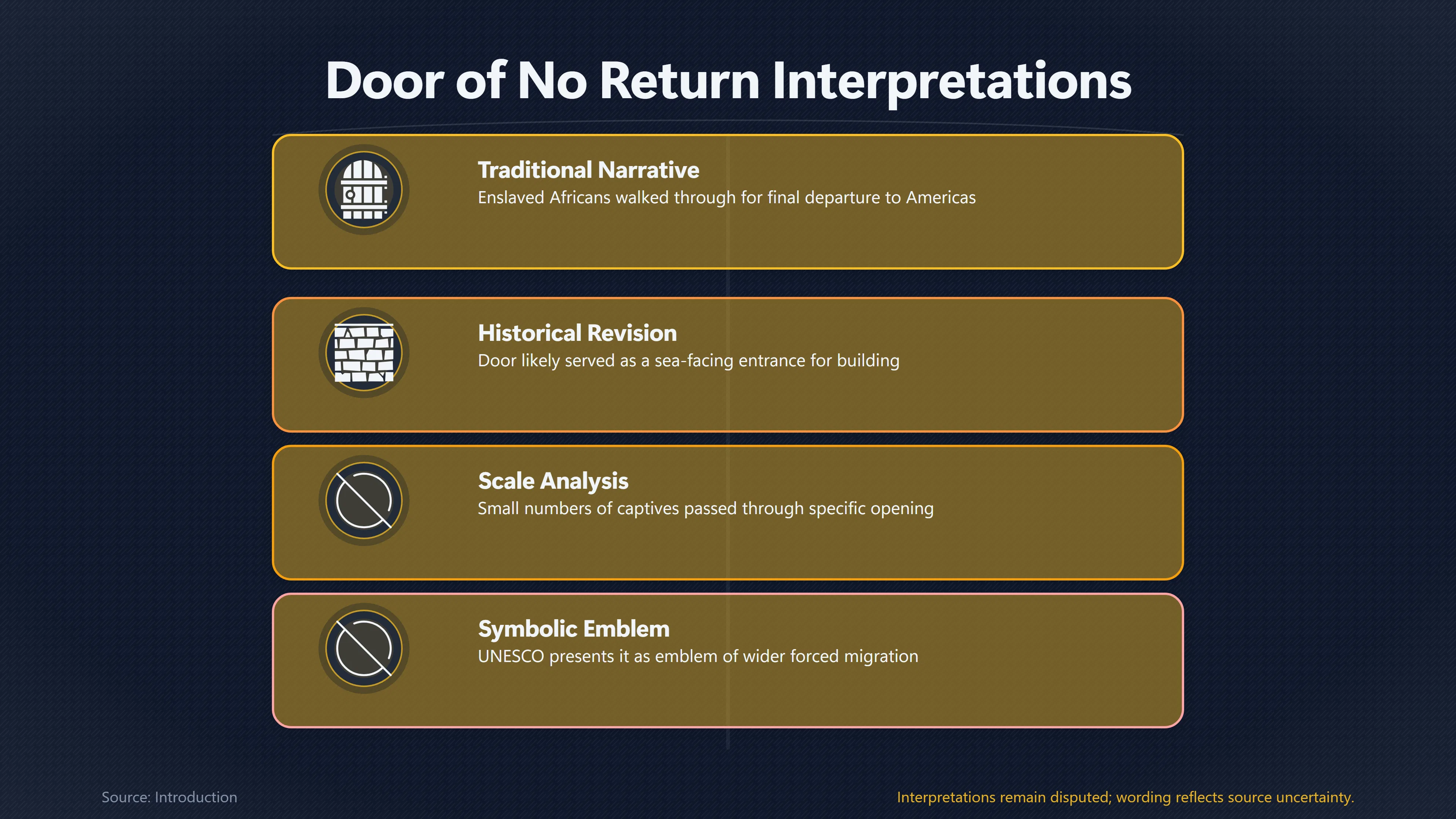
The Door of No Return has become one of the most recognisable images associated with the Atlantic slave trade. According to the traditional interpretation, enslaved Africans walked through this opening for the final time before boarding ships bound for the Americas.
Historical research has complicated that story. Several specialists argue that the doorway’s position, construction date and relationship to the harbour make it unlikely that it served as the principal embarkation point portrayed in popular accounts. Some suggest it functioned primarily as a sea-facing entrance connected with the building itself rather than as the main exit for thousands of captives. Others believe relatively small numbers of enslaved people may have passed through it while rejecting claims that it handled millions.[wiley.com]onlinelibrary.wiley.comOnline Library Landscapes of the Slave Trade in Senegal and The GambiaWiley Online LibraryLandscapes of the Slave Trade in Senegal and The Gambia - Wikle - 2014 - Focus on Geography - Wiley Online LibraryMar…
The debate therefore concerns scale and function rather than the existence of slavery on Gorée. Few serious historians dispute that enslaved people were bought, sold and imprisoned on the island. The disagreement centres on whether this particular building—and this particular doorway—became famous because of later memorialisation rather than because surviving evidence demonstrates it was the principal departure point.
For many visitors, however, the symbolic meaning remains powerful regardless of the architectural debate. UNESCO itself frequently presents the Door of No Return primarily as an emblem of the wider tragedy of forced migration rather than as a narrowly technical archaeological claim.[UNESCO Courier]courier.unesco.orgCourier Slavery: From recognition to demands for justice I The UNESCO CourierUNESCO CourierSlavery: From recognition to demands for justice I The UNESCO Courier…
Fort d’Estrées and the Island Museum Landscape
Focusing only on the House of Slaves risks overlooking the rest of Gorée’s heritage landscape.
Fort d’Estrées, occupying the island’s elevated ground, now houses the Historical Museum of Senegal. Rather than concentrating solely on slavery, it presents a broader narrative covering Senegal’s past from prehistory through independence. Archaeological material, military history and colonial history place Gorée within a much larger historical framework, reminding visitors that the island served multiple strategic purposes over several centuries.[UNESCO World Heritage Centre]whc.unesco.orgWorld Heritage Centre Island of GoréeUNESCO World Heritage CentreIsland of Gorée - UNESCO World Heritage Centre…
Seen together, the island’s museums create a layered experience:
[House of Slaves]WikipediaHouse of Slaves Slaves functions primarily as a memorial and place of reflection.
- Fort d’Estrées places slavery within Senegal’s wider political and historical development.
- The preserved streets, colonial houses, batteries and defensive works show that Gorée was simultaneously a military outpost, trading settlement and living town.[UNESCO World Heritage Centre]whc.unesco.orgWorld Heritage Centre Island of GoréeUNESCO World Heritage CentreIsland of Gorée - UNESCO World Heritage Centre…
This combination makes Gorée unusual within Senegal’s museum landscape. Instead of isolating history inside one building, nearly the entire island functions as an interconnected historical exhibit while remaining home to a permanent community.

Why the Myth Endures
The continuing influence of Gorée demonstrates that heritage is shaped by memory as well as documentation.
For descendants of enslaved Africans, the island has become a place of pilgrimage where family history, identity and remembrance converge. Political leaders, religious figures and members of the African diaspora have used visits to Gorée as acts of acknowledgement, apology and reconciliation. Those experiences do not depend entirely upon resolving every historical dispute surrounding one building.[UNESCO Courier]courier.unesco.orgUNESCO CourierGorée island, destination for memorial tourism and symbol of the tragedy of slavery I The UNESCO Courier…
Modern scholarship increasingly treats Gorée as a case study in the relationship between evidence and memory. The traditional narrative created an exceptionally powerful symbol that helped draw international attention to the Atlantic slave trade during a period when its history received comparatively little public recognition. Later historical revision has refined aspects of that narrative without eliminating the island’s moral and educational significance.[Cambridge University Press & Assessment]cambridge.orgUniversity Press & Assessment The Door of Return (Chapter 2Cambridge University Press & AssessmentThe Door of Return (Chapter 2) - Decolonizing Heritage…
For visitors interested in Senegal’s unusual heritage, Gorée therefore stands apart not because it contains mysterious artefacts or hidden relics, but because it shows how museums, historic buildings and landscapes can acquire meanings that extend beyond what archaeology or archival records alone can prove. It remains one of the world’s clearest examples of a place where historical evidence, collective memory and myth coexist rather than neatly replacing one another.
Amazon book picks
Further Reading
Books and field guides related to How Much of Goree's Story Is Proven?. Use these as the next step if you want deeper reading beyond the article.
The Slave Ship: A Human History
The slave ship was the instrument of history's greatest forced migration and a key to the origins and growth of global capitalism, yet mu...
Silencing the Past: Power and the Production of History
Rating: 4.5/5 from 5 Google Books ratings
Silencing the Past is a thought-provoking analysis of historical narrative. Taking examples ranging from the Haitian Revolution to Columb...
Lose Your Mother: A Journey Along the Atlantic Slave Route
In Lose Your Mother, Saidiya Hartman journeys along a slave route in Ghana, following the trail of captives from the hinterland to the At...
eBay marketplace picks
Marketplace Samples
Live-tested eBay searches with available results related to this page.
Selected fromtravel wall art oneBay.co.uk.
Current eBay listing
Barmouth Bridge Travel Poster Print - Wales Coastal Wall Art
Current eBay listing
Burgh Island Travel Poster Print - Devon Beachfront Coastal Wall Art

Endnotes
1.
Source: whc.unesco.org
Title: World Heritage Centre Island of Gorée
Link:https://whc.unesco.org/en/list/26
Source snippet
UNESCO World Heritage CentreIsland of Gorée - UNESCO World Heritage Centre...
2.
Source: courier.unesco.org
Link:https://courier.unesco.org/en/articles/goree-island-memory
Source snippet
UNESCO CourierGorée island, destination for memorial tourism and symbol of the tragedy of slavery I The UNESCO Courier...
3.
Source: courier.unesco.org
Title: Courier Slavery: From recognition to demands for justice I The UNESCO Courier
Link:https://courier.unesco.org/en/articles/political-recognition-demands-justice
Source snippet
UNESCO CourierSlavery: From recognition to demands for justice I The UNESCO Courier...
4.
Source: onlinelibrary.wiley.com
Title: Online Library Landscapes of the Slave Trade in Senegal and The Gambia
Link:https://onlinelibrary.wiley.com/doi/full/10.1111/foge.12025
Source snippet
Wiley Online LibraryLandscapes of the Slave Trade in Senegal and The Gambia - Wikle - 2014 - Focus on Geography - Wiley Online LibraryMar...
5.
Source: cambridge.org
Title: University Press & Assessment The Door of Return (Chapter 2)
Link:https://www.cambridge.org/core/books/decolonizing-heritage/door-of-return/C6D875C3C43C3B944FF5FA152664D000
Source snippet
Cambridge University Press & AssessmentThe Door of Return (Chapter 2) - Decolonizing Heritage...
6.
Source: Wikipedia
Title: House of Slaves
Link:https://en.wikipedia.org/wiki/House_of_Slaves
7.
Source: unesco.org
Title: the House of Slaves: Island of Gorée | World Heritage
Link:https://www.unesco.org/archives/multimedia/document-1333
Source snippet
the House of Slaves: Island of Gorée | World Heritage - UNESCO Multimedia Archives...
8.
Source: unesco.org
Title: Goree, the Slave Island | World Heritage
Link:https://www.unesco.org/archives/multimedia/document-32
Source snippet
Goree, the Slave Island | World Heritage - UNESCO Multimedia Archives...
10.
Source: youtube.com
Title: Goree Island: The History of The Slave Island In Senegal
Link:https://www.youtube.com/watch?v=OZ74DXZpdfs
Source snippet
Senegal - Clintons visit Goree Island...
11.
Source: youtube.com
Link:https://www.youtube.com/watch?v=2XZGOIdSDJ0
Source snippet
Untold Stories of the Slave Trade: Goree Island, Senegal...
12.
Source: youtube.com
Title: Untold Stories of the Slave Trade: Goree Island, Senegal
Link:https://www.youtube.com/watch?v=pd-7Er-hnlo
Source snippet
Gorée Island - The House of Slaves...
13.
Source: youtube.com
Title: Gorée Island
Link:https://www.youtube.com/watch?v=v0li2ANPIbg
Source snippet
Goree Island slave trade Senegal history Goree Island: The History of The Slave Island In Senegal The African Dream...
14.
Source: thehouseofslaves.com
Link:https://thehouseofslaves.com/about/
Source snippet
IN FACT, FOR THE GENERAL CONSCIENCE, THIS "ISLAND OF MEMORY" IS A SYMBOL OF THE SLAVE TRADE, TRI...
Additional References
15.
Source: washingtonpost.com
Title: The sincere fiction of Goree Island, Africa’s best-known slave trade memorial
Link:https://www.washingtonpost.com/news/worldviews/wp/2013/07/01/the-sincere-fiction-of-goree-island-africas-best-known-slave-trade-memorial/
Source snippet
The Washington PostJuly 1, 2013 — THE SINCERE FICTION OF GOREE ISLAND, AFRICA’S BEST-KNOWN SLAVE TRADE MEMORIAL July 1, 2013 More than 13...
Published: July 1, 2013
16.
Source: washingtonpost.com
Link:https://www.washingtonpost.com/news/worldviews/wp/2013/06/28/what-obama-really-saw-at-the-door-of-no-return-a-debunked-memorial-to-the-slave-trade/
17.
Source: youtube.com
Title: Island of Gorée (UNESCO/NHK)
Link:https://www.youtube.com/watch?v=WKdnvw1uymg
Source snippet
Goree Island: The History of The Slave Island In Senegal...