Within Cape Verde Curiosities
Can a Museum Preserve a Living Ritual?
The Museum of Tabanca preserves instruments and ceremonial objects whose meaning survives through music, procession and devotion.
On this page
- What Tabanca is and where it is practised
- How instruments and ceremonial objects function
- Preservation, heritage status and community control
Page outline Jump by section
Introduction
The Museum of Tabanca is one of Cape Verde’s most distinctive heritage collections because it attempts to preserve something that cannot simply be placed in a display case. Its musical instruments, ceremonial staffs, banners, crowns, drums and ritual objects only acquire their full meaning when used by living communities during annual processions, religious observances and communal celebrations. Rather than presenting relics from a vanished culture, the museum documents an active tradition that continues to be practised, especially on the islands of Santiago and Maio, where local associations maintain ceremonies centred on patron saints, music and collective identity. This makes the museum unusual within Cape Verde’s landscape of curious collections: it is as much a meeting place between communities and visitors as it is a repository of historic objects.[Instituto do Patrimnio Cultural]ipc.cvOpen source on ipc.cv.
What Tabanca is and where it is practised
Tabanca is a community organisation and ceremonial tradition that blends Catholic devotion with African-derived musical practices, local social organisation and mutual support. Each Tabanca group has its own leadership, ceremonial hierarchy and patron saint, with festivals combining religious observance, processions, feasting and highly distinctive musical performances. Although forms of the tradition have existed elsewhere, it survives most strongly today on Santiago and Maio, where annual celebrations remain important parts of local cultural life.[Instituto do Patrimnio Cultural]ipc.cvInstituto do Patrimnio Cultural Tabanca Instituto do Patrimnio CulturalInstituto do Patrimnio Cultural Tabanca Instituto do Patrimnio Cultural
The celebrations are not staged as historical re-enactments for tourists. Preparations begin weeks in advance as communities raise funds, repair costumes and instruments, organise shared meals and prepare ceremonial spaces. Rituals include prayers, processions, flag ceremonies, drum performances and communal gatherings that reinforce neighbourhood ties as much as religious devotion. In 2019 the Cape Verdean state formally recognised the Tabanca manifestation as National Intangible Cultural Heritage after extensive community-based documentation, acknowledging that its significance lies in living practice rather than in artefacts alone.[Instituto do Patrimnio Cultural]ipc.cvInstituto do Patrimnio Cultural Tabanca Instituto do Patrimnio CulturalInstituto do Patrimnio Cultural Tabanca Instituto do Patrimnio Cultural
This distinction matters when considering the Museum of Tabanca. Unlike a conventional ethnographic museum displaying objects from a discontinued culture, it documents traditions whose custodians are still active participants rather than historical subjects.
How instruments and ceremonial objects function
The museum’s permanent exhibition includes musical instruments, ceremonial costumes, banners, crosses, crowns, staffs, ritual objects, items associated with communal meals and objects connected with batuque performance. Individually they may appear simple, but each belongs to a carefully ordered sequence of ceremonies.[Instituto do Patrimnio Cultural]ipc.cvOpen source on ipc.cv.
Several categories of objects illustrate how the tradition operates:
- Drums provide the rhythmic foundation for ceremonies, accompanying prayers, dances and processions rather than serving merely as entertainment.
- Conch-shell and horn instruments announce gatherings and processional moments, functioning as audible signals that draw communities together.
- Flags, staffs and ceremonial regalia identify individual Tabanca groups and represent authority within the ritual hierarchy.
- Crosses and devotional objects demonstrate the close relationship between Catholic observance and local ceremonial practice.
- Costumes and crowns distinguish ceremonial roles such as kings, queens and court officials during festivals.
- Objects connected with communal meals remind visitors that hospitality and shared food are central parts of the celebration rather than incidental social events.[Instituto do Patrimnio Cultural]ipc.cvOpen source on ipc.cv.
These artefacts should therefore be understood as working equipment rather than decorative folklore. Their value comes from repeated use during annual ceremonies, where sound, movement and collective participation transform them from museum pieces into active components of ritual life.
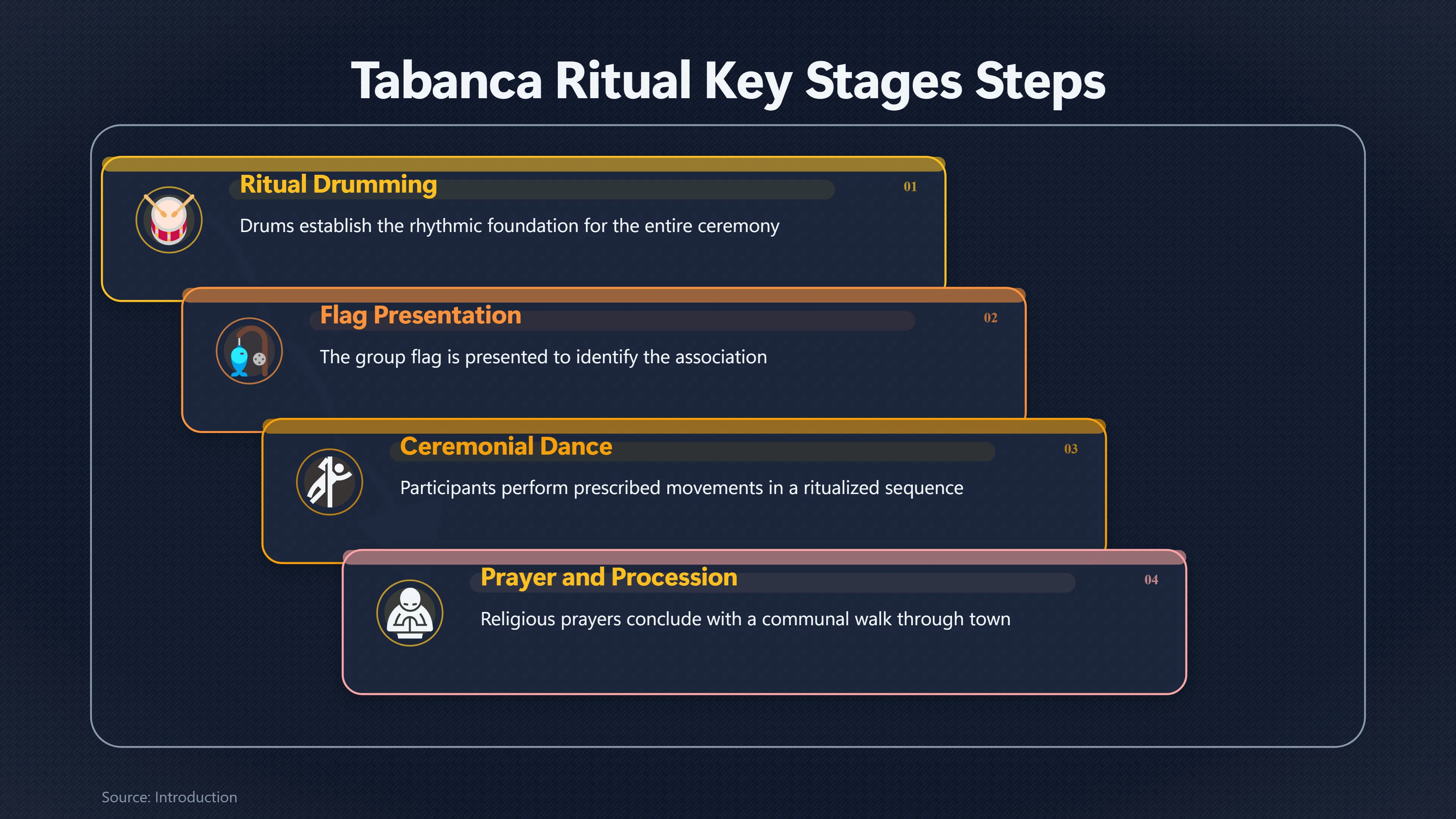
One striking example is the sequence of ceremonies known as the toque de salva, in which ritual drumming, the presentation of the flag, ceremonial dances, prayers and processional acts occur in a prescribed order. The museum preserves many of the physical objects involved, but their full meaning becomes clear only when viewed as part of this wider ceremonial sequence.[Instituto do Patrimnio Cultural]ipc.cvInstituto do Patrimnio Cultural Tabanca Instituto do Patrimnio CulturalInstituto do Patrimnio Cultural Tabanca Instituto do Patrimnio Cultural
Can a museum preserve a living ritual?
The Museum of Tabanca was originally established in 2000 during efforts to rescue a tradition then considered vulnerable to decline. In 2010 it moved from Assomada to Ch de Tanque, a community closely associated with active Tabanca practice. The relocation reflected an important curatorial choice: instead of isolating the collection within an urban cultural institution, it placed the museum inside a community where the tradition continues to be performed.[Instituto do Patrimnio Cultural]ipc.cvOpen source on ipc.cv.
This community-centred approach shapes the museum’s purpose. According to the Cultural Heritage Institute, the collection was assembled through fieldwork undertaken in several phases during the 1990s and 2000s across different communities on Santiago. Rather than collecting spectacular curiosities, researchers documented everyday ceremonial equipment that might otherwise have disappeared as groups modernised or older members passed away.[Instituto do Patrimnio Cultural]ipc.cvOpen source on ipc.cv.
The museum also positions itself as an educational centre. School groups, community organisations and Tabanca associations are intended audiences alongside tourists, emphasising that preservation depends upon transmitting knowledge as well as conserving objects. This reflects a broader understanding of intangible heritage, where songs, performance techniques, ceremonial roles and community memory are inseparable from the physical artefacts that support them.[Instituto do Patrimnio Cultural]ipc.cvOpen source on ipc.cv.
Preservation, heritage status and community control
The Museum of Tabanca illustrates an important principle in heritage preservation: community traditions cannot simply be frozen behind glass. Instruments wear out, costumes require repair, and ceremonial objects continue to circulate through annual celebrations. Preservation therefore means balancing documentation with continued use.
Cape Verde’s recognition of Tabanca as National Intangible Cultural Heritage strengthened this approach by acknowledging that safeguarding depends upon practitioners themselves. Official inventories and museum collections record material culture, but local associations remain responsible for organising festivals, maintaining ceremonial hierarchies, transmitting musical knowledge and preserving ritual practice.[Instituto do Patrimnio Cultural]ipc.cvInstituto do Patrimnio Cultural Tabanca Instituto do Patrimnio CulturalInstituto do Patrimnio Cultural Tabanca Instituto do Patrimnio Cultural
Visitors should also be aware that the museum’s accessibility has varied in recent years, with the Cultural Heritage Institute noting periods of temporary closure. Even so, its significance extends beyond opening hours. It represents an unusual type of collection in which preservation is measured not only by what survives in storage or display cases, but by whether drums continue to sound, processions continue to form and communities continue to recognise the objects as part of their own living tradition.[Instituto do Patrimnio Cultural]ipc.cvOpen source on ipc.cv.

Amazon book picks
Further Reading
Books and field guides related to Can a Museum Preserve a Living Ritual?. Use these as the next step if you want deeper reading beyond the article.
The Anthropology of Music
In this highly praised and seminal work, Alan Merriam demonstrates that music is a social behavior—one worthy and available to study thro...
The Interpretation Of Cultures
One of the twentieth century's most influential books, this classic work of anthropology offers a groundbreaking exploration of what cult...
Intangible Heritage
Intangible Heritage fills a significant gap in the heritage literature available and represents a significant cross section of ideas and...
The Work of the Dead
The meaning of our concern for mortal remains—from antiquity through the twentieth century The Greek philosopher Diogenes said that when...
eBay marketplace picks
Marketplace Samples
Live-tested eBay searches with available results related to this page.
Selected fromafrican ceremonial art oneBay.co.uk.
Endnotes
1.
Source: ipc.cv
Link:https://ipc.cv/en/museus/museu-da-tabanca/
2.
Source: ipc.cv
Title: Instituto do Patrimnio Cultural Tabanca Instituto do Patrimnio Cultural
Link:https://ipc.cv/en/patromonio-imaterial/tabanca/
3.
Source: ipc.cv
Link:https://ipc.cv/en/museus/museu-da-tabanca/2/
4.
Source: ipc.cv
Link:https://ipc.cv/en/noticias/a-tabanca-e-o-empoderamento-da-comunidade-onde-esta-inserida-mcic-abraao-vicente/
Source snippet
May 7, 2024 A TABANCA O EMPODERAMENTO DA COMUNIDADE ONDE EST INSERIDA MCIC, ABRAO VICENTE Image: 442476792_849991707173241_89145...
Published: May 7, 2024
5.
Source: ipc.cv
Link:https://ipc.cv/museus/museu-da-tabanca/
6.
Source: ipc.cv
Link:https://ipc.cv/cv/museus/museu-da-tabanca/2/
7.
Source: ipc.cv
Link:https://ipc.cv/patromonio-imaterial/tabanca/
8.
Source: ipc.cv
Link:https://ipc.cv/en/patromonio-imaterial/
9.
Source: museus.cv
Link:https://museus.cv/en/museum_net
Additional References
10.
Source: governo.cv
Link:https://www.governo.cv/a-tabanca-e-o-empoderamento-da-comunidade-onde-esta-inserida-ministro-da-cultura-e-das-industrias-criativas-abraao-vicente/
Source snippet
Governo de Cabo VerdeMay 8, 2024 A TABANCA O EMPODERAMENTO DA COMUNIDADE ONDE EST INSERIDA MINISTRO DA CULTURA E DAS INDSTRIAS...
Published: May 8, 2024
11.
Source: cabo-verde.cv
Title: Tabanka: The Rhythms of Resistance on Santiago Island Cabo Verde
Link:https://cabo-verde.cv/tabanka-the-rhythms-of-resistance-on-santiago-island/
Source snippet
April 17, 2026 NEWS Latest News * Cabo Verde * News * Culture * Tabanka: The Rhythms of Resistance on Santiago Island Image: Tabanka: T...
Published: April 17, 2026
12.
Source: cabo-verde.cv
Title: Cape Verde Festivals & Traditions: A Cultural Guide Cabo Verde
Link:https://cabo-verde.cv/cape-verde-festivals-traditions-a-cultural-guide/
Source snippet
March 24, 2026 * Cape Verde Festivals & Traditions: A Cultural Guide Image: Cape Verde Festivals & Traditions: A Cultural Guide Cape Ve...
Published: March 24, 2026
13.
Source: youtube.com
Title: Cape Verde: Cultural and historical treasures on Santiago Island
Link:https://www.youtube.com/watch?v=A8v5gWjXjL4
Source snippet
Tradition meets tourism in Cape Verde's Tabanca festival...
14.
Source: youtube.com
Title: Island of Maio
Link:https://www.youtube.com/watch?v=8qT6vUfN7z8
Source snippet
Santiago Island Cape Verde | Discovering Tabanca and Batuku...
15.
Source: youtube.com
Title: Inside a living museum of Tabanca culture in Cabo Verde
Link:https://www.youtube.com/watch?v=S08R34nL2p4
Source snippet
Island of Maio - Cape Verde | Tabanca tradition and community...
16.
Source: youtube.com
Title: Tradition meets tourism in Cape Verde’s Tabanca festival
Link:https://www.youtube.com/watch?v=rXjO6LdZ0Y4
Source snippet
Inside a living museum of Tabanca culture in Cabo Verde...
17.
Source: caboverde-info.com
Link:https://www.caboverde-info.com/Identidade/Cultura/Tabanca
18.
Source: caboverde-info.com
Link:https://www.caboverde-info.com/eng/Identity/Culture/Tabanca
19.
Source: governo.cv
Link:https://www.governo.cv/queremos-tornar-santa-catarina-numa-centralidade-das-festividades-da-tabanca-mcic-abraao-vicente/