Within Strange Libya
How Did the Sahara Become an Open Air Archive?
The Acacus cliffs preserve thousands of images showing animals, cattle, rituals and communities from a greener prehistoric Sahara.
On this page
- What the rock images show
- A greener Sahara recorded in stone
- Visiting and protecting a vast outdoor collection
Page outline Jump by section
Introduction
The Tadrart Acacus in south-west Libya is one of the world’s most remarkable open-air image archives. Instead of paintings gathered inside a museum, its “collection” is spread across cliffs, rock shelters and sandstone outcrops extending through a remote Saharan landscape. Thousands of paintings and engravings, created between roughly 12,000 BC and AD 100, preserve a visual record of changing climates, animals and human societies over many millennia.[UNESCO World Heritage Centre]whc.unesco.orgWorld Heritage Centre Rock-Art Sites of Tadrart AcacusUNESCO World Heritage CentreRock-Art Sites of Tadrart Acacus - UNESCO World Heritage Centre…
For anyone interested in unusual collections, the Acacus is extraordinary because the archive is the landscape itself. Every decorated shelter forms part of a dispersed gallery that records a Sahara very different from today’s desert. Rather than documenting endless dunes, the images preserve memories of rivers, grasslands, wild animals, herding communities and ceremonies, allowing visitors to read environmental history directly from stone.
How Did the Sahara Become an Open-Air Archive?
The Acacus Mountains lie near Libya’s border with Algeria, adjoining the famous Tassili n’Ajjer rock-art region. UNESCO recognised the Libyan sites as a World Heritage Site in 1985 because together they preserve an exceptional record of cultures that occupied the central Sahara across thousands of years.[UNESCO World Heritage Centre]whc.unesco.orgWorld Heritage Centre Rock-Art Sites of Tadrart AcacusUNESCO World Heritage CentreRock-Art Sites of Tadrart Acacus - UNESCO World Heritage Centre…
Unlike a conventional museum, there was never a single place where these images were assembled. Prehistoric artists painted and engraved the sandstone wherever people camped, travelled, hunted or gathered. Over time, countless shelters accumulated new artwork without completely erasing older images, producing a layered visual record that archaeologists can compare with excavated campsites, burials and environmental evidence. Researchers increasingly study the entire landscape rather than isolated paintings, treating the Acacus as a connected archaeological archive rather than a collection of individual masterpieces.[acacus.org]acacus.orgThe Archaeological Mission in the SaharaRock art…
This makes the Acacus especially valuable within Libya’s unusual heritage. Instead of preserving objects behind glass, it preserves human experience where it originally happened.
What the Rock Images Show
The paintings and engravings cover an immense span of time, and their changing subjects mirror the transformation of the Sahara itself.
Among the most striking themes are:
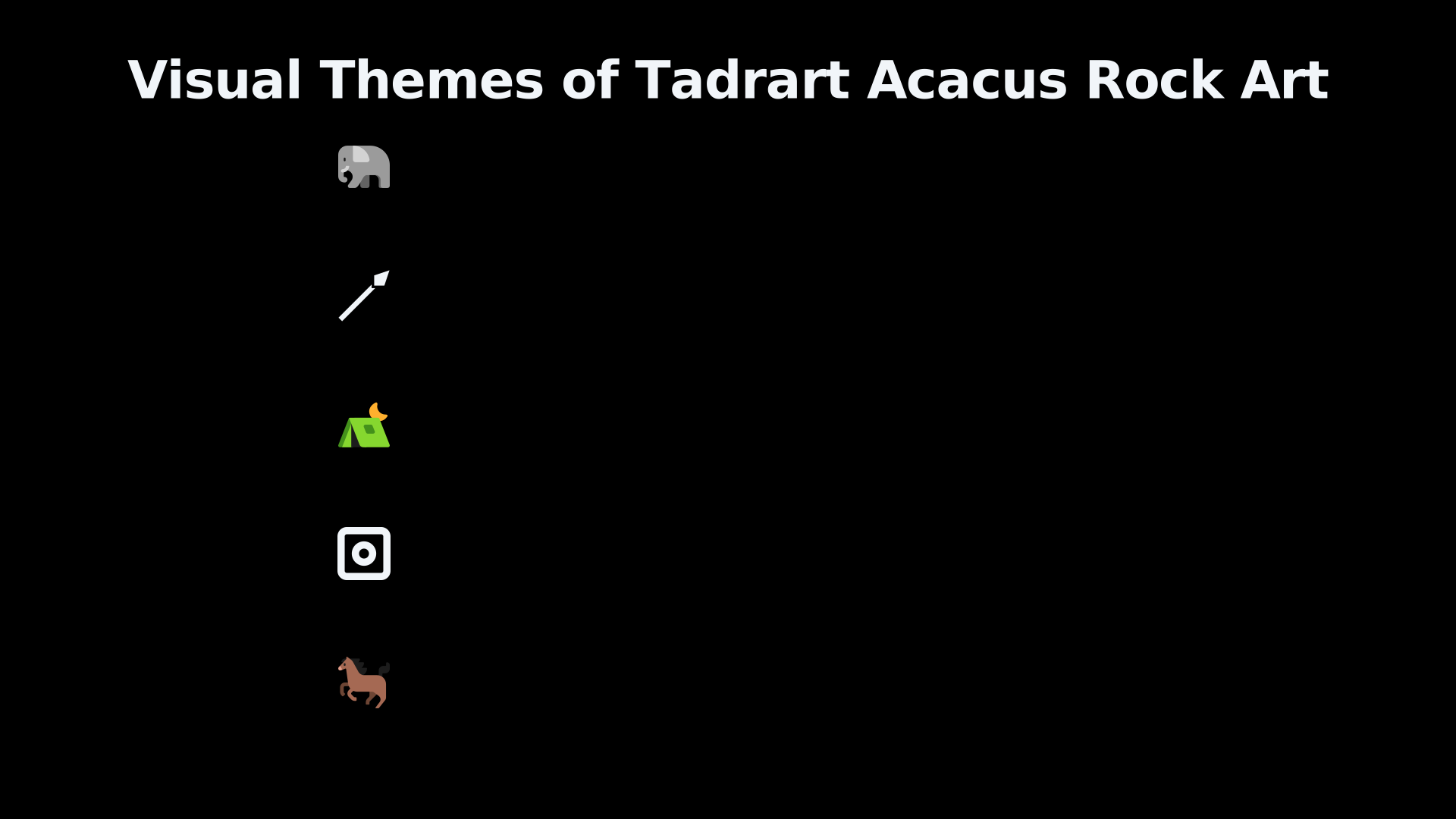
- Large wild animals including elephants, giraffes, rhinoceroses, hippopotamuses and crocodiles, demonstrating that the region once supported abundant water and vegetation.
- Hunting scenes showing bows, spears and organised groups pursuing game.
- Cattle herding, revealing the emergence of pastoral communities after hunting became less dominant.
- Domestic life, including families, camps, livestock and everyday activities.
- Ceremonial dances, decorated figures and scenes that may reflect ritual or symbolic practices, although many remain open to interpretation.
- Horses and later camels, signalling changing transport systems and the progressive drying of the Sahara.[UNESCO World Heritage Centre]whc.unesco.orgWorld Heritage Centre Rock-Art Sites of Tadrart AcacusUNESCO World Heritage CentreRock-Art Sites of Tadrart Acacus - UNESCO World Heritage Centre…
Archaeologists distinguish several broad artistic phases based on style, subject matter and archaeological context. Although exact dating remains debated for some individual paintings, the overall sequence consistently shows human communities adapting as climate, wildlife and ways of life changed across millennia.[acacus.org]acacus.orgThe Archaeological Mission in the SaharaRock art…
A Greener Sahara Recorded in Stone
Perhaps the greatest curiosity of the Acacus is that it functions as a visual climate archive.
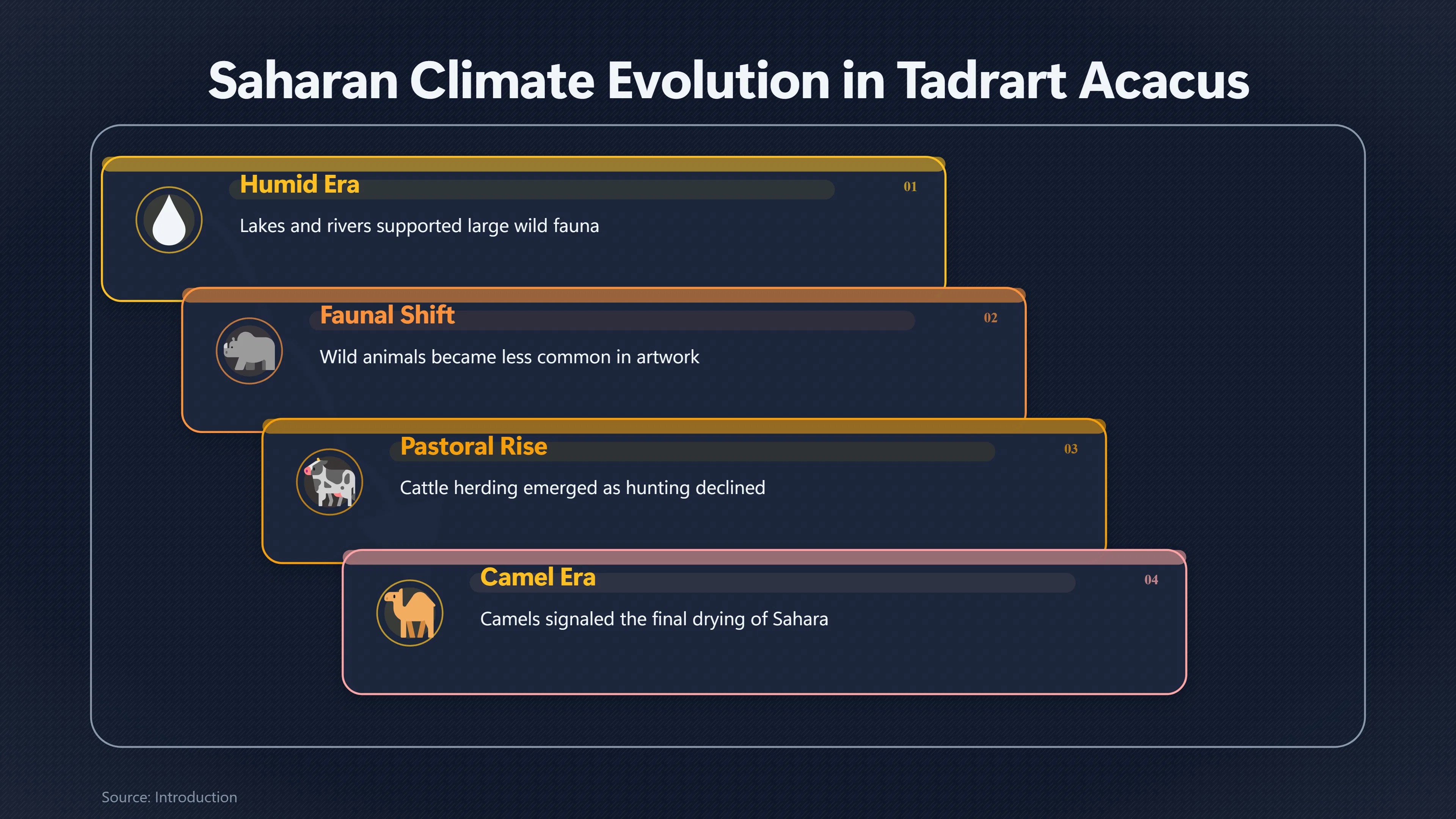
Modern visitors encounter an arid desert, yet the oldest images depict creatures that could only survive in landscapes with lakes, rivers and extensive grasslands. These scenes correspond with scientific evidence for the African Humid Period, when much of today’s Sahara supported permanent water, abundant vegetation and diverse wildlife before becoming progressively drier.
As rainfall declined, the artwork changed as well. Images of wild fauna became less common, while cattle, herders and eventually camels reflected new economic strategies suited to increasingly harsh conditions. Rather than illustrating a single moment in history, the Acacus records environmental change unfolding over thousands of years through successive generations of artists.[UNESCO World Heritage Centre]whc.unesco.orgWorld Heritage Centre Rock-Art Sites of Tadrart AcacusUNESCO World Heritage CentreRock-Art Sites of Tadrart Acacus - UNESCO World Heritage Centre…
For this reason, researchers often use the paintings alongside archaeological excavations, pollen studies and geological evidence to reconstruct prehistoric Saharan environments and the people who adapted to them.
Why the Images Matter Beyond Art
The Acacus is not simply a gallery of prehistoric pictures. Each decorated shelter forms part of a wider archaeological landscape containing campsites, stone tools, hearths, burials and other traces of everyday life.
Viewed together, these remains allow archaeologists to connect images with real communities instead of treating the paintings as isolated works of art. This broader landscape approach has become central to modern research, helping explain how symbolic expression, settlement patterns and environmental change interacted over long periods.[acacus.org]acacus.orgThe Archaeological Mission in the SaharaRock art…
Within Libya’s wider landscape of unusual heritage, the Acacus complements sites such as Uan Muhuggiag, where prehistoric burials reveal how the same Saharan societies treated their dead. The paintings provide the living world; the archaeological sites reveal the people behind it.

Visiting and Protecting a Vast Outdoor Collection
The Acacus is one of Libya’s most spectacular heritage destinations, but it is also among its most fragile. Its remoteness has helped preserve many paintings, yet isolation alone has not guaranteed their safety.
The site has suffered repeated damage from vandalism, including spray paint and deliberate defacement of famous panels, while theft of decorated rock fragments has also been documented. Political instability has complicated conservation, monitoring and visitor management, leading UNESCO to keep the Rock-Art Sites of Tadrart Acacus on the List of World Heritage in Danger since 2016. Recent World Heritage Committee decisions continue to stress the need for stronger conservation, cooperation with local communities and efforts to prevent illicit trafficking of cultural property.[UNESCO World Heritage Centre]whc.unesco.orgWorld Heritage Centre UNESCO World Heritage CentreUNESCO World Heritage CentreUNESCO World Heritage Centre - Decision - 42 COM 7A.26…
For visitors, access depends not only on the desert environment but also on current security conditions and local arrangements. Travel to the region normally requires experienced local guides and careful logistical planning. Responsible tourism means treating every painted shelter as part of a single irreplaceable archive rather than as an isolated attraction.
The Acacus remains remarkable precisely because it transforms an entire landscape into a museum without walls. Instead of preserving history inside display cases, the desert itself has become the gallery, and the sandstone cliffs continue to hold one of humanity’s longest surviving visual records of environmental change and everyday life.
Amazon book picks
Further Reading
Books and field guides related to How Did the Sahara Become an Open Air Archive?. Use these as the next step if you want deeper reading beyond the article.

A History of Modern Libya
First published 2006. Subjects: Libya, history, Libya, politics and government, Liberia, economic conditions.
The Oxford History of Ancient Egypt
The Oxford History of Ancient Egypt describes the emergence and development of the distinctive civilization of the ancient Egyptians, fro...
The Sahara: A Cultural History
The Sahara is the quintessence of isolation, epitomizing both remoteness and severity of environment unlike any other place on the face o...
The First Signs: Unlocking the Mysteries of the World's Oldes...
“If you love mysteries, you’ll love this book. Genevieve von Petzinger acts as guide and sleuth in this fascinating, accessible, and fast...
eBay marketplace picks
Marketplace Samples
Live-tested eBay searches with available results related to this page.
Selected fromrock art print oneBay.co.uk.



Endnotes
1.
Source: whc.unesco.org
Title: World Heritage Centre Rock-Art Sites of Tadrart Acacus
Link:https://whc.unesco.org/en/list/287/
Source snippet
UNESCO World Heritage CentreRock-Art Sites of Tadrart Acacus - UNESCO World Heritage Centre...
2.
Source: acacus.org
Title: The Archaeological Mission in the Sahara
Link:https://www.acacus.org/research/rock-art
Source snippet
Rock art...
3.
Source: whc.unesco.org
Title: World Heritage Centre UNESCO World Heritage Centre
Link:https://whc.unesco.org/en/decisions/7199
Source snippet
UNESCO World Heritage CentreUNESCO World Heritage Centre - Decision - 42 COM 7A.26...
4.
Source: whc.unesco.org
Title: World Heritage Centre UNESCO World Heritage Centre
Link:https://whc.unesco.org/en/decisions/8711
Source snippet
Having examined Document WHC/25/47.COM/7A, 2. Recalling Decision 46 COM 7A.24 adopted at i...
5.
Source: whc.unesco.org
Title: World Heritage Centre UNESCO World Heritage Centre
Link:https://whc.unesco.org/en/decisions/8493/
Source snippet
UNESCO World Heritage CentreUNESCO World Heritage Centre - Decision - 46 COM 7A.24...
6.
Source: unesco.org
Link:https://www.unesco.org/archives/multimedia/document-1145
7.
Source: unesco.nl
Link:https://www.unesco.nl/werelderfgoed/rotskunstgebied-van-tadrart-acacus
8.
Source: worldheritageexplorer.org
Title: Rock-Art Sites of Tadrart Acacus | World Heritage Explorer
Link:https://www.worldheritageexplorer.org/sites/rock-art_sites_of_tadrart_acacus.html
Source snippet
July 4, 2026 — ROCK-ART SITES OF TADRART ACACUS * * * World Heritage Identification Number: 287 World Heritage since: 1985 Category: Cult...
Published: July 4, 2026
Additional References
9.
Source: ecolex.org
Title: Rock-Art Sites of Tadrart Acacus (Libya) (C 287)
Link:https://www.ecolex.org/details/decision/rock-art-sites-of-tadrart-acacus-libya-c-287-f232a620-0a36-422f-a37a-a79f4f5bb967/
Source snippet
July 10, 2016 — ROCK-ART SITES OF TADRART ACACUS (LIBYA) (C 287) Document type Decision Reference number 7B.25 Date Jul 10, 2016 Source U...
Published: July 10, 2016
10.
Source: youtube.com
Title: Prehistoric Rock Art of the Sahara and the Research of András Zboray
Link:https://www.youtube.com/watch?v=3EBYT6sJz5Y
Source snippet
14,000-year-old rock art vandalised in lawless Sahara...
11.
Source: smarthistory.org
Title: rock art sites
Link:https://smarthistory.org/rock-art-sites/
Source snippet
Rock-art sites of Tadrart AcacusSeptember 23, 2016 — ROCK-ART SITES OF TADRART ACACUS by UNESCO Artwork Details Rock-Art S...
Published: September 23, 2016
12.
Source: youtube.com
Title: Saharan Rock Art in Peril
Link:https://www.youtube.com/watch?v=vXLm2O_kt1w
Source snippet
Tadrart Acacus rock art Libya UNESCO Rock-Art Sites of Tadrart Acacus (UNESCO/NHK) UNESCO...
13.
Source: africanworldheritagesites.org
Link:https://www.africanworldheritagesites.org/cultural-places/rock-art-pre-history/rock-art-of-tadrart-acacus.html
14.
Source: khanacademy.org
Link:https://www.khanacademy.org/humanities/prehistoric-art/neolithicart/neolithic-sites/a/rock-art-sites-of-tadrart-acacus-backstory
15.
Source: youtube.com
Title: Rock Art in the Green Sahara
Link:https://www.youtube.com/watch?v=HD_Ot2GaCXo
Source snippet
Prehistoric Rock Art of the Sahara and the Research of András Zboray...
16.
Source: youtube.com
Title: 14,000-year-old rock art vandalised in lawless Sahara
Link:https://www.youtube.com/watch?v=gSNo3gtdQEs
Source snippet
Saharan Rock Art in Peril...
17.
Source: youtube.com
Title: Rock-Art Sites of Tadrart Acacus (UNESCO/NHK)
Link:https://www.youtube.com/watch?v=C_OxZpaOShg
Source snippet
Rock Art in the Green Sahara...