Within Strange Germany
How Germany Turns Death Into Public Memory
Kassel's funerary museum uses coffins, clothing and memorial objects to show how societies make grief visible.
On this page
- What visitors encounter in Kassel
- How mourning objects reveal social change
- Why the museum is more humane than macabre
Page outline Jump by section
Introduction
Germany’s most distinctive museum devoted to death is not designed as a haunted attraction or a collection of gruesome curiosities. Instead, the Museum of Sepulchral Culture in Kassel asks a more universal question: how do ordinary people remember the dead? Through coffins, mourning clothes, memorial jewellery, funeral photographs, grave markers and other everyday objects, it explores how grief becomes visible in material culture. Rather than treating death as spectacle, the museum presents burial, remembrance and mourning as changing social practices that reflect religion, family life, art and public memory. In the wider landscape of Germany’s unusual museums, it stands out because its collections reveal not only how people died, but how the living chose to remember them.[Sepulkral Museum]sepulkralmuseum.deSepulkral Museum Sepulchral Museum | Museum of Sepulchral CultureSepulkral Museum Sepulchral Museum | Museum of Sepulchral Culture

What visitors encounter in Kassel
The Museum of Sepulchral Culture is unique in Germany as a museum dedicated entirely to death, burial, mourning and remembrance. Its permanent collections span roughly two millennia, although their main focus is the development of Central European funeral culture from the late Middle Ages to the present day. The museum combines historical artefacts with contemporary art, design, research and changing exhibitions, making it both a cultural history museum and an active centre for discussion about death in modern society.[Sepulkral Museum]sepulkralmuseum.deSepulkral MuseumMuseum of Sepulchral Culture in KasselAugust 25, 2025…
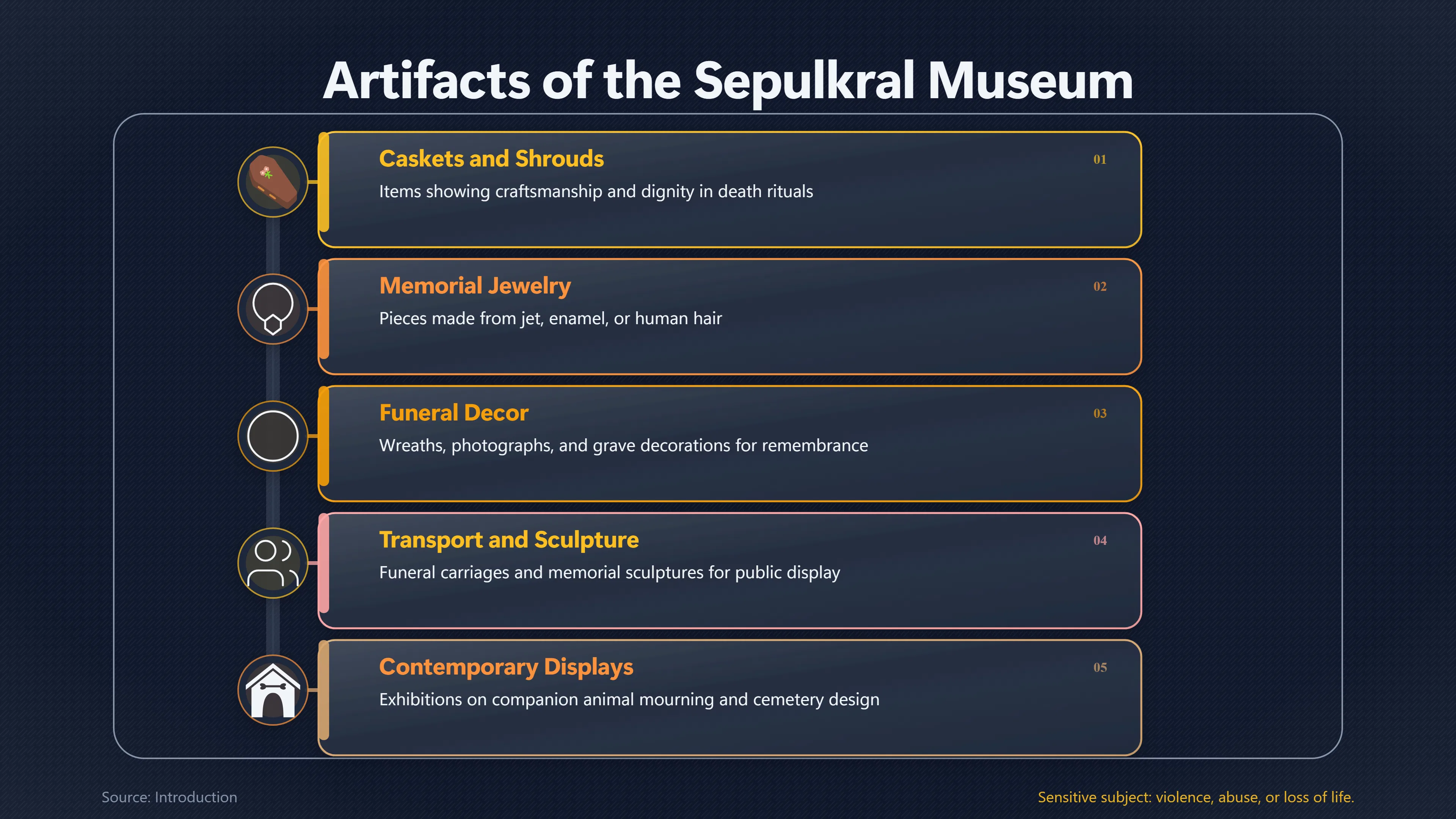
Visitors encounter objects that would once have been familiar parts of everyday life but now seem unusual because funeral customs have changed. These include:
- Coffins showing changing ideas about craftsmanship, religion and status.
- Burial clothing and shrouds that illustrate shifting expectations of dignity and ritual.
- Mourning jewellery made from jet, enamel or woven human hair, preserving the memory of deceased relatives.
- Funeral wreaths, memorial photographs and grave decorations.
- Funeral carriages, memorial sculptures and religious artworks.
- Temporary exhibitions examining contemporary questions about remembrance, cemetery design and even the mourning of companion animals.[kassel.de]www1.kassel.deStadt Kassel Museum für Sepulkralkultur | Stadt KasselStadt Kassel Museum für Sepulkralkultur | Stadt Kassel
Instead of arranging these objects as macabre curiosities, the displays explain why they mattered to the families who used them and how their meanings changed over time.
How mourning objects reveal social change
One of the museum’s strongest ideas is that the objects left behind after death are historical evidence. They record changing attitudes towards family, religion and emotion far more clearly than written records alone.
In earlier centuries, mourning was often expected to be highly visible. Black clothing, elaborate funeral processions and carefully decorated graves publicly demonstrated respect for the deceased and reinforced social identity. Personal memorial objects—especially jewellery containing locks of hair or miniature portraits—allowed families to carry physical reminders of loved ones long before photography became widespread. These items transformed grief into something tangible and portable rather than purely emotional.[Sepulkral Museum]sepulkralmuseum.deSepulkral Museum Permanent exhibition | Museum of Sepulchral CultureSepulkral Museum Permanent exhibition | Museum of Sepulchral Culture
The collections also show how industrialisation and modernisation altered funeral culture. Mass production made coffins, memorial ornaments and funeral accessories more standardised, while changing religious beliefs and urban living gradually reshaped burial customs. Contemporary displays often contrast these older traditions with today’s cremation practices, environmentally conscious burials and increasingly personalised memorials, illustrating that remembrance continues to evolve rather than disappear.[Sepulkral Museum]sepulkralmuseum.deSepulkral Museum Sepulchral Museum | Museum of Sepulchral CultureSepulkral Museum Sepulchral Museum | Museum of Sepulchral Culture
Why the museum feels humane rather than macabre
Many visitors expect a museum about death to focus on horror or pathology. Kassel deliberately avoids that approach.
Its exhibitions concentrate on the relationships between the living and the dead rather than on human remains themselves. The museum describes its mission as creating space for reflection through historical, artistic, social and scientific perspectives, encouraging visitors to think about mourning as a shared human experience instead of an abnormal subject. Educational programmes, public discussions and research activities reinforce that aim.[Sepulkral Museum]sepulkralmuseum.deSepulkral Museum Sepulchral Museum | Museum of Sepulchral CultureSepulkral Museum Sepulchral Museum | Museum of Sepulchral Culture
Even exhibitions that address difficult themes are framed around care and memory rather than shock. Recent displays, for example, have examined how people grieve for companion animals and how changing family relationships influence memorial practices. Such exhibitions expand the idea of remembrance beyond traditional funeral history while remaining grounded in everyday emotional experience.[Stadt Kassel]kassel.deStadt Kassel Museum für Sepulkralkultur Sonderausstellung | Stadt KasselStadt Kassel Museum für Sepulkralkultur Sonderausstellung | Stadt Kassel
Objects that preserve memory instead of fear
The museum demonstrates that seemingly ordinary artefacts become culturally significant because they survive long after the people connected with them have gone.
A simple mourning dress reflects expectations about gender and public behaviour. A wreath records changing funeral symbolism. A gravestone documents artistic taste alongside family history. A lock of hair preserved inside jewellery represents a time when photography was uncommon and physical keepsakes carried exceptional emotional weight.
Seen together, these collections reveal that societies continually invent material ways to cope with loss. The objects themselves are rarely extraordinary, but the stories they preserve make them powerful historical evidence. They show how remembrance is built through ritual, craftsmanship and personal keepsakes rather than through dramatic relics alone.[Sepulkral Museum]sepulkralmuseum.deSepulkral Museum Permanent exhibition | Museum of Sepulchral CultureSepulkral Museum Permanent exhibition | Museum of Sepulchral Culture
Why this museum matters within Germany’s curiosity culture
Germany’s stranger museums often challenge visitors’ expectations by replacing sensational stories with careful interpretation. The Museum of Sepulchral Culture exemplifies that tradition.
Rather than presenting death as an attraction, it examines the cultural mechanisms that surround it: how communities bury their dead, how families express grief, how memorial traditions evolve and how material objects preserve memory across generations. In doing so, it offers a different kind of curiosity. The fascination comes not from confronting mortality itself, but from recognising how ordinary possessions—coffins, clothing, jewellery and memorials—become lasting records of the ways people have tried to give meaning to loss.[Sepulkral Museum]sepulkralmuseum.deSepulkral Museum Sepulchral Museum | Museum of Sepulchral CultureSepulkral Museum Sepulchral Museum | Museum of Sepulchral Culture
Amazon book picks
Further Reading
Books and field guides related to How Germany Turns Death Into Public Memory. Use these as the next step if you want deeper reading beyond the article.
The Work of the Dead
The meaning of our concern for mortal remains—from antiquity through the twentieth century The Greek philosopher Diogenes said that when...
From Here to Eternity
The best-selling author ofSmoke Gets in Your Eyes expands our sense of what it means to treat the dead with "dignity."
The Denial of Death
'It made me rethink the roots of our deepest fears and insecurities, and why we often disappoint ourselves in how we manifest them' Bill...
Death and the Afterlife
"In Death and the Afterlife, philosopher Samuel Scheffler poses this thought experiment in order to show that the continued life of the h...
eBay marketplace picks
Marketplace Samples
Live-tested eBay searches with available results related to this page.
Selected fromfuneral art oneBay.co.uk.
Endnotes
1.
Source: www1.kassel.de
Title: Stadt Kassel Museum für Sepulkralkultur | Stadt Kassel
Link:https://www1.kassel.de/buerger/kunst_und_kultur/museen/museen/museum-fuer-sepulkralkultur.php
2.
Source: kassel.de
Title: Stadt Kassel Museum für Sepulkralkultur Sonderausstellung | Stadt Kassel
Link:https://www.kassel.de/aktuelles/aktuelle-meldungen/kunst-und-kultur/sepulkralmuseum-sonderausstellung.php
3.
Source: visit.kassel.de
Link:https://visit.kassel.de/en/poi/museum-of-sepulchral-culture
4.
Source: visit.kassel.de
Link:https://visit.kassel.de/poi/museum-fuer-sepulkralkultur
5.
Source: kassel.de
Link:https://www.kassel.de/buerger/kunst_und_kultur/museen_sammlungen.php
6.
Source: visit.kassel.de
Link:https://visit.kassel.de/en/poi/museum-of-hessian-history
7.
Source: museum.de
Title: für sepulkralkultur
Link:https://www.museum.de/en/museen/museum-f%C3%BCr-sepulkralkultur
8.
Source: museum.de
Title: für sepulkralkultur
Link:https://www.museum.de/de/museen/museum-f%C3%BCr-sepulkralkultur
9.
Source: sepulkralmuseum.de
Title: Sepulkral Museum Sepulchral Museum | Museum of Sepulchral Culture
Link:https://www.sepulkralmuseum.de/en/museum-fuer-sepulkralkultur/
10.
Source: sepulkralmuseum.de
Title: Sepulkral Museum Permanent exhibition | Museum of Sepulchral Culture
Link:https://www.sepulkralmuseum.de/en/permanent-presentation/
11.
Source: sepulkralmuseum.de
Link:https://www.sepulkralmuseum.de/en/
Source snippet
Sepulkral MuseumMuseum of Sepulchral Culture in KasselAugust 25, 2025...
Published: August 25, 2025
12.
Source: sepulkralmuseum.de
Link:https://www.sepulkralmuseum.de/EN/research/research-on-sepulchral-culture/central-institute-for-sepulchral-culture
13.
Source: sepulkralmuseum.de
Title: Opening Hours & Prices | Museum of Sepulchral Culture
Link:https://www.sepulkralmuseum.de/en/besuch/
Source snippet
17:00 p.m. Wednesday: 10:00 a.m. – 20:00 p.m Thursday to Sunday: 10:00 AM – 17:00 PM MUSEUM OPENING HOURS * Monday Closed * Tuesday...
14.
Source: sepulkralmuseum.de
Title: Museum für Sepulkralkultur in Kassel
Link:https://www.sepulkralmuseum.de/
Source snippet
August 25, 2025 — Öffnungszeiten Museum Montag: geschlossen Dienstag: 10:00 – 17:00 Uhr Mittwoch: 10:00 – 20:00 Uhr Donnerstag bis Sonnta...
Published: August 25, 2025
15.
Source: sepulkralmuseum.de
Title: Museum of Sepulchral Culture in Kassel
Link:https://www.sepulkralmuseum.de/en/?kalender_woche=2026
Source snippet
17:00 p.m. Wednesday: 10:00 a.m. – 20:00 p.m Thursday to Sunday: 10:00 AM – 17:00 PM MUSEUM OF SEPULCHRAL CULTURE in Kassel DEATH IS P...
16.
Source: sepulkralmuseum.de
Link:https://www.sepulkralmuseum.de/en/ausstellung/dazwischen/
Source snippet
in between | Museum for Sepulchral CultureMay 19, 2024 — BETWEEN Image Period 19.05.2024 01.09.2024 Admission prices Learn more Guided To...
Published: May 19, 2024
17.
Source: sepulkralmuseum.de
Title: New concept | Museum for Sepulchral Culture
Link:https://www.sepulkralmuseum.de/en/museum-fuer-sepulkralkultur/neukonzeption/
18.
Source: sepulkralmuseum.de
Link:https://www.sepulkralmuseum.de/EN/museum/projects/redesign
19.
Source: sepulkralmuseum.de
Link:https://www.sepulkralmuseum.de/EN/museum/museum-for-sepulchral-culture/mission-statement
20.
Source: sepulkralmuseum.de
Link:https://sepulkralmuseum.de/EN/museum/museum-for-sepulchral-culture/
Additional References
21.
Source: kultur-kassel.de
Link:https://www.kultur-kassel.de/kultur/kassel/museen/sepulkralmuseum/sepukralmuseum.html
22.
Source: youtube.com
Title: 20 Jahre Museum für Sepulkralkultur
Link:http://www.youtube.com/watch?v=jlN4Z1CJ2IY
Source snippet
Lucy Dacus Reacts to Victorian Doll's House and Haunted Hair Jewellery...
23.
Source: youtube.com
Title: Lucy Dacus Reacts to Victorian Doll’s House and Haunted Hair Jewellery
Link:http://www.youtube.com/watch?v=8FN4Tn0HbHY
Source snippet
What is Victorian Jewellery?...
24.
Source: youtube.com
Title: The Art of Mourning Jewelry
Link:https://www.youtube.com/watch?v=S9oPj1uX5jA
Source snippet
Exploring the Mütter Museum's Collection...
25.
Source: youtube.com
Title: Museum of Sepulchral Culture: Death and Mourning
Link:https://www.youtube.com/watch?v=sO-o_wH4s-k
Source snippet
The Art of Mourning Jewelry...
26.
Source: youtube.com
Title: Exploring the Mütter Museum’s Collection
Link:https://www.youtube.com/watch?v=b2yZhTieVsI
Source snippet
Hair Jewelry and Victorian Remembrance...
27.
Source: youtube.com
Title: Hair Jewelry and Victorian Remembrance
Link:https://www.youtube.com/watch?v=jW7zN97lZ0o
Source snippet
Medical Oddities and Material Culture...
28.
Source: youtube.com
Title: What is Victorian Jewellery?
Link:http://www.youtube.com/watch?v=1wzhPPeGAaE
Source snippet
The Art of Mourning...
29.
Source: youtube.com
Title: Medical Oddities and Material Culture
Link:https://www.youtube.com/watch?v=38QlL9XnSWA
30.
Source: youtube.com
Title: The Art of Mourning
Link:http://www.youtube.com/watch?v=s0Y_544e3tU
Source snippet
Death in the Victorian Era...