Within Uncanny Belgium
Why Binche's Masks Are Still Alive
MUMASK preserves masks and costumes that still belong to an active civic ritual rather than a vanished or invented folklore display.
On this page
- What the Gilles wear and why it matters
- How carnival rules shape the museum collection
- The risks of displaying masks without their communities
Page outline Jump by section
Introduction
The masks of Binche are unusual because they belong to a collection that is still in active use rather than to a vanished tradition. At MUMASK, the International Carnival and Mask Museum in Binche, visitors encounter costumes, wax masks, feather hats, photographs, recordings and workshop knowledge that remain part of an annual civic ritual rather than a reconstructed historical spectacle. The museum’s role is therefore different from that of a conventional folklore museum: it preserves evidence of a living tradition while recognising that its most important exhibits only become fully meaningful when they return to the streets during the Carnival of Binche. This approach reflects why the carnival was recognised by UNESCO as Intangible Cultural Heritage: the knowledge, craftsmanship and social rules are as important as the physical objects themselves.[Mumask]mumask.beCarnival in BincheCarnival in Binche - Mumask…

What the Gilles wear and why it matters
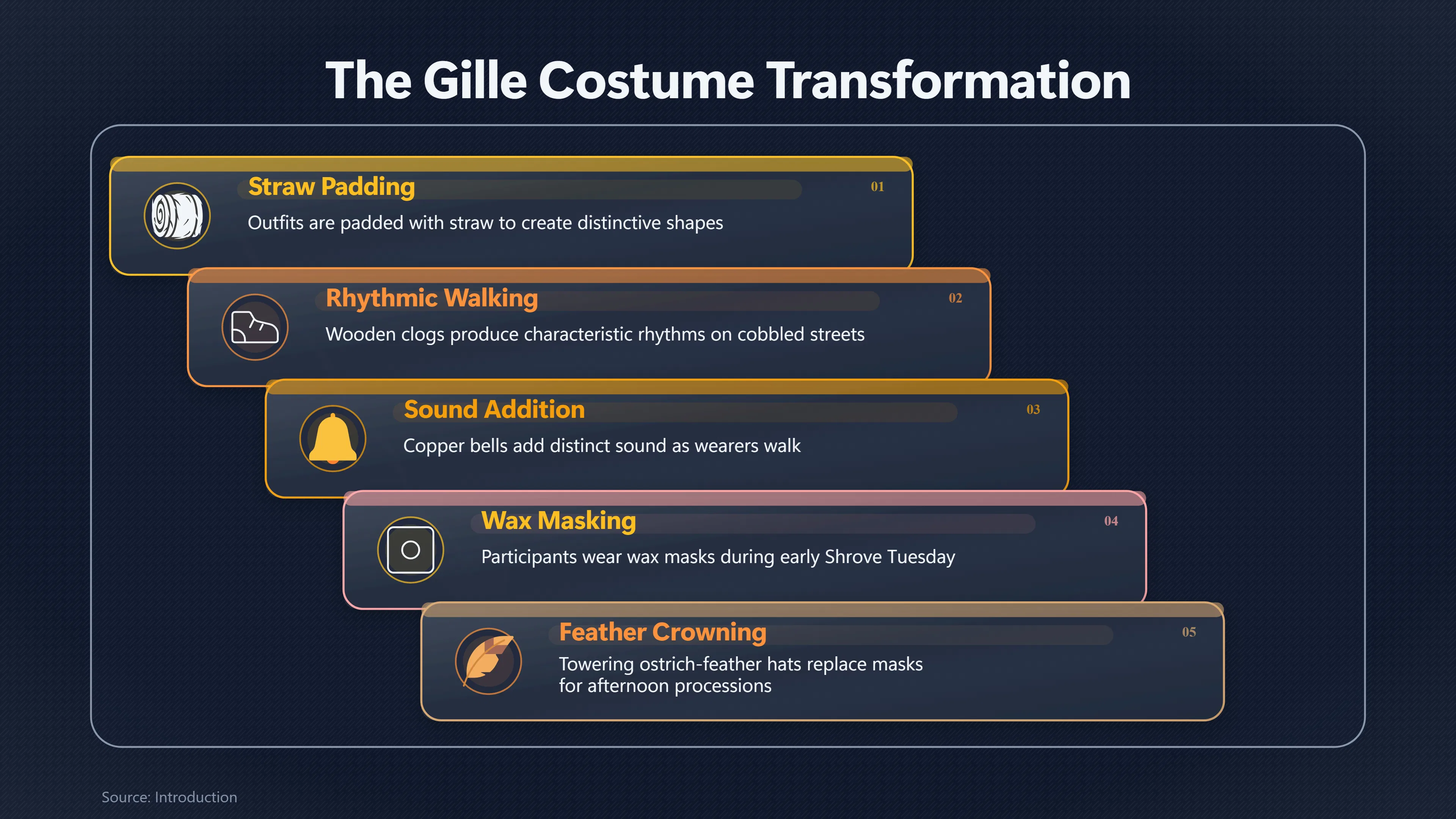
The best-known figure in the carnival is the Gille, whose appearance is governed by strict local custom rather than personal creativity. Every element of the costume carries practical and symbolic weight. The red, yellow and black outfit is padded with straw to create its distinctive shape, wooden clogs produce the characteristic rhythm on cobbled streets, copper bells add sound as the wearer walks, and the famous wax mask is worn only during part of Shrove Tuesday before being replaced by the towering ostrich-feather hat for the afternoon procession.[Binche]binche.beThe Gille — BincheThe Gille — Binche - English…
The museum’s collection demonstrates that these are not theatrical props assembled for tourists. Many pieces are made by specialist craftspeople whose skills continue to be passed between generations. Costumes are traditionally rented from a small number of established costume makers rather than owned outright, while the distinctive wax masks remain tightly controlled. The City of Binche registered the mask’s design, and authentic examples are reserved for participants in the carnival, reinforcing the idea that the object belongs to a living community rather than an open commercial market.[Binche]binche.beThe Gille — BincheThe Gille — Binche - English…
Just as significant are the rules governing who may wear the costume. Participation is limited by longstanding local customs, and the Gille costume may only be worn during the carnival itself. A well-known saying captures the principle: “a Gille never leaves”, reflecting the rule that the costume does not leave the town. These restrictions are central to understanding why the museum treats the costume as evidence of a continuing social system rather than simply an attractive historical artefact.[Binche]binche.beThe Gille — BincheThe Gille — Binche - English…
How carnival rules shape the museum collection
Unlike many folklore museums that preserve traditions after they have faded, MUMASK actively documents a celebration that continues to evolve. Its Binche Carnival Interpretation Centre brings together more than 2,000 objects, alongside photographs, film, oral testimony and audio recordings that explain not only the famous Gilles but also other recognised carnival figures such as the Peasant, Pierrot, Sailor and Harlequin. The collection continues to grow as new material is documented and researched, reflecting changes within the tradition instead of freezing it at a single historical moment.[Mumask]mumask.beCarnival in BincheCarnival in Binche - Mumask…
This curatorial approach highlights an important distinction between tangible and intangible heritage. The museum can preserve masks, hats and costumes indefinitely, but it also records the annual calendar, dressing rituals, music, dance, family participation and local organisation that give those objects meaning. UNESCO’s recognition specifically emphasises the preservation of craftsmanship, music, costume making and community knowledge, illustrating that the carnival survives because people continue to perform it rather than because museums display it.[ICH UNESCO]ich.unesco.orgICH UNESCOCarnival of BincheUNESCO Intangible Cultural Heritage…
Visitors therefore encounter two overlapping collections. One consists of physical objects displayed in galleries. The other is effectively the town itself during carnival season, where those same traditions are activated through rehearsal, performance and inherited local practice. The museum serves as an interpretation centre between these two worlds rather than as a substitute for the event.

The risks of displaying masks without their communities
Binche also illustrates a challenge faced by museums that collect living traditions. A mask displayed in a glass case can easily appear mysterious or anonymous, encouraging visitors to interpret it as an isolated work of folk art. In reality, the Binche mask only functions within an intricate network of local rules, family participation, music, costume rental, craftsmanship and civic identity.
MUMASK deliberately addresses this problem by placing the Binche collections alongside documentation of performances, interviews and historical development instead of presenting masks as detached curiosities. The emphasis shifts from asking “What does this mask look like?” to “Who is permitted to wear it, when, why and according to whose traditions?”[Mumask]mumask.beCarnival in BincheCarnival in Binche - Mumask…
The museum also avoids suggesting that the Gilles alone define the carnival. Recent interpretation increasingly explains the wider cast of carnival characters and acknowledges the broader community that sustains the event, including costume makers, musicians, organisers and families. This reflects a wider understanding of heritage as a collective practice rather than a display of iconic objects alone.[Mumask]mumask.beCarnival in BincheCarnival in Binche - Mumask…
Why Binche matters in Belgium’s curiosity landscape
Among Belgium’s unusual collections, Binche occupies a distinctive position because its central objects have never become purely historical. Many curiosity collections preserve extinct beliefs, abandoned rituals or obsolete technologies. MUMASK instead documents an annual tradition that still defines local identity and continues to require specialist craftsmanship, financial commitment and strict adherence to inherited customs.
For visitors interested in Belgium’s stranger cultural heritage, this makes Binche unusual in a different way from museums devoted to witchcraft, medical oddities or cabinets of curiosity. Its fascination lies not in bizarre artefacts alone but in watching museum objects repeatedly return to public life. The wax mask, feather hat and straw-filled costume remain significant precisely because they are still embedded in a community that insists they belong first to the carnival and only second to the museum.[mumask.be]mumask.beCarnival in BincheCarnival in Binche - Mumask…
Amazon book picks
Further Reading
Books and field guides related to Why Binche's Masks Are Still Alive. Use these as the next step if you want deeper reading beyond the article.
Carnival and Other Christian Festivals
With a riotous mix of saints and devils, street theater and dancing, and music and fireworks, Christian festivals are some of the most li...
Intangible Heritage
Intangible Heritage fills a significant gap in the heritage literature available and represents a significant cross section of ideas and...
The Birth of the Museum
In a series of richly detailed case studies from Britian, Australia and North America, Tony Bennett investigates how nineteenth- and twen...
eBay marketplace picks
Marketplace Samples
Live-tested eBay searches with available results related to this page.
Selected fromcultural collectible oneBay.co.uk.

Current eBay listing
Vintage Ethiopian Lion of Judah Pendant Collectible Cultural Charm
Current eBay listing
Indonesian Handmade Decorative Fan JAVA Cultural Collectible
Endnotes
1.
Source: mumask.be
Title: Carnival in Binche
Link:https://mumask.be/en/carnival-in-binche/
Source snippet
Carnival in Binche - Mumask...
2.
Source: ich.unesco.org
Title: ICH UNESCOCarnival of Binche
Link:https://ich.unesco.org/en/RL/carnival-of-binche-00033?RL=00033
Source snippet
UNESCO Intangible Cultural Heritage...
3.
Source: binche.be
Title: The Gille — Binche
Link:https://www.binche.be/en/things-to-do/carnivals/carnival-of-binche/the-carnival/participants/the-gille
Source snippet
The Gille — Binche - English...
4.
Source: mumask.be
Link:https://mumask.be/en/
Source snippet
Dive into the fascinating universe of masks and carnivals from around the world. Discover living traditions, spectacular costumes, and one...
5.
Source: mumask.be
Title: Carnaval de binche
Link:https://mumask.be/carnaval-de-binche/
Source snippet
CARNAVAL DE BINCHE CARNAVAL DE BINCHE Reconnu en 2003 comme Patrimoine Culturel Immatériel par l’UNESCO, le Carnaval de Binche est...
6.
Source: mumask.be
Link:https://mumask.be/
Source snippet
Plongez dans l’univers fascinant des masques et des carnavals du monde entier. Découvrez des traditions vivantes, des costumes spectacula...
7.
Source: mumask.be
Title: Our history
Link:https://mumask.be/en/our-history/
Source snippet
A journey rich in highlights, encounters and cultural commitment. FROM ITS FOUNDATION TO THE P...
8.
Source: binche.be
Title: International Carnival and Mask Museum — Binche
Link:https://www.binche.be/en/things-to-do/tourism/binche-tourism/to-see-to-do/museum/musee-international-du-carnaval-et-du-masque
Source snippet
EnglishINTERNATIONAL CARNIVAL AND MASK MUSEUM Image: 22Copyrights VICTRO EXHIBITON Formerly an Augustinian school in the 18th century, th...
9.
Source: binche.be
Title: Musée international du Carnaval et du Masque — Binche
Link:https://www.binche.be/en/directory/musee-du-masque
10.
Source: binche.be
Link:https://www.binche.be/fr/que-faire/culture/musee-international-du-carnaval-et-du-masque
11.
Source: binche.be
Title: Shrove Tuesday — Binche
Link:https://www.binche.be/en/things-to-do/carnivals/carnival-of-binche/the-carnival/shrove-tuesday
12.
Source: binche.be
Link:https://www.binche.be/fr/que-faire/carnavals/carnaval-de-binche/le-carnaval/les-participants/le-gilles
13.
Source: ich.unesco.org
Title: accredited ong 01052
Link:https://ich.unesco.org/en/accredited-ngos/accredited-ong-01052
14.
Source: unesco.org
Title: Carnival of Binche, Belgium (NHK) | Intangible Heritage
Link:https://www.unesco.org/archives/multimedia/document-3468
15.
Source: ich.unesco.org
Title: ong accreditee 01052
Link:https://ich.unesco.org/fr/ong-accreditees/ong-accreditee-01052
16.
Source: en.binchetourisme.be
Title: be International Carnival and Mask Museum — Binche
Link:https://en.binchetourisme.be/to-see-to-do/museum/musee-international-du-carnaval-et-du-masque
17.
Source: binchetourisme.be
Link:https://www.binchetourisme.be/a-voir-a-faire/musee/musee-international-du-carnaval-et-du-masque
18.
Source: parcmuseum.be
Link:https://www.parcmuseum.be/musee-du-carnaval-et-du-masque-binc
Additional References
19.
Source: maskmuseum.org
Link:https://www.maskmuseum.org/mask/gille-binche/
20.
Source: carnavaldebinche.be
Link:https://www.carnavaldebinche.be/le-carnaval/les-participants/le-gilles
21.
Source: visitwallonia.com
Link:https://visitwallonia.com/en-gb/content/international-carnival-and-mask-museum-binche
22.
Source: youtube.com
Link:https://www.youtube.com/watch?v=09ieJqWD-tk
23.
Source: youtube.com
Link:https://www.youtube.com/watch?v=FhW5ny9sKMI
24.
Source: youtube.com
Link:https://www.youtube.com/watch?v=w8hXBbGmsxY
25.
Source: museedumasque.be
Title: The institution
Link:https://www.museedumasque.be/en/museum/the-institution/
26.
Source: museedumasque.be
Link:https://www.museedumasque.be/en/