Within Curious Angola
How Dundo's Masks Became a Restitution Story
Dundo's celebrated Chokwe objects reveal how ritual heritage became colonial property, war loot and a focus of modern restitution.
On this page
- What the Chokwe objects originally did
- How a diamond company built the collection
- Looting, recovery and the modern restitution trail
Page outline Jump by section
Introduction
The Dundo Museum in north-eastern Angola is best known for its exceptional collection of Chokwe masks, sculptures and ceremonial objects. Yet the museum is unusual not simply because of what it displays, but because the collection itself tells a story of colonial extraction, wartime loss and ongoing restitution. Many of the museum’s most celebrated objects were gathered under Portuguese colonial rule by a diamond company operating in Chokwe territory. Decades later, Angola’s civil war scattered parts of the collection into the international art market, turning the museum into an important case study in how African cultural heritage is lost, identified and sometimes recovered.[Wikipedia]WikipediaDundo MuseumDundo Museum

Rather than presenting masks as mysterious curiosities, the museum increasingly frames them as living cultural heritage with complex biographies. Visitors therefore encounter not only remarkable ritual art, but also the ethical questions surrounding ownership, collecting and the return of displaced cultural objects.
What the Chokwe objects originally did
The masks that attract most attention at Dundo were never created as museum pieces. Chokwe masks formed part of ceremonies marking initiation, education, leadership and community identity. They were animated through dance, music and performance rather than intended as static sculptures.
Among the best known is the Mwana Pwo female mask, representing ideals of womanhood, beauty and ancestral continuity. Male masks and carved figures served different ceremonial and social roles, reflecting political authority, moral instruction or relationships between the living and the spiritual world. Their meaning depended on performance, costume and the wider ritual setting rather than the carved wood alone.[TAAGPortal]flytaag.comTAAGPortal DundoTAAGPortalDundo - Place of interest - Dundo Museum…
This distinction matters because many visitors first encounter these works inside glass cases. The museum preserves extraordinary craftsmanship, but it cannot fully recreate the ceremonies that originally gave the objects their significance. Modern interpretation therefore places increasing emphasis on explaining cultural context rather than presenting the masks as isolated works of “tribal art”.
How a diamond company built the collection
The Dundo Museum was founded in 1936 by Diamang, the Companhia de Diamantes de Angola, which controlled much of Angola’s diamond industry during the colonial period. Although established by a mining company, the museum rapidly became one of Africa’s leading ethnographic institutions, collecting artefacts, photographs, sound recordings and documentation relating especially to Chokwe communities.[Wikipedia]WikipediaDundo MuseumDundo Museum
The collection grew through several channels:
- company-sponsored collecting expeditions;
- purchases and exchanges with local communities;
- acquisitions through colonial administrators and researchers;
- archaeological and natural history fieldwork.
The resulting museum became both a major research centre and a product of colonial power. Diamang possessed financial resources, transport networks and administrative authority that made large-scale collecting possible. While many objects were documented with unusual care for their time, the unequal colonial relationship inevitably shaped what was collected, how consent operated and why ceremonial objects entered museum storage instead of remaining in community use.[Wikipedia]WikipediaDundo MuseumDundo Museum
Today this dual legacy defines much discussion of the museum. It preserves one of the world’s richest records of Chokwe material culture while simultaneously illustrating how colonial institutions transformed ritual heritage into museum property.
Looting during Angola’s civil war
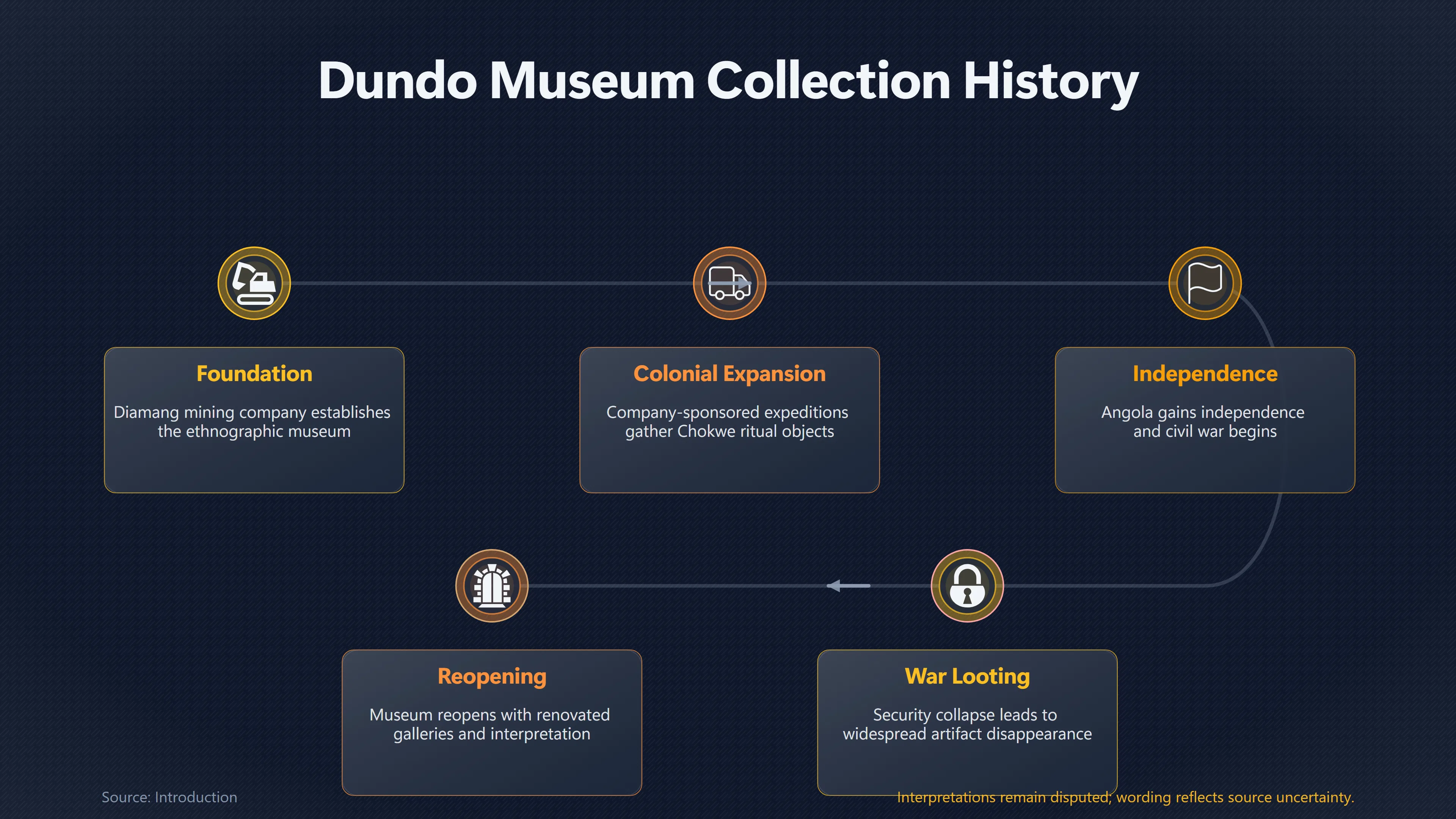
The museum’s greatest losses occurred after Angola gained independence in 1975. As the country descended into a civil war lasting until 2002, security collapsed and numerous ethnographic objects disappeared from the museum.
The exact scale of the losses remains uncertain. Contemporary documentation was itself damaged or lost, making it difficult to establish precisely which artefacts vanished. Before the conflict, the museum estimated holdings of around 20,000 ethnographic objects. During and after the war, important masks, sculptures and associated records entered private collections and the international art market.[Wikipedia]WikipediaDundo MuseumDundo Museum
This missing documentation complicates restitution. Museums typically rely on inventories, photographs and acquisition records to prove ownership, but many of Dundo’s own archives suffered during the conflict. Provenance research has therefore depended on surviving photographs, older catalogues and comparisons with objects appearing in galleries or auction houses.
The modern restitution trail
Dundo’s experience illustrates that restitution is often a gradual process rather than a single political decision.
An important milestone came in 2015, when the Sindika Dokolo Foundation announced the recovery of three significant Chokwe works—a rare male statue and two Pwo masks—that had been traced to European private collections. The foundation purchased the works specifically to return them to the museum, arguing that they had disappeared during the civil war rather than leaving Angola through legitimate museum exchange.[Art Newspaper]theartnewspaper.comArt Newspaper Africa’s top collector returns ancestral works to AngolaArt NewspaperAfrica’s top collector returns ancestral works to Angola - The Art Newspaper - International art news and events…
The recovery effort continued. In 2018 Angola announced the return of six ethnographic objects looted from the museum during the conflict after they had been identified on the international art market. Their recovery demonstrated that careful provenance research, cooperation between collectors, dealers and Angolan authorities, and growing international attention to restitution could produce tangible results.[Wikipedia]WikipediaDundo MuseumDundo Museum
Museum staff have also worked with national authorities and international policing organisations to identify further missing artefacts. Even decades after the war, investigations continue because objects can reappear unexpectedly through inheritance, estate sales or commercial galleries.[Africa Press English]africa-press.netAfrica Press English Bibliographic collection of the Museum of Dundo reinforcedAfrica Press EnglishBibliographic collection of the Museum of Dundo reinforced - AngolaApril 18, 2023…
Why Dundo’s story matters beyond Angola
The Dundo Museum differs from many well-known restitution debates because its central issue is not only colonial collecting by European museums abroad. Instead, several overlapping histories intersect:
- ceremonial objects entered a museum created by a colonial mining company;
- the museum itself became an important centre for preserving Chokwe heritage;
- civil war caused further dispersal of the collection;
- modern restitution seeks to repair losses caused by both colonialism and armed conflict.
This layered history makes straightforward narratives difficult. Some objects left Chokwe communities during colonial rule, while others unquestionably belonged to the museum before being stolen during wartime. Restitution discussions therefore involve different legal and ethical questions depending on each object’s individual history.
The museum also reminds visitors that African museums can themselves become victims of looting. Much international attention focuses on African artefacts held in Europe or North America, but Dundo demonstrates that conflicts within Africa have also displaced major collections, creating another route by which cultural heritage entered global markets.

Visiting the museum today
Following extensive renovation, the Dundo Museum reopened in 2012 with updated galleries and renewed interpretation of its collections. Only a fraction of its holdings is on permanent display, with several hundred ethnographic objects exhibited from a collection numbering many thousands. Visitors encounter reconstructed Chokwe environments, ceremonial masks, sculptures, musical instruments and historical photographs alongside archaeological and natural history collections.[flytaag.com]flytaag.comTAAGPortal DundoTAAGPortalDundo - Place of interest - Dundo Museum…
For many visitors, the masks remain the visual highlight. Increasingly, however, their greatest significance lies in the stories attached to them: objects once used in living ceremonies, transformed into colonial museum collections, scattered by war and gradually reassembled through painstaking restitution efforts. That history makes Dundo not only one of Angola’s most important museums, but also one of the country’s clearest examples of how cultural heritage can survive extraction, conflict and displacement while continuing to shape debates about ownership and memory.
Amazon book picks
Further Reading
Books and field guides related to How Dundo's Masks Became a Restitution Story. Use these as the next step if you want deeper reading beyond the article.
Africa's Struggle for Its Art: History of a Postcolonial Defeat
"A major new history of how, between 1965 and 1985, African nations sought the restitution of works of art stolen during the colonial per...
The Brutish Museums: The Benin Bronzes, Colonial Violence and...
New York Times 'Best Art Books' 2020 'Essential' – Sunday Times 'Brilliantly enraged' - New York Review of Books 'A real game-changer'– E...
eBay marketplace picks
Marketplace Samples
Live-tested eBay searches with available results related to this page.
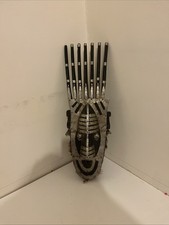
Selected fromAfrican mask wall art oneBay.co.uk.
Endnotes
1.
Source: Wikipedia
Title: Dundo Museum
Link:https://en.wikipedia.org/wiki/Dundo_Museum
2.
Source: africa-press.net
Title: Africa Press English Bibliographic collection of the Museum of Dundo reinforced
Link:https://www.africa-press.net/angola/all-news/bibliographic-collection-of-the-museum-of-dundo-reinforced
Source snippet
Africa Press EnglishBibliographic collection of the Museum of Dundo reinforced - AngolaApril 18, 2023...
Published: April 18, 2023
3.
Source: theartnewspaper.com
Title: Art Newspaper Africa’s top collector returns ancestral works to Angola
Link:https://www.theartnewspaper.com/2015/12/22/africas-top-collector-returns-ancestral-works-to-angola
Source snippet
Art NewspaperAfrica’s top collector returns ancestral works to Angola - The Art Newspaper - International art news and events...
4.
Source: flytaag.com
Title: TAAGPortal Dundo
Link:https://flytaag.com/en/Destinations/Destination-Guide/Suggestion/dundo-museum
Source snippet
TAAGPortalDundo - Place of interest - Dundo Museum...
5.
Source: theartnewspaper.com
Title: Angola recovers six artefacts looted from museum during civil war
Link:https://www.theartnewspaper.com/2018/06/07/angola-recovers-six-artefacts-looted-from-museum-during-civil-war
6.
Source: hoteisangola.com
Title: Dundo Museum
Link:https://www.hoteisangola.com/en/nao-perder/lunda-norte/museu-dundo.html
Additional References
7.
Source: researchgate.net
Title: (PDF) Restitution: Debate and Action
Link:https://www.researchgate.net/publication/330807852_Restitution_Debate_and_Action
Source snippet
February 1, 2019 — Article PDF Available RESTITUTION: DEBATE AND ACTION * February 2019 * African Arts 52(1):8-10 DOI:10.1162/afar_a_0044...
Published: February 1, 2019
8.
Source: youtube.com
Link:https://www.youtube.com/watch?v=p0ceMn7uV0o
Source snippet
Activist draws attention to looted African art through unconventional method...
9.
Source: unesco.org
Title: restitution cultural objects
Link:https://www.unesco.org/en/articles/restitution-cultural-objects
Source snippet
Restitution of cultural objects | UNESCOOctober 12, 2020 — RESTITUTION OF CULTURAL OBJECTS Some examples Image 12 October 2020 Last updat...
Published: October 12, 2020
10.
Source: youtube.com
Title: Africa’s stolen treasures: Time to give them back? | To The Point
Link:https://www.youtube.com/watch?v=eHR5pME8xQo
Source snippet
How does restitution of cultural artefacts affect the future of Western museums? | Inside Story...
11.
Source: journals.sagepub.com
Link:https://journals.sagepub.com/doi/10.1177/2753412X251395333
Source snippet
Restitution and Repatriation of Cultural Objects After Subjugation: Battles, Brazil, and Beyond - Mirosław M Sadowski, 2026November 13, 2...
12.
Source: youtube.com
Link:https://www.youtube.com/watch?v=2UJQKYyCb0k
Source snippet
Africa's stolen treasures: Time to give them back? | To The Point...
Published: September 2021
13.
Source: novojornal.co.ao
Link:https://novojornal.co.ao/cultura/detalhe/pecas-de-arte-roubadas-durante-a-guerra-do-museu-do-dundo-recuperadas-e-devolvidas-a-angola-17132.html
14.
Source: umma.umich.edu
Link:https://umma.umich.edu/exhibitions/traces-reconstructing-the-history-of-a-chokwe-mask/
15.
Source: artafricamagazine.org
Link:https://artafricamagazine.org/notes-on-the-making-of-the-dundo-museum-collection-juliana-ribeiro-da-silva-bevilacqua/
16.
Source: e-cultura.pt
Link:https://www.e-cultura.pt/artigo/20676