Within Curious Cambodia
How Should Cambodia Display the Evidence of Genocide?
Tuol Sleng and Choeung Ek preserve evidence of mass violence while raising difficult questions about remains, tourism and remembrance.
On this page
- Tuol Sleng as prison, archive and memorial
- Human remains and ritual at Choeung Ek
- Tourism, politics and changing display ethics
Page outline Jump by section
Introduction
Cambodia’s best-known memorial sites are unusual because they function simultaneously as preserved crime scenes, museums, archives, places of mourning and educational institutions. The former S-21 prison at Tuol Sleng and the execution and burial site at Choeung Ek do not simply display historical objects. They preserve material evidence of genocide while asking difficult questions about how human suffering should be presented to the public. Their curators must balance historical accuracy, respect for victims, religious traditions, survivor testimony, tourism and education. Those tensions make these sites central not only to Cambodia’s history, but also to wider debates about the ethics of displaying atrocity.
Since 2025, Tuol Sleng, Choeung Ek and the former M-13 prison have been jointly recognised by UNESCO as the serial World Heritage property “Cambodian Memorial Sites: From Centres of Repression to Places of Peace and Reflection”. That designation explicitly frames them as places for remembrance, education and reflection rather than dark attractions.[UNESCO]unesco.orgCongratulates Cambodia on the Inscription of Its Memorial SitesUNESCO Congratulates Cambodia on the Inscription of Its Memorial SitesJuly 11, 2025…
Tuol Sleng: Prison, archive and memorial
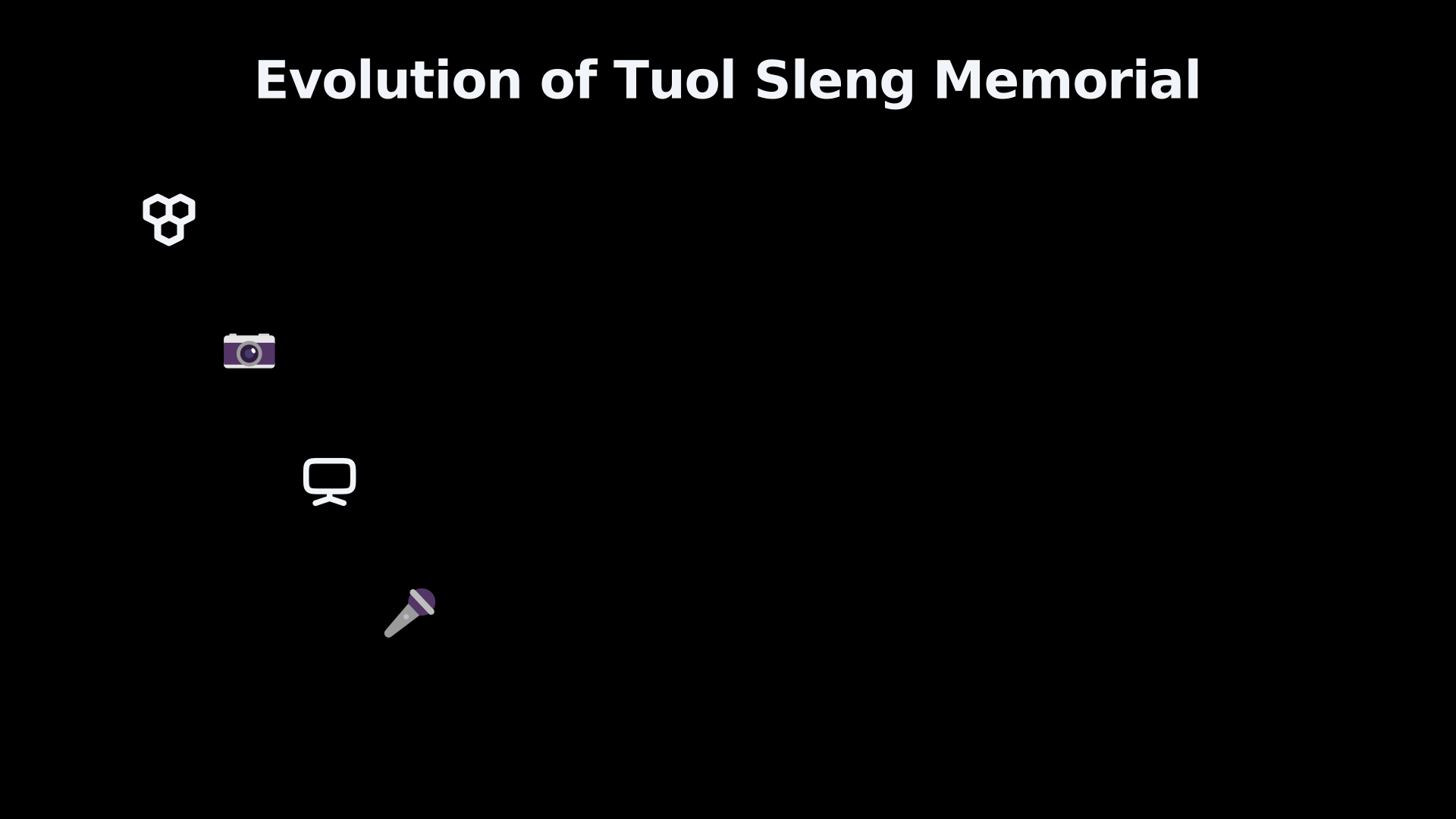
Unlike many memorial museums created after conflict, Tuol Sleng retains much of the original fabric of the prison itself. Former classrooms remain divided into tiny cells, interrogation rooms still contain iron bedframes, and thousands of prisoner photographs, confessions and administrative records survived because the prison bureaucracy meticulously documented its victims.
This creates an unusual ethical challenge. The power of the museum comes from its authenticity, yet many of the surviving objects were originally created as instruments of persecution. Mugshots that today help identify victims were once tools of dehumanisation. Forced confessions are historical evidence despite having been extracted through torture. Rather than treating these documents as neutral archives, curators increasingly interpret them within the context of coercion and state violence.
The museum has also evolved significantly since it first opened in 1979. Early displays were designed soon after the Khmer Rouge fell, when the immediate aim was to document crimes and demonstrate what had happened. Some exhibitions relied heavily on shock value, including the famous arrangement of hundreds of human skulls into the outline of Cambodia. As attitudes towards memorialisation changed, that display was dismantled in 2002 because of deterioration, conservation concerns and growing recognition that victims’ remains deserved more respectful treatment. The shift reflected broader international museum practice, which increasingly favours contextual interpretation over graphic spectacle.
Today, survivor testimony, educational programmes and archival interpretation play a larger role alongside the preserved buildings themselves. UNESCO likewise highlights the site’s archives, educational mission and conservation rather than presenting it as a static museum of horror.[UNESCO World Heritage Centre]whc.unesco.orgUNESCO World Heritage CentreCambodian Memorial Sites: From centres of repression to places of peace and reflection - UNESCO World Heritag…
Human remains and ritual at Choeung Ek
Choeung Ek presents a different ethical problem because it remains both a former mass grave and an active place of remembrance. Thousands of victims were buried there after execution, and human remains continue to emerge naturally from the ground during heavy rain or seasonal erosion.
Visitors often notice fragments of bone or clothing surfacing along pathways. Rather than removing every fragment immediately, staff have historically documented and respectfully collected newly exposed remains while acknowledging that the landscape itself continues to reveal evidence of the killings. This reinforces that Choeung Ek is not merely an archaeological site but a burial ground.
The memorial’s best-known feature is the glass stupa containing thousands of recovered skulls and other human remains. For some visitors, the transparent display provides undeniable evidence against genocide denial and conveys the scale of the crimes more powerfully than photographs ever could. For others, displaying human remains raises profound ethical questions about consent, dignity and whether victims become objects of observation.
Cambodian religious practice complicates simple answers. Buddhist traditions place strong emphasis on honouring the dead, yet there are also local understandings that preserving remains within memorial structures can serve remembrance and spiritual respect when carried out appropriately. The stupa therefore functions simultaneously as evidence, memorial and ritual space rather than simply as a museum display.
These overlapping meanings distinguish Choeung Ek from many Western memorial museums, where human remains are often displayed only rarely or not at all.
Can genocide memorials avoid becoming dark tourism?
The enormous international profile of Tuol Sleng and Choeung Ek creates an unavoidable tension. Both sites receive large numbers of foreign visitors alongside Cambodian school groups, survivors’ families and religious pilgrims. Their educational mission depends partly on public access, yet tourism inevitably changes how visitors experience places associated with immense suffering.
Curators have increasingly responded by shaping visitor behaviour rather than attempting to eliminate tourism altogether. Audio guides emphasise individual lives rather than anonymous statistics. Interpretation increasingly explains how the prison system operated instead of relying solely on graphic evidence. Quiet spaces for reflection have become more prominent, and educational outreach to Cambodian students has expanded alongside international visitation. UNESCO’s management framework similarly emphasises visitor management, interpretation, conservation and the appropriate treatment of human remains across the memorial sites.[UNESCO World Heritage Centre]unesco.orgWorld Heritage Centre Cambodian Memorial Sites: From centres of repression to places of peace and reflectionUNESCO World Heritage CentreCambodian Memorial Sites: From centres of repression to places of peace and reflection - UNESCO World Heritag…
The challenge remains that visitors arrive with very different expectations:
- Some seek historical understanding.
- Some come because of family connections or national remembrance.
- Some approach the sites as part of broader heritage tourism.
- Others are drawn by curiosity about one of the twentieth century’s worst atrocities.
Ethical interpretation attempts to redirect attention away from spectacle towards individual human stories and historical responsibility.
Politics, memory and changing display ethics
Memorial sites are never politically neutral. Tuol Sleng opened under the government that replaced the Khmer Rouge, and for decades debates have continued over how remembrance intersects with national politics, transitional justice and reconciliation.
The conclusion of the Extraordinary Chambers in the Courts of Cambodia (the Khmer Rouge Tribunal) added another layer by reinforcing the evidential importance of surviving archives, photographs and prison records. Rather than functioning solely as museum exhibits, many objects preserved at Tuol Sleng have also served as legal evidence in criminal proceedings.
The 2025 UNESCO World Heritage inscription marks another important shift. Rather than recognising the sites purely as locations of atrocity, UNESCO frames them as places transformed “from centres of repression to places of peace and reflection”. The management plans accompanying the inscription stress conservation, education, community involvement, careful visitor management and the respectful treatment of human remains, signalling an international endorsement of memorial practices that privilege remembrance over sensational display.[UNESCO World Heritage Centre]whc.unesco.orgUNESCO World Heritage CentreCambodian Memorial Sites: From centres of repression to places of peace and reflection - UNESCO World Heritag…

Why these memorials matter within Cambodia’s unusual heritage
Within Cambodia’s wider landscape of unusual museums and collections, Tuol Sleng and Choeung Ek occupy a unique position. They are neither curiosity museums nor conventional historical collections. Their most significant exhibits are preserved places, documentary archives and, in some cases, the physical remains of victims.
Their importance lies not in displaying the strange for entertainment, but in demonstrating how museums can preserve uncomfortable evidence while continually reconsidering the ethics of doing so. Every curatorial decision—whether to exhibit human remains, how much graphic material to show, how to balance survivor testimony with archival documents, or how to accommodate millions of visitors without trivialising suffering—reflects an ongoing negotiation between historical truth, cultural values and respect for those who died.
The result is a form of memorial museum in which the ethics of display are inseparable from the collection itself. The debate is not simply about what should be exhibited, but about how a society remembers genocide without allowing remembrance to become spectacle.
Amazon book picks
Further Reading
Books and field guides related to How Should Cambodia Display the Evidence of Genocide?. Use these as the next step if you want deeper reading beyond the article.
When the War Was Over: Cambodia and the Khmer Rouge Revolution
Chronicles the turbulent history of Cambodia from the era of French colonialism in the first half of the twentieth century to the death o...
First They Killed My Father
A major film, co-written and directed by Angelina Jolie Until the age of five, Loung Ung lived in Phnom Penh, one of seven children of a...

Voices from S-21: Terror and History in Pol Pot's Secret Prison
First published 1999. Subjects: Politics and government, Torture, Political prisoners, Political persecution, Genocide.
eBay marketplace picks
Marketplace Samples
Live-tested eBay searches with available results related to this page.
Selected fromshould poster oneBay.co.uk.



Endnotes
1.
Source: unesco.org
Title: Congratulates Cambodia on the Inscription of Its Memorial Sites
Link:https://www.unesco.org/en/articles/unesco-congratulates-cambodia-inscription-its-memorial-sites-world-heritage-list
Source snippet
UNESCO Congratulates Cambodia on the Inscription of Its Memorial SitesJuly 11, 2025...
Published: July 11, 2025
2.
Source: whc.unesco.org
Link:https://whc.unesco.org/en/list/1748/
Source snippet
UNESCO World Heritage CentreCambodian Memorial Sites: From centres of repression to places of peace and reflection - UNESCO World Heritag...
4.
Source: unesco.org
Title: From Remembrance to Resilience: Choeung Ek Genocidal Center
Link:https://www.unesco.org/en/articles/remembrance-resilience-choeung-ek-genocidal-center-strengthens-its-role-cambodias-heritage-future
Source snippet
From Remembrance to Resilience: Choeung Ek Genocidal Center...
5.
Source: whc.unesco.org
Title: World Heritage Centre UNESCO World Heritage Centre
Link:https://whc.unesco.org/en/decisions/8948/
Source snippet
UNESCO World Heritage CentreUNESCO World Heritage Centre - Decision - 47 COM 8B.14...
6.
Source: unesco.org
Link:https://www.unesco.org/en/articles/audiovisual-heritage-focus-strengthening-exhibition-capacities-choeung-ek-genocidal-center
Source snippet
October 27, 2025 — AUDIOVISUAL HERITAGE IN FOCUS: STRENGTHENING EXHIBITION CAPACITIES AT CHOEUNG EK GENOCIDAL CENTER On World Day for Aud...
Published: October 27, 2025
7.
Source: unesco.org
Title: From Memory to Peace: Cambodia’s Youth at the Heart of Heritage
Link:https://www.unesco.org/en/articles/memory-peace-cambodias-youth-heart-heritage-preservation
Source snippet
October 20, 2025 — FROM MEMORY TO PEACE: CAMBODIA’S YOUTH AT THE HEART OF HERITAGE PRESERVATION Cambodian youth connect with history and...
Published: October 20, 2025
8.
Source: whc.unesco.org
Link:https://whc.unesco.org/en/list/1748/maps/
9.
Source: whc.unesco.org
Link:https://whc.unesco.org/en/documents/220592
10.
Source: whc.unesco.org
Link:https://whc.unesco.org/en/list/1748/gallery/
11.
Source: worldheritageexplorer.org
Link:https://www.worldheritageexplorer.org/sites/cambodian_memorial_sites_from_centres_of_repression_to_places_of_peace_and_reflection.html
Source snippet
July 7, 2026 — CAMBODIAN MEMORIAL SITES: FROM CENTRES OF REPRESSION TO PLACES OF PEACE AND REFLECTION * * * World Heritage Identification...
Published: July 7, 2026
Additional References
12.
Source: reuters.com
Link:https://www.reuters.com/world/asia-pacific/cambodia-marks-unesco-recognition-khmer-rouge-sites-places-peace-reflection-2025-07-13/
Source snippet
The recognized sites—Tuol Sleng prison, Choeung Ek killing fields in Phnom Penh, and M-13 prison in Kampong Chhnang province—have been ac...
13.
Source: cambodgemag.com
Link:https://www.cambodgemag.com/en/post/cambodia-s-memorial-sites-from-centers-of-repression-to-places-of-peace-and-reflection-a-new-chap
14.
Source: worldheritagesite.org
Link:https://www.worldheritagesite.org/list/cambodian-memorial-sites/
15.
Source: brill.com
Link:https://brill.com/display/book/9789004536890/BP000023.pdf
16.
Source: youtube.com
Title: Preserving The Victims’ Clothes At Tuol Sleng
Link:https://www.youtube.com/watch?v=xFvRrHj30DU
Source snippet
Inside Pol Pot's HORRIBLE Prison — Camp S-21 In Cambodia...
17.
Source: youtube.com
Title: Is Dark Tourism Ethical?
Link:https://www.youtube.com/watch?v=tQYPJVCX8iM
Source snippet
Preserving The Victims' Clothes At Tuol Sleng...
18.
Source: youtube.com
Title: Inside Pol Pot’s HORRIBLE Prison — Camp S-21 In Cambodia
Link:https://www.youtube.com/watch?v=wUWaUW8vAEo
Source snippet
Lecture for everyone – Dark Tourism...
19.
Source: youtube.com
Title: In Their Presence: The ‘Life’ of Museum Objects
Link:https://www.youtube.com/watch?v=I-BUK_sTspM
Source snippet
Is Dark Tourism Ethical?...
20.
Source: akp.gov.kh
Title: Agence Kampuchea Presse
Link:https://www.akp.gov.kh/post/detail/341997
21.
Source: youtube.com
Title: Lecture for everyone – Dark Tourism
Link:https://www.youtube.com/watch?v=k2Ifzv6HZig