Within Curious Georgia
Why Dmanisi Changed the Human Story
Dmanisi's 1.8-million-year-old remains place Georgia at the centre of one of archaeology's most important human migration stories.
On this page
- What archaeologists found at Dmanisi
- Why the five skulls remain scientifically important
- What visitors can see at Dmanisi and in Tbilisi
Page outline Jump by section
Introduction
Dmanisi is one of the most important archaeological sites in the world because it preserves some of the earliest known evidence of human ancestors living outside Africa. Buried beneath the ruins of a medieval town in southern Georgia, the site has produced remarkably complete fossil skulls, stone tools and thousands of animal remains dating to around 1.8 million years ago. These discoveries transformed ideas about when, how and by whom the first migrations out of Africa took place. Rather than being an archaeological curiosity in the sensational sense, Dmanisi is a place where careful scientific excavation has rewritten a major chapter of human history. For visitors interested in unusual collections, it offers something rarer than myth: genuine evidence that has changed the story of humanity itself.[UNESCO World Heritage Centre]whc.unesco.orgWorld Heritage Centre Dmanisi Hominid Archaeological SiteUNESCO World Heritage CentreDmanisi Hominid Archaeological Site - UNESCO World Heritage CentreOctober 24, 2007…

Why Dmanisi Changed the Human Story
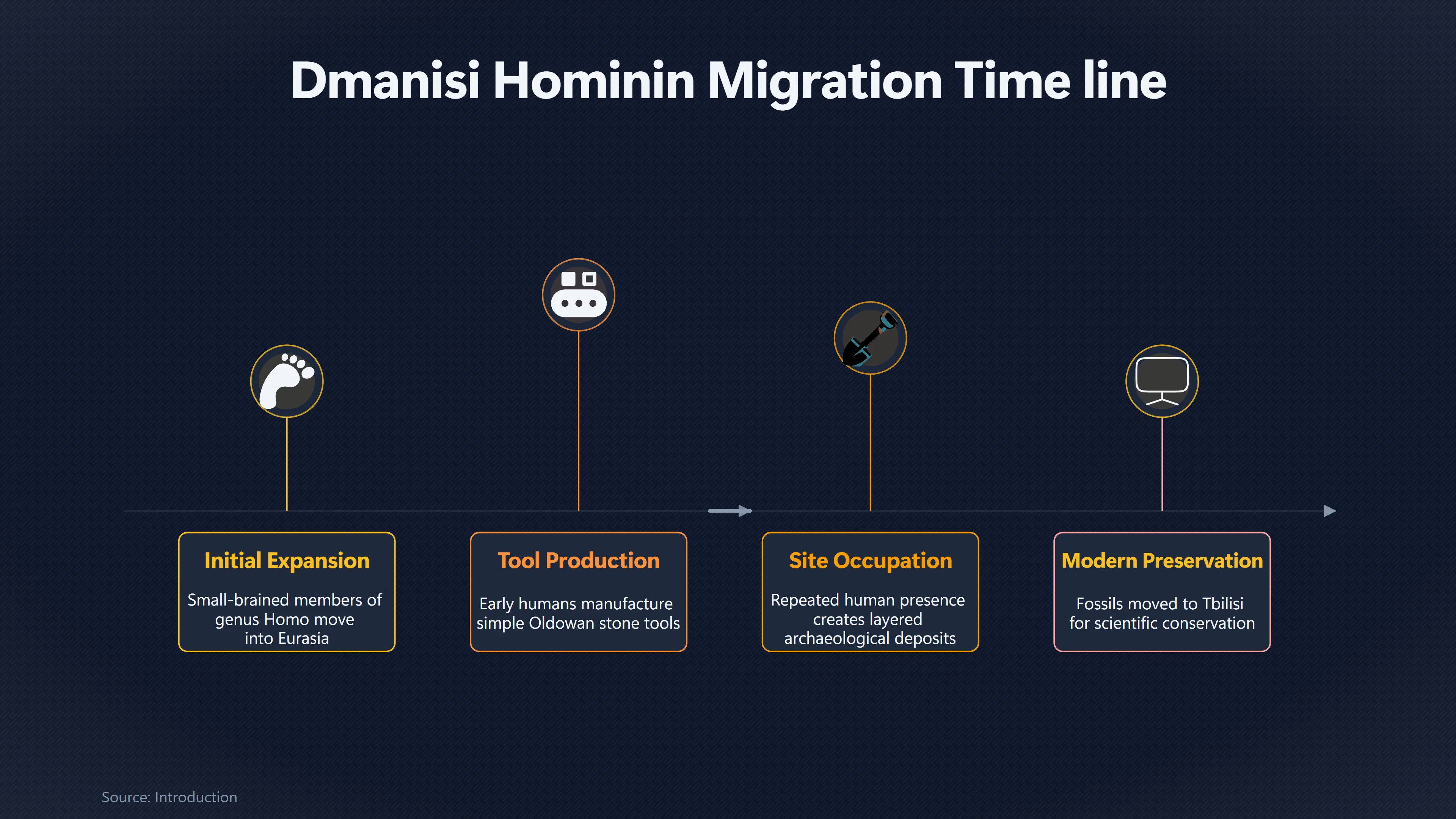
Before the discoveries at Dmanisi, many researchers believed that early humans only expanded beyond Africa after developing larger brains, more sophisticated stone tools and more advanced bodies adapted for long-distance travel. The Georgian evidence challenged that model.
Excavations beginning in the 1980s uncovered primitive stone tools alongside fossil animals from the Early Pleistocene. The first hominin jawbone followed in 1991, and subsequent field seasons revealed exceptionally well-preserved skulls and skeletal remains belonging to several individuals. Together they demonstrated that small-brained members of the genus Homo had already dispersed into Eurasia roughly 1.8 million years ago.[UNESCO World Heritage Centre]whc.unesco.orgWorld Heritage Centre Dmanisi Hominid Archaeological SiteUNESCO World Heritage CentreDmanisi Hominid Archaeological Site - UNESCO World Heritage CentreOctober 24, 2007…
The site is especially valuable because everything was found in secure geological layers. The human fossils, animal bones and stone tools all belong to the same ancient landscape, allowing researchers to reconstruct not only who these early people were but also the environment in which they lived. Fossil evidence includes extinct rhinoceroses, sabre-toothed cats, giant ostriches, deer and other animals that help reconstruct the climate and ecology of the time.[UNESCO World Heritage Centre]whc.unesco.orgWorld Heritage Centre Dmanisi Hominid Archaeological SiteUNESCO World Heritage CentreDmanisi Hominid Archaeological Site - UNESCO World Heritage CentreOctober 24, 2007…
Unlike many famous prehistoric sites represented by isolated teeth or fragmentary bones, Dmanisi preserves an unusually complete community of early humans. This richness has made it one of the world’s benchmark sites for studying the first expansion of humans beyond Africa.[UNESCO World Heritage Centre]whc.unesco.orgWorld Heritage Centre Dmanisi Hominid Archaeological SiteUNESCO World Heritage CentreDmanisi Hominid Archaeological Site - UNESCO World Heritage CentreOctober 24, 2007…
What Archaeologists Found at Dmanisi
The importance of Dmanisi comes from the combination of discoveries rather than any single spectacular fossil.
The excavations have produced:
- Five unusually complete skulls from early members of the genus Homo.
- Multiple lower jaws and numerous postcranial bones.
- Thousands of stone tools made using relatively simple Oldowan technology.
- Thousands of fossil animal remains representing dozens of extinct species.
- Evidence that the site preserves repeated occupations rather than a single moment in time.[unesco.org]whc.unesco.orgWorld Heritage Centre Dmanisi Hominid Archaeological SiteUNESCO World Heritage CentreDmanisi Hominid Archaeological Site - UNESCO World Heritage CentreOctober 24, 2007…
The human fossils are generally dated to about 1.77–1.85 million years old, placing them among the earliest securely dated hominin remains outside Africa. Their excellent preservation has allowed researchers to compare skull shape, body proportions, walking ability and even aspects of health and ageing in far greater detail than is possible at many other sites.[Human Origins]humanorigins.si.eduHuman OriginsD2282 | The Smithsonian Institution's Human Origins Program…
The surrounding medieval ruins add another unusual dimension. Visitors walk through the remains of a medieval settlement while standing above deposits that preserve evidence from nearly two million years earlier, making Dmanisi one of the rare archaeological landscapes where vastly different periods occupy the same location.[Georgia Travel]georgia.travelTravel Dmanisi Archaeological SiteDmanisi Archaeological Site - Home of the First Europeans | Georgia Travel…
Why the Five Skulls Remain Scientifically Important
The five Dmanisi skulls are among the most discussed fossil discoveries in modern palaeoanthropology.
What makes them exceptional is not simply their age but their variation. Although all came from essentially the same population and period, the skulls differ noticeably in brain size, facial shape and jaw structure. Previously, fossils showing differences of this magnitude from different African sites had often been assigned to separate species.
When Skull 5 was described in 2013, researchers argued that the range of variation within the Dmanisi population might suggest that several named early human species could instead represent normal variation within a single evolving lineage. That interpretation proved controversial and remains debated, but it forced scientists to reconsider long-standing assumptions about how many early human species actually existed.[Human Origins]humanorigins.si.eduHuman OriginsD2282 | The Smithsonian Institution's Human Origins Program…
Not every specialist agrees with a single-species interpretation. Some researchers continue to recognise distinctions between early African forms, while more recent analyses of Dmanisi fossils—including studies of fossil teeth—have suggested that the picture may be more complex than either side originally proposed. New evidence continues to refine, rather than settle, the debate.[Live Science]livescience.comBy analyzing 24 fossilized teeth from the Dmanisi site in Georgia—dating back approximately 1.8 million years—researchers discovered dent…
The site has also revealed evidence of resilience and social behaviour. One famous individual survived for years despite losing nearly all of its teeth, implying that companions may have helped provide food. While this does not prove modern-style caregiving, it offers rare insight into cooperation among some of the earliest humans known outside Africa.[UNESCO World Heritage Centre]whc.unesco.orgWorld Heritage Centre Dmanisi Hominid Archaeological SiteUNESCO World Heritage CentreDmanisi Hominid Archaeological Site - UNESCO World Heritage CentreOctober 24, 2007…
What the Fossils Reveal About Early Human Migration
Dmanisi suggests that the first expansion beyond Africa did not necessarily require large brains or sophisticated technology.
The stone tools are relatively simple, yet the people who made them successfully occupied environments well beyond tropical Africa. Postcranial remains show a mixture of primitive and more modern characteristics. They retained small body size and relatively small brains but possessed body proportions and lower limbs well suited to efficient walking over long distances.[Nature]nature.comPostcranial evidence from early Homo from Dmanisi, Georgia | NaturePostcranial evidence from early Homo from Dmanisi, Georgia | Nature…
This combination changed scientific thinking about migration. Instead of waiting for a dramatic evolutionary breakthrough, early humans may have dispersed gradually using flexible behaviour and modest technological abilities.
The discoveries have therefore become central to discussions of one of archaeology’s biggest questions: how a small African population eventually spread across Eurasia and, much later, the rest of the world.[UNESCO World Heritage Centre]whc.unesco.orgWorld Heritage Centre Dmanisi Hominid Archaeological SiteUNESCO World Heritage CentreDmanisi Hominid Archaeological Site - UNESCO World Heritage CentreOctober 24, 2007…

What Visitors Can See at Dmanisi and in Tbilisi
Visitors should not expect a museum dominated by dramatic fossil displays at the excavation site itself.
The Dmanisi Museum-Reserve combines several attractions:(#endnote-10 “Endnote 10”)[dmo.ge]dmo.geDmanisi Historical and Architectural Museum-ReserveDmanisi Historical and Architectural Museum-Reserve
- The active archaeological landscape.
- Medieval fortifications and settlement remains.
- Interpretation explaining the prehistoric discoveries.
- Views across the river valleys where the ancient deposits accumulated.[Georgia Travel]georgia.travelTravel Dmanisi Archaeological SiteDmanisi Archaeological Site - Home of the First Europeans | Georgia Travel…
Many of the original hominin fossils, including the celebrated skulls, are conserved and displayed by the Georgian National Museum in Tbilisi rather than left at the excavation site. This reflects normal museum practice for fragile scientific specimens, allowing them to be protected under controlled conditions while remaining available for research. Visitors interested in the complete story therefore benefit from seeing both the excavation site and the museum collections in the capital.[Georgia Travel]georgia.travelTravel Dmanisi Archaeological SiteDmanisi Archaeological Site - Home of the First Europeans | Georgia Travel…
For travellers exploring Georgia’s unusual heritage, Dmanisi stands apart from folklore museums or collections of curious objects. Its appeal lies in encountering evidence that is both scientifically rigorous and genuinely astonishing: fossils that permanently altered our understanding of humanity’s earliest journeys across the world.
Amazon book picks
Further Reading
Books and field guides related to Why Dmanisi Changed the Human Story. Use these as the next step if you want deeper reading beyond the article.
The Enemies of Rome
"Matyszak writes clearly and engagingly . . . nicely produced, with ample maps and illustrations." —Classical Outlook This engrossing boo...
Mythology
"A treasure house of illustrations . . . erudite and enjoyable." --Contemporary Review
Sapiens
Rating: 4.5/5 from 12 Google Books ratings
NATIONAL BESTSELLER NEW YORK TIMES BESTSELLER Destined to become a modern classic in the vein of Guns, Germs, and Steel, Sapiens is a liv...
Tikal
The primary question addressed in this book focuses on how the ancient Maya in the northern Petén Basin sustained large populations durin...
eBay marketplace picks
Marketplace Samples
Live-tested eBay searches with available results related to this page.
Selected fromhuman evolution model oneBay.co.uk.

Endnotes
1.
Source: whc.unesco.org
Title: World Heritage Centre Dmanisi Hominid Archaeological Site
Link:https://whc.unesco.org/en/tentativelists/5225
Source snippet
UNESCO World Heritage CentreDmanisi Hominid Archaeological Site - UNESCO World Heritage CentreOctober 24, 2007...
Published: October 24, 2007
2.
Source: nature.com
Title: Postcranial evidence from early Homo from Dmanisi, Georgia | Nature
Link:https://www.nature.com/articles/nature06134
Source snippet
Postcranial evidence from early Homo from Dmanisi, Georgia | Nature...
3.
Source: georgia.travel
Title: Travel Dmanisi Archaeological Site
Link:https://georgia.travel/dmanisi-home-to-the-first-europeans
Source snippet
Dmanisi Archaeological Site - Home of the First Europeans | Georgia Travel...
4.
Source: georgia.travel
Title: Unique Places in Georgia for Archeology and History Lovers | Georgia Travel
Link:https://georgia.travel/unique-places-in-georgia-for-archeology-and-history-lovers
Source snippet
December 22, 2022 — 2022-12-22T03:44:00.000000Z 2026-07-15T21:14:14.000000Z Image: Unique Places in Georgia for Archeology and History Lo...
Published: December 22, 2022
5.
Source: nature.com
Title: Philip Rightmire^{4},
Link:https://www.nature.com/articles/434717b
Source snippet
The earliest toothless hominin skull | NatureApril 6, 2005 — * Brief Communication *...
Published: April 6, 2005
6.
Source: humanorigins.si.edu
Link:https://humanorigins.si.edu/evidence/human-fossils/fossils/d2282
Source snippet
Human OriginsD2282 | The Smithsonian Institution's Human Origins Program...
7.
Source: livescience.com
Link:https://www.livescience.com/archaeology/human-evolution/homo-erectus-wasnt-the-first-human-species-to-leave-africa-1-8-million-years-ago-fossils-suggest
Source snippet
By analyzing 24 fossilized teeth from the Dmanisi site in Georgia—dating back approximately 1.8 million years—researchers discovered dent...
8.
Source: si.edu
Link:https://www.si.edu/object/homo-erectus%3Adpo_3d_200045
Additional References
9.
Source: youtube.com
Title: Homo Georgicus Homo Erectus Amazing Human Ancestor Fossils From Dmanisi
Link:http://www.youtube.com/watch?v=Tjv7QzVlhlY
Source snippet
Dmanisi earliest humans Georgia archaeological site documentary Homo georgicus - the homeland of the earliest hominins outside Africa ერო...
10.
Source: theguardian.com
Title: They are the earliest human remains to b
Link:https://www.theguardian.com/science/2009/sep/08/fossils-georgia-dmanisi-early-humans
Source snippet
Fossil find in Georgia challenges theories on early humans | Fossils | The GuardianSeptember 8, 2009 — Image: Fossil skull of Homo erectu...
Published: September 8, 2009
11.
Source: youtube.com
Title: A Face Lost in Time: The 1.8 Million-Year-Old Human Discovery in Georgia
Link:http://www.youtube.com/watch?v=Ttut1k68t7g
Source snippet
8M-Year-Old Jawbone Rewrites Human Migration! | Orozmani Discovery 2025...
12.
Source: youtube.com
Link:http://www.youtube.com/watch?v=XQcnksg_0G0
Source snippet
Homo Georgicus Homo Erectus Amazing Human Ancestor Fossils From Dmanisi...
13.
Source: youtube.com
Title: What an ancient boneyard reveals about our earliest global wanderers
Link:http://www.youtube.com/watch?v=yH_HvF70GKE
Source snippet
A Face Lost in Time: The 1.8 Million-Year-Old Human Discovery in Georgia...
14.
Source: youtube.com
Title: Homo georgicus
Link:http://www.youtube.com/watch?v=j5zG3pHrDR0
Source snippet
What an ancient boneyard reveals about our earliest global wanderers...
15.
Source: nhm.ac.uk
Link:https://www.nhm.ac.uk/discover/homo-erectus-our-ancient-ancestor.html
16.
Source: dmo.ge
Title: Dmanisi Historical and Architectural Museum-Reserve
Link:https://www.dmo.ge/en/region/Dmanisi-Historical-and-Architectural-Museum-Reserve/
17.
Source: map.nationalgeographic.ge
Title: map Hominins from Dmanisi
Link:https://map.nationalgeographic.ge/en/element/dmanisis-homininebi/
Source snippet
Hominins from Dmanisi - map...