Within Curious Belize
What Makes ATM Cave Belize's Strangest Collection?
ATM Cave preserves Maya pottery, ritual objects and human remains in situ, creating an extraordinary site where tourism depends on strict restraint.
On this page
- Entering the cave and reaching the ritual chambers
- Human remains, pottery and uncertain interpretations
- Why guides, camera bans and conservation rules matter
Page outline Jump by section
Introduction
Actun Tunichil Muknal (ATM) is one of the world’s rarest visitor-accessible archaeological experiences because it functions less like a conventional museum than as a ritual collection preserved exactly where it was created. Deep inside this protected Maya cave in western Belize, pottery, stone objects and human remains have largely been left in their original positions rather than transferred to display cases. The result is an extraordinary form of “in-place collection”: visitors do not look at artefacts behind glass but move carefully through the same chambers where Maya rituals took place more than a thousand years ago. That unusual approach makes conservation the central story. Every tour, access rule and restriction exists because the collection cannot simply be repaired or rearranged if it is damaged.[nichbelize.org]nichbelize.orgActun Tunichil Muknal (ATM) – National Institute of Culture and HistoryJune 13, 2024…
What Makes ATM Cave Belize’s Strangest Collection?
Unlike most archaeological sites, ATM’s greatest value lies in the relationship between its objects and their surroundings. Pottery fragments, ceremonial vessels, stone monuments and skeletal remains still occupy the cave chambers where they were deposited during the Classic Maya period. Archaeologists have documented this spatial arrangement in detail because the position of each object helps explain how different parts of the cave were used for ceremonies rather than simply revealing what objects were left behind.[Archaeology Magazine]archive.archaeology.orgArchaeology Magazine…
This means the cave operates as a collection without shelves or cabinets. The cave itself provides the context that a museum gallery would normally reconstruct artificially. Broken ceramic vessels remain scattered where they were deliberately smashed during rituals, while human remains appear in separate locations associated with different ceremonial practices. Removing these materials would preserve the objects but destroy much of the information created by their original placement.[Archaeology Magazine]archive.archaeology.orgArchaeology Magazine…
For Belize, this makes ATM an unusual example of heritage management. Rather than separating artefacts from their landscape, the country’s archaeological authorities have largely chosen to preserve the entire ritual environment as one protected assemblage.[nichbelize.org]nichbelize.orgActun Tunichil Muknal (ATM) – National Institute of Culture and HistoryJune 13, 2024…
Entering the Cave and Reaching the Ritual Chambers
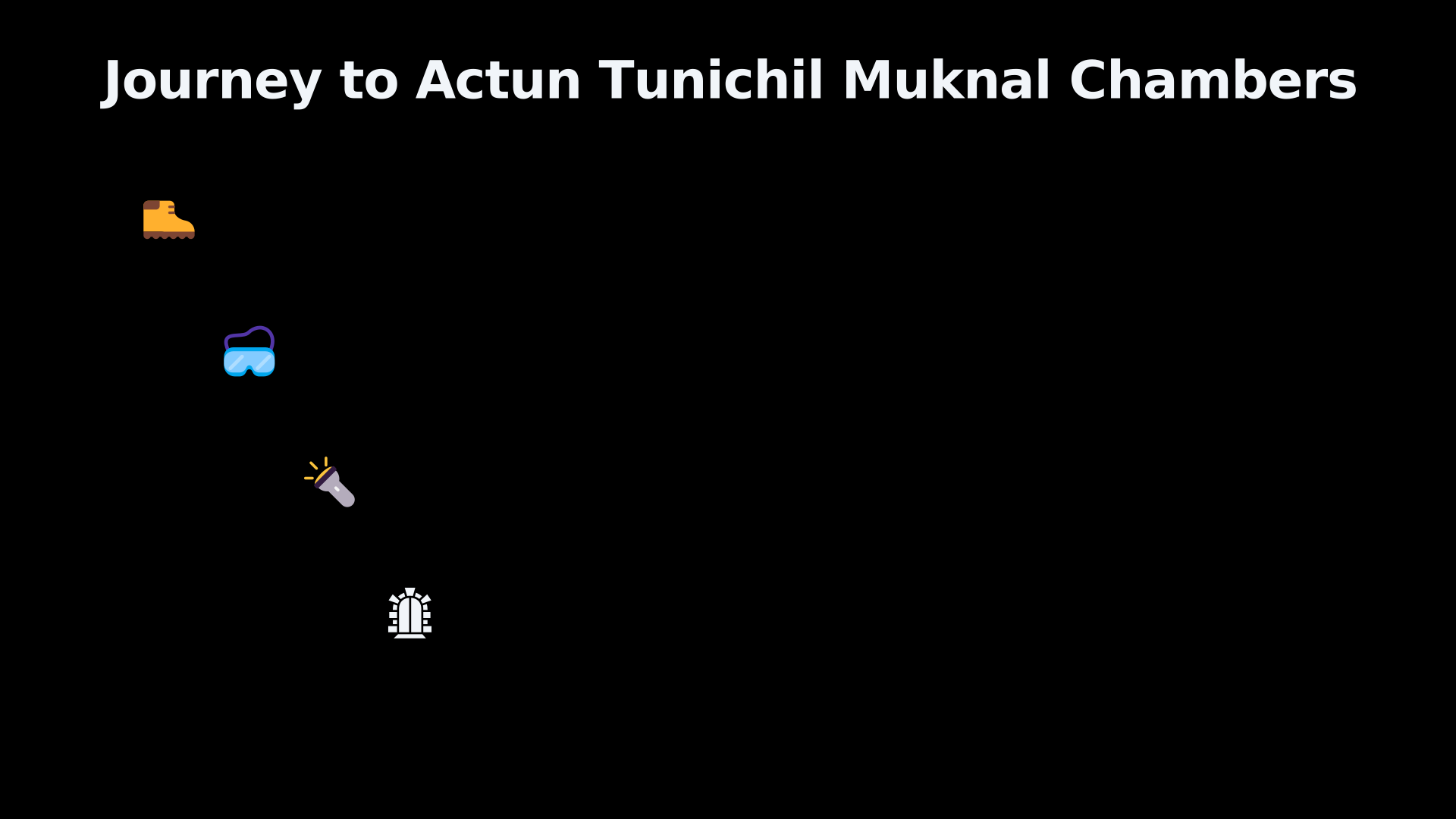
Reaching the collection is intentionally demanding. Visitors hike through tropical forest before swimming or wading through the cave entrance and following an underground river into progressively darker passages. Only after negotiating water, rocks and narrow sections do they arrive at the elevated chambers containing the richest archaeological deposits.[National Geographic]nationalgeographic.comNational GeographicSee Maya Actun Tunichil Muknal Cave, or ATM Cave, in Belize | National GeographicApril 9, 2018…
The physical journey is significant because it mirrors, to some extent, the cave’s ancient ritual role. Maya belief regarded caves as entrances to the underworld and places where communication with deities and ancestors was possible, especially during periods of environmental stress or political uncertainty. Archaeological evidence suggests that ceremonies intensified in the cave during the Late Classic period, when droughts and social upheaval affected parts of the Maya world. While individual rituals cannot always be reconstructed with certainty, the concentration of offerings demonstrates that the cave was used repeatedly for formal religious activity rather than occasional refuge.[archaeology.org]archive.archaeology.orgArchaeology Magazine…
Because the route itself passes archaeological material, visitors are constantly moving through the collection rather than arriving at a single display space. That continuous overlap between landscape and artefacts is one reason conservation is so challenging.
Human Remains, Pottery and Uncertain Interpretations
ATM contains hundreds of ceramic objects together with numerous human remains distributed across different chambers. The best-known skeleton, popularly called the “Crystal Maiden”, owes its appearance not to crystal but to centuries of calcite deposited by dripping water, creating a reflective surface under artificial light. Although often described as a sacrificed teenage girl, some aspects of the individual’s age, sex and exact circumstances continue to be debated by researchers, illustrating how popular stories sometimes become more certain than the archaeological evidence itself.[Archaeology Magazine]archive.archaeology.orgArchaeology Magazine…
The pottery is equally important. Many vessels were intentionally broken before being left in the cave, a practice recognised at other Maya ritual sites. Rather than representing discarded rubbish, these ceramics appear to have formed part of ceremonial acts that deliberately transformed useful objects into offerings. Their distribution across different chambers helps archaeologists distinguish areas used for particular ritual activities.[Archaeology Magazine]archive.archaeology.orgArchaeology Magazine…
The cave also preserves slate monuments associated with bloodletting rituals and additional ceremonial features that reinforce its importance as a sacred rather than domestic space. Archaeologists continue to study how different chambers were used, but many interpretations remain provisional because ritual behaviour cannot always be reconstructed from surviving objects alone.[Archaeology Magazine]archive.archaeology.orgArchaeology Magazine…
Why Guides, Camera Bans and Conservation Rules Matter
ATM demonstrates that preserving an archaeological collection sometimes requires controlling people more than protecting objects.
Belize’s Institute of Archaeology manages access through a series of measures designed to minimise cumulative damage:
- Entry is only permitted with licensed guides.
- Visitor numbers are controlled through advance booking.
- Groups follow designated routes.
- Artefacts must never be touched or moved.
- Visitors remove their footwear and continue in socks when entering the upper ceremonial chamber to reduce abrasion and accidental damage.[nichbelize.org]nichbelize.orgPolicies, Terms & Conditions – National Institute of Culture and HistoryPolicies, Terms & Conditions – National Institute of Culture and History
One rule has become particularly well known: ordinary cameras are banned. The restriction followed incidents in which visitors accidentally damaged fragile human remains, including a skull fractured after a dropped camera. Because the archaeological material cannot realistically be repaired or replaced, authorities concluded that eliminating handheld cameras was preferable to accepting continued risk. The ban has become an example of how conservation policy can change in response to relatively small but irreversible accidents.[wikipedia.org]WikipediaActun Tunichil MuknalActun Tunichil Muknal
These rules sometimes surprise visitors expecting an adventure attraction, but they reflect the site’s dual identity. ATM is simultaneously a natural cave, an archaeological reserve, a sacred landscape and an irreplaceable research archive.

A Collection Preserved Through Restraint
Many museums protect collections by placing objects behind glass. ATM protects its collection by asking visitors to exercise unusual restraint instead. The experience depends on accepting limits: no wandering away from the guide, no handling artefacts, no casual photography and no expectation that damaged objects can simply be restored.
This philosophy has influenced broader cave management in Belize. National policy increasingly treats archaeological caves as fragile cultural landscapes whose scientific and historical value depends on preserving relationships between artefacts, geology and environment rather than maximising visitor access. The cave therefore serves not only as one of Belize’s most remarkable archaeological attractions but also as a model for balancing tourism with long-term preservation of an exceptionally delicate ritual collection.[nichbelize.org]nichbelize.orgPOLIC Y FOR THE MANAGEMENT OF TOURIST CAVE SITES IN BIZEPOLIC Y FOR THE MANAGEMENT OF TOURIST CAVE SITES IN BIZE
Amazon book picks
Further Reading
Books and field guides related to What Makes ATM Cave Belize's Strangest Collection?. Use these as the next step if you want deeper reading beyond the article.
The Ancient Maya
"Comprehensive synthesis of ancient Maya scholarship. Extensive summary of the archaeology of the Maya world provides the historical cont...
Stone Houses and Earth Lords: Maya Religion in the Cave Context
Stone Houses and Earth Lords is the first volume dedicated exclusively to the use of caves in the Maya Lowlands, covering primarily Class...
Caves and the Ancient Greek Mind
Caves and the Ancient Greek Mind analyses techniques of searching for ultimate wisdom in ancient Greece. The Greeks perceived mental expe...
eBay marketplace picks
Marketplace Samples
Live-tested eBay searches with available results related to this page.
Selected fromarchaeology collectible oneBay.co.uk.
Endnotes
1.
Source: nichbelize.org
Title: Actun Tunichil Muknal (ATM) – National Institute of Culture and History
Link:https://nichbelize.org/ia-sites/actun-tunichil-muknal/
Source snippet
June 13, 2024...
Published: June 13, 2024
2.
Source: archive.archaeology.org
Link:https://archive.archaeology.org/online/features/belize/tunichil.html
Source snippet
Archaeology Magazine...
3.
Source: nichbelize.org
Title: POLIC Y FOR THE MANAGEMENT OF TOURIST CAVE SITES IN BIZE
Link:https://nichbelize.org/wp-content/uploads/2025/02/IA-Cave-Management-Policy-2025.pdf
4.
Source: nichbelize.org
Title: Policies, Terms & Conditions – National Institute of Culture and History
Link:https://nichbelize.org/policies-terms-conditions/
5.
Source: Wikipedia
Title: Actun Tunichil Muknal
Link:https://en.wikipedia.org/wiki/Actun_Tunichil_Muknal
6.
Source: archive.archaeology.org
Link:https://archive.archaeology.org/online/features/belize/updates/remote1.html
Source snippet
31, 2000 — Remote Sensing: Update 1 "Maya Caves of West-Central Belize" August 31, 2000 by Cameron Griffith Image: image The Garmin III G...
Published: August 31, 2000
7.
Source: nichbelize.org
Link:https://nichbelize.org/institute-of-archaeology/
Source snippet
Institute of Archaeology – National Institute of Culture and HistoryPreserving the Past for the Future INSTITUTE OF ARCHAEOLOGY The Insti...
8.
Source: archive.archaeology.org
Link:https://archive.archaeology.org/online/features/belize/2000.html
Source snippet
Caves of West-Central Belize | Summer 2000 by BVAR/WBCRP staff and Amélie A. Walker Trip to Xibalba | Interview | Field Notes | Student J...
9.
Source: nationalgeographic.com
Link:https://www.nationalgeographic.com/travel/article/actun-tunichil-muknal-atm-cave-maya
Source snippet
National GeographicSee Maya Actun Tunichil Muknal Cave, or ATM Cave, in Belize | National GeographicApril 9, 2018...
Published: April 9, 2018
10.
Source: ambergriscaye.com
Title: Ambergris Caye Cameras Banned from Actun Tunichil Muknal Cave
Link:https://ambergriscaye.com/forum/ubbthreads.php/posts/437296.html
Source snippet
Cameras Banned from Actun Tunichil Muknal Cave - Ambergris Caye Belize Message BoardMay 7, 2012 — ImageCameras Banned from Actun Tunichil...
Published: May 7, 2012
Additional References
11.
Source: internationalparks.org
Link:https://www.internationalparks.org/belize/Actun%20Tunichil%20Muknal
Source snippet
Actun Tunichil Muknal, Belize: Ratings & Visitor GuideGEOLOGY Actun Tunichil Muknal is carved into the Cretaceous-age limestone bedrock o...
12.
Source: youtube.com
Title: Discovery: Maya Ritual Cave Untouched for 1,000 Years | Ancient Architects
Link:https://www.youtube.com/watch?v=_PoUr_GEbws
Source snippet
"The Shining Skeleton of the Maya Crystal Maiden[https://www.youtube.com/watch?v=hNrDYLzk87Y..."](https://www.youtube.com/watch?v=hNrDYLzk87Y...")...
13.
Source: youtube.com
Title: Belize’s Ancient Maya Sacrificial Cave: Rare Footage | One Strange Rock
Link:https://www.youtube.com/watch?v=vRjnhwWSiEI
Source snippet
Jaime Awe - Maya Cities & Sacred Caves of Belize...
14.
Source: youtube.com
Title: Jaime Awe
Link:https://www.youtube.com/watch?v=eWHzbYQW7B4
Source snippet
Discovery: Maya Ritual Cave Untouched for 1,000 Years | Ancient Architects...
15.
Source: whc.unesco.org
Link:https://whc.unesco.org/en/tentativelists/5739
Source snippet
Caves of Naj Tunich - UNESCO World Heritage CentreApril 27, 2012 — THE CAVES OF NAJ TUNICH Guatemala Date of Submission: 27/04/2012 Crite...
Published: April 27, 2012
17.
Source: whc.unesco.org
Link:https://whc.unesco.org/en/list/1014/
Source snippet
Archaeological Heritage of Niah National Park’s Caves Complex - UNESCO World Heritage CentreAugust 1, 2024 — THE ARCHAEOLOGICAL HERITAGE...
Published: August 1, 2024
18.
Source: youtube.com
Title: ATM Cave Belize 🇧🇿: Watch This Before You Go
Link:https://www.youtube.com/watch?v=WtMthwmFR08
19.
Source: youtube.com
Link:https://www.youtube.com/watch?v=hNrDYLzk87Y
Source snippet
ATM Cave Belize 🇧🇿: Watch This Before You Go...