Within Curious South Korea
When Does a Tourist Attraction Become a Museum?
From sanitation heritage to novelty attractions, South Korea's playful museums blur the line between public education, spectacle and tourist entertainment.
On this page
- Haewoojae and the public history of sanitation
- Jeju's novelty attractions and photo friendly spectacle
- How to judge credibility, interpretation and commercial intent
Page outline Jump by section
Introduction
South Korea has become famous for attractions that blur the line between museum, educational exhibition and entertainment business. No place illustrates this better than Haewoojae, the country’s toilet museum, alongside the photo-friendly novelty attractions that have flourished in tourist destinations such as Jeju Island. At first glance these places appear to belong to the same category: unusual museums designed to attract curious visitors. In practice they represent very different ideas about what a museum is for.
Haewoojae uses an intentionally humorous subject to explain sanitation, public health and urban history. Many commercial “museum” attractions, by contrast, use the label primarily to market immersive experiences, oversized props and social media photography. Understanding that distinction helps visitors judge both the credibility and the purpose of South Korea’s unusual attractions, rather than assuming every museum with an eccentric theme serves the same role.[VISITKOREA - Imagine Your Korea]english.visitkorea.or.krImagine Your KoreaHaewoojae Museum (Mr. Toilet House) (해우재)- VISITKOREA…
When Does a Tourist Attraction Become a Museum?
South Korea applies the word “museum” more broadly than many visitors expect. Some institutions are publicly funded collections with conservation responsibilities, while others are private businesses that combine exhibition design with entertainment, cafés, souvenir shops or themed photography.
That broad use of the term reflects several overlapping trends:
- local governments using distinctive attractions to promote regional tourism;
- entrepreneurs creating immersive experiences around popular themes;
- a public appetite for interactive displays rather than traditional glass cases;
- increasing competition for domestic family tourism.
As a result, visitors should not assume that every museum-labelled attraction has research collections, curators or historical interpretation. Some are genuine collecting institutions. Others are essentially themed entertainment presented in museum form. The distinction is not necessarily negative—many commercial attractions openly prioritise fun—but it changes what visitors should expect.[VISITKOREA - Imagine Your Korea]english.visitkorea.or.krImagine Your KoreaHaewoojae Museum (Mr. Toilet House) (해우재)- VISITKOREA…
Haewoojae and the Public History of Sanitation
Haewoojae, in Suwon, is probably South Korea’s best-known curiosity museum. The building itself is shaped like a giant toilet, making it one of the country’s most recognisable examples of novelty architecture. Yet reducing it to a joke misses its original purpose.
The museum began as the private residence of Sim Jae-duck, the former mayor of Suwon, who became internationally known as “Mr Toilet” because of his campaign to improve public sanitation. He helped establish the World Toilet Association and argued that access to clean toilets should be treated as a public health issue rather than an embarrassing afterthought. After his death, the house was donated to the city and converted into a public museum and cultural centre.[wikipedia.org]WikipediaOpen source on wikipedia.org.
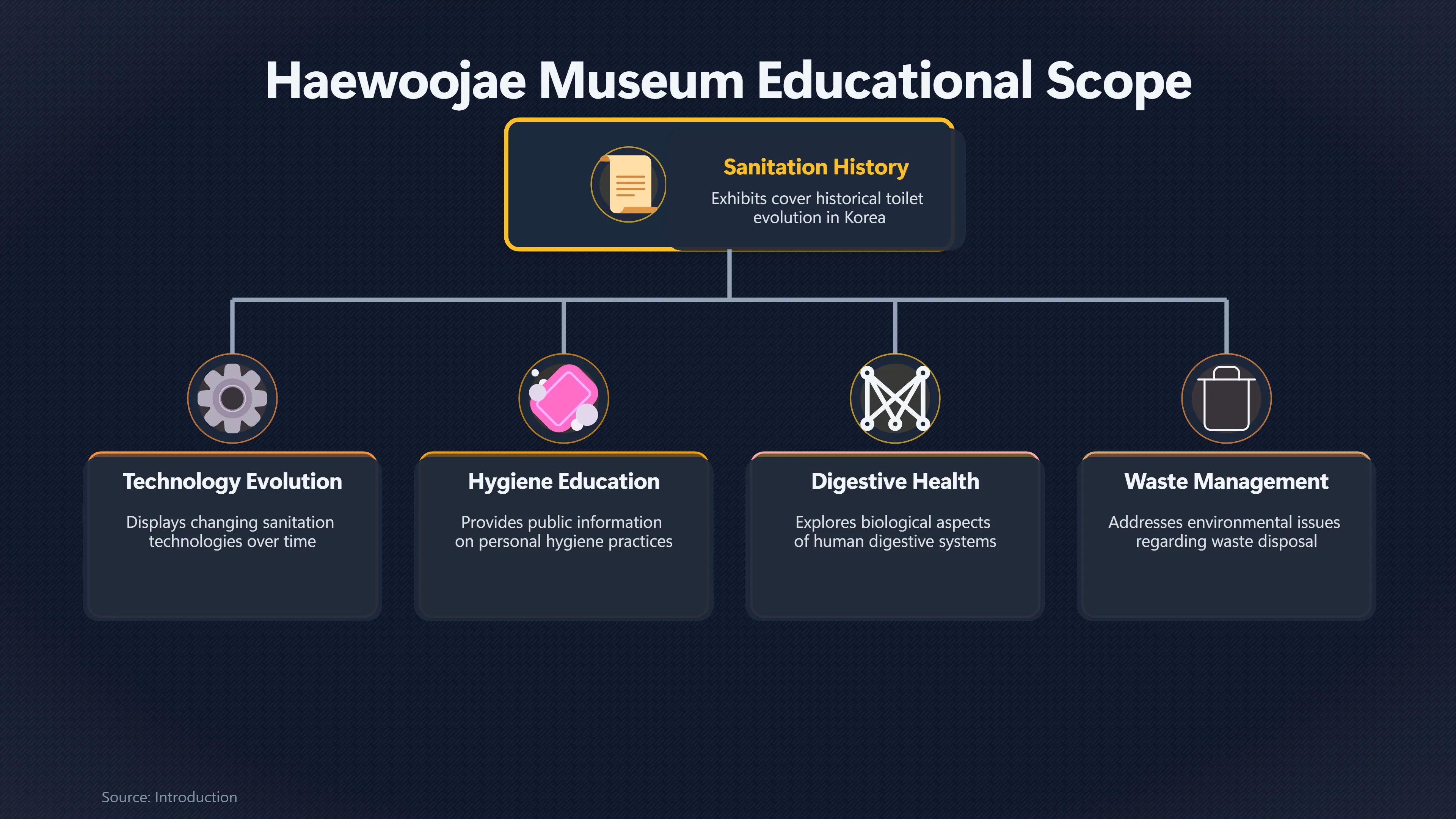
Inside, the exhibitions cover subjects that are more serious than the architecture suggests. Visitors encounter:
- the history of toilets in Korea and elsewhere;
- changing sanitation technologies;
- hygiene education;
- digestive health;
- environmental issues relating to waste management;
- temporary exhibitions connected with sanitation and public health.
The surrounding sculpture park continues the playful tone, with humorous statues depicting toilet use throughout history, but these outdoor displays support rather than replace the educational message. The contrast between comedy and civic education is deliberate: laughter attracts visitors who might otherwise ignore the subject of sanitation.[or.kr]english.visitkorea.or.krImagine Your KoreaHaewoojae Museum (Mr. Toilet House) (해우재)- VISITKOREA…
For this reason, Haewoojae is unusual but not frivolous. Its novelty architecture functions as an interpretive tool rather than the entire attraction.
Jeju’s Novelty Attractions and Photo-Friendly Spectacle
Jeju Island represents a different branch of South Korea’s curiosity culture. Rather than preserving one specialised subject, the island has become a concentration of privately developed attractions competing for tourists.
Many carry the word “museum” despite operating more like themed entertainment venues. Examples include teddy bear collections, optical illusion museums, trick-art galleries, wax figure displays and immersive photography spaces. Their success depends less on conserving rare artefacts than on producing memorable visitor experiences and highly shareable images.[Real Korea: realK]realk.krReal Korea: real KHaewoojae Museum | Suwon-si | Real Korea: real KReal Korea: real KHaewoojae Museum | Suwon-si | Real Korea: real K
This does not automatically make them misleading. Many openly advertise themselves as interactive attractions rather than scholarly institutions. Their priorities are different:
- carefully designed photo opportunities;
- family-friendly activities;
- seasonal commercial appeal;
- retail and café integration;
- repeat visits through changing displays.
In these cases, the museum label signals a themed destination rather than an archive or research collection.
Jeju therefore illustrates how commercial tourism has expanded the meaning of “museum” in South Korea. Visitors interested in unusual collections may enjoy these attractions, but they should not expect the same level of historical documentation or curatorial interpretation found in civic or national museums.
How to Judge Credibility, Interpretation and Commercial Intent
South Korea’s unusual attractions reward a simple credibility check before visiting.
A museum is more likely to have strong interpretive value when it:
- explains why objects matter rather than simply displaying them;
- identifies collectors, donors or institutional responsibility;
- provides historical or scientific context;
- distinguishes evidence from entertainment;
- collaborates with government, universities or recognised organisations.
Haewoojae performs well against these criteria. Although visually eccentric, it clearly identifies its educational mission, documents the sanitation movement associated with Sim Jae-duck, and links exhibitions to wider public-health issues rather than relying solely on novelty.[or.kr]english.visitkorea.or.krImagine Your KoreaHaewoojae Museum (Mr. Toilet House) (해우재)- VISITKOREA…
Commercial attractions often signal different priorities. Large gift shops, extensive selfie zones, minimal explanatory text and rapidly changing installations usually indicate that visitor experience, rather than preservation, is the primary objective. That does not diminish their entertainment value, but it changes how they should be interpreted.
The most useful question is therefore not whether an attraction is “real” or “fake”, but what it is trying to achieve. A public museum seeks to preserve and explain. A commercial attraction seeks to entertain, encourage repeat visits and support tourism. Some successful venues combine both.

Why Toilet Museums Matter in South Korea’s Curiosity Landscape
Among South Korea’s many eccentric attractions, Haewoojae occupies a distinctive position because it connects genuine public history with playful presentation. It demonstrates that an unusual subject can support serious discussion about sanitation, urban planning and global health without abandoning humour.
More broadly, it shows how South Korea’s commercial curiosity culture operates. The country embraces eye-catching architecture, themed environments and unconventional museum subjects, yet these attractions vary enormously in purpose. Some preserve cultural knowledge. Others sell memorable experiences. Many occupy a space somewhere between the two.
For travellers exploring South Korea’s stranger museums, recognising that spectrum is often more revealing than asking whether a place is merely quirky. The country’s curiosity culture is shaped not only by unusual objects, but also by the different ways museums, businesses and local governments use spectacle to attract attention while telling very different stories.
Amazon book picks
Further Reading
Books and field guides related to When Does a Tourist Attraction Become a Museum?. Use these as the next step if you want deeper reading beyond the article.
The Museum Experience
As the first book to take a "visitor's eye view" of the museum visit, The Museum Experience revolutionized the way museum professionals u...
The Participatory Museum
Offers a practical guide to working with community members and visitors to make cultural institutions more dynamic, relevant, essential p...
The Birth of Korean Cool
How did a really unhip country suddenly become cool? How could a nation that once banned miniskirts, long hair on men and rock 'n' roll c...
eBay marketplace picks
Marketplace Samples
Live-tested eBay searches with available results related to this page.
Selected fromtoilet museum collectible oneBay.co.uk.
Endnotes
1.
Source: english.visitkorea.or.kr
Link:https://english.visitkorea.or.kr/svc/contents/contentsView.do?vcontsId=72851
Source snippet
Imagine Your KoreaHaewoojae Museum (Mr. Toilet House) (해우재)- VISITKOREA...
2.
Source: haewoojae.com
Link:https://haewoojae.com/m/load.asp?idx=720&page=112&subPage=412
Source snippet
Haewoojae해우재...
3.
Source: realk.kr
Title: Real Korea: real KHaewoojae Museum | Suwon-si | Real Korea: real K
Link:https://www.realk.kr/travel-directory/haewoojae-museum/
4.
Source: Wikipedia
Link:https://en.wikipedia.org/wiki/Haewoojae
5.
Source: english.visitkorea.or.kr
Link:https://english.visitkorea.or.kr/svc/contents/contentsView.do?menuSn=351&vcontsId=72851
Source snippet
Imagine Your KoreaHaewoojae Museum (Mr. Toilet House) (해우재)- VISITKOREA...
6.
Source: youtube.com
Title: Mr. Toilet House Suwon, South Korea
Link:https://www.youtube.com/watch?v=61wE-r1sqsg
Source snippet
Haewoojae Toilet Museum Suwon South Korea Mr Toilet museum, Suwon, South Korea Food Fun Travel...
7.
Source: theguardian.com
Link:https://www.theguardian.com/world/2012/nov/09/south-korea-toilet-theme-park
8.
Source: withwta.org
Title: World Toilet Association
Link:https://www.withwta.org/home_en/b3_view.php?idx=3&m=5&s=43&startPage=
9.
Source: withwta.org
Title: World Toilet Association
Link:https://www.withwta.org/home_en/w2.php?s=22&year=2019
10.
Source: koreatriptips.com
Title: Haewoojae Museum (Mr. Toilet House) (해우재)
Link:https://www.koreatriptips.com/en/cultural-facilities/1998223.html
Additional References
11.
Source: wonderfulmuseums.com
Link:https://www.wonderfulmuseums.com/museum/toilet-museum/
Source snippet
Wonderful MuseumsAugust 26, 2025 — TOILET MUSEUM: UNVEILING THE SURPRISING HISTORY, CULTURAL IMPACT, AND VITAL IMPORTANCE OF SANITATION B...
Published: August 26, 2025
12.
Source: wonderfulmuseums.com
Title: Toilet Museum South Korea: Unpacking the Quirky and Cultured Haewoojae, Mr
Link:https://www.wonderfulmuseums.com/museum/toilet-museum-south-korea/
Source snippet
Toilet House - Wonderful MuseumsSeptember 9, 2025 — TOILET MUSEUM SOUTH KOREA: UNPACKING THE QUIRKY AND CULTURED HAEWOOJAE, MR. TOILET HO...
Published: September 9, 2025
13.
Source: youtube.com
Title: Inside Korea’s Mr. Toilet House: How Haewoojae Turned Toilets Into Culture
Link:https://www.youtube.com/watch?v=jdwt2Yv6sIQ
Source snippet
Inside the World's First TOILET MUSEUM! | Mr. Toilet House Suwon, South Korea...
14.
Source: suwon.go.kr
Link:https://www.suwon.go.kr/sw-www/deptHome/dep_env/env_03/env_04_04/env_04_04_01.jsp
Source snippet
화장실문화전시관 운영: HOME > 분야별정보 > 환경·녹지·위생 > 청소 > 화장실 > 화장실문화전시관 운영January 28, 2026 — 화장실문화전시관 운영 * 홈 * 환경·녹지·위생 * 뉴스포털 * 교육·청년·청소년 * 교통 * 도시...
Published: January 28, 2026
15.
Source: guinnessworldrecords.com
Link:https://www.guinnessworldrecords.com/world-records/341423-tallest-house-shaped-like-a-toilet
16.
Source: french.visitkorea.or.kr
Link:https://french.visitkorea.or.kr/svc/contents/contentsView.do?vcontsId=72993
17.
Source: tripadvisor.co
Link:https://www.tripadvisor.co/Attraction_Review-g297892-d2202463-Reviews-Teddy_Bear_Museum_Jeju-Seogwipo_Jeju_Island.html
18.
Source: tripadvisor.ie
Link:https://www.tripadvisor.ie/Attraction_Review-g297892-d2202463-Reviews-Teddy_Bear_Museum_Jeju-Seogwipo_Jeju_Island.html
19.
Source: youtube.com
Title: Inside the World’s First TOILET MUSEUM! | Mr. Toilet House Suwon, South Korea
Link:https://www.youtube.com/watch?v=3OlgPcCryp4
Source snippet
Suwon Toilet Museum, Mr Toilet's House...
20.
Source: thesmartlocal.kr
Title: Mr. Toilet House: A Toilet Bowl-Shaped Museum About Public Hygiene
Link:https://thesmartlocal.kr/mr-toilet-house/