Within Strange Serbia
What Did Thousands of Gifts Say About Tito?
Thousands of gifts and relay batons reveal how diplomacy, mass ritual and personal loyalty were organised around Tito.
On this page
- Diplomatic gifts and presidential authority
- Homemade tributes from citizens and institutions
- Relay batons, public ritual and the House of Flowers
Page outline Jump by section
Introduction
The Museum of Yugoslavia in Belgrade preserves one of Europe’s most unusual political collections: tens of thousands of gifts presented to Josip Broz Tito by foreign leaders, factories, schools, military units, artists and ordinary citizens. Unlike a conventional art or history museum, the collection documents how diplomacy, mass participation and carefully staged public loyalty were expressed through physical objects. Decorative weapons, embroidered textiles, handmade models, ceremonial batons and luxury diplomatic presents all served as messages about authority, friendship and belonging rather than simply as souvenirs.[muzej-jugoslavije.org]muzej-jugoslavije.orgMuseum of YugoslaviaMuseum of Yugoslavia
For visitors interested in Serbia’s stranger collections, the fascination lies less in the individual artefacts than in what they reveal about political ritual. The gifts record a society in which public affection for a leader was organised through ceremonies, workplaces, schools and international protocol. Today they can be viewed not only as relics of socialist Yugoslavia but also as evidence of how material culture helped construct political legitimacy.
What Did Thousands of Gifts Say About Tito?
The museum’s gift collection began during Tito’s lifetime and expanded through the institutions that later became today’s Museum of Yugoslavia. It now contains more than 75,000 objects inherited from the former Memorial Centre “Josip Broz Tito”, the Museum of the Revolution and later acquisitions. The collection is deliberately broad, including state gifts, personal tributes, ceremonial objects, artworks, crafts, industrial products and everyday items that together illustrate the social and political culture of Yugoslavia.[muzej-jugoslavije.org]muzej-jugoslavije.orgMuseum of YugoslaviaMuseum of Yugoslavia
What makes the collection unusual is its extraordinary range of donors. Expensive diplomatic gifts from monarchs and presidents sit alongside objects made by schoolchildren, miners, agricultural cooperatives, veterans, emigrant communities and amateur artists. Rather than separating “fine art” from popular culture, the museum preserves both as evidence of different forms of political communication.[muzej-jugoslavije.org]muzej-jugoslavije.orgMuseum of YugoslaviaMuseum of Yugoslavia
The result is neither a shrine nor a simple condemnation of personality cults. Modern exhibitions increasingly encourage visitors to ask why these objects were made, who commissioned them and how their meanings have changed since the collapse of Yugoslavia.[arXiv]arxiv.orgPlaying games with Tito: Designing hybrid museum experiences for critical playJanuary 29, 2021…
Diplomatic Gifts and Presidential Authority
At the highest political level, gift exchange followed international diplomatic protocol. Heads of state presented Tito with luxury objects intended to demonstrate respect while also expressing their country’s identity and political relationship with Yugoslavia.
Examples preserved by the museum include finely crafted silverwork, ceremonial weapons, jewellery, archaeological artefacts, porcelain and other prestigious objects from royal households and governments across Europe, Asia and Africa. Temporary exhibitions such as Royal Gifts have highlighted how carefully these exchanges followed diplomatic etiquette rather than personal generosity.[muzej-jugoslavije.org]muzej-jugoslavije.orgMuseum of YugoslaviaJuly 21, 2013…
Some individual gifts also illuminate changing Cold War politics. A silver jewellery chest presented by Admiral Louis Mountbatten during a 1952 meeting symbolised improving relations between Yugoslavia and Western powers after Tito’s break with Stalin. The object carries its original dedication, making its diplomatic purpose unmistakable.[muzej-jugoslavije.org]muzej-jugoslavije.orgMuseum of YugoslaviaMuseum of Yugoslavia
Another celebrated exhibit is the fragment of lunar rock presented by US President Richard Nixon in 1970 following the Apollo 11 mission. Accompanied by a Yugoslav flag that had travelled to the Moon, the gift demonstrated Yugoslavia’s distinctive international position as a socialist country maintaining relations with both East and West through the Non-Aligned Movement.[muzej-jugoslavije.org]muzej-jugoslavije.orgMuseum of YugoslaviaMuseum of Yugoslavia
Seen together, these objects function less as displays of wealth than as records of international recognition. Each gift documented a political relationship at a specific historical moment.
Homemade Tributes from Citizens and Institutions
If diplomatic gifts projected Yugoslavia onto the world stage, domestic gifts demonstrated participation inside the country.
Factories produced elaborate commemorative models. Schools embroidered banners. Municipalities commissioned sculptures. Amateur artists painted portraits. Sports clubs, veterans’ organisations, professional associations and workplaces all contributed objects marking anniversaries, birthdays or official celebrations. Many were handcrafted rather than expensive, emphasising participation over monetary value.[muzej-jugoslavije.org]muzej-jugoslavije.orgMuseum of YugoslaviaMuseum of Yugoslavia
These tributes reflected a political culture in which organisations were expected to express collective loyalty publicly. The value of many objects therefore lies not in artistic excellence but in their symbolism. Their inscriptions often identify the donor community, workplace or town, preserving a map of how political identity was organised throughout Yugoslavia.[muzej-jugoslavije.org]muzej-jugoslavije.orgMuseum of YugoslaviaMuseum of Yugoslavia
For today’s visitors this mixture can feel strikingly unfamiliar. Luxury diplomatic treasures stand beside carefully carved wooden models, embroidered greetings and amateur crafts, revealing that official devotion was expressed across every social level rather than only by governments.
Relay Batons, Public Ritual and the House of Flowers
The most distinctive objects in the collection are the relay batons associated with the annual Youth Relay.
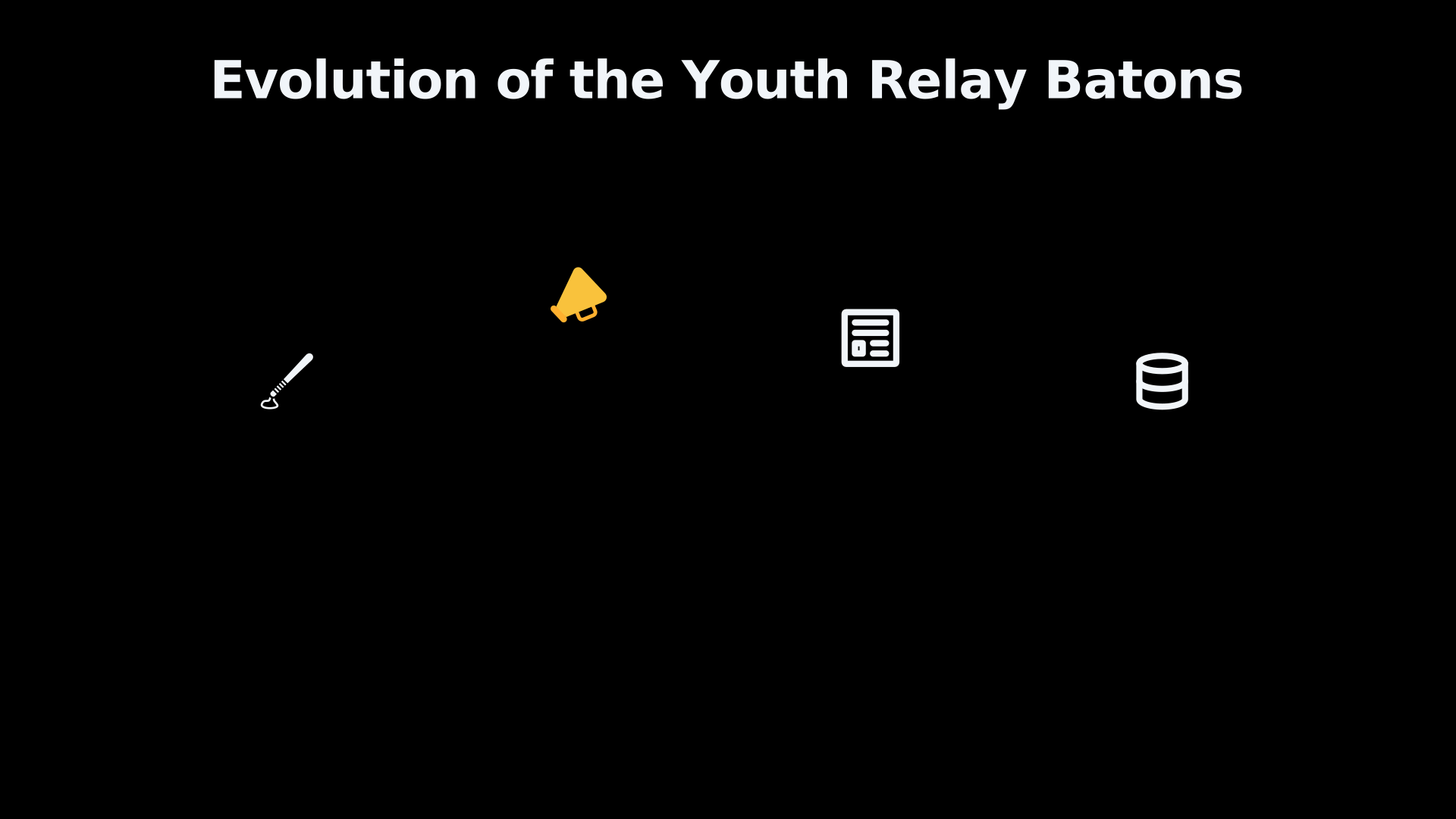
Beginning in 1945, young people carried ceremonial batons across Yugoslavia before presenting them to Tito as birthday gifts. What started as several regional relays evolved into the nationally organised Relay of Youth in 1957, when 25 May became the official Day of Youth. A single federal baton eventually represented thousands of local relays passing through towns and villages before reaching the final stadium ceremony.[muzej-jugoslavije.org]muzej-jugoslavije.orgMuseum of YugoslaviaMuseum of Yugoslavia
The batons themselves became increasingly elaborate works of design. Some resembled books, sculptures or modernist artworks rather than sporting equipment. The famous “Blue Book” from Kragujevac replaced a simple metal baton with a volume containing around 15,000 signatures collected from local young people, transforming the relay into a symbolic petition of loyalty.[muzej-jugoslavije.org]muzej-jugoslavije.orgMuseum of YugoslaviaMuseum of Yugoslavia
The annual ceremony combined athletic participation, choreographed mass performances and political theatre. The baton’s arrival before Tito represented not merely a sporting event but the physical embodiment of national unity passing from hand to hand across the federation.[muzej-jugoslavije.org]muzej-jugoslavije.orgMuseum of YugoslaviaMuseum of Yugoslavia
The tradition also reveals how political rituals evolved. The final Relay of Youth in 1987 became controversial after promotional material was discovered to echo imagery from a 1930s Nazi poster, triggering public scandal. The replacement baton, interpreted by some observers as ominously symbolic, is now displayed as evidence of a political culture approaching its end rather than its confident height.[muzej-jugoslavije.org]muzej-jugoslavije.orgMuseum of YugoslaviaMuseum of Yugoslavia
Many relay batons are displayed alongside the House of Flowers, Tito’s mausoleum within the Museum of Yugoslavia complex. Their proximity reinforces the transformation of once-living political rituals into historical artefacts. What were originally gifts intended for an active political leader now function as museum objects documenting collective memory and changing interpretations of Yugoslavia’s past.[muzej-jugoslavije.org]muzej-jugoslavije.orgMuseum of YugoslaviaMuseum of Yugoslavia
Why the Collection Still Matters
The Museum of Yugoslavia does not present Tito’s gifts simply as treasures. Instead, the collection demonstrates how objects can accumulate political meaning over time.
For historians, the gifts document diplomatic networks, state ceremonies and everyday participation in socialist Yugoslavia. For designers and museum specialists, they illustrate how exhibitions can reinterpret contested heritage rather than merely preserve it. Recent museum projects have explicitly encouraged visitors to question the authority of artefacts, explore competing memories and examine how political symbols acquire new meanings after the societies that created them disappear.[arXiv]arxiv.orgPlaying games with Tito: Designing hybrid museum experiences for critical playJanuary 29, 2021…
Within Serbia’s wider landscape of unusual collections, Tito’s gifts occupy a distinctive place. Unlike museums built around natural curiosities, folklore or archaeological mysteries, this collection reveals how ordinary objects became instruments of political devotion. The strangeness lies not in supernatural claims or bizarre artefacts but in the sheer scale of a material culture created to express loyalty, identity and state power through gifts that were never merely gifts.
Amazon book picks
Further Reading
Books and field guides related to What Did Thousands of Gifts Say About Tito?. Use these as the next step if you want deeper reading beyond the article.
The Invention of Tradition
Rating: 4.5/5 from 16 Google Books ratings
This book explores examples of this process of invention and addresses the complex interaction of past and present in a fascinating study...

Tito: A Biography
Tito was the last survivor of the great allied leaders of WW2. But when he died in May 1980, he was far from being a figure whom the marc...
The Dictators: Hitler's Germany, Stalin's Russia
"A book of great importance; it surpasses all others in breadth and depth."--Commentary If the past century will be remembered for its tr...
The Museum of Other People
A TLS BEST BOOK OF 2023 'A formidable work' Nigel Barley, author of The Innocent Anthropologist 'Should be required reading' Richard Lamb...
eBay marketplace picks
Marketplace Samples
Live-tested eBay searches with available results related to this page.
Selected fromYugoslavia memorabilia oneBay.co.uk.
Endnotes
1.
Source: muzej-jugoslavije.org
Title: Museum of Yugoslavia
Link:https://muzej-jugoslavije.org/en/fond/
2.
Source: muzej-jugoslavije.org
Title: Museum of Yugoslavia
Link:https://muzej-jugoslavije.org/en/predistorija-osnova-za-razumevanje-muzeja-jugoslavije/
3.
Source: arxiv.org
Link:https://arxiv.org/abs/2101.12533
Source snippet
Playing games with Tito: Designing hybrid museum experiences for critical playJanuary 29, 2021...
Published: January 29, 2021
4.
Source: muzej-jugoslavije.org
Title: Museum of Yugoslavia
Link:https://muzej-jugoslavije.org/en/exhibition/figure-secanja/
5.
Source: muzej-jugoslavije.org
Title: Museum of Yugoslavia
Link:https://muzej-jugoslavije.org/en/exhibition/carski-darovi/
Source snippet
July 21, 2013...
Published: July 21, 2013
6.
Source: muzej-jugoslavije.org
Title: Museum of Yugoslavia
Link:https://muzej-jugoslavije.org/en/art/kutija-za-nakit-u-obliku-skrinje/
7.
Source: muzej-jugoslavije.org
Title: Museum of Yugoslavia
Link:https://muzej-jugoslavije.org/en/art/delovi-mesecevog-tla/
8.
Source: muzej-jugoslavije.org
Title: Museum of Yugoslavia
Link:https://muzej-jugoslavije.org/en/art/plava-knjiga/
9.
Source: muzej-jugoslavije.org
Title: Museum of Yugoslavia
Link:https://muzej-jugoslavije.org/en/art/stafeta-mladosti-1957/
10.
Source: muzej-jugoslavije.org
Title: Museum of Yugoslavia
Link:https://muzej-jugoslavije.org/en/art/stafeta-mladosti/
11.
Source: serbia.travel
Title: The museum displays exhibits from all stages of developme
Link:https://www.serbia.travel/en/museum-of-yugoslavia/
Source snippet
Museum of Yugoslavia - Туристичка организација СрбијеNovember 18, 2024 — MUSEUM OF YUGOSLAVIA 2 MIN Image Image The Museum of Yugoslavia...
Published: November 18, 2024
12.
Source: muzej-jugoslavije.org
Title: Museum of Yugoslavia
Link:https://muzej-jugoslavije.org/en/exhibition/nesvrstani-od-beograda-do-beograda/
13.
Source: muzej-jugoslavije.org
Link:https://muzej-jugoslavije.org/en/o-nama/
14.
Source: atthemuseum.org
Title: Museum of Yugoslavia
Link:https://atthemuseum.org/museums/museum-of-yugoslavia
Additional References
15.
Source: youtube.com
Title: [4K] Walking Through Tito’s Legacy – Museum of Yugoslavia in Belgrade_Part 1
Link:https://www.youtube.com/watch?v=H4PPExZD-YQ
Source snippet
THE HOUSE OF FLOWERS, the place where TITO is buried - the communist beloved by Serbs...
16.
Source: youtube.com
Title: BROZ TITO, Palace of Flowers: Why Yugoslavia and the USSR Collapsed Together?
Link:https://www.youtube.com/watch?v=zQ3bJjySMl0
Source snippet
[4K]_Exploring The House of Flowers – Tito's Resting Place in Belgrade...
17.
Source: youtube.com
Title: [4K]_Exploring The House of Flowers – Tito’s Resting Place in Belgrade
Link:https://www.youtube.com/watch?v=qgKUAcVKZGo
Source snippet
A Visit to the Museum of Yugoslavia in Belgrade, Serbia...
18.
Source: youtube.com
Title: A Visit to the Museum of Yugoslavia in Belgrade, Serbia
Link:https://www.youtube.com/watch?v=_c3kIIMPtbM
Source snippet
[4K] Walking Through Tito's Legacy – Museum of Yugoslavia in Belgrade_Part 1...
19.
Source: mau.rs
Link:https://www.mau.rs/en/benefactors/a-history-of-the-gifts-to-the-maa.html
20.
Source: new-east-archive.org
Link:https://www.new-east-archive.org/features/show/11662/museum-of-yugoslavia-belgrade-serbia-history
21.
Source: commons.wikimedia.org
Link:https://commons.wikimedia.org/wiki/File%3ADisplay_of_many_of_the_gifts_given_to_Tito_who_kept_the_6Yugoslav_countries_federated%281943-1991%29-_Museum_of_Yugoslav_History%2813810216923%29.jpg
22.
Source: beogradskiizlet.com
Link:https://beogradskiizlet.com/en/tour/museum-of-yugoslavia-belgrade/
23.
Source: flickr.com
Title: Relay Batons for Tito. | The House of Flowers in Belgrade, r… | Flickr
Link:https://www.flickr.com/photos/johnadwillis/49044800701
24.
Source: youtube.com
Title: THE HOUSE OF FLOWERS, the place where TITO is buried
Link:https://www.youtube.com/watch?v=a_tnym4_tP8