Where Indonesia Keeps Its Strangest Stories
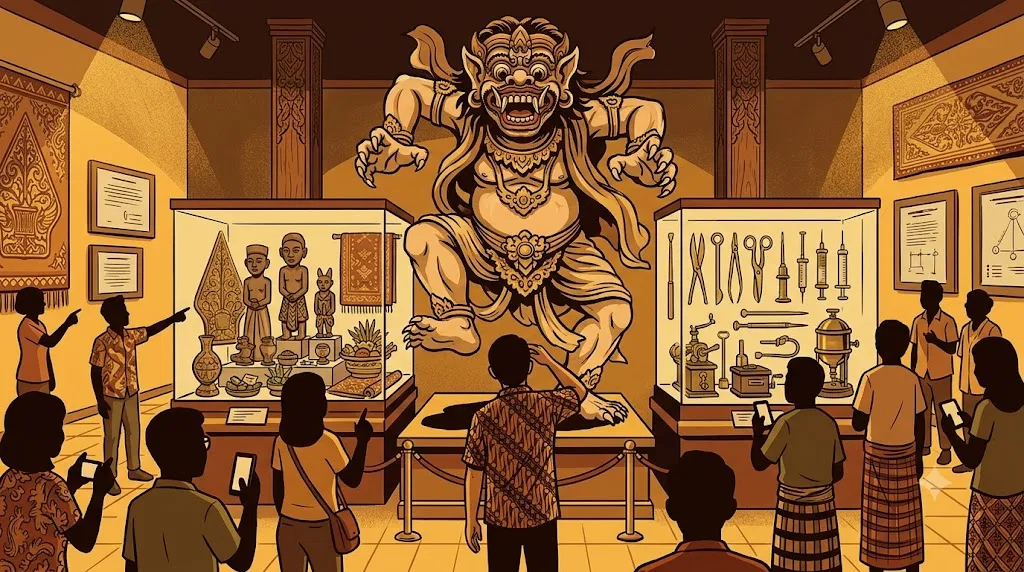
Indonesia does not have a single national “museum of the bizarre”. Its unusual collections are scattered across university departments, ritual-art galleries, disaster memorials, political monuments, small private displays and living funerary landscapes.
Page outline Jump by section
Introduction
What makes Indonesia especially interesting is the uncertainty over where a museum ends and a sacred, political or commemorative site begins. Some collections are academic and carefully interpreted; others are commercial attractions, community memorials or official narratives whose credibility must be judged critically. Visitors should therefore expect more than odd objects. These places reveal how Indonesians preserve relationships with ancestors, natural catastrophe, supernatural healing, colonial science and disputed national history.
Where death becomes a field of study
Indonesia’s clearest purpose-built museum of mortality is the Ethnography Museum and Centre for Death Studies at Airlangga University in Surabaya. Often informally called the Death Museum, it belongs to a university anthropology setting rather than the entertainment-led world of horror attractions. Its subject is not merely the dead body, but the many ways communities understand burial, mourning, commemoration and the transition between life and death. Airlangga University describes it as both a museum and a research centre, with activities for students, researchers and anthropology practitioners.[unair.ac.id]scholar.unair.ac.idUniversitas Airlangga Ethnography Museum and Center of Death StudyUniversitas AirlanggaEthnography Museum and Center of Death Study - Universitas Airlangga# Ethnography Museum and Center of Death Study *…
Displays reported by the university and contemporary press have included replicas or representations of graves, coffins, burial equipment and mortuary practices from different Indonesian societies. This makes it unusual without reducing its subject to spectacle. A visitor is being shown that death customs are social systems: they express family status, religious belief, ideas about the body and obligations between the living and the dead. The museum grew out of Airlangga’s strength in physical anthropology, a field concerned with human biological remains as well as their cultural setting.[The Jakarta Post]thejakartapost.comThe Jakarta Post Indonesia's first museum of deathThe Jakarta PostIndonesia's first museum of death - Art & Culture30 Oct 2018 — The Ethnography Museum and Mortality Study Center, the fir…
Its academic status gives it more interpretive credibility than attractions marketed simply as haunted or macabre. Even so, displays involving bones, funerary objects or representations of minority traditions raise familiar museum questions: who authorised the display, whether sacred material has been separated from its original setting, and whether visitors are encouraged to understand rather than merely stare. The museum’s connection with continuing research is therefore one of its most important features. It presents mortality as a serious subject of comparative study, not as proof of paranormal claims.
Ancestors are not simply exhibits
The strangest death-related experiences in Indonesia are often found outside conventional galleries. In the Toraja region of South Sulawesi, cliff graves, ancestral effigies and elaborate funeral traditions form part of a living cultural landscape. Carved figures representing deceased people may stand near burial chambers, while certain ceremonies renew relationships between families and their dead. These sites are frequently described in tourism as though they were open-air museums, but that description can be misleading: they remain places of kinship, status, ritual obligation and remembrance.[indonesiamuseum.org]indonesiamuseum.org* Indonesia Travel: Tau-Tau, Patung Perwujudan Orang Mati di Tana TorajaArsitektur Pemakaman Toraja dan Ingatan Leluhur | Museum NusantaraMay 11, 2026 — Museum sebaiknya tidak menampilkan arsitektur Toraja seb…
Regional museums provide a more conventional route into this culture. Buntu Kalando Museum, housed in a former royal complex in Tana Toraja, preserves historical and cultural material under the management of a local foundation and is recorded in Indonesia’s national museum system. The Pong Tiku Museum in North Toraja is promoted as holding archaeological and ethnographic objects connected with Toraja life, including ancestral figures and material associated with funerary practice. Tourism descriptions have also referred to preserved bodies or mummies, although prospective visitors should confirm what is currently displayed rather than assume that human remains are permanently available for viewing.[Visit Indonesia]indonesia.travelOpen source on indonesia.travel.
That distinction matters because Toraja mortuary objects do not become culturally neutral when placed behind glass. An ancestral figure is not simply a carved curiosity, and a preserved body is not equivalent to a medical specimen. Family authority, social rank and continuing ritual meaning may all affect how an object should be treated. The most responsible museums explain these relationships and resist presenting the culture as a timeless “tribe of death”.
Indonesia has other preserved ancestral remains that attract visitors, particularly in parts of Papua, but these are often held by families or communities rather than collected by formal museums. Access can depend on local permission, guides and changing community decisions. Photographs circulated online commonly detach such remains from their precise identity and setting, so dramatic claims about the age, ownership or treatment of individual bodies should be treated cautiously.
Bali’s monsters move from parade to gallery
The Ogoh-Ogoh Museum at Mengwi in Bali preserves a form of ritual art normally built for a brief and noisy public life. Ogoh-ogoh are enormous, vividly coloured effigies representing demons, destructive forces or characters drawn from religious and mythological stories. They are associated with the period before Nyepi, Bali’s Day of Silence, when communities parade them through the streets. Many are subsequently destroyed, dismantled or left to deteriorate. A museum collection therefore turns deliberately temporary festival sculpture into lasting heritage.[Visit Indonesia]indonesia.travelOpen source on indonesia.travel.
Visitors can expect looming faces, exaggerated bodies, claws, fangs and theatrical poses rather than ancient archaeological idols. The craftsmanship is real, but the figures are modern community creations, often incorporating contemporary materials and visual references. They should not be read as literal portraits of creatures Balinese people claim to have seen. Their meaning comes from ritual, storytelling, artistic competition and the controlled representation of disorder.
This tension between temporary ritual and permanent display is also explored at SAKA Museum, a privately operated cultural museum within the AYANA resort complex. Open to the public by reservation, it launched with an exhibition of ten newly commissioned ogoh-ogoh made by Balinese artists and community groups. One figure representing the epic king Ravana rises to roughly 11 metres. The museum also connects the effigies with calendars, manuscripts, music and the cultural framework surrounding Nyepi.[sakamuseum.org]sakamuseum.orgOpen source on sakamuseum.org.
The two institutions serve different audiences. Mengwi’s collection has the atmosphere of a specialised local attraction, while SAKA presents ritual art through polished architecture, commissioned work and resort-linked cultural tourism. Neither is simply a “monster museum”. Their real interest lies in how fearsome imagery can be communal, comic, moral, devotional and spectacular at the same time.
Medicine, healing and the supernatural
Surabaya’s Dr Adhyatma Health Museum became widely known as the “sorcery museum” because part of its collection addressed supernatural and traditional approaches to illness. Established through Indonesia’s Ministry of Health, developed from 1990 and formally inaugurated in 2004, it was intended as a history-of-health institution. Its wider holdings included medical instruments, hospital equipment, public-health material and objects associated with different attempts to prevent or cure disease.[indonesia-tourism.com]indonesia-tourism.comIndonesia Tourism Health Museum of Dr. Adhyatma, MPHIndonesia Tourism Health Museum of Dr. Adhyatma, MPH
The collection’s notoriety came from objects said to relate to harmful magic, spirit beliefs, protective practices and non-biomedical healing. Reports described dolls, sharp objects, amulets and other items linked by donors or interpreters to episodes of supposed sorcery. The museum did not thereby establish that supernatural attacks had occurred. Its strongest interpretation is anthropological and medical-historical: these objects document what patients, healers and communities believed could cause illness, and how those beliefs affected treatment. Contemporary accounts emphasised that the institution contained far more than occult material.[telusuri.id]telusuri.idTelusu RIAda Apa Saja di Museum Santet Surabaya?Telusu RIAda Apa Saja di Museum Santet Surabaya?
That framing makes the collection valuable. Museums of medicine often tell a simple story in which science steadily replaces ignorance. The Surabaya displays complicated that narrative by placing hospital technology beside practices that remained socially meaningful. For many people, biomedical treatment, religious observance and traditional healing are not mutually exclusive categories.
The museum’s recent operating status is difficult to establish confidently. Government cultural databases still carry a listing, and a museum-branded social-media account continues to show an address, but travel directories conflict over whether it is open or permanently closed. The site was reportedly used for patient isolation during the COVID-19 pandemic, and some older buildings in the complex were affected by later redevelopment. Visitors should therefore obtain direct confirmation before travelling specifically for the collection.[go.id]referensi.data.kemendikdasmen.go.idOpen source on go.id.
A more clearly educational medical collection is iMuseum at the University of Indonesia’s medical education and research institute in Jakarta. Its visitor areas present the history of medicine, medical training and healthcare instruments. It is less uncanny than the Surabaya collection, but it belongs to the same broader story: the preservation of obsolete instruments, anatomical teaching material and changing ideas about the human body.[imeri.fk.ui.ac.id]imeri.fk.ui.ac.idOpen source on ui.ac.id.
When disaster creates the collection
Some of Indonesia’s most powerful oddity displays were not assembled by collectors. They were created by earthquakes, eruptions and tsunamis, which transformed everyday objects into evidence.
The Mini Museum Sisa Hartaku on the slopes of Mount Merapi preserves possessions damaged during the volcano’s devastating 2010 eruption. Its collection includes scorched household goods, deformed metal, damaged vehicles, photographs and a clock stopped amid the disaster. Rather than presenting rare or valuable artefacts, it makes ordinary objects strange through heat, ash and sudden loss. The small, community-oriented display has become a common stop on commercial jeep tours around the eruption zone.[tripadvisor.com]tripadvisor.comVery ImpressiveVery Impressive
Its power depends on proximity. The objects came from homes and livelihoods in the surrounding settlements, so they function simultaneously as family remains, disaster evidence and tourism attractions. Limited labelling and the commercial pace of organised tours can make the display feel less curated than a major museum. Yet that roughness also preserves the character of a local memorial assembled from what survived.
The Aceh Tsunami Museum in Banda Aceh operates on a much larger and more formal scale. It commemorates the 2004 Indian Ocean tsunami, explains disaster risk and preserves testimony about destruction and recovery. The building was designed not only as a museum but also as a potential refuge during a future tsunami. Its visitor experience uses architecture, photographs, names and immersive spaces to move from disorientation and loss towards remembrance and resilience.[Dark Tourism]dark-tourism.com1016 tsunamimuseum1016 tsunamimuseum
New displays continue to reshape the institution. In February 2025, the museum and the United Nations launched a permanent photographic exhibition on the aftermath of the tsunami and the international humanitarian response. This continuing development distinguishes it from a frozen memorial. It also illustrates how disaster collections change as immediate shock becomes public history and younger visitors arrive with no personal memory of the event.[The United Nations in Indonesia]indonesia.un.org293350 tsunami museum aceh and un launch permanent photo exhibition after waves293350 tsunami museum aceh and un launch permanent photo exhibition after waves
These museums belong within Indonesia’s curiosity culture because they preserve objects whose appearance demands explanation. A melted radio or mud-stained possession may look bizarre, but the responsible response is not wonder alone. The object matters because it carries a trace of someone’s home, danger and survival.
Political horror and the problem of official truth
The Pancasila Sakti Monument and museum complex at Lubang Buaya in Jakarta is one of Indonesia’s most unsettling public collections. It stands at the site associated with the killing of army officers during the events of 30 September and 1 October 1965. Preserved buildings, a well, monumental statues and graphic dioramas create an environment that combines crime scene, national shrine and political museum.[Wikipedia]WikipediaLubang BuayaLubang Buaya
The displays were developed under President Suharto’s New Order government and present the Indonesian Communist Party as a long-running, exceptionally brutal threat to the nation. Scenes of conspiracy, kidnapping and violence are arranged to provoke disgust and reinforce the heroism of the armed forces. Their theatrical intensity has made the museum famous among dark-tourism visitors, but it should not be treated as a neutral reconstruction of the killings.[VICE]vice.comIndonesia's Anti-Communist Museum Is a Spooky,Indonesia's Anti-Communist Museum Is a Spooky,
Historians and human-rights commentators have challenged crucial elements of the official account, including sensational allegations about the torture and mutilation of the officers and the role assigned to members of the women’s organisation Gerwani. The site is therefore important partly as evidence of state storytelling: it shows how models, preserved rooms and emotionally charged narration can make one disputed version of history feel physically undeniable.[nobleworld.biz]nobleworld.bizLubang Buaya: Myth, Misogyny and MassacreLubang Buaya: Myth, Misogyny and Massacre
Visitors can learn from Lubang Buaya, but only by examining the museum as an artefact of the Suharto era as well as a memorial to the dead. The unanswered questions surrounding the 1965 coup attempt, the subsequent mass killings and decades of censorship cannot be resolved by accepting the dioramas at face value. Here, curatorial authority is itself the strangest object on display.
Colonial collections and absent objects
Part of Indonesia’s history of unusual collecting lies beyond the country’s borders. During the colonial period, European soldiers, doctors, missionaries and scientists removed human remains, sacred objects and ethnographic material from the Dutch East Indies. Some entered anatomical museums as evidence for racial classification; others were treated as curiosities or trophies.
Museum Vrolik in Amsterdam has reported that roughly 80 per cent of the approximately 400 ancestral human remains in its colonial-context holdings originated in the former Dutch East Indies. The museum has begun inventory and provenance work, and a community-led effort resulted in the return of Moluccan ancestral skulls. Such cases show that a curiosity cabinet can become a restitution case once the people represented by its contents regain a voice in their interpretation.[Museum Vrolik]museumvrolik.nlOpen source on museumvrolik.nl.
Fossil remains raise related questions. Early human discoveries made in Java were central to the development of palaeoanthropology, yet important specimens were transported to Europe. The Wajak skulls, found in East Java in the late nineteenth century and now held in the Netherlands, are an example of Indonesian archaeological heritage whose scientific afterlife unfolded largely abroad.[Wikipedia]WikipediaWajak craniaWajak crania
These absent collections matter within an account of strange museums in Indonesia. What visitors cannot see may be as significant as what remains on display. Repatriation debates are forcing institutions to reconsider whether human remains are scientific specimens, colonial property, ancestors or all three at once.
How to read Indonesia’s unusual museums
Indonesia’s strangest collections vary enormously in purpose and credibility. A few practical distinctions help make sense of them:
- Academic collections, such as Airlangga’s Death Museum, are strongest when they explain evidence, terminology and cultural variation rather than relying on shock.
- Devotional and funerary sites should be approached as living places with community authority, not as unrestricted open-air displays.
- Festival-art museums preserve objects that were originally temporary. Their displays may be highly theatrical without claiming that the depicted beings are physically real.
- Medical and supernatural collections document beliefs and healing practices; an object labelled as connected with sorcery is evidence of a claim or social practice, not proof of magical causation.
- Disaster museums use damaged objects to carry testimony. Commercial tourism around them does not automatically invalidate their memorial value, but interpretation and respect matter.
- Political museums may preserve genuine places and objects while arranging them into a contested ideological narrative.
Operating details also require care. Smaller Indonesian museums may close for renovation, religious holidays, institutional changes or local events without maintaining reliable English-language websites. Displays of sensitive material can be removed, relocated or restricted. Direct confirmation from the institution or local tourism authority is more dependable than an old travel blog.
Why Indonesia’s curiosity culture matters
Indonesia’s unusual collections are most revealing when they are not treated as a catalogue of frightening objects. They show several different ways of making the uncanny public. Universities turn death into a comparative field of knowledge. Balinese artists give disorder a giant temporary body, while museums rescue selected effigies from destruction. Families and regional institutions negotiate whether ancestors can be displayed. Communities preserve possessions altered by volcanoes, and the state uses dioramas to turn disputed violence into an apparently fixed national memory.
The country’s strange-history landscape is therefore defined less by eccentric private collectors than by the meeting of museums with active belief, ritual and political power. The central question is rarely “Is this object real?” A more useful question is: real in what sense—as physical evidence, sacred presence, artistic embodiment, family ancestor, disaster witness, medical record or instrument of propaganda?
That question changes the visitor’s role. Indonesia’s best unusual museums do not merely offer odd things to photograph. They reveal who has the power to preserve an object, name it, explain it and decide whether it should be seen at all.
Amazon book picks
Further Reading
Books and field guides related to Where Indonesia Keeps Its Strangest Stories. Use these as the next step if you want deeper reading beyond the article.
The Art of Not Being Governed
From the acclaimed author and scholar James C. Scott, the compelling tale of Asian peoples who until recently have stemmed the vast tide...
Death and the Regeneration of Life
It is a classical anthropological paradox that symbols of rebirth and fertility are frequently found in funerary rituals throughout the w...
eBay marketplace picks
Marketplace Samples
Live-tested eBay searches with available results related to this page.
Selected fromBalinese art print oneBay.co.uk.




Endnotes
1.
Source: indonesiamuseum.org
Title: * Indonesia Travel: Tau-Tau, Patung Perwujudan Orang Mati di Tana Toraja
Link:https://indonesiamuseum.org/id/articles/toraja-funeral-architecture-and-ancestral-memory
Source snippet
Arsitektur Pemakaman Toraja dan Ingatan Leluhur | Museum NusantaraMay 11, 2026 — Museum sebaiknya tidak menampilkan arsitektur Toraja seb...
Published: May 11, 2026
2.
Source: indonesia.travel
Link:https://www.indonesia.travel/gb/en/destination/sulawesi/south-sulawesi/buntu-kalando-museum–national-museum–indonesian-museum-collection-of-toraja-culture
3.
Source: indonesia.travel
Link:https://www.indonesia.travel/fr/en/destination/sulawesi/south-sulawesi/pong-tiku-museum–national-museum–museum-collections-in-toraja-utara/
4.
Source: indonesia.travel
Link:https://www.indonesia.travel/in/en/explore-indonesia/bali-nusa-tenggara/bali/museum-ogoh-ogoh/
5.
Source: indonesia.travel
Link:https://www.indonesia.travel/fr/en/destination/bali-nusa-tenggara/bali/museum-ogoh-ogoh
6.
Source: sakamuseum.org
Link:https://www.sakamuseum.org/en
7.
Source: time.com
Link:https://time.com/6992403/saka-museum/
8.
Source: indonesia-tourism.com
Title: Indonesia Tourism Health Museum of Dr. Adhyatma, MPH
Link:https://www.indonesia-tourism.com/blog/health-museum-of-dr-adhyatma-mph-3/
9.
Source: hellotravel.com
Link:https://www.hellotravel.com/indonesia/museum-kesehatan-dr-adhyatma
10.
Source: telusuri.id
Title: Telusu RIAda Apa Saja di Museum Santet Surabaya?
Link:https://telusuri.id/ada-apa-saja-di-museum-santet-surabaya/
11.
Source: wanderlog.com
Link:https://wanderlog.com/list/geoCategory/131483/best-free-museums-in-surabaya
12.
Source: instagram.com
Link:https://www.instagram.com/museumkesehatansby/
13.
Source: imeri.fk.ui.ac.id
Link:https://imeri.fk.ui.ac.id/services/visit-imuseum/
14.
Source: tripadvisor.com
Title: Very Impressive
Link:https://www.tripadvisor.com/ShowUserReviews-g2304080-d12162482-r756866522-Museum_Mini_Sisa_Hartaku-Sleman_Sleman_District_Yogyakarta_Region_Java.html
15.
Source: getyourguide.com
Link:https://www.getyourguide.com/sisa-hartaku-mini-museum-l181337/
16.
Source: dark-tourism.com
Title: 1016 tsunamimuseum
Link:https://www.dark-tourism.com/index.php/1016-tsunamimuseum
17.
Source: Wikipedia
Title: Lubang Buaya
Link:https://en.wikipedia.org/wiki/Lubang_Buaya
18.
Source: dark-tourism.com
Link:https://www.dark-tourism.com/index.php/1018-pancasila-sakti
19.
Source: vice.com
Title: Indonesia’s Anti-Communist Museum Is a Spooky,
Link:https://www.vice.com/en/article/indonesias-anti-communist-museum-is-a-spooky-confusing-place/
20.
Source: nobleworld.biz
Title: Lubang Buaya: Myth, Misogyny and Massacre
Link:https://www.nobleworld.biz/images/Drakeley.pdf
21.
Source: Wikipedia
Title: Wajak crania
Link:https://en.wikipedia.org/wiki/Wajak_crania
22.
Source: tripadvisor.com
Title: Attractions g294225 Activities c47 t24 Indonesia
Link:https://www.tripadvisor.com/Attractions-g294225-Activities-c47-t24-Indonesia.html
23.
Source: tripadvisor.com
Title: Museum Kesehatan Dr. Adhyatma MPH
Link:https://www.tripadvisor.com/Attraction_Review-g297715-d10592811-Reviews-Museum_Kesehatan_Dr_Adhyatma_MPH-Surabaya_East_Java_Java.html
24.
Source: tripadvisor.com
Title: Mount Merapi Museum
Link:https://www.tripadvisor.com/Attraction_Review-g2304080-d3280310-Reviews-or10-Mount_Merapi_Museum-Sleman_Sleman_District_Yogyakarta_Region_Java.html
25.
Source: indonesia.travel
Link:https://www.indonesia.travel/gb/en/destination/java/east-java/museum-kanker-indonesia/
26.
Source: indonesia.travel
Link:https://www.indonesia.travel/de/de/destination/bali-nusa-tenggara/bali/museum-ogoh-ogoh/
27.
Source: indonesia.travel
Link:https://www.indonesia.travel/ru/ru/destination/bali-nusa-tenggara/bali/museum-ogoh-ogoh
28.
Source: indonesia.travel
Link:https://www.indonesia.travel/th/en/destination/java/east-java/museum-dan-pusat-kajian-etnografi-universitas-airlangga
29.
Source: indonesia.travel
Link:https://www.indonesia.travel/id/id/destination/java/east-java/museum-kanker-indonesia
30.
Source: indonesia.travel
Title: Tin Museum of Indonesia: Exploring the Rich Heritage
Link:https://www.indonesia.travel/gb/en/explore-indonesia/sumatra/bangka-belitung-islands/pangkalpinang—the-tin-museum-of-indonesia/
31.
Source: indonesia.travel
Link:https://www.indonesia.travel/gb/en/destination/java/yogyakarta/museum-gunungapi-merapi
32.
Source: wanderlog.com
Title: Museum Kesehatan Dr. Adhyatma, MPH, Surabaya, Indonesia
Link:https://wanderlog.com/place/details/78702
33.
Source: wanderlog.com
Title: Museum Kesehatan Dr. Adhyatma, MPH, Surabaya, Indonesia
Link:https://wanderlog.com/place/details/78702/museum-kesehatan-dr-adhyatma-mph
34.
Source: instagram.com
Link:https://www.instagram.com/reel/DSShyCHE4dY/?hl=en-gb
35.
Source: instagram.com
Link:https://www.instagram.com/p/DVF8s7HjFAU/
36.
Source: instagram.com
Link:https://www.instagram.com/p/DSFM_esCEHZ/
37.
Source: instagram.com
Link:https://www.instagram.com/p/DOtLrJ-jnRI/?hl=en
38.
Source: instagram.com
Link:https://www.instagram.com/reel/DWVAbl_jkEq/?hl=en
39.
Source: instagram.com
Link:https://www.instagram.com/reel/Ch8YaWxg_AN/?hl=en
40.
Source: instagram.com
Link:https://www.instagram.com/reel/DRW8sAzjxnl/
41.
Source: sakamuseum.org
Link:https://www.sakamuseum.org/id
42.
Source: sakamuseum.org
Title: Collection | SAKA Museum COLLECTION HIGHLIGHTS: Ogoh
Link:https://www.sakamuseum.org/en/collection
43.
Source: indonesiamuseum.org
Title: toraja funeral architecture and ancestral memory
Link:https://indonesiamuseum.org/en/articles/toraja-funeral-architecture-and-ancestral-memory
44.
Source: indonesia-tourism.com
Link:https://www.indonesia-tourism.com/west-papua/wamena/mummy_of_aikima.html
45.
Source: tripadvisor.in
Title: MUSEU M KESEHATAN DR. ADHYATMA MPH
Link:https://www.tripadvisor.in/Attraction_Review-g297715-d10592811-Reviews-Museum_Kesehatan_Dr_Adhyatma_MPH-Surabaya_East_Java_Java.html
46.
Source: scholar.unair.ac.id
Title: Universitas Airlangga Ethnography Museum and Center of Death Study
Link:https://scholar.unair.ac.id/en/organisations/ethnography-museum-and-center-of-death-study/
Source snippet
Universitas AirlanggaEthnography Museum and Center of Death Study - Universitas Airlangga# Ethnography Museum and Center of Death Study *...
47.
Source: unair.ac.id
Link:https://unair.ac.id/museum-etnografi-unair-tawarkan-pengalaman-menarik-soal-kematian/
Source snippet
Sementara di luar negeri, Museum Etnografi membina kerjasama penelitian dengan University of Otago, Tokyo National Museum, dan Netherland...
48.
Source: thejakartapost.com
Title: The Jakarta Post Indonesia’s first museum of death
Link:https://www.thejakartapost.com/life/2018/10/30/indonesias-first-museum-of-death
Source snippet
The Jakarta PostIndonesia's first museum of death - Art & Culture30 Oct 2018 — The Ethnography Museum and Mortality Study Center, the fir...
49.
Source: unair.ac.id
Link:https://unair.ac.id/department-of-anthropology-pioneer-of-indonesian-physical-anthropology-studies/
Source snippet
The establishment of the museum was motivated by an interest in the study of Physical Anthropology, which is the only one in Indonesia...
50.
Source: theguardian.com
Title: six new museums around world 2025 egypt nigeria indonesia india culture art
Link:https://www.theguardian.com/global-development/2024/dec/30/six-new-museums-around-world-2025-egypt-nigeria-indonesia-india-culture-art
51.
Source: budaya.data.kemdikbud.go.id
Link:https://budaya.data.kemdikbud.go.id/lembaga/objek/MS000295
52.
Source: timesindonesia.co.id
Title: mengenal santet di museum kesehatan
Link:https://timesindonesia.co.id/wisata/110514/mengenal-santet-di-museum-kesehatan
53.
Source: referensi.data.kemendikdasmen.go.id
Link:https://referensi.data.kemendikdasmen.go.id/budayakita/lembaga/objek/MS000295
54.
Source: indonesia.un.org
Title: 293350 tsunami museum aceh and un launch permanent photo exhibition after waves
Link:https://indonesia.un.org/en/293350-tsunami-museum-aceh-and-un-launch-permanent-photo-exhibition-after-waves
55.
Source: museumvrolik.nl
Link:https://www.museumvrolik.nl/en/bericht/successful-repatriation-of-moluccan-ancestral-skulls-by-diaspora-group-and-museum-vrolik/
56.
Source: scholar.unair.ac.id
Link:https://scholar.unair.ac.id/en/clippings/menjelajahi-museum-unik-di-indonesia-museum-etnografi-kematian-un/
57.
Source: unair.ac.id
Title: FISI P Ethnographic Museum collections support UNAIR SDGs Program
Link:https://unair.ac.id/en/fisip-ethnographic-museum-collections-support-unair-sdgs-program/
58.
Source: scholar.unair.ac.id
Title: unair.ac.id RESEARC H CENTER MUSEUM ETHNOGRAPHY AND DEATH STUDIES
Link:https://scholar.unair.ac.id/en/organisations/research-center-museum-ethnography-and-death-studies/
59.
Source: scholar.unair.ac.id
Title: unair.ac.id Pusat Kajian Etnografi
Link:https://scholar.unair.ac.id/en/organisations/pusat-kajian-etnografi/
60.
Source: scholar.unair.ac.id
Title: unair.ac.id Social Sciences
Link:https://scholar.unair.ac.id/en/organisations/social-sciences-3/
61.
Source: scholar.unair.ac.id
Title: unair.ac.id Anthropology
Link:https://scholar.unair.ac.id/en/organisations/anthropology-3/persons/
62.
Source: scholar.unair.ac.id
Title: unair.ac.id Pusat Kajian Pembangunan, Kependudukan, dan Perubahan Budaya
Link:https://scholar.unair.ac.id/en/organisations/pusat-kajian-pembangunan-kependudukan-dan-perubahan-budaya/
63.
Source: tripadvisor.co.uk
Title: Attractions g294225 Activities c49 t161 Indonesia
Link:https://www.tripadvisor.co.uk/Attractions-g294225-Activities-c49-t161-Indonesia.html
64.
Source: tripadvisor.co.id
Title: Museum Kesehatan Dr. Adhyatma MPH (Surabaya, Indonesia)
Link:https://www.tripadvisor.co.id/Attraction_Review-g297715-d10592811-Reviews-Museum_Kesehatan_Dr_Adhyatma_MPH-Surabaya_East_Java_Java.html
Additional References
65.
Source: museoetno.fisip.unair.ac.id
Link:https://museoetno.fisip.unair.ac.id/
Source snippet
Museum Etnografi dan Pusat Kajian Kematian FISIP Universitas Airlangga menyelenggarakan rangkaian workshop yang terbuka bagi para mahasis...
66.
Source: visittoraja.com
Link:https://www.visittoraja.com/destination/toraja/lemo/
67.
Source: youtube.com
Link:https://www.youtube.com/watch?v=o7MWVXzEBXc
Source snippet
Surabaya Witchcraft Museum Collection This report visually explores the unique wing of the health museum in Surabaya dedicated exclusivel...
68.
Source: youtube.com
Link:https://www.youtube.com/watch?v=ZmVXAHVbsys
Source snippet
Sculpting the Spirit: The Sacred Purpose of Ogoh Ogoh...
69.
Source: id.usembassy.gov
Link:https://id.usembassy.gov/press-release-partnership-in-resilience-exhibition-commemorates-20-years-of-u-s-indonesia-cooperation-following-the-indian-ocean-tsunami/
70.
Source: youtube.com
Title: Museum dedicated to witchcraft and the supernatural
Link:https://www.youtube.com/watch?v=KyzliBtio4w
Source snippet
My Remaining Treasures Mini Museum Tour Review | Merapi Lava Tour 2022...
71.
Source: youtube.com
Title: Trunyan Village: Isle of the Dead
Link:https://www.youtube.com/watch?v=9aX6oN4Ox9k
Source snippet
Toraja — funerals and bizarre death rituals in the Land of the Living Dead (part 1)...
72.
Source: jejakpiknik.com
Link:https://jejakpiknik.com/museum-kesehatan-surabaya/
73.
Source: researchgate.net
Link:https://www.researchgate.net/publication/388501535_Evaluating_Tsunami_Memorial_Museums_in_Indonesia_and_Japan_as_Post-Disaster_Dark_Tourism_Sites
74.
Source: researchgate.net
Link:https://www.researchgate.net/publication/401109470_The_Sacred_Pancasila_Museum_and_Monument_Lubang_Buaya_in_Indonesia_Nationhood_and_Collective_Trauma