Within Strange Niger
Why Niger Preserved a Dead Desert Tree
The preserved trunk of the Tree of Tenere turns a lost desert landmark into an object of navigation, folklore and national remembrance.
On this page
- The tree as a Saharan landmark
- Its destruction and move to Niamey
- From natural object to national relic
Page outline Jump by section
Introduction
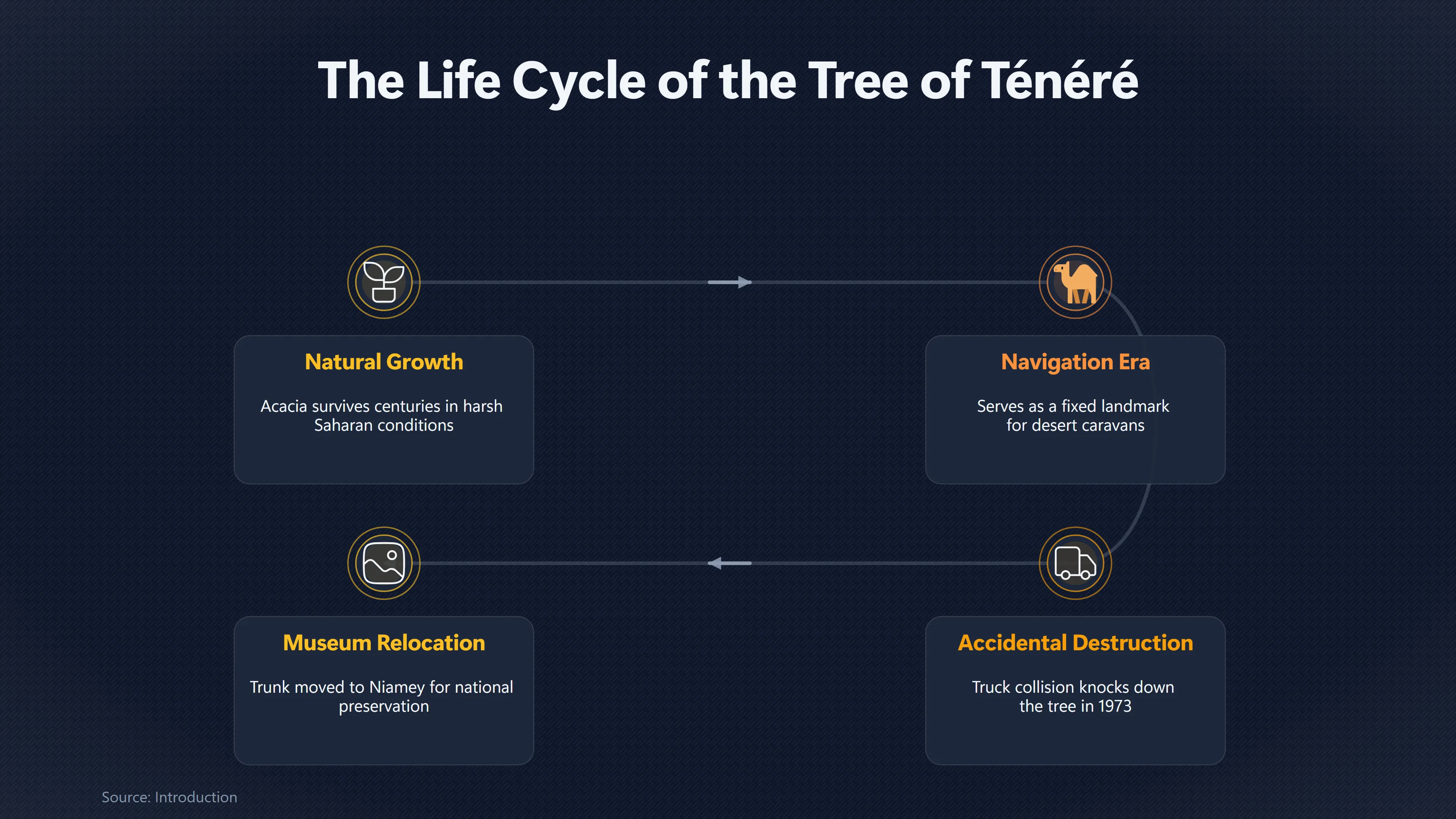
The preserved remains of the Tree of Ténéré are among Niger’s most unusual heritage objects. Rather than displaying a rare artwork or archaeological treasure, the National Museum in Niamey preserves the trunk of a dead acacia that once stood alone in the Sahara, where it served as a practical landmark for caravans, explorers and motorists crossing one of the world’s harshest deserts. After the tree was destroyed in 1973, its remains were moved from the Ténéré Desert and treated almost as a national relic. Today, the preserved trunk represents far more than a botanical specimen: it embodies memories of Saharan travel, environmental change, national identity and the fragile relationship between people and an unforgiving landscape.[Wikipedia]WikipediaTree of TénéréTree of Ténéré
The tree as a Saharan landmark
The Tree of Ténéré was extraordinary because it combined biological survival with geographical importance. It grew near a well on an otherwise featureless stretch of the Sahara in north-eastern Niger and became one of the few fixed reference points available to generations of travellers. Its isolation was so remarkable that it appeared on small-scale maps of Africa, an honour almost never given to a single individual tree.[Wikipedia]WikipediaTree of TénéréTree of Ténéré
French military personnel, explorers and ethnographers documented the tree during the twentieth century. When a well was dug nearby in 1938–39, engineers found that its roots reached more than 30 metres down to the water table, illustrating how an acacia could survive in one of the driest inhabited regions on Earth. Henri Lhote, who visited the tree in both the 1930s and the 1950s, described an ageing but still living acacia whose continued existence seemed almost miraculous amid the surrounding dunes.[Wikipedia]WikipediaTree of TénéréTree of Ténéré
Its significance was never based on supernatural belief. Instead, the tree acquired an almost mythical reputation because it was dependable. Salt caravans, desert expeditions and later vehicle convoys could navigate towards a living object that stood where virtually nothing else broke the horizon. In a landscape where orientation could mean survival, the tree became a cultural landmark as much as a natural one.[Wikipedia]WikipediaOpen source on wikipedia.org.
Its destruction and move to Niamey
The story is remembered largely because of its abrupt ending. After surviving centuries of drought, the tree was accidentally struck and knocked down in 1973 by a truck driver, an incident widely reported as involving a drunken Libyan driver. Although some details of the driver’s condition rely on repeated secondary accounts rather than official documentation, there is no serious dispute that a vehicle collision destroyed the tree.[wikipedia.org]WikipediaTree of TénéréTree of Ténéré
Rather than leaving the remains in the desert, Niger chose to preserve them. On 8 November 1973 the trunk was transported to the National Museum in Niamey, where it was installed inside a dedicated protective structure. At the original desert location, a metal sculpture now marks where the famous acacia once stood. Replicas have also been created elsewhere in Niger, including Agadez, allowing the image of the tree to survive even though the original no longer exists.[Wikipedia]WikipediaTree of TénéréTree of Ténéré
This decision transformed the tree from a practical navigation aid into a museum object. Visitors no longer encounter it in the silence of the Sahara but within a curated national collection, where its meaning is interpreted through history, memory and environmental heritage.
From natural object to national relic
The preserved trunk occupies an unusual place within Niger’s museum landscape because it is neither a conventional natural history specimen nor an archaeological artefact. It has become a relic of a vanished landscape.
Unlike preserved plants collected for scientific study, the Tree of Ténéré is displayed because of what it symbolised. It recalls a period when caravans crossed the Sahara using landmarks that were remembered collectively rather than located by satellite navigation. It also serves as a reminder that the Sahara has not always looked as it does today. While the tree itself probably germinated only a few centuries ago, its existence hinted at older, wetter environmental conditions and demonstrated how isolated life could persist in extreme desert environments.[Wikipedia]WikipediaTree of TénéréTree of Ténéré
The museum presentation therefore shifts attention away from botany towards memory. Visitors are encouraged to see the tree as an object carrying stories of endurance, exploration and loss. In this sense, the preserved trunk functions much like the remains of a famous ship, locomotive or historic building: the physical object has become valuable because of the human narratives attached to it.
Why the relic matters in Niger’s curiosity culture
For readers interested in unusual collections, the Tree of Ténéré demonstrates that curiosity does not always arise from the bizarre or supernatural. Sometimes an ordinary natural object becomes extraordinary through circumstance.
The preserved tree stands out because it combines several different forms of significance:
- Geographical: it once served as one of the Sahara’s most recognisable navigation points.
- Historical: it represents centuries of caravan travel before modern positioning systems.
- Environmental: it illustrates the remarkable adaptations required for survival in an extreme desert.
- Museological: its preservation turned a destroyed landscape feature into an exhibit worthy of national protection.
- Symbolic: it has become one of Niger’s best-known cultural icons despite no longer being alive.[Wikipedia]WikipediaTree of TénéréTree of Ténéré
Within Niger’s wider landscape of unusual collections, the Tree of Ténéré occupies a distinctive position. Fossils, archaeological discoveries and ethnographic collections explain deep history or cultural diversity, but the preserved trunk captures a single dramatic moment when a famous living landmark ceased to exist and immediately entered national memory.

A relic remembered more for its story than its wood
Visitors expecting a spectacular botanical specimen may be surprised. The surviving trunk is visually modest, especially compared with the legend surrounding it. Its power comes from context rather than appearance.
The object represents the transition from living landmark to museum relic. Destroyed by chance after surviving centuries of desert conditions, preserved instead of discarded, and commemorated by sculptures at its former site, the Tree of Ténéré has become one of Niger’s most evocative examples of how an everyday natural object can acquire lasting cultural meaning. The museum does not preserve it because it was the largest tree, the oldest tree or the rarest species, but because it became inseparable from the memory of crossing the Sahara itself.[Wikipedia]WikipediaTree of TénéréTree of Ténéré
Amazon book picks
Further Reading
Books and field guides related to Why Niger Preserved a Dead Desert Tree. Use these as the next step if you want deeper reading beyond the article.
Sahara
Michael Palin's superb No. 1 bestseller about his incredible voyage across the Sahara. Michael Palin's epic voyages have seen him circumn...
The Sahara: A Cultural History
The Sahara is the quintessence of isolation, epitomizing both remoteness and severity of environment unlike any other place on the face o...
Wind, Sand and Stars
Rating: 4.0/5 from 5 Google Books ratings
Reminiscences by a flyer in Africa, South America and Europe.
The Hidden Life of Trees: What They Feel, How They Communicate
Sunday Times Bestseller‘A paradigm-smashing chronicle of joyous entanglement’ Charles Foster Waterstones Non-Fiction Book of the Month (S...
eBay marketplace picks
Marketplace Samples
Live-tested eBay searches with available results related to this page.
Selected fromdesert art print oneBay.co.uk.

Current eBay listing
Sahara Desert Art Print Framed Wall Art Poster Canvas Print Picture


Current eBay listing
Modern Desert Dunes Framed Wall Art Poster Canvas Print Picture
Endnotes
1.
Source: Wikipedia
Title: Tree of Ténéré
Link:https://en.wikipedia.org/wiki/Tree_of_T%C3%A9n%C3%A9r%C3%A9
2.
Source: Wikipedia
Link:https://en.wikipedia.org/wiki/T%C3%A9n%C3%A9r%C3%A9
3.
Source: smithsonianmag.com
Link:https://www.smithsonianmag.com/smart-news/the-most-isolated-tree-in-the-world-was-killed-by-a-probably-drunk-driver-5369329/
Additional References
4.
Source: currentindia.com
Link:https://currentindia.com/channels/timesofindia/toi-world/the-worlds-loneliest-tree-had-no-other-tree-within-400-km-across-the-sahara-desert-and-roots-over-30-metres-deep-to-reach-hidden-groundwater-then-one-drunk-truck-driver-knocked-it-down-after-300-yea/
Source snippet
ater, then one drunk truck driver knocked it down after 300 years of survival | CurrentIndia.comJuly 14, 2026 — Image: <div>The world's l...
Published: July 14, 2026
5.
Source: infotoknow.com
Title: The Tree of Ténéré: The Story of the World’s Most Isolated Tree
Link:https://infotoknow.com/tree-of-tenere-sahara-mystery
Source snippet
Info to knowJanuary 28, 2026 — THE TREE OF TÉNÉRÉ: HOW A SINGLE ACACIA BECAME THE WORLD'S MOST ISOLATED NAVIGATIONAL PUZZLE By Julian Tho...
Published: January 28, 2026
6.
Source: commons.wikimedia.org
Title: Commons File:Niger, Agadez (20), Arbre du Ténéré, replica.jpg
Link:https://commons.wikimedia.org/wiki/File%3ANiger%2C_Agadez_%2820%29%2C_Arbre_du_T%C3%A9n%C3%A9r%C3%A9%2C_replica.jpg
Source snippet
Wikimedia CommonsFile:Niger, Agadez (20), Arbre du Ténéré, replica.jpg - Wikimedia Commons...
7.
Source: jalopnik.com
Title: The Remarkable Life And Sad Death Of The World’s Most Isolated Tree
Link:https://www.jalopnik.com/the-remarkable-life-and-sad-death-of-the-world-s-most-i-5855650/
Source snippet
The Remarkable Life And Sad Death Of The World's Most Isolated Tree...
8.
Source: timesofindia.indiatimes.com
Link:https://timesofindia.indiatimes.com/world/rest-of-world/the-worlds-loneliest-tree-had-no-other-tree-within-400-km-across-the-sahara-desert-and-roots-over-30-metres-deep-to-reach-hidden-groundwater-then-one-drunk-truck-driver-knocked-it-down-after-300-years-of-survival/articleshow/132384027.cms
Source snippet
world's loneliest tree had no other tree within 400 km across the Sahara Desert and roots over 30 metres deep to reach hidden groundwater...
9.
Source: findtourguide.com
Link:https://www.findtourguide.com/destinations/niger/niamey-3158/national-museum-3165
10.
Source: cntraveler.com
Link:https://www.cntraveler.com/stories/2013-04-29/tree-of-tenere-niger-africa-maphead-ken-jennings
11.
Source: maximilien-bruggmann.ch
Link:https://maximilien-bruggmann.ch/expo-section-detail/2019—In-the-heart-of-the-Sahara/Niger
12.
Source: the153club.org
Link:https://www.the153club.org/tenere2.html
13.
Source: maximilien-bruggmann.ch
Link:https://www.maximilien-bruggmann.ch/PhotoSearch/?kw=Arbre+du+T%C3%A9n%C3%A9r%C3%A9