Within Syria Curiosities
Inside Syria's Museum of Ancient Wonders
The National Museum of Damascus brings together extraordinary objects from early writing, ancient kingdoms and Syria's many lost civilisations.
On this page
- Early writing and lost kingdoms
- Objects that changed ancient history
- Protection and recovery after conflict
Page outline Jump by section
Introduction
The National Museum of Damascus is Syria’s great archaeological “cabinet of curiosities”: not a collection of myths or unexplained objects, but a place where discoveries from vanished kingdoms, lost writing systems and ancient cities are gathered in one building. Founded in 1919, it preserves artefacts that span thousands of years, including some of the most important discoveries from sites such as Ugarit, Ebla and Mari. Its unusual appeal lies in the fact that many objects are not simply beautiful antiques; they are evidence that changed how historians understand the origins of writing, diplomacy, religion and urban life in the ancient Near East.[UNESCO]unesco.orgSyria: UNESCO resumes operations with a first initiative at theJune 10, 2025…
For visitors interested in strange and extraordinary collections, the museum offers a different kind of wonder. Its “mysteries” are not supernatural claims, but real traces of forgotten societies: clay tablets recording ancient languages, royal archives from Bronze Age kingdoms, monumental sculpture, funerary objects and artworks recovered from some of the most significant archaeological sites in Syria.[UNESCO]unesco.orgSyria: UNESCO resumes operations with a first initiative at theJune 10, 2025…
Early writing and lost kingdoms
The most remarkable part of the National Museum of Damascus is its ancient Near Eastern collection, where objects reveal how early states organised power, trade and communication. The museum’s holdings connect directly to archaeological discoveries from sites that reshaped knowledge of the ancient world, particularly Ugarit, Ebla and Mari.[UNESCO]unesco.orgSyria: UNESCO resumes operations with a first initiative at theJune 10, 2025…
Ugarit and the birth of alphabetic writing
Among the museum’s most famous treasures are finds connected with Ugarit, the ancient coastal city discovered at Ras Shamra near modern Latakia. Excavations there uncovered archives written in several languages and revealed a writing system that became a crucial link in the history of alphabets. The Ugaritic alphabet used a small number of wedge-shaped signs and helped scholars understand how alphabetic writing developed in the eastern Mediterranean world.[Wikipedia]WikipediaNational Museum of DamascusNational Museum of Damascus
What makes these objects especially fascinating is their everyday nature. The tablets are not merely royal monuments; they include records of administration, literature, religious texts and correspondence. Together they show an ancient society managing trade, law and belief through written communication more than 3,000 years ago. The museum therefore preserves not just objects, but evidence of a major turning point in human history.[Wikipedia]WikipediaNational Museum of DamascusNational Museum of Damascus
Ebla and the rediscovery of a forgotten kingdom
The ancient city of Ebla, near modern Tell Mardikh, provided another revolutionary discovery. Excavations uncovered a large palace archive containing thousands of clay tablets, revealing a powerful Bronze Age kingdom that had been largely unknown before archaeological work began. The finds expanded understanding of political organisation, economics and languages in ancient Syria.[Wikipedia]WikipediaNational Museum of DamascusNational Museum of Damascus
Objects associated with Ebla help visitors see that ancient Syria was not simply a crossroads between larger empires. It was also home to influential kingdoms with their own administrations, diplomatic networks and cultural traditions. The museum’s role is unusual because it brings together evidence from societies that disappeared from popular memory but left behind detailed records of their existence.[UNESCO]unesco.orgSyria: UNESCO resumes operations with a first initiative at theJune 10, 2025…
Mari and the archaeology of royal life
The discoveries from Mari, an ancient city on the Euphrates, add another layer to the museum’s ancient collections. Mari’s excavations revealed a sophisticated palace culture with archives, artworks and objects connected to administration and international relations. These finds provide a picture of Bronze Age diplomacy and the complex relationships between Syrian and Mesopotamian kingdoms.[Wikipedia]WikipediaNational Museum of DamascusNational Museum of Damascus
For modern visitors, the importance of Mari lies in how ordinary-looking objects can transform historical understanding. A tablet, seal or administrative record may appear small compared with monumental statues, but these objects preserve the practical systems that allowed ancient cities to function.

Objects that changed ancient history
The National Museum of Damascus is unusual because many of its most important exhibits represent discoveries that changed academic interpretations rather than simply filling display cases. Its collection links archaeological excavation with questions that still shape modern scholarship: When did writing become widespread? How did early states govern themselves? How did different cultures exchange ideas?
Beyond the ancient Near Eastern galleries, the museum preserves major examples from later periods, including Roman, Byzantine and Islamic Syria. Notable displays include Palmyrene sculpture, mosaics, and architectural elements from historic buildings such as the eighth-century façade of Qasr al-Hayr al-Gharbi.[Wikipedia]WikipediaNational Museum of DamascusNational Museum of Damascus
This mixture of eras gives the museum a distinctive character. A visitor can move from the first experiments in writing to the art of imperial cities and then to medieval Islamic craftsmanship. Rather than presenting history as separate civilisations, the collections show Syria as a place where cultures repeatedly met, influenced one another and left physical traces behind.[UNESCO]unesco.orgSyria: UNESCO resumes operations with a first initiative at theJune 10, 2025…
Protection and recovery after conflict
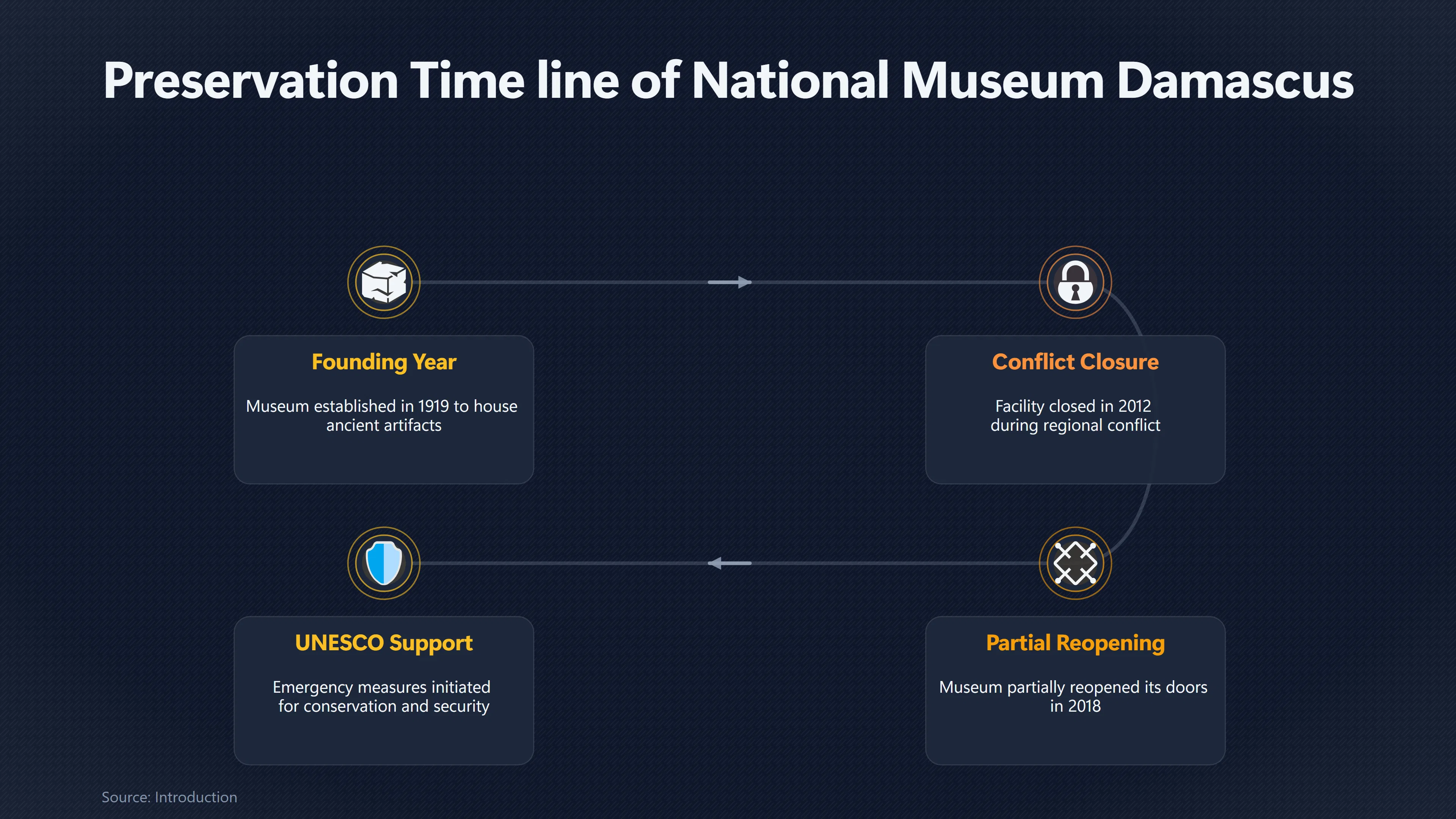
The modern story of the National Museum of Damascus is closely connected to preservation. During the Syrian conflict, the museum closed in 2012 and many objects were moved or protected because of the risks facing cultural collections. It partially reopened in 2018, and UNESCO later supported emergency measures aimed at improving conservation, storage, security and digital preservation.[UNESCO]unesco.orgSyria: UNESCO resumes operations with a first initiative at theJune 10, 2025…
This recovery effort adds another unusual dimension to the museum. The building is not only a place where ancient discoveries are displayed; it is also part of a wider struggle to protect archaeological evidence from damage, illegal trafficking and loss. UNESCO’s recent work has focused on practical measures such as improving storage conditions, strengthening museum infrastructure and supporting documentation of collections.[UNESCO]unesco.orgEmergency support and first-aid measures for the rehabilitation of the National Museum of Damascus - UNESCO Heritage Emergency Fund…
The challenges are ongoing. Syria’s archaeological heritage has been affected by years of conflict, and the protection of museum collections remains a major concern. The National Museum’s importance therefore extends beyond tourism: it acts as a central archive of evidence for civilisations whose remains are spread across archaeological sites throughout the country.[UNESCO]unesco.orgEmergency support and first-aid measures for the rehabilitation of the National Museum of Damascus - UNESCO Heritage Emergency Fund…
Why the Damascus Museum matters in Syria’s strange-history landscape
The National Museum of Damascus fits into Syria’s unusual heritage story because its wonders come from reality rather than legend. Its collections contain objects that can seem almost impossible in their age and significance: the records of forgotten kingdoms, the foundations of alphabetic writing and the material remains of cities that disappeared thousands of years ago.
For visitors seeking unusual collections, the museum offers a rare form of curiosity culture. Its most extraordinary exhibits are not oddities created for entertainment, but genuine archaeological discoveries that reveal how humans first recorded knowledge, built cities and connected distant societies. In that sense, the museum is a collection of lost worlds made visible.[UNESCO]unesco.orgSyria: UNESCO resumes operations with a first initiative at theJune 10, 2025…
Amazon book picks
Further Reading
Books and field guides related to Inside Syria's Museum of Ancient Wonders. Use these as the next step if you want deeper reading beyond the article.
A History of the Arab Peoples
Hourani, the distinguished historian and interpreter, has written a masterwork--a panoramic view encompassing twelve centuries of Arab hi...
A History of the Ancient Near East, ca. 3000-323 BC
Incorporating the latest scholarly research, the third edition of A History of the Ancient Near East ca. 3000–323 BC presents a comprehen...
The Oxford History of the Ancient Near East
This groundbreaking, five-volume series offers a comprehensive, fully illustrated history of Egypt and Western Asia (the Levant, Anatolia...
The Ancient Near East: A Very Short Introduction
This book explores the lands of the ancient Near East from around 3200 BCE to 539 BCE. The earth-shaking changes that marked this era inc...
eBay marketplace picks
Marketplace Samples
Live-tested eBay searches with available results related to this page.
Selected fromarchaeology poster oneBay.co.uk.


Endnotes
1.
Source: unesco.org
Link:https://www.unesco.org/en/articles/syria-unesco-resumes-operations-first-initiative-national-museum-damascus
Source snippet
Syria: UNESCO resumes operations with a first initiative at theJune 10, 2025...
Published: June 10, 2025
2.
Source: Wikipedia
Title: National Museum of Damascus
Link:https://en.wikipedia.org/wiki/National_Museum_of_Damascus
3.
Source: unesco.org
Link:https://www.unesco.org/en/culture-emergencies/heritage-emergency-fund/emergency-support-and-first-aid-measures-rehabilitation-national-museum-damascus
Source snippet
Emergency support and first-aid measures for the rehabilitation of the National Museum of Damascus - UNESCO Heritage Emergency Fund...
4.
Source: unesco.org
Link:https://www.unesco.org/en/node/66281
Source snippet
Abdulkarim Last update:6 July 2026 Since the beginning of the conflict in Syria in March 2011, cultural heritage has been affected. Now...
Published: July 2026
5.
Source: unesco.org
Title: UNESC O supports the inventory of over 350 objects at the National
Link:https://www.unesco.org/en/articles/unesco-supports-inventory-over-350-objects-national-museum-aleppo-syria
Source snippet
UNESCO supports the inventory of over 350 objects at the NationalJune 18, 2026 — UNESCO SUPPORTS THE INVENTORY OF OVER 350 OBJECTS AT THE...
Published: June 18, 2026
6.
Source: whc.unesco.org
Link:https://whc.unesco.org/en/tentativelists/1293
7.
Source: Wikipedia
Title: Ebla tablets
Link:https://en.wikipedia.org/wiki/Ebla_tablets
8.
Source: cdli.earth
Link:https://cdli.earth/collections/1206
Source snippet
National Museum of Syria, Damascus, Syria - Collections - Cuneiform Digital Library InitiativeMay 12, 2026 — COLLECTION: NATIONAL MUSEUM...
Published: May 12, 2026
Additional References
9.
Source: moc.gov.sy
Link:https://www.moc.gov.sy/en/news/1f390da9-9375-4145-84fe-3225ace55dec
Source snippet
April 27, 2026 — The Ministry of Culture opens an exhibition entitled "Syria: From Symbol to Letter",news | Ministry Of Culture Image: I...
Published: April 27, 2026
10.
Source: thenationalnews.com
Title: AFP An artefact from Raqqa in northern Syria takes its place
Link:https://www.thenationalnews.com/news/mena/2026/07/10/frances-return-of-syrian-artefacts-key-to-cultural-restoration-as-country-rebuilds-after-war/
Source snippet
France's return of Syrian artefacts key to cultural restoration as country rebuilds after war | The NationalJuly 10, 2026 — Image: An art...
Published: July 10, 2026
11.
Source: youtube.com
Title: Secrets Revealed: Unraveling the History of Ugarit
Link:https://www.youtube.com/watch?v=ZWmxjDsNf1k
Source snippet
What Impact Have The Ebla Tablets Had On Our Understanding Of History?...
12.
Source: si.edu
Link:https://www.si.edu/exhibitions/art-and-archaeology-ancient-syria-ebla-damacus%3Aevent-exhib-2236
13.
Source: facebook.com
Link:https://www.facebook.com/groups/archeologyandcivilizations/posts/9745369725556464/
14.
Source: smb.museum
Link:https://www.smb.museum/en/museums-institutions/vorderasiatisches-museum/collection-research/research/materials-for-the-storage-of-cuneiform-tablets-in-damascus-syria/
15.
Source: virtual-museum-syria.org
Link:https://virtual-museum-syria.org/damascus/
16.
Source: thenationalnews.com
Link:https://www.thenationalnews.com/arts-culture/art/syria-s-ancient-heritage-on-show-again-national-museum-of-damascus-reopens-doors-1.785427
17.
Source: gonomad.com
Link:https://www.gonomad.com/100217-ugarit-syria-place-alphabets-began
18.
Source: syrianguides.com
Link:https://syrianguides.com/worlds-first-alphabet-displayed-in-damascus-after-15-years/