Within Tajik Curiosities
The Giant Buddha Hidden in Tajikistan
The Ajina Tepe Buddha reveals a forgotten Buddhist past preserved within modern Tajikistan's archaeological collections.
On this page
- The discovery of Ajina Tepe monastery
- Why the reclining Buddha is unusual
- Buddhist heritage in Central Asia
Page outline Jump by section
Introduction
The Ajina Tepe Buddha is one of Tajikistan’s most extraordinary archaeological discoveries: a monumental clay sculpture of the Buddha in nirvana, recovered from a forgotten Buddhist monastery in the Vakhsh Valley. Dating from the 7th–8th centuries CE, the statue reveals a period when Buddhist communities, monasteries and artistic traditions flourished in parts of Central Asia that are now associated mainly with Islamic and Persian heritage.[UNESCO World Heritage Centre]whc.unesco.orgUNESCO World Heritage CentreWorld Heritage Centre - Tajikistan- Operational project for the preservation of the Buddhist Monastery of Aji…
Today, the reclining Buddha is preserved in Dushanbe at the National Museum of Antiquities of Tajikistan, where it stands as a reminder that the country’s past was shaped by many religious and cultural networks. It is not a mysterious object in the supernatural sense, but it is a genuinely surprising survival: a large Buddhist monument hidden for centuries beneath an archaeological mound in modern Tajikistan.[Tajikistan Museum of Antiquities]ombt.tjTajikistan Museum of Antiquities NATIONAL MUSEUM OF ANTIQUITIES OF TAJIKISTANTajikistan Museum of Antiquities NATIONAL MUSEUM OF ANTIQUITIES OF TAJIKISTAN
The discovery of Ajina Tepe monastery
Ajina Tepe, meaning “Devil’s Hill” in local usage, is an archaeological site near the modern city of Bokhtar in southern Tajikistan. Despite its name, the site is not connected to any proven legend of demons or supernatural events. Its importance comes from what archaeologists uncovered there: the remains of a large Buddhist monastery complex built from earth and mud-brick during the early medieval period.[UNESCO World Heritage Centre]whc.unesco.orgWorld Heritage Centre Buddhistic cloister of Ajina-TepaUNESCO World Heritage CentreBuddhistic cloister of Ajina-Tepa - UNESCO World Heritage Centre…
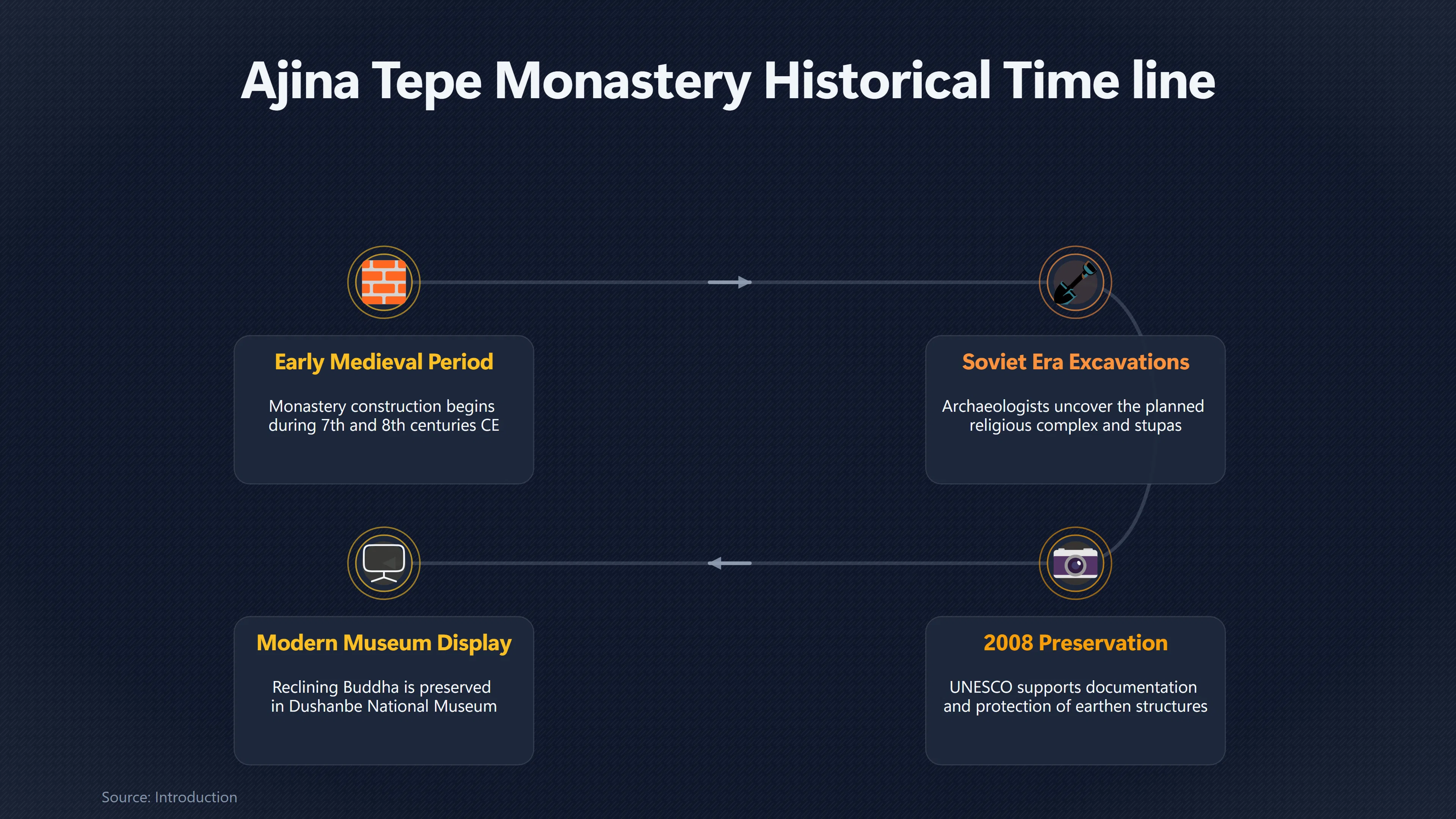
Excavations carried out during the Soviet period revealed a carefully planned religious complex dating mainly to the 7th and 8th centuries CE. The monastery contained separate areas for monastic life and religious worship, including courtyards, monks’ rooms, stupas (structures associated with Buddhist relics and devotion), temples, sculptures and painted decoration. UNESCO describes the site as one of the significant Buddhist complexes of Central Asia and notes that its physical remains still provide important evidence of Silk Road religious life.[UNESCO World Heritage Centre]whc.unesco.orgUNESCO World Heritage CentreWorld Heritage Centre - Tajikistan- Operational project for the preservation of the Buddhist Monastery of Aji…
The discovery changed perceptions of Tajikistan’s ancient history. Rather than being a region with a single continuous cultural identity, the archaeological record shows a landscape where different beliefs and artistic traditions met. Ajina Tepe belonged to the wider world of Tokharistan, a historical region where influences from India, Iran, China and local Central Asian cultures interacted through trade and religious exchange.[ResearchGate]researchgate.netResearchGate(PDF) Buddhist monument Ajina-Teppa – the evidence of the oldest cultural interaction of Tajikistan and IndiaSeptember 1, 2017…
Why the reclining Buddha is unusual
The most famous discovery from Ajina Tepe is the enormous Buddha in nirvana, a representation of Buddha at the moment of final liberation from the cycle of rebirth. The sculpture originally measured around 12 metres in length and is considered one of the largest surviving ancient Buddhist sculptures discovered in Central Asia.[UNESCO World Heritage Centre]whc.unesco.orgUNESCO World Heritage CentreWorld Heritage Centre - Tajikistan- Operational project for the preservation of the Buddhist Monastery of Aji…
Unlike many famous Buddhist monuments carved directly from stone, the Ajina Tepe Buddha was created from clay-based materials. The statue was built using a combination of earthen modelling techniques and structural supports, then decorated with painted details. This method reflects the architectural and artistic traditions of Central Asian Buddhist monasteries, where clay sculpture and wall painting were often central features.[the University of Bath's research portal]researchportal.bath.ac.ukOpen source on bath.ac.uk.
The statue’s reclining position is also significant. In Buddhist art, the reclining Buddha usually represents parinirvana, the Buddha’s passing beyond ordinary existence after enlightenment. The image is not a scene of defeat or death in a simple sense; it represents spiritual completion and release. For visitors unfamiliar with Buddhist imagery, the calm pose can seem unusual because it differs from the more common seated Buddha figures seen in temples across Asia.
The Ajina Tepe sculpture is especially valuable because it preserves evidence of how Buddhist ideas were adapted along the Silk Roads. Its style reflects a meeting point between Indian Buddhist traditions and local Central Asian artistic practices rather than a simple copy of a distant model. Archaeological studies of the site emphasise the combination of sculpture, wall paintings and architecture as evidence of a distinctive regional Buddhist culture.[the University of Bath's research portal]researchportal.bath.ac.ukOpen source on bath.ac.uk.

What the monastery reveals about Buddhist Central Asia
Ajina Tepe is important because it shows that Buddhism was not limited to South Asia or East Asia. For centuries, monasteries across Central Asia served as places of worship, education and travel along major trade routes. Monks, merchants and pilgrims moved between regions, carrying religious texts, artistic styles and ideas.
The monastery’s layout provides clues about daily life. Archaeologists identified spaces connected with both religious practice and community living, including areas for monks and ceremonial activities. The presence of sculpture, paintings and stupas suggests that Ajina Tepe was not simply a small local shrine but part of a wider Buddhist network.[UNESCO World Heritage Centre]whc.unesco.orgWorld Heritage Centre Buddhistic cloister of Ajina-TepaUNESCO World Heritage CentreBuddhistic cloister of Ajina-Tepa - UNESCO World Heritage Centre…
The discoveries also help explain why Central Asian Buddhist art looks different from later Buddhist traditions elsewhere. Artists working in the region combined multiple influences, including Indian religious imagery, Iranian cultural elements and local artistic techniques. Ajina Tepe therefore belongs to a broader Silk Road story in which cultures were constantly adapting rather than existing in isolation.[ResearchGate]researchgate.netResearchGate(PDF) Buddhist monument Ajina-Teppa – the evidence of the oldest cultural interaction of Tajikistan and IndiaSeptember 1, 2017…
From buried monastery to museum curiosity
For modern visitors, the Ajina Tepe Buddha is unusual because its story reverses expectations. A country often associated with Islamic architecture, Persian literature and mountain landscapes also preserves one of the world’s notable ancient Buddhist sculptures.
The original monastery remains an archaeological site, while the reconstructed and conserved Buddha is displayed in the National Museum of Antiquities of Tajikistan in Dushanbe. This separation between discovery site and museum display is common for fragile archaeological objects: the museum protects the sculpture while allowing visitors to see one of the most important surviving pieces of Tajikistan’s Buddhist heritage.[Tajikistan Museum of Antiquities]ombt.tjTajikistan Museum of Antiquities NATIONAL MUSEUM OF ANTIQUITIES OF TAJIKISTANTajikistan Museum of Antiquities NATIONAL MUSEUM OF ANTIQUITIES OF TAJIKISTAN
The Buddha’s preservation has required international conservation work. Because Ajina Tepe was built largely from vulnerable earthen materials, erosion, moisture and environmental damage created serious challenges. A UNESCO-supported preservation project between 2005 and 2008 focused on documenting the site, protecting damaged structures and improving conservation methods.[UNESCO World Heritage Centre]whc.unesco.orgUNESCO World Heritage CentreFinal Steering Committee for Preservation of Ajina Tepa Monastery and Silk Roads World Heritage Serial Nomina…
Why Ajina Tepe matters in Tajikistan’s strange-history landscape
Ajina Tepe fits into Tajikistan’s unusual heritage not because it is a mystery or a legend, but because it challenges modern assumptions about place and identity. The discovery of a giant Buddha in southern Tajikistan reveals a forgotten chapter in the country’s history, when Buddhist monasteries stood alongside other cultural and religious traditions.
For visitors interested in unusual collections, lost religions and archaeological surprises, the Ajina Tepe Buddha is one of Tajikistan’s strongest examples. It connects a modern museum display in Dushanbe with a vanished Silk Road world of monks, artists and travellers, showing that the country’s past extends far beyond the boundaries of its present-day cultural image.[Tajikistan Museum of Antiquities]ombt.tjTajikistan Museum of Antiquities NATIONAL MUSEUM OF ANTIQUITIES OF TAJIKISTANTajikistan Museum of Antiquities NATIONAL MUSEUM OF ANTIQUITIES OF TAJIKISTAN
Amazon book picks
Further Reading
Books and field guides related to The Giant Buddha Hidden in Tajikistan. Use these as the next step if you want deeper reading beyond the article.

The Silk Road: A New History
First published 2012. Subjects: Sources, Trade routes, Historic sites, Local History, Description and travel.
The Silk Roads: A New History of the World
Far more than a history of the Silk Roads, this book is truly a revelatory new history of the world, promising to destabilize notions of...

The Art of Gandhara in the Metropolitan Museum of Art
"Ancient Gandhara, located in the rugged foothills of the Himalayas in what is today northwest Pakistan and eastern Afghanistan, was for...
eBay marketplace picks
Marketplace Samples
Live-tested eBay searches with available results related to this page.
Selected fromBuddhist wall art oneBay.co.uk.

Endnotes
1.
Source: whc.unesco.org
Link:https://whc.unesco.org/en/activities/307/
Source snippet
UNESCO World Heritage CentreWorld Heritage Centre - Tajikistan- Operational project for the preservation of the Buddhist Monastery of Aji...
2.
Source: whc.unesco.org
Title: World Heritage Centre Buddhistic cloister of Ajina-Tepa
Link:https://whc.unesco.org/en/tentativelists/1382/
Source snippet
UNESCO World Heritage CentreBuddhistic cloister of Ajina-Tepa - UNESCO World Heritage Centre...
3.
Source: whc.unesco.org
Title: World Heritage Centre Silk Roads Sites in Tajikistan
Link:https://whc.unesco.org/en/tentativelists/5790
Source snippet
UNESCO World Heritage CentreSilk Roads Sites in Tajikistan - UNESCO World Heritage Centre...
4.
Source: researchgate.net
Link:https://www.researchgate.net/publication/320229298Buddhist_monument_Ajina-Teppa-_the_evidence_of_the_oldest_cultural_interaction_of_Tajikistan_and_India
Source snippet
ResearchGate(PDF) Buddhist monument Ajina-Teppa – the evidence of the oldest cultural interaction of Tajikistan and IndiaSeptember 1, 2017...
Published: September 1, 2017
5.
Source: whc.unesco.org
Link:https://whc.unesco.org/en/events/546
Source snippet
UNESCO World Heritage CentreFinal Steering Committee for Preservation of Ajina Tepa Monastery and Silk Roads World Heritage Serial Nomina...
6.
Source: researchgate.net
Link:https://www.researchgate.net/publication/289493358_Deterioration_and_conservation_of_earthen_walls_in_Ajina_Tepa_Tajikistan
7.
Source: researchgate.net
Link:https://www.researchgate.net/publication/344397725AWAKENING_OF_THE_SLEEPING_BUDDHA_OF_AJINA_TEPA_A_CASE_STUDY_OF_DIFFUSION_OF_BUDDHISM_IN_THE_VAKHSH_VALLEY_REGION-_International_Journal_of_Social_Science_and_Economic_Research
9.
Source: researchgate.net
Link:https://www.researchgate.net/publication/233680423_Preservation_of_Earthen_Sites_in_Remote_Areas_the_Buddhist_Monastery_of_Ajina_Tepa_Tajikistan?_tp=eyJjb250ZXh0Ijp7InBhZ2UiOiJzY2llbnRpZmljQ29udHJpYnV0aW9ucyIsInByZXZpb3VzUGFnZSI6bnVsbCwic3ViUGFnZSI6bnVsbH19
10.
Source: ombt.tj
Title: Tajikistan Museum of Antiquities NATIONAL MUSEUM OF ANTIQUITIES OF TAJIKISTAN
Link:https://ombt.tj/en
11.
Source: researchportal.bath.ac.uk
Link:https://researchportal.bath.ac.uk/en/publications/preservation-of-earthen-sites-in-remote-areas-the-buddhist-monast/
12.
Source: researchportal.bath.ac.uk
Link:https://researchportal.bath.ac.uk/en/publications/digital-photogrammetry-for-the-documentation-of-structural-damage/
13.
Source: traveldojo.com
Link:https://www.traveldojo.com/ajina-tepe/
14.
Source: archaeolist.com
Link:https://archaeolist.com/sites/tajikistan/ajina-tepe
15.
Source: lonelyplanet.com
Link:https://www.lonelyplanet.com/points-of-interest/national-museum-of-antiquities-of-tajikistan/1376505
16.
Source: lonelyplanet.com
Title: National Museum | Dushanbe, Tajikistan | Attractions
Link:https://www.lonelyplanet.com/points-of-interest/national-museum/1392592
17.
Source: tripadvisor.ca
Title: National Museum of Antiquities
Link:https://www.tripadvisor.ca/Attraction_Review-g293964-d11998329-Reviews-National_Museum_of_Antiquities-Dushanbe.html
18.
Source: tripadvisor.com
Title: National Museum of Antiquities
Link:https://www.tripadvisor.com/Attraction_Review-g293964-d11998329-Reviews-National_Museum_of_Antiquities-Dushanbe.html
Additional References
19.
Source: youtube.com
Link:https://www.youtube.com/watch?v=e7rd72HWL8w
Source snippet
TAJIKISTAN: The Isolated Mountain Communities Preserving a Lost Silk Road World...
20.
Source: youtube.com
Title: Sweden to Afghanistan: Vrang; Local Life and the Historic Buddhist Stupa
Link:https://www.youtube.com/watch?v=LQHoMush7Q8
Source snippet
Tajikistan Tour: Ajina Tepa Buddhist Ruins where a Reclining Buddha Statue was Excavated...
21.
Source: youtube.com
Title: TAJIKISTAN: The Isolated Mountain Communities Preserving a Lost Silk Road World
Link:https://www.youtube.com/watch?v=Im1EBbXjS-Q
Source snippet
The Kushan Empire: Silk Road, Buddhism & Cultural Fusion...
22.
Source: flickr.com
Link:https://www.flickr.com/photos/awvdm2013/55047256621
Source snippet
DSC69138 | Dushanbe (Душанбе) - National Museum of Antiquiti… | FlickrJanuary 18, 2026 — Image: DSC69138 | by awvdm8881 Image: DSC69138 |...
Published: January 18, 2026
23.
Source: traveltajikistan.tj
Link:https://traveltajikistan.tj/en/ajina-tepa-buddhist-monastery-wakhsh-district/
24.
Source: stantrips.com
Link:https://stantrips.com/en/tajikistan/sights/ajina-teppa
25.
Source: sciencedirect.com
Link:https://www.sciencedirect.com/science/article/abs/pii/S0013795208003165
26.
Source: sciencedirect.com
Link:https://www.sciencedirect.com/science/article/pii/S0013795208003165
27.
Source: osorkhonaimilliidip.tj
Link:https://osorkhonaimilliidip.tj/en/exhibitions/presentation-of-tajikistan-s-monuments-at-the-british-museum-s-international-exhibition-the-silk-roads/
28.
Source: tandfonline.com
Link:https://www.tandfonline.com/doi/abs/10.1179/175355207X404188