Where Madagascar Keeps Its Strangest Stories
Madagascar does not have a large, clearly signposted circuit of witchcraft museums, cryptid attractions or medical-oddity collections.
Page outline Jump by section
Introduction
For visitors seeking the unusual, the strongest cluster is in Antananarivo. The capital combines the idiosyncratic Pirate Museum, the natural-history displays at Tsimbazaza, royal collections at the Rova and Andafiavaratra Palace, and the University of Antananarivo’s archaeological holdings. Beyond the capital, the Museum of Androy at Berenty offers a rare regional collection shaped by the culture and funerary traditions of southern Madagascar. These places vary greatly in scale, interpretation and reliability, so opening arrangements and access should be checked directly rather than assumed from old travel listings.
Madagascar’s strangest museum is about pirates
The Pirate Museum of Antananarivo is the country’s most obvious purpose-built oddity attraction. Founded in 2008, it tells the story of piracy internationally and around Madagascar, with particular attention to the island’s role in Indian Ocean maritime history. Visitor accounts describe an intimate, privately run display rather than a conventional national museum: illustrated panels, maps, models and a small number of objects arranged in rooms that can feel closer to a specialist enthusiast’s collection than a large public institution. Much of the interpretation has historically been in French, although translated reading material has sometimes been supplied.[piratenmuseum.ch]piratenmuseum.chPirate Museum Madagascar: Piratenmuseum Madagaskar…Das im Dezember 2008 neu eingeweihte Piratenmuseum in Antananarivo / Madagaskar erz…
That modest scale matters. The museum is best approached as an illustrated historical argument, not as a treasure vault full of authenticated pirate weapons and recovered gold. Its value lies in connecting Madagascar to the late seventeenth- and early eighteenth-century world of pirates, merchants, enslaved people and coastal settlements. Current listings still describe it as open, but the most readily available visitor reviews are unevenly dated, so prospective visitors should confirm its location, hours and language provision before travelling across the city.[Tripadvisor]tripadvisor.co.ukTripadvisor PIRATE MUSEUM OF ANTANANARIVO103, rue de Liège, Tsaralalana, Antananarivo PRIORI Voyages, 5th floor/5 etage/ 5…. Open now… Aug 2022 • Solo… Very interesting…
The collection’s most seductive subject is Libertalia, the supposed democratic pirate republic founded somewhere in northern Madagascar. In the familiar story, pirates rejected national allegiance, shared property and abolished slavery. Historians have found no convincing evidence that this organised republic existed. The tale comes from an eighteenth-century literary account, and modern research generally treats its idealised state and its supposed founder as fictional.[monde-diplomatique.fr]monde-diplomatique.frLe Monde diplomatique Libertalia, une république des pirates à MadagascarInterprétations d’un mythe (XVIIe – XXIe siècle), par Nicolas Norrito (Le Monde diplomatique, juin 2021)June 18, 2021 — # Libertalia, une…
The myth nevertheless grew from a real historical setting. Pirates did use Madagascar and nearby islands as bases, and European seafarers formed relationships and families within coastal communities. Their activities were not consistently egalitarian: pirates also participated in slave trading and owned enslaved people, making the abolitionist image of Libertalia particularly doubtful. The museum is therefore most useful when it encourages visitors to separate three layers: documented piracy, later political speculation and romantic legend.[clionautes.org]clio-cr.clionautes.orgOpen source on clionautes.org.
Giant birds and extinct creatures at Tsimbazaza
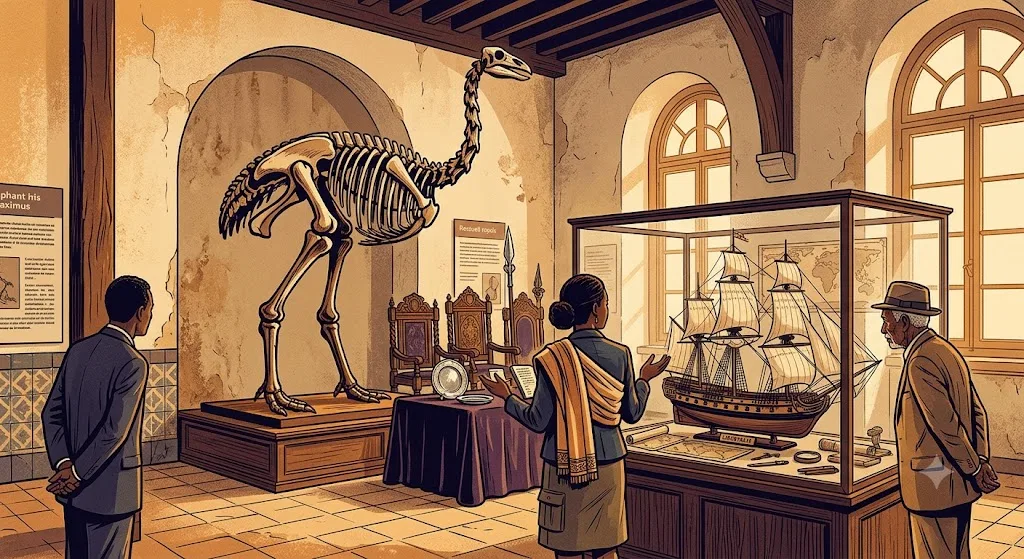
The Museum of Ethnology and Palaeontology within Antananarivo’s Tsimbazaza botanical and zoological complex contains Madagascar’s most striking natural-history curiosities. Its collections include taxidermied animals and the remains of extinct fauna, notably elephant birds and giant lemurs. These are not invented monsters or cryptids: they are scientifically documented animals whose extraordinary scale can make the exhibits feel more fantastic than many folklore displays.[Wikipedia]WikipediaMuseum of Ethnology and PaleontologyMuseum of Ethnology and Paleontology
Elephant birds were enormous flightless birds unique to Madagascar. Some species reached roughly three metres in height and exceeded 500 kilograms, making them the largest known birds. Their eggs were correspondingly immense, and fragments remain important archaeological and scientific evidence. Modern research places their disappearance much earlier than some older museum and travel descriptions, which have occasionally claimed that elephant birds survived into the seventeenth century. Scientific work based on dating and eggshell evidence instead links their extinction broadly to the period around the end of the first millennium and the centuries that followed.[CSIRO]csiro.auelephant birdselephant birds
This is an important credibility point. Historical displays are sometimes slow to absorb revised scientific findings, and visitors should distinguish between the age of a specimen, the age of its label and the current scholarly consensus. Even with uneven interpretation, seeing the remains of elephant birds and giant lemurs in Madagascar provides something that replicas elsewhere cannot: a direct connection between the island’s living biodiversity and its lost ecosystem.
Tsimbazaza is a public scientific and educational institution rather than a commercial oddity museum. Its ethnographic material also places the natural specimens alongside displays on Madagascar’s communities, crafts and customs. That older “nature plus peoples” museum structure reflects the history of ethnographic collecting, but it can compress many distinct societies into simplified categories. Visitors interested in cultural objects should therefore treat it as an introduction and compare its displays with more specialised regional and archaeological collections.[Wikipedia]WikipediaMuseum of Ethnology and PaleontologyMuseum of Ethnology and Paleontology
Royal relics rescued from a burning palace
Few Malagasy collections have a history as dramatic as the royal objects associated with the Rova of Antananarivo. The hilltop palace complex was the political and ceremonial centre of the Merina monarchy. On 6 November 1995, a fire devastated its principal buildings. People entered the burning complex to save royal and historical objects, while other pieces were destroyed, dispersed or reportedly stolen. Estimates reproduced in historical accounts suggest that about 1,675 objects were rescued from a collection of roughly 6,700.[Wikipedia]WikipediaRova of AntananarivoRova of Antananarivo
The episode transformed ordinary palace possessions into a collection of survivors. Thrones, ceremonial objects, royal furnishings, portraits and other remnants acquired an additional layer of meaning: they became evidence not only of monarchy, but of loss, emergency rescue and contested national memory. Some salvaged objects were subsequently housed at Andafiavaratra Palace, the former residence of Prime Minister Rainilaiarivony, which became an important repository and exhibition site for the royal collection.[MADAMAGAZINE]madamagazine.comThe Palace of the Prime MinisterThe Palace of the Prime Minister
The cause of the fire remains politically sensitive. The official investigation concluded that it was accidental, while rumours of deliberate destruction have persisted and have blamed various political, ethnic and foreign actors. No persuasive public evidence has established these competing accusations. For a strange-history visitor, the responsible approach is not to turn the disaster into an unsolved-crime attraction, but to recognise why a royal palace fire would generate enduring suspicion in a country where the complex carries enormous symbolic weight.[Wikipedia]WikipediaRova of AntananarivoRova of Antananarivo
The collection also illustrates the difference between an object’s material survival and its secure preservation. In 2018, the International Centre for the Study of the Preservation and Restoration of Cultural Property worked with UNESCO, Madagascar’s authorities and museum partners to improve storage and preventive conservation for the Andafiavaratra royal holdings and collections from ten other museums. The project suggests that the rescued artefacts’ long-term future depends on documentation, storage and environmental control as much as on reconstruction of the palace itself.[ICCROM]iccrom.orgOpen source on iccrom.org.
Ambohimanga is both heritage site and sacred place
The Royal Hill of Ambohimanga, outside Antananarivo, is not merely a palace displayed as a dead historical monument. It contains a royal city, burial places and an ensemble of sacred locations, and it remains a place of worship and pilgrimage. UNESCO describes it as the spiritual and political cradle of the kingdom that helped shape the modern Malagasy state.[UNESCO World Heritage Centre]whc.unesco.orgWorld Heritage Centre Royal Hill of AmbohimangaWorld Heritage Centre Royal Hill of Ambohimanga
That continuing devotional role makes Ambohimanga especially important within Madagascar’s curiosity landscape. Visitors encounter architecture, gates, royal compounds, tombs, sacred water and a landscape whose meaning depends on remembered rulers, ancestors and ritual practice. The site should not be treated as a supernatural theme park or a cabinet of “primitive beliefs”. Its unusual power comes from the coexistence of heritage management, tourism and active sacred significance.
This distinction affects visitor behaviour. A museum object behind glass is usually presented as available for detached inspection. A sacred fountain, burial place or royal location may remain embedded in obligations and prohibitions recognised by local communities. Photography, movement and conduct can therefore carry meanings that are not obvious to an outsider. Ambohimanga rewards a guided visit that explains why particular spaces matter, rather than a rapid search for supposedly mystical objects.
Archaeological grave goods and long-distance mysteries
The Museum of Art and Archaeology at the University of Antananarivo is one of the country’s most valuable collections for readers interested in unusual objects with serious research contexts. Its holdings include archaeological material and funerary artefacts, some connected to burial sites that reveal Madagascar’s place within much wider Indian Ocean networks. The institution is academic in character, and public access or the proportion of the collection on display may be more limited than at a conventional tourist museum.[unifr.ch]unifr.chOpen source on unifr.ch.
Among the most intriguing material is that associated with the cemetery at Vohémar in north-eastern Madagascar. Excavations produced funerary objects and imported ceramics that indicate connections with maritime trading worlds extending towards East Africa, the Middle East and Asia. Objects from the site are divided between collections in Madagascar and France, including the University of Antananarivo museum and major French institutions.[Orientations]orientations.com.hkOrientations The Vohemar Necropolis, Madagascar, and the RegionalOrientations The Vohemar Necropolis, Madagascar, and the Regional
Such finds can easily be misrepresented as archaeological anomalies: mysterious foreign artefacts that supposedly overturn everything known about Madagascar. Their real significance is subtler and stronger. Imported objects in graves show participation in long-distance exchange; they do not, by themselves, prove lost civilisations, secret colonies or implausible transoceanic visitors. The museum’s academic setting makes it one of the better places to encounter unusual material without reducing it to mystery marketing.
Death, memory and the Museum of Androy
At Berenty in southern Madagascar, the Museum of Androy preserves and interprets aspects of the culture of the Tandroy people. Developed through the work of researchers including Georges Heurtebize and Sarah Fee, it is one of relatively few museum collections outside Antananarivo and provides a regional counterweight to institutions organised from the capital.[www-personal.umd.umich.edu]www-personal.umd.umich.eduOpen source on umich.edu.
The museum’s relevance to unusual collections lies particularly in southern Madagascar’s material culture of death and remembrance. Textiles, personal possessions, ritual practices and funerary arts help explain relationships between living families and ancestors. These are not “death museum” exhibits in the sensational European or North American sense. They concern social identity, kinship, status and the continuing place of the dead within community life.[National Museum of African Art]africa.si.eduOpen source on si.edu.
The region is also associated with carved funerary posts commonly known internationally as aloalo. Traditionally placed around imposing stone tombs, these wooden sculptures may combine geometric forms with birds, cattle, human figures or scenes referring to the deceased. They function as commemorative markers and as statements about relationships between the living, the dead and ancestral continuity.[The Metropolitan Museum of Art]metmuseum.orgkingdoms of madagascar malagasy funerary artskingdoms of madagascar malagasy funerary arts
Visitors should distinguish between seeing such work in an interpretive museum and encountering it at an active tomb. A funerary landscape is not an open-air oddities collection. Removal from a grave, sale through the art market or display without clear provenance can strip the sculpture of context. Museum interpretation is most credible when it identifies the community, maker, original use and collecting history rather than presenting a post merely as exotic decoration.
Berenty itself is privately managed and widely known for its reserve, so access to the museum may be tied to local accommodation, tours or reserve arrangements. Its importance is less about polished exhibition design than about preserving regional knowledge that is otherwise poorly represented in Madagascar’s public museum network.
Photography as a cabinet of recovered memory
The Museum of Photography of Madagascar is not an oddity museum, but its method resembles a modern cabinet of recovered memory. Established as a non-profit organisation, it works to digitise photographs made in Madagascar between 1860 and 1960. Images have been recovered from family trunks, private holdings, descendants of colonial residents and national archives, then documented and returned to public view through exhibitions and digital presentation.[Photo Madagascar]photo-madagascar.comPhoto Madagascar Musée de la photographie de Madagascar|Le projetPhoto Madagascar Musée de la photographie de Madagascar|Le projet
Its unusual quality lies in the afterlife of the photographs. Many were never created for museums: they were family portraits, administrative records, commercial views or private souvenirs. Once separated from their original owners, an image can become mysterious because names, dates and circumstances have been lost. The museum’s work therefore depends not only on scanning pictures but on rebuilding their identities through contributions from families and communities.[Photo Madagascar]photo-madagascar.comPhoto Madagascar Musée de la photographie de Madagascar|Le projetPhoto Madagascar Musée de la photographie de Madagascar|Le projet
For readers interested in colonial curiosities, photography also requires caution. An old photograph may look authoritative while reflecting a staged pose, a colonial classification system or the photographer’s commercial expectations. The museum matters because it can reposition such images within Malagasy historical memory rather than allowing them to survive only as anonymous exotic scenes in foreign collections.
Human remains and the politics of return
Madagascar’s strangest and most sensitive collections are not all located inside the country. During colonial rule, human remains and cultural objects were removed to European museums. In August 2025, France returned three skulls to Madagascar under a law designed to facilitate the restitution of human remains held in public collections. The remains were associated with members of the Sakalava people killed by French colonial forces in 1897; one was believed to be the skull of King Toera, although identification questions required careful expert assessment.[reuters.com]reuters.comFrance returns three colonial-era human skulls to MadagascarFrance returns three colonial-era human skulls to Madagascar
This was not simply the transfer of scientific specimens between institutions. For descendants and communities, ancestral remains can be persons requiring ceremony and respectful reburial, not museum property. The case exposes a fundamental tension in older anthropological collections: an institution may classify a skull by catalogue number, while the source community understands it through identity, violence, kinship and spiritual obligation.
Restitution also changes what counts as Madagascar’s museum landscape. A national survey limited to objects physically displayed on the island would miss the large number of Malagasy artefacts and human remains held abroad. It would also miss the ways in which returns, claims and provenance research are reshaping public understanding of collections. Madagascar’s curiosity culture is therefore partly a story of absence: objects preserved elsewhere, knowledge detached from communities and collections that may eventually come home.
How credible and accessible are these collections?
Madagascar’s museums range from academic institutions and UNESCO-listed heritage sites to small private attractions. They should not be judged by a single standard, but visitors can ask a few practical questions.
- Is the object authentic or illustrative? The Pirate Museum’s strongest contribution is narrative interpretation, whereas Tsimbazaza and the university museum hold scientific or archaeological specimens. Models and illustrations can be useful, but they should not be mistaken for excavated pirate artefacts.
- Is the interpretation current? Older natural-history labels may preserve outdated extinction dates or classifications. Archaeological objects can also acquire exaggerated “mystery” stories when removed from their excavation context.
- Is the place devotional as well as public? Ambohimanga and active funerary landscapes require different behaviour from a conventional gallery. Sacred significance does not disappear because tourists are admitted.
- Is provenance explained? Human remains, funerary sculpture and colonial-era ethnographic objects require clear accounts of how they were obtained. Silence about collecting history is itself a warning sign.
- Is access reliably documented? Small museums may change premises, hours or language provision without major updates to international travel websites. University collections may not maintain daily visitor schedules, while privately managed regional museums may require advance arrangements.
Conservation is another practical concern. Madagascar’s museum professionals work with collections vulnerable to inadequate storage, incomplete documentation, fire and extreme weather. In February 2026, Cyclone Gezani severely damaged the Vavitiana Museum in Toamasina, leaving heritage objects in urgent need of stabilisation and restoration. The incident demonstrates that a collection can move rapidly from visitor attraction to endangered archive.[UNESCO]unesco.orgOpen source on unesco.org.
UNESCO has also reported serious problems in the handling of finds recovered from an Asian shipwreck near Madagascar, including missing gold coins, incomplete inventories and unscientific recovery and storage. This does not mean that all Malagasy museums are unreliable. It shows why spectacular claims about shipwreck treasure require documentation, controlled archaeology and transparent custody rather than adventurous recovery alone.[UNESCO]unesco.orgOpen source on unesco.org.
What makes Madagascar’s curiosity culture distinctive
Madagascar’s unusual collections are rarely built around theatrical horror or paranormal spectacle. Their recurring subject is the unstable boundary between object and presence. Royal belongings can embody political authority; a funerary post can maintain a relationship with an ancestor; a skull can be both a museum specimen and a murdered ruler; an extinct bird skeleton can seem legendary while remaining scientifically real.
The country also complicates the usual distinction between museum, shrine, research collection and heritage landscape. Ambohimanga remains sacred while receiving tourists. The Museum of Androy translates living and funerary traditions into displays. University archaeology collections preserve evidence of international exchange, while the Pirate Museum turns a mixture of documented history and literary myth into a visitor narrative.
For the curious traveller, the most rewarding approach is therefore not to search only for a Malagasy equivalent of a Western witchcraft or cryptid museum. Madagascar’s stranger heritage lies in royal objects saved from flames, grave goods carried through ancient maritime networks, carvings made to speak between generations, creatures so large they resemble folklore, and collections whose ownership is still being renegotiated. The result is a museum landscape that is limited in infrastructure but unusually rich in questions about memory, belief, evidence and the responsibilities of display.
Amazon book picks
Further Reading
Books and field guides related to Where Madagascar Keeps Its Strangest Stories. Use these as the next step if you want deeper reading beyond the article.
The Travels of Marco Polo
It was perhaps the first book to achieve best-seller status before the invention of the printing press-it was certainly the most controve...

Madagascar: A Natural History
Illustrates the unusual flora and fauna of the island of Madagascar
The Eighth Continent: Life, Death, and Discovery in the Lost...
Since the age of dinosaurs, Madagascar has thrived in isolation off the east coast of Africa. In this real-life "lost world," hundreds of...
The Pirate Coast: Thomas Jefferson, the First Marines, and th...
A real-life thriller—the true story of the unheralded American who brought the Barbary Pirates to their knees. "It is a tale of high idea...
eBay marketplace picks
Marketplace Samples
Live-tested eBay searches with available results related to this page.
Selected fromMadagascar art oneBay.co.uk.


Endnotes
1.
Source: piratenmuseum.ch
Link:https://www.piratenmuseum.ch/
Source snippet
Pirate Museum Madagascar: Piratenmuseum Madagaskar...Das im Dezember 2008 neu eingeweihte Piratenmuseum in Antananarivo / Madagaskar erz...
2.
Source: tripadvisor.com
Title: There are about four glass cases of artifacts, but nothing fancy.Read more
Link:https://www.tripadvisor.com/Attraction_Review-g293809-d2401111-Reviews-Pirate_Museum_of_Antananarivo-Antananarivo_Antananarivo_Province.html
Source snippet
Pirate Museum of Antananarivo (2026) - All You SHOULD...The rooms have drawings of famous pirates and pirate scenes, with Fre...
3.
Source: monde-diplomatique.fr
Title: Le Monde diplomatique Libertalia, une république des pirates à Madagascar
Link:https://www.monde-diplomatique.fr/2021/06/NORRITO/63220
Source snippet
Interprétations d’un mythe (XVIIe – XXIe siècle), par Nicolas Norrito (Le Monde diplomatique, juin 2021)June 18, 2021 — # Libertalia, une...
Published: June 18, 2021
4.
Source: cessma.org
Link:https://www.cessma.org/Libertalia-une-republique-des-pirates-a-Madagascar-Interpretations-d-un-mythe
Source snippet
Libertalia: une république des pirates à [...] - CESSMA# Libertalia: une république des pirates à Madagascar...
5.
Source: Wikipedia
Title: Museum of Ethnology and Paleontology
Link:https://en.wikipedia.org/wiki/Museum_of_Ethnology_and_Paleontology
6.
Source: csiro.au
Title: elephant birds
Link:https://www.csiro.au/en/news/all/articles/2023/march/elephant-birds
7.
Source: museum.ie
Link:https://www.museum.ie/en-IE/Collections-Research/Collection/Documentation-Discoveries/Artefact/An-Elephant-Bird-Egg-from-Madagascar/63324e2f-f7f8-46ac-aa72-a3a930113dd3
8.
Source: Wikipedia
Title: Rova of Antananarivo
Link:https://en.wikipedia.org/wiki/Rova_of_Antananarivo
9.
Source: iccrom.org
Link:https://www.iccrom.org/news/re-org-madagascar
10.
Source: madamagazine.com
Title: The Palace of the Prime Minister
Link:https://www.madamagazine.com/en/der-palast-des-premierministers/
11.
Source: whc.unesco.org
Title: World Heritage Centre Royal Hill of Ambohimanga
Link:https://whc.unesco.org/en/list/950
13.
Source: wanderlog.com
Link:https://wanderlog.com/place/details/9627262/mus%C3%A9e-dart-et-darch%C3%A9ologie
14.
Source: www-personal.umd.umich.edu
Link:https://www-personal.umd.umich.edu/~fdolins/berenty/aboutberenty/history/tandroy/Museum%20of%20Androy.html
15.
Source: www-personal.umd.umich.edu
Link:https://www-personal.umd.umich.edu/~fdolins/berenty/aboutberenty/history/index.html
16.
Source: photo-madagascar.com
Title: Photo Madagascar Musée de la photographie de Madagascar|Le projet
Link:https://www.photo-madagascar.com/presentation/
17.
Source: Wikipedia
Title: Musée de la photographie de Madagascar
Link:https://fr.wikipedia.org/wiki/Mus%C3%A9e_de_la_photographie_de_Madagascar
18.
Source: reuters.com
Title: France returns three colonial-era human skulls to Madagascar
Link:https://www.reuters.com/world/africa/france-returns-three-colonial-era-human-skulls-madagascar-2025-08-26/
19.
Source: unesco.org
Link:https://www.unesco.org/en/culture-emergencies/heritage-emergency-fund/emergency-rehabilitation-and-restoration-vavitiana-museum-toamasina-madagascar-following-cyclone
20.
Source: unesco.org
Link:https://www.unesco.org/en/node/217139
21.
Source: nature.com
Link:https://www.nature.com/articles/s40494-024-01170-z
22.
Source: libertalia.re
Title: , utopie de pirates
Link:https://libertalia.re/2021/02/12/libertalia-utopie-de-pirates/
23.
Source: libertalia.re
Title: , mythe ou réalité?
Link:https://libertalia.re/2021/02/11/libertalia-mythe-ou-realite/
24.
Source: unesco.org
Title: Madagascar National Museums share experience re-organizing their
Link:https://www.unesco.org/en/articles/madagascar-national-museums-share-experience-re-organizing-their-reserves-iccrom-re-org-webinar
25.
Source: iccrom.org
Title: re org madagascar 0
Link:https://www.iccrom.org/news/re-org-madagascar-0
26.
Source: photo-madagascar.com
Title: Musée de la photographie de Madagascar » Informations pratiques
Link:https://www.photo-madagascar.com/informations-pratiques/
27.
Source: iccrom.org
Title: re org madagascar
Link:https://www.iccrom.org/fr/news/re-org-madagascar
28.
Source: whc.unesco.org
Link:https://whc.unesco.org/en/news/143
29.
Source: whc.unesco.org
Link:https://whc.unesco.org/en/activities/739/
30.
Source: whc.unesco.org
Link:https://whc.unesco.org/en/statesparties/mg
31.
Source: whc.unesco.org
Link:https://whc.unesco.org/en/list/950/gallery/
32.
Source: whc.unesco.org
Link:https://whc.unesco.org/en/decisions/2300
33.
Source: whc.unesco.org
Link:https://whc.unesco.org/en/list/950/documents/
34.
Source: whc.unesco.org
Link:https://whc.unesco.org/fr/list/950
35.
Source: whc.unesco.org
Link:https://whc.unesco.org/en/statesparties/mg/documents/
36.
Source: whc.unesco.org
Link:https://whc.unesco.org/en/list/950/maps/
37.
Source: whc.unesco.org
Title: search region=5&pattern&mode=table&action=list
Link:https://whc.unesco.org/en/activities/search_region%3D5%26pattern%26mode%3Dtable%26action%3Dlist
38.
Source: whc.unesco.org
Link:https://whc.unesco.org/en/decisions/4110
39.
Source: whc.unesco.org
Link:https://whc.unesco.org/en/decisions/8105
40.
Source: whc.unesco.org
Link:https://whc.unesco.org/en/decisions/6659
41.
Source: whc.unesco.org
Link:https://whc.unesco.org/en/decisions/8521/
42.
Source: whc.unesco.org
Link:https://whc.unesco.org/en/decisions/8681
43.
Source: whc.unesco.org
Link:https://whc.unesco.org/en/decisions/7710
44.
Source: tripadvisor.com
Title: Attractions g293808 Activities c49 t161 Madagascar
Link:https://www.tripadvisor.com/Attractions-g293808-Activities-c49-t161-Madagascar.html
45.
Source: tripadvisor.com
Link:https://www.tripadvisor.com/Attractions-g293808-Activities-c49-Madagascar.html
46.
Source: tripadvisor.com
Link:https://www.tripadvisor.com/Attractions-g293809-Activities-c49-Antananarivo_Antananarivo_Province.html
47.
Source: tripadvisor.com
Title: Attractions g293808 Activities c49 t30 Madagascar
Link:https://www.tripadvisor.com/Attractions-g293808-Activities-c49-t30-Madagascar.html
48.
Source: Wikipedia
Link:https://en.wikipedia.org/wiki/Antananarivo
49.
Source: Wikipedia
Link:https://de.wikipedia.org/wiki/Antananarivo
50.
Source: Wikipedia
Title: List of museums in Madagascar
Link:https://en.wikipedia.org/wiki/List_of_museums_in_Madagascar
51.
Source: Wikipedia
Title: Datei:Sampy talisman idol Madagascar.jpg
Link:https://de.wikipedia.org/wiki/Datei%3ASampy_talisman_idol_Madagascar.jpg
52.
Source: Wikipedia
Link:https://en.wikipedia.org/wiki/Aloalo
53.
Source: wanderlog.com
Link:https://wanderlog.com/place/details/25123/pirates-museum
54.
Source: www-personal.umd.umich.edu
Link:https://www-personal.umd.umich.edu/~fdolins/berenty/aboutberenty/history/tandroy/index.html
55.
Source: tripadvisor.it
Link:https://www.tripadvisor.it/LocationPhotoDirectLink-g6033091-i692459321-Sakaraha_Toliara_Province.html
56.
Source: tripadvisor.in
Title: PIRAT E MUSEUM OF ANTANANARIVO
Link:https://www.tripadvisor.in/Attraction_Review-g293809-d2401111-Reviews-Pirate_Museum_of_Antananarivo-Antananarivo_Antananarivo_Province.html
57.
Source: tripadvisor.in
Title: PIRAT E MUSEUM OF ANTANANARIVO
Link:https://www.tripadvisor.in/Attraction_Review-g293809-d2401111-Reviews-or10-Pirate_Museum_of_Antananarivo-Antananarivo_Antananarivo_Province.html
58.
Source: africa.com
Link:https://africa.com/museums-of-madagascar
59.
Source: tripadvisor.ca
Title: Musee de la Photographie de Madagascar
Link:https://www.tripadvisor.ca/Attraction_Review-g293809-d13551813-Reviews-Musee_de_la_Photographie_de_Madagascar-Antananarivo_Antananarivo_Province.html
60.
Source: tripadvisor.co.uk
Title: Tripadvisor PIRATE MUSEUM OF ANTANANARIVO
Link:https://www.tripadvisor.co.uk/Attraction_Review-g293809-d2401111-Reviews-Pirate_Museum_of_Antananarivo-Antananarivo_Antananarivo_Province.html
Source snippet
103, rue de Liège, Tsaralalana, Antananarivo PRIORI Voyages, 5th floor/5 etage/ 5.... Open now... Aug 2022 • Solo... Very interesting...
61.
Source: newyorker.com
Link:https://www.newyorker.com/magazine/2024/07/22/were-pirates-foes-of-the-modern-order-or-its-secret-sharers
62.
Source: clio-cr.clionautes.org
Link:https://clio-cr.clionautes.org/libertalia-une-republique-des-pirates-a-madagascar-interpretation-dun-mythe-xviie-xxie-siecle.html
63.
Source: unifr.ch
Link:https://www.unifr.ch/geo/archaeometry/en/research/activeprojects/madagascar/
64.
Source: orientations.com.hk
Title: Orientations The Vohemar Necropolis, Madagascar, and the Regional
Link:https://www.orientations.com.hk/highlights/the-vohemar-necropolis-madagascar-and-the-regional-distribution-of-chinese-ceramics-in-the-swahili-world
65.
Source: africa.si.edu
Link:https://africa.si.edu/exhibitions/gifts-and-blessings-textile-arts-madagascar
66.
Source: metmuseum.org
Title: kingdoms of madagascar malagasy funerary arts
Link:https://www.metmuseum.org/essays/kingdoms-of-madagascar-malagasy-funerary-arts
67.
Source: metmuseum.org
Title: The Metropolitan Museum of Art Aloalo (funerary sculpture)
Link:https://www.metmuseum.org/art/collection/search/317882
68.
Source: apnews.com
Link:https://apnews.com/article/07740fcd28e50219f03ccb4295b58bb4
69.
Source: lemonde.fr
Link:https://www.lemonde.fr/afrique/article/2024/10/03/la-france-pourrait-restituer-a-madagascar-le-crane-d-un-roi-decapite-pendant-la-colonisation_6342944_3212.html
70.
Source: mta.gov.mg
Link:https://www.mta.gov.mg/actualites/madagascar-coree-un-partenariat-touristique-en-perspective/
71.
Source: wiki2.org
Title: Andafiavaratra Palace
Link:https://wiki2.org/en/Andafiavaratra_Palace
72.
Source: australian.museum
Link:https://australian.museum/about/history/exhibitions/death-the-last-taboo/burial-madagascar/
73.
Source: tripadvisor.co.uk
Link:https://www.tripadvisor.co.uk/Attraction_Review-g293809-d556532-Reviews-Rova_Le_Palais_de_la_Reine-Antananarivo_Antananarivo_Province.html
74.
Source: tripadvisor.co.uk
Link:https://www.tripadvisor.co.uk/Attraction_Review-g293809-d13551813-Reviews-Musee_de_la_Photographie_de_Madagascar-Antananarivo_Antananarivo_Province.html
75.
Source: skr.de
Link:https://www.skr.de/madagaskar-reisen/sehenswuerdigkeiten/antananarivo/
76.
Source: metmuseum.org
Link:https://www.metmuseum.org/perspectives/ambohimanga
77.
Source: africa.si.edu
Link:https://africa.si.edu/collection/object/nmafa
78.
Source: tripadvisor.com.au
Title: Pirate Museum of Antananarivo
Link:https://www.tripadvisor.com.au/Attraction_Review-g293809-d2401111-Reviews-Pirate_Museum_of_Antananarivo-Antananarivo_Antananarivo_Province.html
79.
Source: en.tripadvisor.com.hk
Title: tripadvisor.com.hk Pirate Museum of Antananarivo
Link:https://en.tripadvisor.com.hk/Attraction_Review-g293809-d2401111-Reviews-Pirate_Museum_of_Antananarivo-Antananarivo_Antananarivo_Province.html
80.
Source: encyclopedia.com
Link:https://www.encyclopedia.com/humanities/encyclopedias-almanacs-transcripts-and-maps/tandroy
81.
Source: musee-foaa.com
Link:https://www.musee-foaa.com/madagascar/
82.
Source: madagascar-island.com
Link:https://www.madagascar-island.com/capitale-antananarivo/antananarivo-parc-tsimbazaza/
83.
Source: byma.gr
Link:https://www.byma.gr/visit/?lang=en
84.
Source: tourisme-antananarivo.com
Link:https://tourisme-antananarivo.com/activities/rova-ambohidratrimo/
85.
Source: madagascarbio.org
Link:https://www.madagascarbio.org/about.html
Additional References
86.
Source: museu.ms
Link:https://museu.ms/museum/details/18343
Source snippet
Pirates Museum MadagascarThe museum explains the history of maritime piracy worldwide and in the Indian Ocean. Exhibitions and eventsRead...
87.
Source: youtube.com
Link:https://www.youtube.com/watch?v=o0Hsdtrd78M
Source snippet
Pirate Museum Antananarivo Madagascar Antananarivo Pirates Museum and Exhibition of Artistic Objects If U don't Go 2...
88.
Source: facebook.com
Link:https://www.facebook.com/Piratenmuseum.Antananarivo/
Source snippet
Piratenmuseum / Musée des Pirates / Pirate MuseumOuverture: du mardi au samedi de 9 h à 16 h Galerie Vellutini: Isoraka, à côté...
89.
Source: youtube.com
Title: Antananarivo Pirates Museum and Exhibition of Artistic Objects
Link:https://www.youtube.com/watch?v=r2K0e0VkjZI
Source snippet
TOP 10 Things to do in Antananarivo, Madagascar 2024...
90.
Source: youtube.com
Title: Tour the Rova Palace Complex
Link:https://www.youtube.com/watch?v=86xGEMoGjc0
Source snippet
No Tourist Visits This Country's Zoo Anymore (Find Out Why) 🇲🇬 Tsimbazaza Zoo and Botanical Gardens...
91.
Source: youtube.com
Link:https://www.youtube.com/watch?v=82QJkLp0DrE
Source snippet
Discover Madagascan History at the Musée Andafiavaratra...
92.
Source: lonelyplanet.com
Link:https://www.lonelyplanet.com/articles/best-places-to-visit-in-madagascar
93.
Source: madagascar.un.org
Link:https://madagascar.un.org/fr/24067-des-professionnels-des-mus%C3%A9es-malgaches-se-lancent-dans-la-conservation-pr%C3%A9ventive-des
94.
Source: atlasobscura.com
Link:https://www.atlasobscura.com/things-to-do/madagascar
95.
Source: ryedalefolkmuseum.co.uk
Link:https://www.ryedalefolkmuseum.co.uk/a-hovel-fit-for-a-witch/