Within Curious Palau
Why Peleliu's Battlefield Still Feels Like a Museum
Peleliu's wreckage, caves and fortifications form an open-air war collection where the landscape remains part of every surviving object.
On this page
- Relic displays, caves and damaged fortifications
- What visitors can and cannot understand from loose objects
- Preservation, memory and the risks of battlefield tourism
Page outline Jump by section
Introduction
Peleliu is unusual because many of its most important Second World War relics have never been gathered into a conventional museum. Instead, the island itself functions as an open-air collection in which caves, bunkers, anti-tank obstacles, rusting vehicles, aircraft wreckage and battle-damaged ridges remain close to where they were used or abandoned in 1944. The result is a landscape where the setting is inseparable from the artefacts. A corroded gun or collapsed fortification is not simply an old object: its position within the terrain explains how the battle unfolded and why Peleliu became one of the Pacific War’s most devastating campaigns. Much of the island has survived with surprisingly little redevelopment, preserving a rare battlefield landscape while also creating difficult questions about safety, conservation and respectful tourism.[nps.gov]npgallery.nps.govNPGallery Asset DetailFebruary 4, 1985…

Why Peleliu Still Feels Like a Museum
Unlike a gallery where artefacts are arranged behind glass, Peleliu asks visitors to read history directly from the landscape. Defensive tunnels disappear into coral ridges, artillery positions overlook former landing beaches, and rusting military equipment appears unexpectedly beside jungle tracks. The geography itself explains why both Japanese and American forces fought such an exhausting battle.
This creates an experience unlike most military museums. Rather than presenting isolated relics with labels, Peleliu preserves relationships between objects and place. A bunker retains meaning because it overlooks a firing field. A wrecked landing vehicle matters because it remains near the coast where amphibious assaults took place. Even natural features such as limestone caves become historical exhibits because they formed the backbone of the island’s defensive system.[Peleliu Historical Society]peleliuhistorical.orgPeleliu Historical Society WWII Battlefield Survey of Peleliu IslandPeleliu Historical Society WWII Battlefield Survey of Peleliu Island
The island’s battlefield has long been recognised as an important historic landscape rather than simply a collection of individual monuments, including listing on the National Register of Historic Places as the Peleliu Battlefield.[NPGallery]npgallery.nps.govNPGallery Asset DetailFebruary 4, 1985…
Relics, Caves and Damaged Fortifications
The most memorable features are often those that remain largely in situ rather than restored.
Visitors commonly encounter:
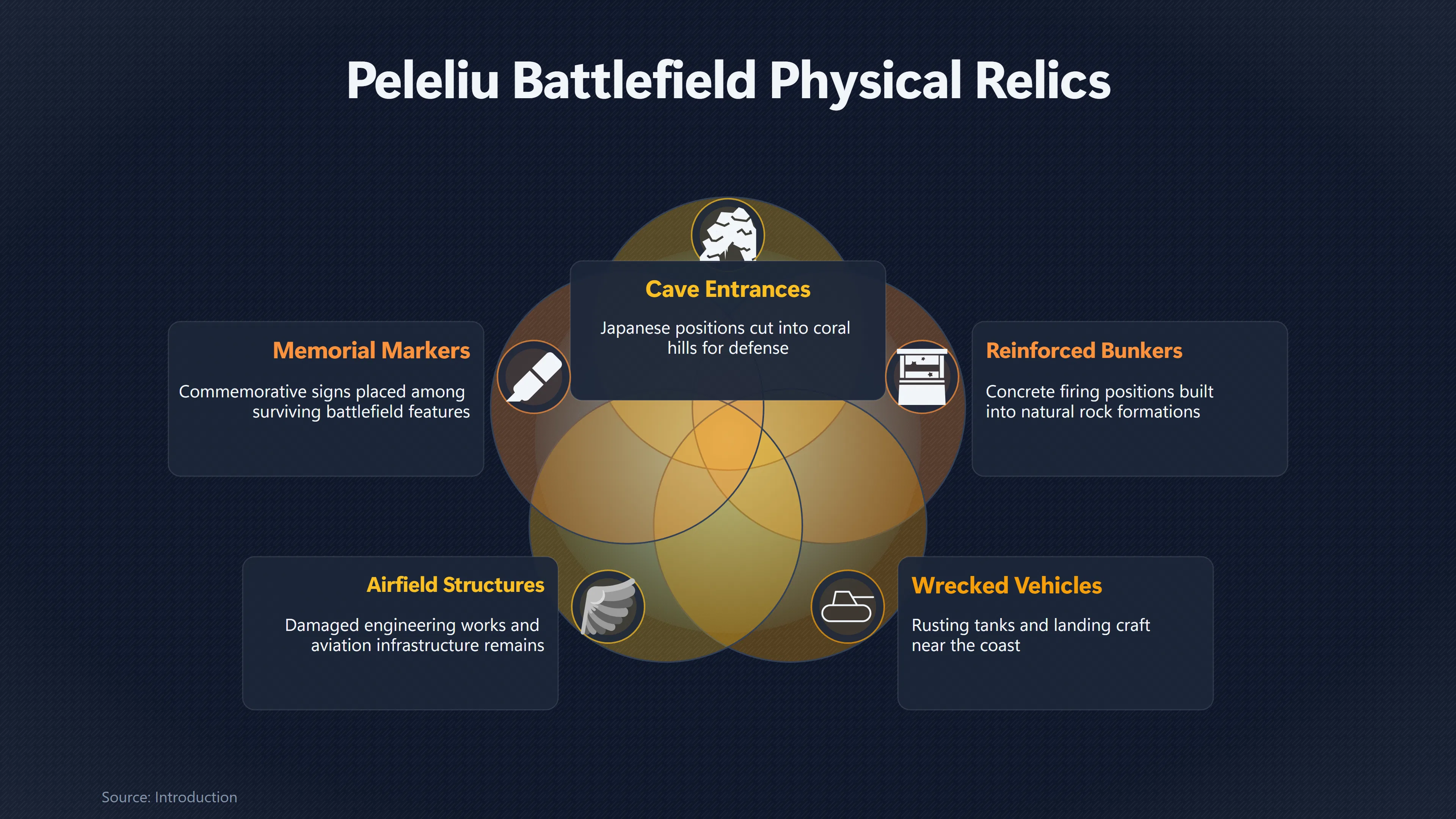
- Japanese cave entrances cut into coral hills that formed interconnected defensive positions.
- Reinforced bunkers and concrete firing positions built into natural rock.
- Damaged airfield structures and military engineering works.
- Rusting tanks, landing craft, aircraft fragments and scattered mechanical components.
- Memorials placed among surviving battlefield features rather than replacing them.[Peleliu Historical Society]peleliuhistorical.orgPeleliu Historical Society WWII Battlefield Survey of Peleliu IslandPeleliu Historical Society WWII Battlefield Survey of Peleliu Island
The famous ridge known as Bloody Nose Ridge illustrates why context matters. Looking at a bunker in isolation reveals little, but seeing it embedded within steep limestone terrain immediately explains why attacking forces struggled to capture the position. The landscape itself becomes part of the interpretation.
Many relics also remain weathered rather than cosmetically restored. Tropical corrosion, vegetation and battle damage are visible reminders that these are archaeological remains rather than reconstructed exhibits. Preservation therefore focuses less on making objects look new and more on preventing further unnecessary loss while allowing visitors to understand their original setting.[National Park Service]nps.govNational Park ServiceGuidelines: Sustaining Battlefield Earthworks (U.S. National Park Service)August 14, 2017…

What Loose Objects Cannot Tell You
One of Peleliu’s most important lessons is that isolated relics are often misleading.
A helmet, shell casing or rusted weapon removed from the battlefield quickly loses much of its historical value. Without its location, archaeologists lose evidence about troop movements, defensive positions and battlefield chronology. Context can reveal whether an object represents combat, post-war clearance or later dumping, while the artefact alone often cannot.
This distinction is especially important because scattered military debris can appear abundant. Visitors may assume that every visible object dates directly from combat, yet some material reflects post-war clean-up, relocation or decades of natural movement caused by erosion and vegetation. Careful archaeological recording is therefore more informative than collecting individual souvenirs.[Peleliu Historical Society]peleliuhistorical.orgPeleliu Report 2012Peleliu Historical SocietyPart 1October 21, 2012
The island demonstrates a broader principle of battlefield archaeology: the landscape is part of the collection. Removing objects not only diminishes the visitor experience but also destroys information that cannot easily be recovered.
Preservation, Memory and the Risks of Battlefield Tourism
Peleliu’s unusual appeal creates equally unusual conservation problems.
For decades after the war, many sites became overgrown and received relatively little international attention. Ironically, this period of neglect helped preserve large parts of the battlefield by limiting redevelopment. More recent interest from veterans’ families, historians and visitors has encouraged conservation projects, improved interpretation and better signage, but it has also increased pressure on fragile locations.[Peleliu Historical Society]peleliuhistorical.orgPeleliu Historical Society WWII Battlefield Survey of Peleliu IslandPeleliu Historical Society WWII Battlefield Survey of Peleliu Island
One continuing challenge is unexploded ordnance. Not every shell, grenade or mortar found on the island is inert. Surveys have documented areas containing exceptionally dense concentrations of wartime ammunition, with some locations considered too dangerous to enter without specialist clearance. Official travel advice likewise warns that unexploded Second World War ordnance remains a risk on Peleliu and recommends using experienced local guides when exploring the island.[peleliuhistorical.org]peleliuhistorical.orgPeleliu Report 2012Peleliu Historical SocietyPart 1October 21, 2012
The combination of authentic battlefield remains and genuine hazards means Peleliu is fundamentally different from an ordinary outdoor museum. Visitors are expected to stay on recognised routes, avoid entering unstable caves or damaged structures, and never touch military objects that could prove dangerous. Similar guidance is used at preserved battlefields elsewhere because corroded ammunition may remain live even after many decades.[National Park Service]nps.govNational Park Service SafetyNational Park ServiceSafety - War In The Pacific National Historical Park (U.S. National Park Service)…
Why the Landscape Matters More Than Individual Artefacts
Peleliu occupies a distinctive place within Palau’s wider culture of unusual heritage because its greatest collection is not housed inside a building. The island preserves a rare combination of relics, terrain and memory in which physical objects cannot be separated from the places where they remain.
That approach also changes how visitors understand preservation. The goal is not simply to save rusting equipment but to protect an entire historical landscape whose caves, fortifications, coral ridges and surviving debris together explain events that no display case could fully recreate. Peleliu therefore functions less as a conventional museum than as one of the Pacific’s most compelling open-air collections, where the landscape itself is the principal exhibit.[Peleliu Historical Society]peleliuhistorical.orgPeleliu Historical Society WWII Battlefield Survey of Peleliu IslandPeleliu Historical Society WWII Battlefield Survey of Peleliu Island
Amazon book picks
Further Reading
Books and field guides related to Why Peleliu's Battlefield Still Feels Like a Museum. Use these as the next step if you want deeper reading beyond the article.
With the Old Breed
Describes the author's experiences after landing on the beach at Peleliu in 1944 with the Marines.
Peleliu 1944
A highly-illustrated examination of the controversial battle for Peleliu.
Brotherhood of Heroes
This riveting read is the gut-wrenching but ultimately triumphant story of the Marines' most ferocious--yet largely forgotten--Pacific ba...
The Battle for Hell's Island
“Stephen L. Moore offers what will soon be ranked a major military classic... A major, first-rate, authoritative contribution to the lite...
eBay marketplace picks
Marketplace Samples
Live-tested eBay searches with available results related to this page.
Selected fromWWII Pacific collectible oneBay.co.uk.
Endnotes
1.
Source: npgallery.nps.gov
Link:https://npgallery.nps.gov/AssetDetail/e38e7768-8d33-4209-900e-5865ed81c9df
Source snippet
NPGallery Asset DetailFebruary 4, 1985...
Published: February 4, 1985
2.
Source: peleliuhistorical.org
Title: Peleliu Historical Society WWII Battlefield Survey of Peleliu Island
Link:https://peleliuhistorical.org/Uploads/Peleliu_Report_2012.pdf
3.
Source: peleliuhistorical.org
Title: Peleliu Historical Society Peleliu WWII Preservation Program
Link:https://www.peleliuhistorical.org/
Source snippet
Peleliu Historical SocietyPeleliu WWII Preservation Program - Peleliu War Historical Society...
4.
Source: nps.gov
Link:https://www.nps.gov/articles/guidelines.htm
Source snippet
National Park ServiceGuidelines: Sustaining Battlefield Earthworks (U.S. National Park Service)August 14, 2017...
Published: August 14, 2017
6.
Source: peleliuhistorical.org
Title: Peleliu Historical Society Peleliu WWII Preservation Program
Link:https://peleliuhistorical.org/projects.html
Source snippet
Peleliu Historical SocietyPeleliu WWII Preservation Program - Projects - Peleliu War Historical Society...
7.
Source: travel.state.gov
Title: Travel.gov Palau Travel Advisory | Travel.State.gov
Link:https://travel.state.gov/en/international-travel/travel-advisories/destination.plw.html
Source snippet
You can plan for safe travel by following the entry and exit requirements, reviewing local laws, and other travel guidance from...
8.
Source: nps.gov
Title: National Park Service Safety
Link:https://www.nps.gov/wapa/planyourvisit/safety.htm
Source snippet
National Park ServiceSafety - War In The Pacific National Historical Park (U.S. National Park Service)...
9.
Source: travel.state.gov
Link:https://travel.state.gov/en/international-travel/travel-advisories/palau.html
10.
Source: nps.gov
Title: Looting & Vandalism
Link:https://www.nps.gov/subjects/archeology/looting-vandalism.htm
11.
Source: nps.gov
Link:https://www.nps.gov/subjects/culturallandscapes/stewardship.htm
12.
Source: home.nps.gov
Link:https://home.nps.gov/subjects/culturallandscapes/stewardship.htm
13.
Source: nps.gov
Link:https://www.nps.gov/articles/pacn-wapa-relics-of-war.htm
14.
Source: npgallery.nps.gov
Link:https://npgallery.nps.gov/AssetDetail/NRIS/85001754
15.
Source: peleliuhistorical.org
Title: Peleliu WWII Preservation Program
Link:https://www.peleliuhistorical.org/contact.html
16.
Source: nps.gov
Link:https://www.nps.gov/subjects/culturallandscapes/stewardship.htm?fullweb=1
17.
Source: architexas.com
Title: Peleliu Battlefield
Link:https://architexas.com/projects/peleliu-battlefield/
18.
Source: youtube.com
Title: Peleliu Battlefield Tour Buildings and Vehicles
Link:https://www.youtube.com/watch?v=6lHnESo9R6s
Source snippet
Peleliu - Bloody Nose Ridge and Caves...
19.
Source: youtube.com
Link:https://www.youtube.com/watch?v=6H7IseAj7BI
Source snippet
The Point Battlefield Tour...
Additional References
20.
Source: youtube.com
Title: Peleliu First Japanese Command Cave
Link:https://www.youtube.com/watch?v=Pne6jwx_J3I
Source snippet
This list highlights key battlefield locations and in-situ relics across the island, showing how Peleliu's terrain preserves its WWII his...
21.
Source: marines.mil
Link:https://www.marines.mil/News/News-Display/Article/2805193/la-quinta-california-native-us-marine-makes-pacific-island-safer-one-bomb-at-a/
22.
Source: mcicom.marines.mil
Link:https://www.mcicom.marines.mil/News/News-Article/Article/2308381/task-force-koa-moana-20-explosive-ordnance-disposal-marines-make-history-on-pel/
23.
Source: abmc.gov
Title: Plan Your Visit
Link:https://www.abmc.gov/plan-your-visit/
Source snippet
Plan Your Visit - American Battle Monuments Commission (ABMC)...
24.
Source: researchgate.net
Title: 265172171 Peleliu 1944 The Archaeology of a South Pacific D Day
Link:https://www.researchgate.net/publication/265172171_Peleliu_1944_The_Archaeology_of_a_South_Pacific_D-Day
25.
Source: pbs.org
Title: peleliu wwiis most well preserved battlefield Ft Onp L
Link:https://www.pbs.org/video/peleliu-wwiis-most-well-preserved-battlefield-FtOnpL/
26.
Source: youtube.com
Title: Peleliu Battlefield Tour Jungle Trail
Link:https://www.youtube.com/watch?v=bZMZN9JGxWI
Source snippet
Peleliu First Japanese Command Cave...
27.
Source: youtube.com
Title: Peleliu The Point Battlefield Tour
Link:https://www.youtube.com/watch?v=bGFWC63Lkc4
Source snippet
Peleliu Battlefield Tour Jungle Trail...
28.
Source: americanrifleman.org
Title: the battle of peleliu and its relics
Link:https://www.americanrifleman.org/content/the-battle-of-peleliu-and-its-relics/
29.
Source: whc.unesco.org
Link:https://whc.unesco.org/en/decisions/4783