Within Haiti Curiosities
Who Should Display Haiti's Sacred Vodou Objects?
The Marianne Lehmann collection preserves thousands of Vodou-related objects while raising difficult questions about access, ownership and consent.
On this page
- Inside the Marianne Lehmann Collection
- Bizango Figures and Restricted Meanings
- Ownership, Consent and the Unfinished Museum
Page outline Jump by section
Introduction
The Marianne Lehmann Collection is one of Haiti’s most remarkable cultural collections, but it is also one of its most ethically complex. Assembled over several decades by Swiss-born collector Marianne Lehmann after she settled in Haiti, it contains roughly 3,000 Vodou-related objects, including ritual flags, altars, mirrors, ceremonial vessels and rare figures associated with Vodou secret societies. Rather than being celebrated simply as an extraordinary museum collection, it has become the centre of difficult debates about who should own, interpret and publicly display sacred religious objects that remain meaningful to living communities. These questions have become even more urgent because the collection has never found a permanent, secure public home in Haiti despite repeated plans to establish one.[Staatliche Museen zu Berlin]smb.museumStaatliche Museen zu Berlin VodouStaatliche Museen zu BerlinVodou - Art and Cult from HaitiMay 18, 2010…
Unlike many collections of archaeological or historical artefacts, the Lehmann Collection consists largely of objects that originated within a living religious tradition. That makes every exhibition a balancing act between cultural preservation, public education and respect for beliefs that are still actively practised.
Inside the Marianne Lehmann Collection
Marianne Lehmann began collecting Vodou objects during the 1970s after Haitian religious practitioners approached her with items they wished to sell. According to interviews and exhibition catalogues, many objects entered the collection because their owners needed money, wished to preserve important ritual works from deterioration or feared they would otherwise disappear into the international art market. Over time the collection expanded into one of the world’s largest assemblies of Haitian Vodou material culture.[DOMRADIO.DE]domradio.deAusstellung über Vodou-Religion in Haiti | DOMRADIO.DEMay 18, 2010…
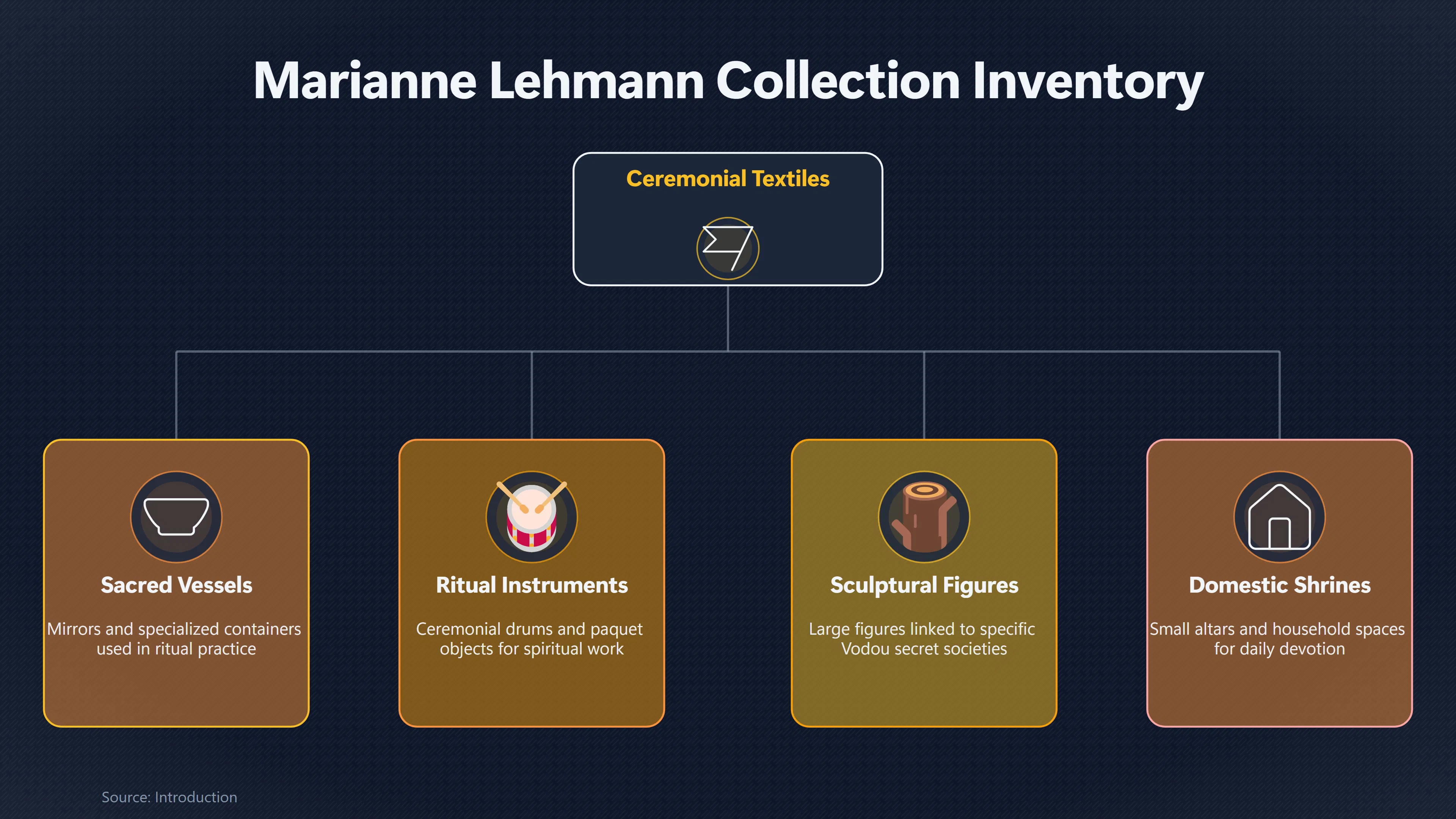
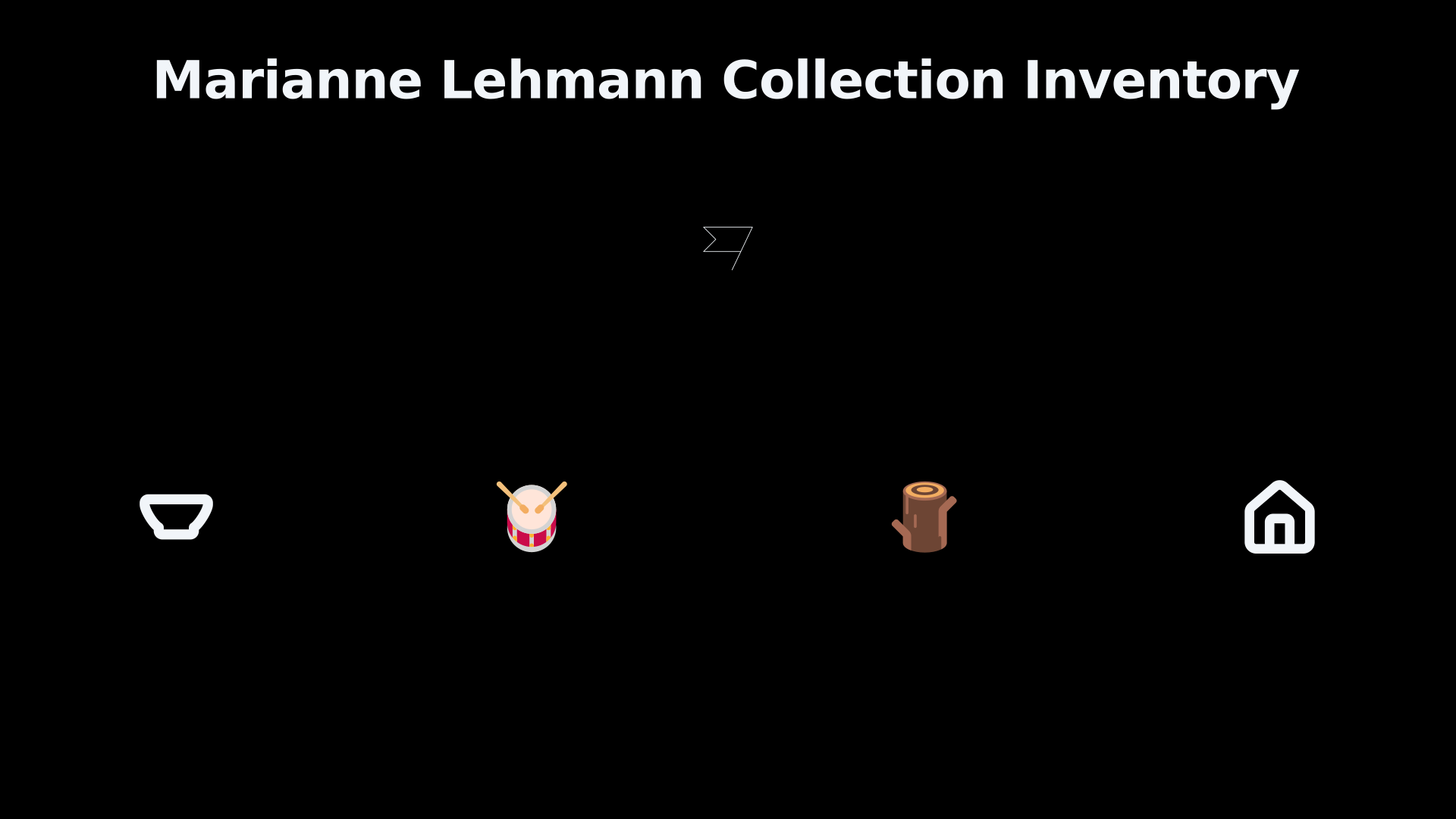
The collection includes an unusually broad range of objects:
- Sequined ceremonial flags.
- Ritual costumes.
- Spirit representations.
- Mirrors and sacred vessels.
- Paquet objects used in ritual practice.
- Ceremonial drums.
- Domestic shrines.
- Large sculptural figures linked with Vodou secret societies.
- A small number of archaeological objects associated with Haiti’s Indigenous past.
Because the collection documents everyday religious practice alongside spectacular ceremonial works, it provides an unusually rich picture of Haitian religious life rather than simply presenting isolated masterpieces. Exhibition organisers in Geneva, Berlin and Canada have consistently argued that this breadth allows visitors to understand Vodou as a complete cultural system instead of the sensationalised “voodoo” often portrayed in popular media.[swissinfo.ch]swissinfo.chSWI swissinfo.ch Voodoo casts spell on GenevaSWI swissinfo.chVoodoo casts spell on Geneva - SWI swissinfo.chJanuary 16, 2008…
A further complication is that many objects were ritually deconsecrated before entering the collection. Conservators involved in the Haiti Cultural Recovery Project note that this process was intended to remove their active ritual status before they became museum objects, although opinions differ over whether all practitioners regard deconsecration as fully resolving religious concerns.[haiti.si.edu]haiti.si.eduHERITAGE CULTURAL RECOVERY AFTER…
Bizango Figures and Restricted Meanings
The most controversial pieces are the life-sized Bizango figures.
These dramatic sculptures combine wood, cloth, mirrors, rope, metal, animal materials and, in some documented cases, human remains. They are associated with Bizango societies, organisations that occupy a complex place in Haitian society and whose traditions have historically been known only to initiated members. Museum catalogues have repeatedly emphasised that such objects were never intended for unrestricted public viewing.[Staatliche Museen zu Berlin]smb.museumStaatliche Museen zu Berlin VodouStaatliche Museen zu BerlinVodou - Art and Cult from HaitiMay 18, 2010…
For museum visitors, the Bizango figures can appear unsettling because of their imposing scale and layered construction. However, reducing them to frightening curiosities misses their cultural significance. They belong within systems of ritual authority, protection, justice and spiritual belief that remain imperfectly understood outside the communities that created them.
This creates a genuine ethical dilemma.
On one hand, exhibiting these objects helps counter long-standing stereotypes by showing that Vodou possesses a sophisticated artistic and religious tradition. On the other, public display inevitably removes them from the controlled ceremonial contexts in which they originally carried meaning. Even carefully researched museum labels cannot fully replace knowledge traditionally restricted to initiates.
The Berlin exhibition deliberately foregrounded this tension by acknowledging that many featured objects had previously been hidden from non-members, inviting visitors to consider not only what they were seeing but whether every sacred object should become museum material simply because it can be displayed.[Staatliche Museen zu Berlin]smb.museumStaatliche Museen zu Berlin VodouStaatliche Museen zu BerlinVodou - Art and Cult from HaitiMay 18, 2010…

Ownership, Consent and the Unfinished Museum
The ethical debate surrounding the Lehmann Collection is not primarily about whether Marianne Lehmann acted in bad faith. Indeed, Haitian scholars and Vodou practitioners collaborated with her through the Fondation pour la préservation, la valorisation et la production d’œuvres culturelles haïtiennes (FPVPOCH), and major exhibitions were developed with Haitian anthropologists including Rachel Beauvoir-Dominique and Max Beauvoir.[canada-haiti.ca]canada-haiti.caAt Canadian Museum of Civilization: Vodou | The Canada-Haiti Information ProjectNovember 14, 2012…
Instead, the central questions are broader.
Who has authority to display sacred heritage? Objects may have been legally acquired, yet communities can still argue that religious meaning cannot simply be transferred through purchase.
Can informed consent survive over decades? Many pieces entered the collection during periods of economic hardship. Critics ask whether financial necessity complicates the idea of voluntary sale, while supporters argue that collecting prevented irreversible dispersal into private international markets.
Should Haiti’s most important Vodou collection remain outside a permanent Haitian museum? For years, the stated ambition has been to create a suitable cultural centre in Haiti where the collection could be preserved and interpreted for Haitian audiences first. Political instability, natural disasters and chronic funding problems have repeatedly delayed that goal.[smb.museum]smb.museumStaatliche Museen zu Berlin VodouStaatliche Museen zu BerlinVodou - Art and Cult from HaitiMay 18, 2010…
These debates reflect wider international discussions about the ownership of Indigenous, colonial and sacred collections. The Lehmann Collection is therefore significant not only because of what it contains but because it forces museums to confront questions that have no universally accepted answers.
Why the Collection Matters Beyond Curiosity
The Marianne Lehmann Collection is sometimes described as one of the world’s greatest Vodou collections, but its importance lies less in its size than in what it reveals about museum practice.
It demonstrates that collections of living religious heritage cannot be approached in the same way as archaeological finds or decorative art. Curators must weigh conservation against religious sensitivity, public education against restricted knowledge, and international access against local cultural authority.
The collection has also played an important educational role. Exhibitions in Geneva, Berlin and Canada deliberately challenged Hollywood stereotypes by presenting Vodou as a sophisticated religious tradition rooted in Haiti’s history, creativity and resistance rather than as a catalogue of zombies, curses and exotic superstition. Haitian scholars and practitioners were incorporated into exhibition planning to ensure that interpretation reflected living voices rather than purely outside academic perspectives.[swissinfo.ch]swissinfo.chSWI swissinfo.ch Voodoo casts spell on GenevaSWI swissinfo.chVoodoo casts spell on Geneva - SWI swissinfo.chJanuary 16, 2008…
For anyone exploring Haiti’s unusual collections, the Lehmann Collection stands apart because its greatest mystery is not the objects themselves. It is the unresolved question of where they ultimately belong, who should speak for them, and whether some forms of sacred heritage can ever be fully at home behind museum glass.
Amazon book picks
Further Reading
Books and field guides related to Who Should Display Haiti's Sacred Vodou Objects?. Use these as the next step if you want deeper reading beyond the article.
Sacred Arts of Haitian Vodou
This abundantly illustrated anthology brings together sixteen essays by artists, scholars and ritual experts who examine the sacred arts...
Faith Works
Today more than ever, many people are hungry for spirituality and community. But the most powerful and meaningful spirituality shows itse...
Who Owns Antiquity?
Whether antiquities should be returned to the countries where they were found is one of the most urgent and controversial issues in the a...

Loot: The Battle over the Stolen Treasures of the Ancient World
First published 2009. Subjects: Art thefts, Cultural property, Art, ancient, New York Times reviewed.
eBay marketplace picks
Marketplace Samples
Live-tested eBay searches with available results related to this page.
Selected fromHaitian folk art oneBay.co.uk.
Endnotes
1.
Source: haiti.si.edu
Link:https://haiti.si.edu/docs/saving_haitis_heritage_book.pdf
Source snippet
HERITAGE CULTURAL RECOVERY AFTER...
2.
Source: domradio.de
Title: Ausstellung über Vodou-Religion in Haiti | DOMRADIO.DE
Link:https://www.domradio.de/artikel/ausstellung-ueber-vodou-religion-haiti
Source snippet
May 18, 2010...
Published: May 18, 2010
3.
Source: swissinfo.ch
Title: SWI swissinfo.ch Voodoo casts spell on Geneva
Link:https://www.swissinfo.ch/eng/history/voodoo-casts-spell-on-geneva/6364130
Source snippet
SWI swissinfo.chVoodoo casts spell on Geneva - SWI swissinfo.chJanuary 16, 2008...
Published: January 16, 2008
4.
Source: canada-haiti.ca
Title: At Canadian Museum of Civilization: Vodou | The Canada-Haiti Information Project
Link:https://canada-haiti.ca/content/canadian-museum-civilization-vodou
Source snippet
November 14, 2012...
Published: November 14, 2012
5.
Source: swissinfo.ch
Title: Le vodou haïtien sur un air de Baudelaire
Link:https://www.swissinfo.ch/fre/archive-science/le-vodou-ha%C3%AFtien-sur-un-air-de-baudelaire/6365516
6.
Source: smb.museum
Title: Staatliche Museen zu Berlin Vodou
Link:https://www.smb.museum/en/museums-institutions/ethnologisches-museum/exhibitions/detail/vodou/
Source snippet
Staatliche Museen zu BerlinVodou - Art and Cult from HaitiMay 18, 2010...
Published: May 18, 2010
7.
Source: meg.ch
Link:https://www.meg.ch/fr/boutique/livre-18
8.
Source: museumpublicity.com
Link:https://museumpublicity.com/2012/11/16/canadian-museum-of-civilization-opens-vodou-exhibition/
Source snippet
Canadian Museum of Civilization opens Vodou exhibition | Museum PublicityNovember 16, 2012 — CANADIAN MUSEUM OF CIVILIZATION OPENS VODOU...
Published: November 16, 2012
9.
Source: smb.museum
Link:https://www.smb.museum/ausstellungen/detail/vodou/
Additional References
10.
Source: commons.wikimedia.org
Title: Category:Vodou exhibition in Museen Dahlem
Link:https://commons.wikimedia.org/wiki/Category%3AVodou_exhibition_in_Museen_Dahlem
Source snippet
wikimedia.orgCategory:Vodou exhibition in Museen Dahlem - Wikimedia CommonsAugust 6, 2022 — CATEGORY:VODOU EXHIBITION IN MUSEEN DAHLEM Th...
Published: August 6, 2022
11.
Source: youtube.com
Title: Wendy Asquith, Kafou: Haiti, Art and Vodou
Link:https://www.youtube.com/watch?v=wyhig4pBi4s
Source snippet
Lecture: Mermaids, Ancestors & Saints:The Dynamism of Myrlande Constant’s Haitian Vodou Ritual Flags...
12.
Source: youtube.com
Title: Kafou: Haiti, Art and Vodou
Link:https://www.youtube.com/watch?v=I3__rNBd3mA
Source snippet
Wendy Asquith, Kafou: Haiti, Art and Vodou...
13.
Source: youtube.com
Title: “Vodou Spirits in Haitian Art” by Donald Cosentino
Link:https://www.youtube.com/watch?v=bRoAxOmagGc
Source snippet
Kafou: Haiti, Art and Vodou - African Spirit - Nottingham Contemporary Gallery...
14.
Source: youtube.com
Title: Sequin Arts: The Flagmakers of Haiti
Link:https://www.youtube.com/watch?v=J6fTVRlQNmY
Source snippet
Une Mémoire Vodou: Marianne Lehmann donne sa vision du Vodou Loray Gwondé · 685 views...
15.
Source: youtube.com
Link:https://www.youtube.com/watch?v=9scHiRm1PYI
Source snippet
Sequin Arts: The Flagmakers of Haiti...
16.
Source: researchgate.net
Link:https://www.researchgate.net/publication/328673080_Producing_Collecting_and_Exhibiting_Bizango_Sculptures_from_Haiti_Transatlantic_Vodou_on_the_International_Art_Scene
17.
Source: escholarship.org
Link:https://escholarship.org/uc/item/47r5v0z3
18.
Source: nawao.ch
Link:https://www.nawao.ch/seiten/kunst/a_kunst_03_e.html
19.
Source: geneveactive.ch
Link:https://www.geneveactive.ch/article/le-vodou-repond-toujours-a-certains-elements-essentiels-de-la-vie-des-peuples/