Within Curious Peru
Should Peru's Andean Mummies Be Put on Display?
Peru's mummy museums reveal extraordinary archaeology while raising difficult questions about conservation, consent and public viewing.
On this page
- Juanita and Inca high mountain sacrifice
- Leymebamba's mummy repository and regional conservation
- Respect, tourism and the problem of looking
Page outline Jump by section
Introduction
Peru’s Andean mummies are among the world’s most remarkable archaeological discoveries, but they also raise one of museum practice’s most difficult questions: should the preserved bodies of ancient people be displayed at all? The debate is not simply about whether visitors can see extraordinary remains. It concerns how museums balance scientific research, public education, tourism, cultural respect and the dignity of people who never consented to becoming exhibits. Peru sits at the centre of this discussion because two of its best-known collections represent very different circumstances: the frozen Inca child known as Juanita, preserved by the cold of a volcano, and the large repository of Chachapoya mummies conserved near their original landscape at Leymebamba. Together they show that the ethics of display depend as much on interpretation and community responsibility as on the remains themselves.[International Council of Museums]icom.museumInternational Council of MuseumsInternational repatriation of human remains of indigenous peoples - International Council of Museums - In…
Why Peru’s mummies are different
Unlike Egyptian mummies prepared through deliberate embalming, many Andean mummies survived because of environmental conditions. Some were naturally freeze-dried on high mountain summits where the Inca placed ceremonial offerings, while others were preserved in dry cliff tombs or rock shelters. Their survival allows archaeologists to study clothing, diet, health, ritual practice and even traces of childhood illness that would otherwise be lost.
For museums, however, the same exceptional preservation creates an ethical challenge. The more complete a body remains, the more visitors recognise it as an individual rather than an anonymous archaeological object. Curators therefore have to decide whether scientific and educational value outweighs the discomfort many people feel when viewing human remains.
International museum guidance increasingly argues that this decision cannot rest on scientific interest alone. Human remains should be cared for and, where displayed, presented with dignity, clear educational purpose and sensitivity to the beliefs of descendant or culturally connected communities.[International Council of Museums]icom.museumInternational Council of MuseumsInternational repatriation of human remains of indigenous peoples - International Council of Museums - In…
Juanita and the legacy of high-mountain sacrifice
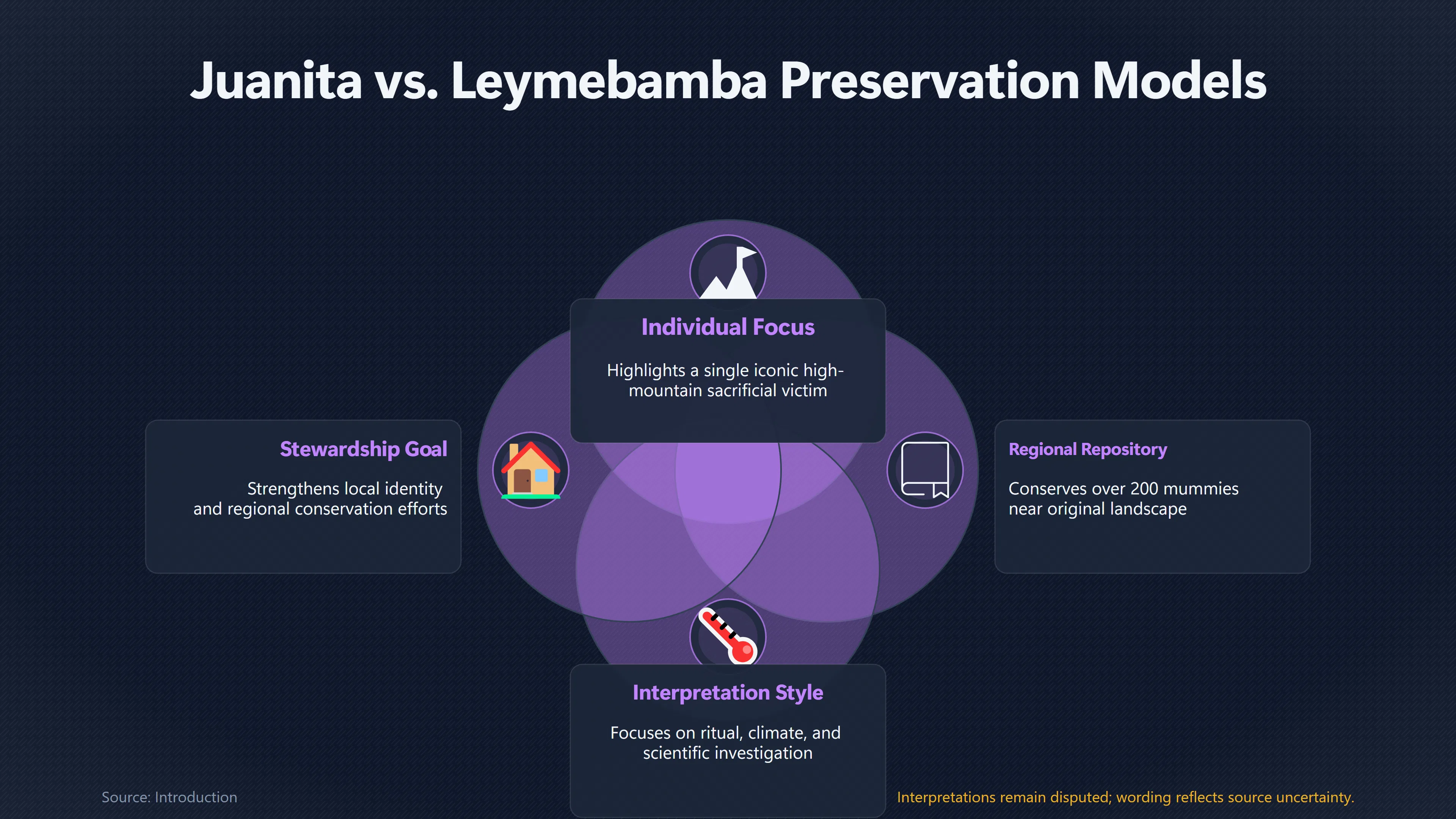
The discovery of Juanita on Mount Ampato in 1995 transformed understanding of Inca high-mountain ceremonies. Exceptionally preserved by freezing temperatures, the teenage girl was found with finely made textiles, figurines and ceremonial offerings that demonstrated the sophistication of Inca state ritual rather than a simple act of violence.
At the Museo Santuarios Andinos in Arequipa, Juanita is not continuously exposed. The body is kept under carefully controlled conservation conditions, with temperature and humidity managed to prevent deterioration. Displays place equal emphasis on archaeology, climate, religion and scientific investigation rather than encouraging visitors to view the mummy simply as a curiosity.
This approach reflects an important ethical distinction. The museum’s interpretation focuses on explaining the cultural world that produced the offering, the excavation process and the conservation challenges. Visitors are encouraged to understand Juanita as a person who lived within a specific historical and religious system, not merely as a spectacular frozen body.
Even so, disagreement remains. Some scholars and Indigenous voices question whether any public display of sacrificial victims is appropriate. Others argue that careful exhibition promotes understanding of Andean civilisation while protecting remains that might otherwise be vulnerable to looting or environmental damage. There is no universal consensus, which is why Juanita continues to feature in wider debates over museum ethics rather than serving as an uncontested model.[International Council of Museums]icom.museumInternational Council of MuseumsInternational repatriation of human remains of indigenous peoples - International Council of Museums - In…
What visitors actually encounter
The public often expects a dramatic encounter with a perfectly preserved body. In practice, responsible interpretation tends to be quieter and more contextual.
Visitors are more likely to encounter:
- conservation equipment alongside archaeological interpretation;
- explanations of Inca cosmology and mountain rituals;
- associated textiles, offerings and scientific evidence;
- discussion of excavation and preservation rather than sensational storytelling.
This framing deliberately shifts attention away from spectacle towards understanding.
Leymebamba’s mummy repository and regional conservation
If Juanita represents a single iconic individual, the Museo Leymebamba represents a different philosophy altogether. More than 200 Chachapoya mummies recovered from the cliffside funerary complex at Laguna de los Cóndores are conserved close to the region where they were discovered rather than being transferred permanently to Lima or overseas collections.
Keeping the collection within Amazonas changes both its scientific and ethical context. The mummies remain connected to the landscape, communities and archaeology that give them meaning. The museum therefore functions not simply as a tourist attraction but as a regional conservation centre protecting fragile remains from looting, humidity and uncontrolled handling.
Displays generally emphasise the funerary traditions of the Chachapoya people, the recovery of artefacts after extensive looting, and the long-term work required to stabilise textiles, baskets and human remains. The mummies form part of a wider archaeological story instead of standing alone as isolated exhibits.
This regional model has become increasingly influential because it demonstrates that preserving remains near their place of origin can strengthen both research and local stewardship. Rather than extracting spectacular discoveries to national capitals, museums can reinforce local identity while giving visitors a fuller understanding of the surrounding cultural landscape.
Respect, tourism and the problem of looking
The ethical question ultimately extends beyond conservation. It also concerns the behaviour encouraged by exhibition design.
Poorly interpreted displays risk reducing ancient people to macabre attractions or social media backdrops. Museums increasingly try to avoid this by limiting photography in sensitive areas, reducing theatrical lighting, explaining archaeological context before visitors encounter remains, and presenting individuals by name or cultural identity wherever possible.
Tourism nevertheless creates unavoidable tension. Juanita attracts visitors because she is famous, while the Chachapoya mummies are among northern Peru’s most distinctive archaeological attractions. Admission fees and visitor interest can support conservation, yet commercial success can also create pressure for increasingly dramatic presentation.
Responsible museums attempt to resolve this tension by making education—not shock—the main attraction. The human remains become part of a larger narrative about Andean societies, environmental preservation, archaeology and cultural continuity.
How museum ethics have changed
Modern museum practice differs markedly from nineteenth-century traditions, when human remains were frequently displayed as exotic curiosities or racial specimens. Contemporary international guidance instead stresses several recurring principles:
- human remains should have a clear educational or research purpose;
- conservation must take priority over entertainment;
- exhibitions should acknowledge cultural and spiritual significance where known;
- descendant or culturally affiliated communities should be consulted whenever possible;
- requests concerning removal, reburial or repatriation deserve respectful consideration rather than automatic refusal.[International Council of Museums]icom.museumInternational Council of MuseumsInternational repatriation of human remains of indigenous peoples - International Council of Museums - In…
These principles do not automatically require museums to remove all mummies from display. Instead, they require institutions to justify why remains are shown, how they are interpreted and whether the display continues to serve the public responsibly.
Why the debate matters beyond Peru
Peru’s mummy museums have become important international case studies because they demonstrate that displaying human remains is neither inherently respectful nor inherently exploitative. The outcome depends on context.
Juanita illustrates how careful conservation and interpretation can transform an archaeological discovery into a thoughtful educational experience while still provoking legitimate ethical questions. Leymebamba shows how keeping collections within their regional setting can preserve archaeological context and strengthen local stewardship instead of treating ancient ancestors as portable museum trophies.
For visitors interested in Peru’s unusual collections, these museums are memorable not because they contain mummies, but because they ask every viewer to consider the same question: when does learning from the past justify looking directly at the people who lived it?
Amazon book picks
Further Reading
Books and field guides related to Should Peru's Andean Mummies Be Put on Display?. Use these as the next step if you want deeper reading beyond the article.
The Archaeology of Death
The archaeology of death and burial is central to our attempts to understand vanished societies. Through the remains of funerary rituals...
The Ancient Americas
A lavishly illustrated catalog of a traveling exhibition marking the Columbus quincentennial explores the common threads in fourteen pre-...
The Past Is a Foreign Country
A completely updated new edition of David Lowenthal's classic account of how we reshape the past to serve present needs.
The Ethics of Collecting Cultural Property
Explores the ethical, legal, and intellectual issues related to excavating, selling, collecting, and owning cultural artifacts.
eBay marketplace picks
Marketplace Samples
Live-tested eBay searches with available results related to this page.
Selected fromancient history poster oneBay.co.uk.
Endnotes
1.
Source: icom.museum
Link:https://icom.museum/en/news/international-repatriation-of-human-remains-of-indigenous-peoples/
Source snippet
International Council of MuseumsInternational repatriation of human remains of indigenous peoples - International Council of Museums - In...
2.
Source: icom.museum
Title: International Council of Museums Code of Ethics
Link:https://icom.museum/en/resources/standards-guidelines/code-of-ethics/
Source snippet
International Council of MuseumsCode of Ethics - International Council of Museums - International Council of Museums...
3.
Source: uk.icom.museum
Link:https://uk.icom.museum/icom-news-new-code-of-ethics-new-decolonisation-standing-committee-and-better-support-for-displaced-persons/
Source snippet
news: New Code of Ethics, New Decolonisation Standing Committee, and better support for displaced persons - ICOM UKJuly 1, 2026 — ICOM NE...
Published: July 1, 2026
4.
Source: uk.icom.museum
Title: THE INTERNATIONAL COUNCIL OF MUSEUMS (ICOM
Link:https://uk.icom.museum/the-revised-icom-code-of-ethics-is-officially-adopted/
Source snippet
revised ICOM Code of Ethics is officially adopted - ICOM UKJune 29, 2026 — THE REVISED ICOM CODE OF ETHICS IS OFFICIALLY ADOPTED Posted o...
Published: June 29, 2026
5.
Source: cimuset.mini.icom.museum
Title: museum ICO M code of Ethics for Museums
Link:https://cimuset.mini.icom.museum/members/icom-code-of-ethics-for-museums/
6.
Source: icom.nl
Title: Code of Ethics
Link:https://icom.nl/en/about-icom/code-of-ethics
7.
Source: chachapoya.org
Link:https://www.chachapoya.org/museo-leymebamba/
8.
Source: museos.cultura.pe
Title: museo leymebamba
Link:https://museos.cultura.pe/museos/museo-leymebamba
9.
Source: iperu.org
Title: Museo Santuarios Andinos
Link:https://www.iperu.org/museo-santuarios-andinos
Additional References
10.
Source: cambridge.org
Link:https://www.cambridge.org/core/journals/international-journal-of-cultural-property/article/testing-ethical-disagreement-on-ancestral-human-remains-in-museums/1010E88D6D8E6F0661019D19350ADBA1
Source snippet
February 11, 2026 — In 1904, a game hunter, James Harrison, brought to Britian two women and four men of the Bambuti ethnic group (who li...
Published: February 11, 2026
11.
Source: mynewsdesk.com
Link:https://www.mynewsdesk.com/icom/pressreleases/icom-adopts-its-revised-code-of-ethics-for-museums-3455988
Source snippet
ICOM adopts its revised Code of Ethics for Museums | International Council of Museums (ICOM)June 25, 2026 — Press release — 25 June 2026...
Published: June 25, 2026
12.
Source: icom-ce.org
Title: En él se establecen las normas mínimas de conducta
Link:https://www.icom-ce.org/nuevo-codigo-de-etica-de-icom-para-los-museos/
Source snippet
Nuevo código de ética de ICOM para los museos - ICOM ESPAÑA - Consejo Internacional de MuseosJuly 6, 2026 — NUEVO CÓDIGO DE ÉTICA DE ICOM...
Published: July 6, 2026
13.
Source: museumsassociation.org
Title: Icom adopts revised Code of Ethics for Museums
Link:https://www.museumsassociation.org/museums-journal/news/2026/06/icom-adopts-revised-code-of-ethics-for-museums/
Source snippet
Museums AssociationJune 29, 2026 — ICOM ADOPTS REVISED CODE OF ETHICS FOR MUSEUMS International framework sets out five core principles R...
Published: June 29, 2026
14.
Source: youtube.com
Title: Ethical considerations for caring and managing human remains in museums
Link:https://www.youtube.com/watch?v=lml7S5-teqc
Source snippet
Should DEAD BODIES be on display? Should human remains be in museums? Egyptian mummies and bog men...
15.
Source: youtube.com
Link:https://www.youtube.com/watch?v=VEqvin_zMpQ
Source snippet
Ethical issues, study and display of human remains | Ancient History...
16.
Source: youtube.com
Link:https://www.youtube.com/watch?v=fa06gaX7kNY
Source snippet
500 Years Frozen: The Inca Children Who Changed History | Mummies Alive...
17.
Source: youtube.com
Title: 500 Years Frozen: The Inca Children Who Changed History | Mummies Alive
Link:https://www.youtube.com/watch?v=aWao35yct-g
Source snippet
Ethical considerations for caring and managing human remains in museums...
18.
Source: obs-traffic.museum
Link:https://www.obs-traffic.museum/ethical-standards-codes-ethics
19.
Source: elperuano.pe
Link:https://www.elperuano.pe/noticia/109732-la-momia-juanita-es-declarada-patrimonio-cultural-de-la-nacion