Where Congo's Strangest Collections Keep Their Secrets
“Congo” covers two neighbouring countries: the much larger Democratic Republic of the Congo, centred on Kinshasa, and the Republic of the Congo, centred on Brazzaville. Neither has a widely documented, purpose-built “museum of witchcraft” or commercial oddities attraction. Their curiosity culture is more substantial than that absence suggests.
Page outline Jump by section
Introduction
The strongest places to explore this material are the National Museum in Kinshasa, the small Kivu Museum in Bukavu, Lubumbashi’s archaeological and ethnographic collections, and the Mâ Loango and Cercle Africain museums near Pointe-Noire. Just as important are objects removed to Belgium and other overseas collections, including the enigmatic Ishango bone and thousands of spiritually significant Congolese artefacts now caught up in provenance and restitution debates.[imnc.cd]imnc.cdMusées Nationaux du Congo IMNCCes collections ont été collectées dans différentes provinces de la RDC…. Collection exceptionnelle de masques rituels des différentes…
What counts as a strange collection in Congo?
Congo’s most unusual museum objects were not normally created as curiosities. Masks, carved figures, medicines, royal emblems and divination equipment belonged to systems of authority, healing, initiation, ancestor veneration and protection. They became “oddities” largely when missionaries, colonial officers, ethnographers and art dealers removed them from their social settings and arranged them as examples of exotic belief.
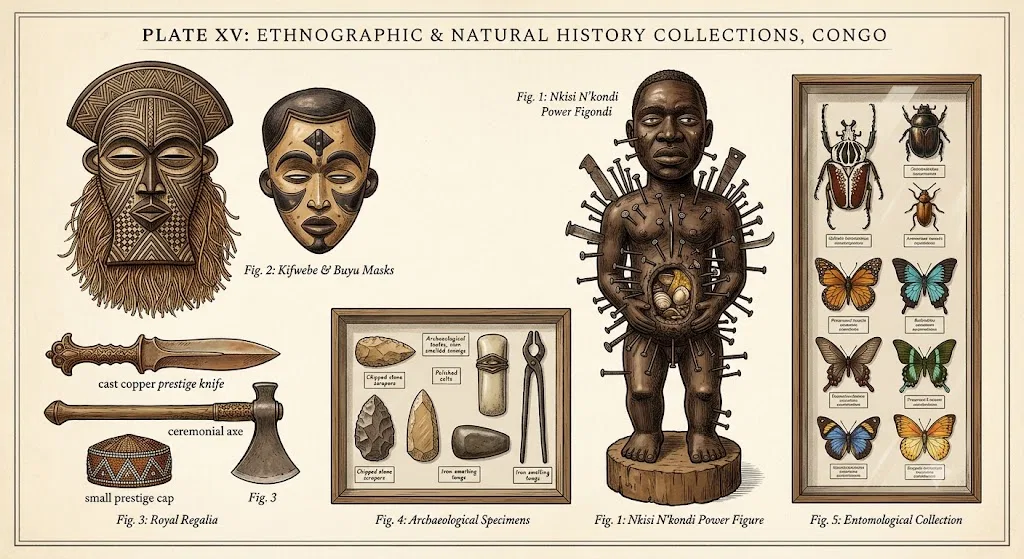
This distinction matters particularly for the famous Kongo power figures found in museums around the world. Such objects could contain spiritually charged substances and might be used to protect agreements, identify wrongdoing, heal illness or confront forces believed to threaten a community. Figures studded with nails or blades can look sinister to an unprepared viewer, but the metal elements often recorded appeals, promises or interventions rather than acts of indiscriminate sorcery. Treating them simply as witchcraft props strips away their legal, medical and communal functions.
The same caution applies to masks. A museum case may reduce one to a carved face, yet many masks were only one component of a full performance involving costume, music, movement, specialist knowledge and restricted participation. The Congolese national museum authority describes its holdings as including ritual masks gathered from different provinces and representing living ancestral traditions, rather than merely decorative art.[imnc.cd]imnc.cdMusées Nationaux du Congo IMNCCes collections ont été collectées dans différentes provinces de la RDC…. Collection exceptionnelle de masques rituels des différentes…
For visitors interested in the uncanny, Congo therefore offers something more demanding than a conventional oddities museum. The unsettling quality often comes from the distance between what an object once did and what its display label can now explain.
The National Museum in Kinshasa
The National Museum of the Democratic Republic of the Congo is the clearest starting point for understanding the country’s unusual material culture. The present museum building was inaugurated in 2019 with support from South Korea, including assistance with conservation, storage, exhibition planning and staff training. It is administered through the Institut des Musées Nationaux du Congo, the public scientific body responsible for several national collections.[Korea Heritage Foundation]kh.or.krKorea Heritage FoundationDemocratic Republic of the CongoThe ribbon-cutting ceremony of the National Museum was held in Kinshasa, the cap…
Its displays cover much more than strange or ritual material, but masks, sculpture, ceremonial objects and signs of political authority form an important part of the visitor experience. The attraction is not that these objects are freakish. It is that they preserve evidence of many different Congolese societies, each with its own rules about leadership, initiation, death, healing and relations with ancestors.
Particularly memorable categories include:
- Ritual masks, whose animal-human forms can embody ancestors, spirits, social roles or forces encountered during initiation.
- Power and protective figures, sometimes equipped with cavities for medicines or other substances supplied by a ritual specialist.
- Royal insignia and prestige objects, in which rare materials, elaborate surfaces and symbolic animals communicate rank.
- Musical and performance objects, which remind visitors that masks and sculptures were often activated through sound and movement.
- Archaeological material, connecting later artistic traditions with a much deeper human history.
The museum is a formal national institution rather than an occult attraction. That generally makes it more credible than a commercial collection assembled around sensational claims. Even so, interpretation is difficult: an object may have been collected decades ago with minimal documentation, and older classifications may reflect the assumptions of missionaries or colonial ethnographers rather than the understanding of the community that made it.
Bukavu’s hidden missionary museum
The Kivu Museum in Bukavu is one of the most intriguing small collections in the Democratic Republic of the Congo. It stands within the grounds of the Xaverian Fathers’ mission and has been described as being largely concealed behind the mission walls rather than promoted as a major tourist institution. Reports describe rooms of wooden statues, masks and other objects associated with communities in eastern Congo, including Buyu and Luba material.[Taipei Times]taipeitimes.comTaipei TimesHidden Congolese museum safeguards tradition…23 Mar 2015 — The museum lies hidden behind the walls of the mission of the X…
Its unusual character comes partly from its atmosphere. This is not a polished national showcase with large visitor facilities. It is a missionary collection whose survival has depended on local custodianship in a region repeatedly affected by political instability and armed conflict. Objects displayed there can preserve knowledge of practices that have changed, declined or become difficult to document.
Missionary museums require especially careful reading. Missionaries sometimes recorded languages, collected artefacts and created institutions that protected objects from physical destruction. At the same time, Christian missions frequently opposed local religious practices and removed sacred objects from the settings in which they had meaning. The AfricaMuseum in Belgium acknowledges that early missionaries in Congo destroyed objects they regarded as “heathen”, while other objects entered European collections through missionary networks.[Royal Museum for Central Africa]africamuseum.beOpen source on africamuseum.be.
The Kivu Museum is therefore both a cultural refuge and a product of unequal historical relationships. Visitors should not assume that every figure was voluntarily surrendered, accurately labelled or intended for unrestricted viewing. Its value lies partly in that unresolved tension.
Practical access can change. Bukavu has been affected by serious security instability, and British travel advice has warned against travel to substantial parts of the Democratic Republic of the Congo. Anyone considering a visit should confirm both regional conditions and admission arrangements directly rather than relying on old travel listings.[GOV.UK]GOV.UKDemocratic Republic of the Congo travel adviceDemocratic Republic of the Congo travel advice
Lubumbashi’s archaeology and entomology
The National Museum of Lubumbashi began in the colonial period and developed from an institution intended to display archaeological discoveries. Its permanent holdings later expanded to include substantial ethnographic and entomological collections. That combination makes it one of Congo’s closest equivalents to an old-fashioned cabinet of curiosity: human artefacts, excavated material and specimens from the natural world share an institutional history.[MoMAA]momaa.orgOpen source on momaa.org.
The archaeological displays are especially important because they place visually dramatic masks and sculptures within a much longer story. Congo’s past cannot be reduced to the objects collected by Europeans in the nineteenth and twentieth centuries. Excavated tools, ceramics and settlement evidence show successive communities adapting to landscapes shaped by rivers, forests, mineral deposits and long-distance exchange.
The entomology holdings add a different kind of strangeness. Large insects, intricate wing patterns and preserved specimens can appear more immediately “curious” than an ethnographic display. Yet these collections also carry scientific value, particularly in one of the world’s most biologically rich regions. Their presence reflects the colonial museum habit of collecting nature and culture through the same taxonomic lens: insects, minerals, tools and ritual objects were all removed, classified and stored as samples of a territory.
That history does not make the collections worthless. It does mean the visitor should ask who collected a specimen, why it was selected and what information was lost when it entered the museum.
The Ishango bone: archaeological object or mathematical mystery?
The Ishango bone is probably the most famous Congolese mystery-object, although the original is held in Belgium rather than in Congo. Discovered in 1950 near the Semliki River in what is now the Democratic Republic of the Congo, it is a small bone marked with carefully arranged groups of notches. The Royal Belgian Institute of Natural Sciences displays it with an interactive feature inviting visitors to examine and interpret the markings.[Institute of Natural Sciences]naturalsciences.beOpen source on naturalsciences.be.
The notches have inspired numerous explanations. They have been interpreted as simple counting marks, evidence of arithmetic, a lunar record, a numerical system or a more elaborate mathematical tool. Some researchers have argued for patterns involving multiplication, prime numbers or a base-twelve structure. More recent analyses continue to search for internal relationships between the columns of marks.[arXiv]arxiv.orgOpen source on arxiv.org.
None of these elaborate readings is universally accepted. The physical pattern is real; the proposed meaning remains disputed. There is no surviving instruction manual, and patterned notches alone cannot prove that the maker understood prime numbers or used a formal calendar. Its appeal lies precisely in this gap between deliberate structure and uncertain purpose.
For a curiosity-focused visitor, the Ishango bone is valuable because it resists two common extremes. It should not be dismissed as a meaningless scratched object, but neither should it be promoted confidently as the world’s first calculator. The honest interpretation is more interesting: people living in the region tens of thousands of years ago deliberately organised marks on a portable object, and modern observers still cannot agree why.
Its location in Brussels also raises a wider question. One of the best-known objects found in Congo is encountered by international audiences mainly through a former colonial power’s museum system rather than in the country where it was excavated.
Mâ Loango: royal memory, ritual objects and the slave coast
In the Republic of the Congo, the Mâ Loango Regional Museum at Diosso is among the most distinctive heritage collections. It grew from the former residence of a Loango ruler and preserves material associated with the history and cultures of the coastal region. Its holdings have been described as including several hundred objects and documents arranged across collections of domestic equipment, clothing, weapons, musical instruments, royal material and objects used in ritual life.[Royaume Loango]royaumeloango.orgSitué a Diosso, à 25 km au nord de Pointe-Noire sur la route du Bas-Kouilou, le Musée régional des arts et des traditions Mâ Loango const…
Among the most relevant objects for strange-history readers are stone statuettes, masks and carved figures associated with local performance and belief. These sit beside ordinary tools, traps, cooking equipment and textiles. That mixture is important. It prevents ritual objects from floating free as inexplicable “tribal magic” and instead places them within societies of farming, hunting, craft, trade, family life and political hierarchy.
The museum’s royal setting adds another layer. A former palace is not simply a neutral container for objects. It is itself evidence of how Loango authority was remembered and represented in the twentieth century. The relatively modest building can surprise visitors expecting a monumental European-style palace, but local architectural customs and ideas about residence, succession and death followed different conventions.
Diosso is also close to the historic Loango embarkation area associated with the Atlantic slave trade. The Congolese government announced a separate slavery-museum construction project at Loango in 2025. Until that institution is completed and verifiably operating, it should be treated as a developing project rather than an established visitor attraction.[Gouvernement]gouvernement.cgOpen source on gouvernement.cg.
The existing Mâ Loango Museum is therefore the more dependable cultural anchor. It connects royal objects and ritual traditions with the much darker history of the coast as a zone of trade, displacement and enslavement.
Pointe-Noire’s Cercle Africain
The Musée du Cercle Africain in Pointe-Noire offers a more compact and accessible introduction to southern Congolese material culture. It occupies a restored 1947 building that once served as an important social and political meeting place before independence. The museum combines the history of Pointe-Noire with African art, photography, contemporary work and an ethnographic display containing masks, statues and ritual objects.[Wikipedia]WikipediaMusée du Cercle africainMusée du Cercle africain
For visitors seeking unusual collections, the principal draw is the concentration of carved figures and masks from the coastal and southern regions. Their presentation in an urban cultural centre differs from the atmosphere of the former royal residence at Diosso. Here, ritual material is placed alongside photographs of the city, railway development and the petroleum economy.
That contrast is revealing. It shows that Congo’s “strange” heritage is not sealed in an imagined timeless village world. Spiritually significant objects coexist with modern city history, colonial infrastructure and contemporary art. The museum building itself embodies that transition: elite meeting place, civic landmark, neglected structure and finally restored exhibition space.
The collection also illustrates a recurring provenance issue. Some displayed material came from a private collection assembled by a former oil-company executive. Private collecting can preserve objects and make them publicly visible, but it may provide less information about original ownership, ritual restrictions or the circumstances of sale than carefully documented archaeological or community-based collecting. A good label should therefore explain not only what an object is believed to represent, but how it entered the collection.
Where are Congo’s most famous ritual objects?
Many of the most visually striking Congolese objects are not in either Congo. Large collections are held in Belgium, France, Britain, Germany, Scandinavia and the United States. The AfricaMuseum in Tervuren is especially important: its holdings were built largely during Belgium’s colonial rule, with contributions from military personnel, administrators, missionaries, traders and scientific expeditions. The museum acknowledges that some objects were collected during military campaigns intended to impose colonial authority.[Royal Museum for Central Africa]africamuseum.beOpen source on africamuseum.be.
This overseas dispersal shapes what visitors can see inside Congo. A national museum may present representative examples of masks and ritual sculpture, while the densest groups of rare, old or heavily documented objects remain in European stores. It also shapes interpretation. For decades, Western exhibitions often presented Congolese spiritual objects as either primitive religion or autonomous fine art. Both approaches could erase the people who commissioned, activated and maintained them.
Provenance research is now revealing how incomplete many collection histories are. The AfricaMuseum states that it often lacks reliable information about how particular pieces were acquired and has made Congolese participation part of ongoing research. Belgium adopted a legal framework in 2022 allowing state-owned objects linked to its colonial past to be made returnable, although actual restitution depends on agreements and case-by-case processes.[Royal Museum for Central Africa]africamuseum.beRoyal Museum for Central Africa Restitution | Royal Museum for Central AfricaRoyal Museum for Central Africa Restitution | Royal Museum for Central Africa
The debate is not merely about possession. Returning an object to a national government may not resolve which region, royal house, lineage or community should control it. Some objects were public emblems; others were restricted religious property. Some were seized violently, while others were purchased, commissioned, gifted or collected under circumstances that are now impossible to reconstruct. Credible museums must distinguish these histories rather than treating every colonial-era acquisition as identical.
How to read “magic” in a Congolese museum
A visitor does not need specialist training to avoid the most common misunderstandings. A few questions can transform an apparently bizarre display into a more meaningful one.
Was the object complete? A mask without its costume, dancer and music is only a fragment. A carved figure may once have contained medicines, fibres, earth, shells or written material that collectors removed.
Was it designed to be seen by everyone? Some objects were public, while others belonged to initiation societies, healers, rulers or particular families. Museum visibility does not prove that unrestricted display was originally acceptable.
Does the label say “fetish”? This colonial term was applied indiscriminately to objects Europeans believed were wrongly treated as possessing power. It can obscure distinctions between medicines, legal instruments, protective devices, memorial figures and devotional objects.
Is witchcraft the object’s purpose or the threat it opposed? Protective figures were often used against suspected harmful forces. Describing every such object as an instrument of witchcraft reverses its intended role.
Is the interpretation certain? Communities changed, objects travelled and collectors recorded information unevenly. A label that identifies an exact use without explaining its evidence may be repeating an old attribution rather than established fact.
Who supplied the object? Archaeological excavation, community donation, missionary collection, military seizure, art-market purchase and private inheritance produce very different levels of credibility and ethical concern.
These questions do not drain the mystery from the collection. They replace artificial exoticism with a more compelling uncertainty: an object may be visually accessible while its original name, owner, contents or ritual history remains partly unrecoverable.

What visitors can realistically expect
Congo’s unusual collections are generally small or medium-sized ethnographic, historical and archaeological museums rather than heavily commercialised attractions. English-language interpretation may be limited, published opening hours can be unreliable, and some institutions depend on individual custodians or advance arrangements. Regional security, transport and public-health conditions can also change quickly.
The most practical clusters are:
- Kinshasa: the modern National Museum, with the broadest introduction to the Democratic Republic of the Congo’s cultural diversity.
- Lubumbashi: ethnography, archaeology and natural-history specimens within one long-established institution.
- Bukavu: a small, atmospheric missionary collection, but access and regional safety require particularly careful checking.
- Pointe-Noire and Diosso: the Cercle Africain and Mâ Loango museums, combining masks and ritual material with urban, royal and coastal history.
Visitors expecting ghosts, monsters or staged occult performances may be disappointed. Congo’s distinctive collections are stranger in a quieter way. They contain objects that once mediated relationships between the living and the dead, rulers and subjects, healers and patients, visible events and invisible causes. Their museum lives then added another history: missionary condemnation, colonial extraction, private collecting, artistic reclassification and, increasingly, demands for provenance research and return.
Why Congo matters to the history of curiosity
Congo occupies a central place in the global museum imagination, even though many of its best-known collections are abroad. Its masks and power figures helped define how European and American audiences pictured “African art”, while its natural specimens and mineral archives fed colonial science and extraction. The consequences remain visible in exhibition halls, museum stores and current restitution negotiations.
Within Congo itself, the most valuable museums resist the idea that ritual objects are isolated supernatural curios. Kinshasa places them within a national cultural history. Lubumbashi combines them with archaeology and biodiversity. Bukavu preserves a fragile regional collection inside a mission. Diosso links royal and spiritual heritage to the history of the Atlantic coast. Pointe-Noire places masks and statues beside urban photographs and contemporary art.
Together, these institutions offer no single museum of the bizarre. Instead, they reveal how strangeness is manufactured: first when powerful objects are taken out of use, then when collectors rename them, and finally when museums attempt to rebuild meanings that were never fully recorded. That unresolved process—not any sensational claim about curses or sorcery—is what makes Congo one of the world’s most important landscapes of unusual collections.
Amazon book picks
Further Reading
Books and field guides related to Where Congo's Strangest Collections Keep Their Secrets. Use these as the next step if you want deeper reading beyond the article.
The Scramble For Africa
In 1880 the continent of Africa was largely unexplored by Europeans. Less than thirty years later, only Liberia and Ethiopia remained unc...
Things Fall Apart
First published in 1958, this novel tells the story of Okonkwo, the leader of an Igbo (Ibo) community who is banished for accidentally ki...
eBay marketplace picks
Marketplace Samples
Live-tested eBay searches with available results related to this page.
Selected fromAfrican art print oneBay.co.uk.

Endnotes
1.
Source: imnc.cd
Title: Musées Nationaux du Congo IMNC
Link:https://imnc.cd/
Source snippet
Ces collections ont été collectées dans différentes provinces de la RDC.... Collection exceptionnelle de masques rituels des différentes...
2.
Source: africamuseum.be
Link:https://www.africamuseum.be/en/discover/origin_collections
3.
Source: GOV.UK
Title: Democratic Republic of the Congo travel advice
Link:https://www.gov.uk/foreign-travel-advice/democratic-republic-of-the-congo
4.
Source: momaa.org
Link:https://momaa.org/directory/musee-national-de-lubumbashi/?srsltid=AfmBOoruwD1MxsoiCSwYVlRYK40ExMm8PRpFDfh0OIDkxwxPouGN1fRK
5.
Source: arxiv.org
Link:https://arxiv.org/abs/1204.1019
6.
Source: arxiv.org
Title: arXiv Decoding the Ishango Bone: Unveiling Prehistoric Mathematical Art
Link:https://arxiv.org/abs/2504.06412
7.
Source: Wikipedia
Title: Nouveau musée Mâ Loango de Diosso
Link:https://fr.wikipedia.org/wiki/Nouveau_mus%C3%A9e_M%C3%A2_Loango_de_Diosso
8.
Source: gouvernement.cg
Link:https://gouvernement.cg/departement-du-kouilou-le-congo-lance-la-construction-dun-musee-de-lesclavage-a-loango/
9.
Source: Wikipedia
Title: Musée du Cercle africain
Link:https://fr.wikipedia.org/wiki/Mus%C3%A9e_du_Cercle_africain
10.
Source: africamuseum.be
Title: Royal Museum for Central Africa Restitution | Royal Museum for Central Africa
Link:https://www.africamuseum.be/en/about_us/restitution
11.
Source: africamuseum.be
Link:https://www.africamuseum.be/en/discover/provenance
12.
Source: gouvernement.cg
Title: Patrimoine: Denis Sassou N’Guesso inaugure le Musée national du Congo
Link:https://gouvernement.cg/patrimoine-denis-sassou-nguesso-inaugure-le-musee-national-du-congo/
13.
Source: diplomatie.belgium.be
Title: be Africa Museum: core player in decolonisation | FPS Foreign Affairs
Link:https://diplomatie.belgium.be/en/policy/policy-areas/highlighted/africamuseum-core-player-decolonisation
14.
Source: africamuseum.be
Title: Restitution | Musée royal de l’Afrique centrale
Link:https://www.africamuseum.be/fr/about_us/restitution
15.
Source: news.belgium.be
Link:https://news.belgium.be/fr/approche-pour-la-restitution-des-objets-dans-le-cadre-du-passe-colonial
16.
Source: news.belgium.be
Link:https://news.belgium.be/nl/aanpak-voor-de-restitutie-van-voorwerpen-het-kader-van-het-koloniale-verleden
17.
Source: africamuseum.be
Title: Standpunkte des Museums | Königliches Museum für Zentralafrika
Link:https://www.africamuseum.be/de/about_us/viewpoints
18.
Source: africamuseum.world
Link:https://www.africamuseum.world/en/about_us/viewpoints.html
19.
Source: momaa.org
Title: national museum of drc
Link:https://momaa.org/directory/national-museum-of-drc/?srsltid=AfmBOop5Qu_FwPL3ZJ1nCLkwH98lyKVDGUlkizhuAqzCrUvXrZTk9UoZ
20.
Source: momaa.org
Link:https://momaa.org/directory/african-circle-museum-of-pointe-noire/?srsltid=AfmBOopHVvQWnqkYAjUGAwmLuFKlx4V_IlPo9BTTV16PE9g2V6YGEKU5
21.
Source: africamuseum.be
Link:https://www.africamuseum.be/nl/see_do/agenda/sikuyakivu
22.
Source: africamuseum.be
Title: Re Thinking Collections | Royal Museum for Central Africa
Link:https://www.africamuseum.be/en/see_do/temporary_exhibition/current/ReThinkingCollections
23.
Source: africamuseum.be
Link:https://www.africamuseum.be/en/discover/history_articles/EO.0.0.7943
24.
Source: Wikipedia
Title: National Museum of Lubumbashi
Link:https://en.wikipedia.org/wiki/National_Museum_of_Lubumbashi
25.
Source: Wikipedia
Title: Ishango bone
Link:https://en.wikipedia.org/wiki/Ishango_bone
26.
Source: Wikipedia
Title: National Museum of the Democratic Republic of the Congo
Link:https://en.wikipedia.org/wiki/National_Museum_of_the_Democratic_Republic_of_the_Congo
27.
Source: africamuseum.world
Link:https://www.africamuseum.world/en/research/discover/collections_management.html
28.
Source: africamuseum.world
Link:https://www.africamuseum.world/en/about_us/history_renovation.html
29.
Source: arxiv.org
Link:https://arxiv.org/html/2504.06412v3
30.
Source: africa.com
Link:https://africa.com/museums-of-democratic-republic-of-congo
31.
Source: imnc.cd
Link:https://imnc.cd/mnrdc
32.
Source: museum.ie
Title: African Collections
Link:https://www.museum.ie/collections/collections-and-research/ethnographic/collections/africa/
33.
Source: rwandaheritage.gov.rw
Link:https://www.rwandaheritage.gov.rw/en/visit-national-museums
34.
Source: kongo.info
Link:https://www.kongo.info/republik-kongo/sehenswuerdigkeiten/nationalmuseum.html
35.
Source: taipeitimes.com
Link:https://www.taipeitimes.com/News/world/archives/2015/03/23/2003614235
Source snippet
Taipei TimesHidden Congolese museum safeguards tradition...23 Mar 2015 — The museum lies hidden behind the walls of the mission of the X...
36.
Source: royaumeloango.org
Link:https://royaumeloango.org/musee-de-loango/
Source snippet
Situé a Diosso, à 25 km au nord de Pointe-Noire sur la route du Bas-Kouilou, le Musée régional des arts et des traditions Mâ Loango const...
37.
Source: africa.si.edu
Link:https://africa.si.edu/collection/object/nmafa_84-6-6.1
Source snippet
There is a question whether this mask and the perhaps one dozen masks identified as Tetela in other collections are actually Tetela at al...
38.
Source: africa.si.edu
Link:https://africa.si.edu/collection/selected-artwork/1699
Source snippet
Domains of sky and earth, nature and culture, are conceptualized in this mask, which was used for the dance of the new moon, funerals, an...
39.
Source: kh.or.kr
Link:https://www.kh.or.kr/cms/content/view/878
Source snippet
Korea Heritage FoundationDemocratic Republic of the CongoThe ribbon-cutting ceremony of the National Museum was held in Kinshasa, the cap...
40.
Source: naturalsciences.be
Link:https://www.naturalsciences.be/en/museum/exhibitions-activities/exhibitions/250-years-of-natural-sciences/the-ishango-bone
41.
Source: wepa.unima.org
Title: republic of the congo
Link:https://wepa.unima.org/en/republic-of-the-congo/
42.
Source: africa.si.edu
Link:https://africa.si.edu/collection?edan_fq%5B0%5D=online_visual_material%3A%22true%22&edan_fq%5B1%5D=-object_type%3A%22Manuscripts%22&edan_fq%5B2%5D=place%3A%22Democratic+Republic+of+the+Congo%22&edan_fq%5B3%5D=-topic%3A%22Tobacco%22&edan_fq%5B4%5D=set_name%3A%22National+Museum+of+African+Art+Collection%22&page=44
43.
Source: whc.unesco.org
Link:https://whc.unesco.org/en/events/31/
44.
Source: whc.unesco.org
Link:https://whc.unesco.org/en/events/95/
45.
Source: artmuseum.princeton.edu
Link:https://artmuseum.princeton.edu/art/collections/objects/36931
46.
Source: artmuseum.princeton.edu
Link:https://artmuseum.princeton.edu/art/collections/objects/32921
47.
Source: artmuseum.princeton.edu
Link:https://artmuseum.princeton.edu/art/collections/objects/32689
48.
Source: afrikamuseum.be
Title: Discover | Royal Museum for Central Africa
Link:https://www.afrikamuseum.be/en/discover
49.
Source: digitalprojects.carlos.emory.edu
Link:https://digitalprojects.carlos.emory.edu/exhibits/show/colonialism/vili-ivory/about
50.
Source: iccrom.org
Link:https://www.iccrom.org/about/overview/history
51.
Source: artgallery.yale.edu
Link:https://artgallery.yale.edu/collections/objects/84730
Additional References
52.
Source: biennaledelubumbashi.com
Link:https://biennaledelubumbashi.com/en/venues/national-museum-of-lubumbashi/
Source snippet
National Museum of LubumbashiA rich ethnographic collection has been built over the years, as well as in entomology. The ensemble constit...
53.
Source: youtube.com
Link:https://www.youtube.com/watch?v=xWn-ullFguE
Source snippet
Great Maths Stories for Curious Minds: Story of the Ishango Bone...
54.
Source: youtube.com
Title: RDC: inauguration attendue du Musée national
Link:https://www.youtube.com/watch?v=vgNK_rH0Trc
Source snippet
One of the most beautiful museums in Africa? My opinion! National Museum of the DR Congo...
55.
Source: academia.edu
Link:https://www.academia.edu/65365327/From_collective_curating_to_sharing_curatorial_authority_Collaborative_practices_as_strategies_of_democratisation_in_exhibition_making_in_Lubumbashi_Democratic_Republic_of_Congo
56.
Source: academia.edu
Link:https://www.academia.edu/145087207/Studies_on_the_iboga_cults_VI_The_divinatory_practices
57.
Source: researchgate.net
Link:https://www.researchgate.net/publication/348219303_Contextualising_Historical_and_Cultural_Identities_with_Exhibitions_of_the_New_National_Museum_in_the_Democratic_Republic_of_Congo
58.
Source: officetourisme.cd
Link:https://www.officetourisme.cd/en
59.
Source: mediacongo.net
Link:https://www.mediacongo.net/article-actualite-160394_l_africamuseum_enquete_sur_la_provenance_de_ses_objets_d_arts_africains.html
60.
Source: diacenco.net
Link:https://diacenco.net/archidiocese-de-bukavu-ordination-sacerdotale-a-birava-deux-nouveaux-pretres-barnabites-accueillis-dans-la-joie/
61.
Source: diacenco.net
Link:https://diacenco.net/archidiocese-de-bukavu-les-freres-serviteurs-de-jesus-elisent-une-nouvelle-equipe-generalisee-conduite-par-le-frere-olivier-kusinza/