Within Nigeria Curiosities
Who Made Esie's Mysterious Stone Figures?
Esie's soapstone population is a genuine archaeological mystery shaped by science, folklore and living local memory.
On this page
- What the Esie figures look like
- What archaeology can and cannot explain
- How folklore reshaped their meaning
Page outline Jump by section
Introduction
The stone figures at Esie in Kwara State are among the greatest archaeological mysteries in West Africa. More than a thousand carved soapstone sculptures, representing men, women and children with remarkably individual features, were discovered around the town centuries ago and are now preserved largely at the National Museum, Esie. Despite decades of archaeological, geological and art-historical research, no consensus exists on exactly who made them, when they were first installed, or why such a large sculptural community was created. That uncertainty has allowed scientific investigation, local folklore and living community memory to coexist rather than replace one another. For visitors interested in Nigeria’s strangest heritage, the Esie figures are compelling not because they promise an unexplained supernatural mystery, but because they reveal how evidence, tradition and unanswered questions can exist side by side.[The Metropolitan Museum of Art]metmuseum.orgThe Metropolitan Museum of Art The Soapstone Sculptures of ÈṣìẹThe Metropolitan Museum of ArtThe Soapstone Sculptures of Èṣìẹ - The Metropolitan Museum of ArtOctober 24, 2025…

What the Esie figures look like
One reason the Esie sculptures continue to fascinate researchers is their extraordinary variety. Rather than repeating a single design, the figures portray a broad cross-section of what appears to have been a complex society.
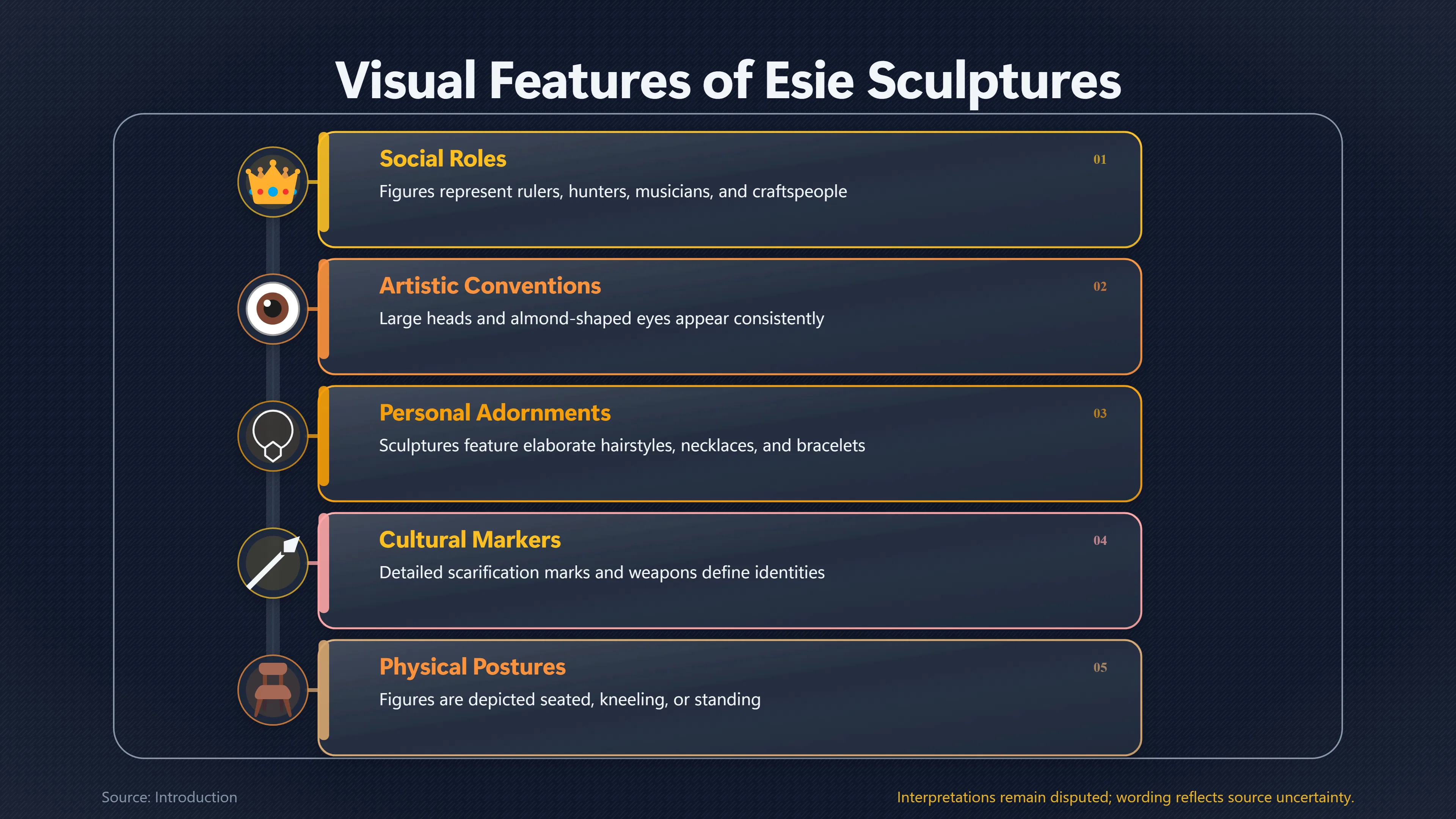
Many sculptures are seated, although others kneel or stand. They display elaborate hairstyles, necklaces, bracelets, scarification marks, weapons and ceremonial objects. Some appear to represent rulers or wealthy individuals, while others resemble hunters, musicians, attendants or craftspeople. Their faces are highly individual rather than generic, suggesting that the sculptors deliberately distinguished different identities and social roles.[The Metropolitan Museum of Art]metmuseum.orgThe Metropolitan Museum of Art The Soapstone Sculptures of ÈṣìẹThe Metropolitan Museum of ArtThe Soapstone Sculptures of Èṣìẹ - The Metropolitan Museum of ArtOctober 24, 2025…
The sculptures also share recognisable artistic conventions. Large heads, almond-shaped eyes and carefully carved hairstyles recur throughout the collection, indicating a coherent artistic tradition despite the diversity of individual figures. Their craftsmanship demonstrates advanced knowledge of carving soapstone, a relatively soft rock that nevertheless requires considerable skill to transform into detailed human portraits.[The Metropolitan Museum of Art]metmuseum.orgThe Metropolitan Museum of Art The Soapstone Sculptures of ÈṣìẹThe Metropolitan Museum of ArtThe Soapstone Sculptures of Èṣìẹ - The Metropolitan Museum of ArtOctober 24, 2025…
Researchers have estimated that well over 1,000 figures originally existed, making Esie one of the largest known concentrations of prehistoric or early historic stone sculpture anywhere south of the Sahara. Their importance was recognised early enough that Nigeria established its first national museum at Esie in 1945 specifically to protect them.[ScienceDirect]sciencedirect.comProvenance studies of Esie sculptural soapstone from southwestern Nigeria - ScienceDirect…
What archaeology can and cannot explain
Scientific research has gradually answered some questions while leaving the central mystery unresolved.
One major breakthrough concerns the stone itself. Mineralogical studies, elemental analysis and geological comparison strongly suggest that many of the sculptures were carved from soapstone available within or near the Esie region rather than being imported from a distant civilisation. Earlier speculation about exotic foreign origins has therefore become much less convincing.[ScienceDirect]sciencedirect.comProvenance studies of Esie sculptural soapstone from southwestern Nigeria - ScienceDirect…
Dating has also improved. Earlier estimates placed the sculptures somewhere between the twelfth and seventeenth centuries. More recent archaeological work, including radiocarbon dating of associated charcoal and thermoluminescence dating of related materials discussed by recent scholarship, points towards a flourishing sculptural tradition roughly between the late thirteenth and mid-fifteenth centuries. While individual dates remain debated, current evidence generally favours a substantial precolonial Yoruba artistic tradition rather than a much later creation.[The Metropolitan Museum of Art]metmuseum.orgThe Metropolitan Museum of Art The Soapstone Sculptures of ÈṣìẹThe Metropolitan Museum of ArtThe Soapstone Sculptures of Èṣìẹ - The Metropolitan Museum of ArtOctober 24, 2025…
Yet several crucial questions remain unanswered:
- No workshop has been conclusively identified.
- No written records describe who commissioned the sculptures.
- Their precise original arrangement is uncertain because many had already been disturbed before systematic archaeological investigation began.
- Their original function—whether commemorative, religious, political or funerary—remains open to interpretation.[The Metropolitan Museum of Art]metmuseum.orgThe Metropolitan Museum of Art The Soapstone Sculptures of ÈṣìẹThe Metropolitan Museum of ArtThe Soapstone Sculptures of Èṣìẹ - The Metropolitan Museum of ArtOctober 24, 2025…
This incomplete archaeological context is one reason the figures continue to resist a single definitive explanation.

Why the makers remain unknown
Over nearly a century of research, several explanations have been proposed.
Some scholars have suggested that the sculptures represented ancestors or important members of a settled community. Others have interpreted them as royal or ritual portraits connected with political authority. Their detailed clothing, scarification and jewellery imply a society with recognised status distinctions rather than anonymous symbolic figures.[The Metropolitan Museum of Art]metmuseum.orgThe Metropolitan Museum of Art The Soapstone Sculptures of ÈṣìẹThe Metropolitan Museum of ArtThe Soapstone Sculptures of Èṣìẹ - The Metropolitan Museum of ArtOctober 24, 2025…
Older theories proposed that the sculptures originated outside the local area or represented the work of an otherwise unknown civilisation. Geological evidence has weakened these arguments by demonstrating that the raw material itself was probably sourced locally. Archaeological discoveries of comparable soapstone carvings, including an unfinished figure from the nearby Igbomina region, have further strengthened the case that stone carving formed part of a broader regional artistic tradition rather than an isolated mystery.[Africabib]africabib.orgAfricaBib | The unfinished stone figurine from Pee-Igbomina: results from recent archaeological research in north central Yoruba…
Even so, “local origin” does not solve the central puzzle. Archaeologists still cannot confidently identify the particular community, political organisation or religious institution responsible for producing such an exceptional body of sculpture.[OUP Academic]academic.oup.comOUP AcademicThe Archaeology of Soapstone Figurines in West Africa | Oxford Research Encyclopedia of Anthropology | Oxford Academic…
How folklore reshaped their meaning
Long before archaeologists attempted scientific explanations, local communities developed stories that explained the remarkable stone population.
The best-known tradition describes the figures as people who were transformed into stone through supernatural intervention. Different versions attribute the transformation to divine punishment, disobedience or protection from danger. These stories vary between tellings, but they share a common purpose: explaining why an apparently complete human community exists in carved stone.[ScienceDirect]sciencedirect.comProvenance studies of Esie sculptural soapstone from southwestern Nigeria - ScienceDirect…
From an archaeological perspective, these narratives are not treated as historical evidence for the sculptures’ manufacture. Instead, they are valued as evidence of something equally important: how later generations interpreted enigmatic monuments whose original meaning had already been forgotten.
This distinction matters. Archaeology investigates physical evidence such as excavation layers, dating techniques and geological sourcing. Folklore records how living communities incorporated mysterious objects into their cultural memory. The two approaches answer different questions rather than competing for the same one.[The Metropolitan Museum of Art]metmuseum.orgThe Metropolitan Museum of Art The Soapstone Sculptures of ÈṣìẹThe Metropolitan Museum of ArtThe Soapstone Sculptures of Èṣìẹ - The Metropolitan Museum of ArtOctober 24, 2025…
Why Esie still matters
The Esie figures occupy an unusual place in Nigeria’s heritage because they are simultaneously archaeological artefacts, museum collections and living cultural landmarks.
For visitors, the National Museum presents the sculptures as carefully preserved heritage objects, yet the surrounding community continues to associate them with local identity and inherited tradition. The result is a site where scientific research has expanded understanding without eliminating mystery.
Rather than proving spectacular lost-civilisation theories, decades of investigation have produced a subtler picture. Researchers now understand far more about the materials, probable dates and regional context of the sculptures than they did a generation ago. At the same time, the identity of the sculptors, the organisation that commissioned them and their original purpose remain unresolved.
That combination of increasing evidence and enduring uncertainty is precisely what makes the Esie Stone Figures one of Nigeria’s most distinctive archaeological curiosities. They are not mysterious because nothing is known about them, but because each new discovery answers one question while revealing how much of their original story has yet to be recovered.[metmuseum.org]metmuseum.orgThe Metropolitan Museum of Art The Soapstone Sculptures of ÈṣìẹThe Metropolitan Museum of ArtThe Soapstone Sculptures of Èṣìẹ - The Metropolitan Museum of ArtOctober 24, 2025…
Amazon book picks
Further Reading
Books and field guides related to Who Made Esie's Mysterious Stone Figures?. Use these as the next step if you want deeper reading beyond the article.
The Brutish Museums
New York Times 'Best Art Books' 2020 'Essential' – Sunday Times 'Brilliantly enraged' - New York Review of Books 'A real game-changer'– E...

Africa: The Art of a Continent
First published 1996. Subjects: Art, african, African Art, Exhibitions, Beeldende kunsten, Art africain.
A History of Art in Africa
This comprehensive work considers and presents the arts of Africa as art history, rather than as expressions of anthropological and socie...
African Art in Cultural Perspective
A general survey of African art as it reflects tribal and cultural influences.
eBay marketplace picks
Marketplace Samples
Live-tested eBay searches with available results related to this page.
Selected fromtribal art oneBay.co.uk.
Endnotes
1.
Source: sciencedirect.com
Link:https://www.sciencedirect.com/science/article/abs/pii/S0305440307002130
Source snippet
Provenance studies of Esie sculptural soapstone from southwestern Nigeria - ScienceDirect...
2.
Source: academic.oup.com
Link:https://academic.oup.com/edited-volume/61643/chapter-abstract/539823001
Source snippet
OUP AcademicThe Archaeology of Soapstone Figurines in West Africa | Oxford Research Encyclopedia of Anthropology | Oxford Academic...
3.
Source: sciencedirect.com
Link:https://www.sciencedirect.com/science/article/pii/0168583X9090620A
Source snippet
PIXE analysis of museum soapstone sculptures from Esie, South-West Nigeria - ScienceDirect...
4.
Source: africabib.org
Link:https://www.africabib.org/rec.php?DB=p&RID=182159671
Source snippet
AfricaBib | The unfinished stone figurine from Pee-Igbomina: results from recent archaeological research in north central Yoruba...
5.
Source: academic.oup.com
Link:https://academic.oup.com/edited-volume/61643/chapter-abstract/539823001?login=false
6.
Source: africabib.org
Link:https://www.africabib.org/rec.php?RID=351967540
7.
Source: africabib.org
Link:https://www.africabib.org/rec.php?DB=p&RID=351967540
8.
Source: africabib.org
Link:https://www.africabib.org/rec.php?RID=117325651
9.
Source: collection.museum.ng
Title: ng Figure Archives
Link:https://collection.museum.ng/category/figure/
10.
Source: museum.ng
Link:https://museum.ng/
11.
Source: collection.museum.ng
Title: ng12th Archives
Link:https://collection.museum.ng/category/12th/
12.
Source: collection.museum.ng
Title: ng Seated Archives
Link:https://collection.museum.ng/category/seated/
13.
Source: metmuseum.org
Title: The Metropolitan Museum of Art The Soapstone Sculptures of Èṣìẹ
Link:https://www.metmuseum.org/it/essays/soapstone-sculptures-esie
Source snippet
The Metropolitan Museum of ArtThe Soapstone Sculptures of Èṣìẹ - The Metropolitan Museum of ArtOctober 24, 2025...
Published: October 24, 2025
14.
Source: metmuseum.org
Title: The Soapstone Sculptures of Èṣìẹ
Link:https://www.metmuseum.org/ko/essays/soapstone-sculptures-esie
Source snippet
The Metropolitan Museum of ArtOctober 24, 2025 — CULTURAL CONTEXT AND RITUAL SIGNIFICANCE Local narratives surrounding the Èṣìẹ̀ sculptur...
Published: October 24, 2025
15.
Source: metmuseum.org
Title: Yoruba artist
Link:https://www.metmuseum.org/art/collection/search/312519
Additional References
16.
Source: historicalnigeria.com
Link:https://historicalnigeria.com/esie-museum-the-astonishing-stone-people-mystery-hidden-in-a-quiet-nigerian-town/
Source snippet
June 12, 2026 — ESIE MUSEUM: THE ASTONISHING STONE PEOPLE MYSTERY HIDDEN IN A QUIET NIGERIAN TOWN Hundreds of ancient human-like stone fi...
Published: June 12, 2026
17.
Source: tandfonline.com
Link:https://www.tandfonline.com/doi/full/10.1080/0067270X.2023.2285154
Source snippet
Taylor & Francis OnlineSpatio-temporal inferences from the study of soapstone figurines in Esie, Kwara State, Nigeria: Azania: Archaeolog...
18.
Source: youtube.com
Title: Inside Esie Museum || Soapstone remains mystery
Link:https://www.youtube.com/watch?v=IAloYXcujxY
Source snippet
This Esie Stone Figures Mystery video provides direct insight into the history, folklore, and unresolved archaeological origins of the so...
19.
Source: youtube.com
Link:https://www.youtube.com/watch?v=7xB_CA7e12I
Source snippet
The Esie Stone Figures: Nigeria's 1,500-Year-Old Mystery That Became Africa's First Museum...
20.
Source: youtube.com
Link:https://www.youtube.com/watch?v=xgEFKQs4Kh8
Source snippet
Esie: The Place Where People Became Stone...
21.
Source: incubator.wikimedia.org
Title: Esiẹ Museum
Link:https://incubator.wikimedia.org/wiki/Wp/kai/Esi%E1%BA%B9_Museum
Source snippet
wikimedia.orgEsiẹ Museum - Wp/kai - Wikimedia IncubatorSeptember 7, 2025 — WP/KAI/ESIẸ MUSEUM Esiẹ Museum museum, natural heritage Incept...
Published: September 7, 2025
22.
Source: scribd.com
Link:https://www.scribd.com/document/939939342/Ja-Cca-Grade-9-Master-Note-1st-Term-2025
23.
Source: si.edu
Link:https://www.si.edu/object/origin-esie%3Asiris_sil_634228
24.
Source: researchgate.net
Link:https://www.researchgate.net/publication/248579452_Provenance_studies_of_Esie_sculptural_soapstone_from_southwestern_Nigeria
25.
Source: si.edu
Link:https://www.si.edu/object/siris_sil_490196