What Makes Afghanistan's Collections So Unusual?
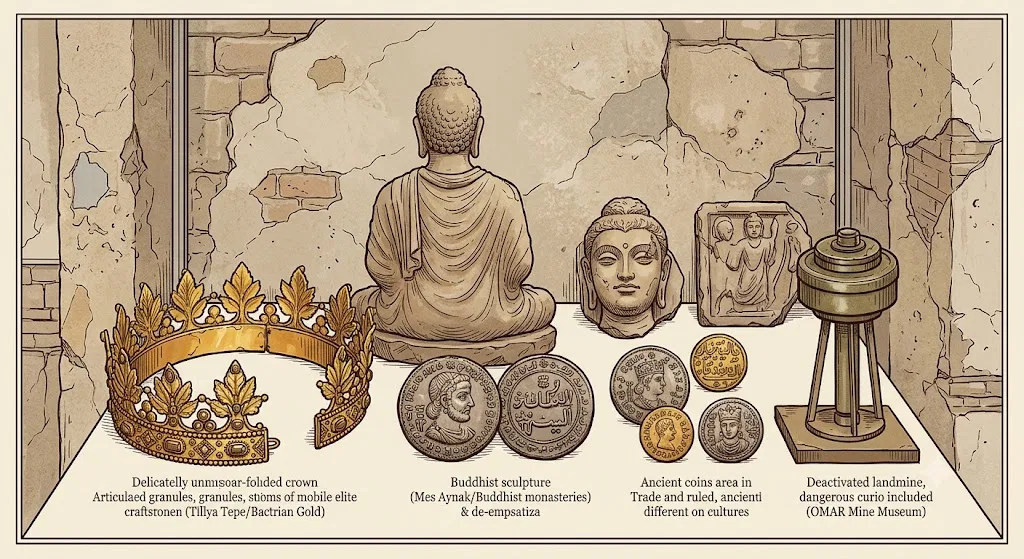
Afghanistan does not have a large circuit of purpose-built “weird museums” devoted to monsters, witchcraft or medical curiosities. Its most unusual collections are stranger for a different reason: they preserve objects that have survived burial, iconoclasm, civil war, looting and political reinvention.
Page outline Jump by section
Introduction
The strongest places to understand this landscape are the National Museum of Afghanistan in Kabul, the OMAR Mine and War Museum, Herat’s Museum of Resistance, and the archaeological collections associated with Herat, Bamiyan and Mes Aynak. Some are conventional museums; others are memorials, safety-training centres or damaged heritage landscapes that function like open-air collections. Visitor access can change quickly, and British authorities currently advise against all travel to Afghanistan.[nationalmuseum.af]nationalmuseum.afNational Museum of AfghanistanNational Museum of AfghanistanThe museum is open today 9:00 AM → 6:00 PM Book a ticket … 1919-2026 National…
Afghanistan’s great cabinet of survival
The National Museum of Afghanistan is the obvious starting point, but it is far more than a general history museum. Its collections compress thousands of years of religious and cultural change into one building: prehistoric tools, Greek-influenced sculpture, Buddhist art, Hindu material, Islamic manuscripts, coins, carved wood and ethnographic objects. One unusual feature is that its historic holdings were overwhelmingly excavated or collected inside Afghanistan rather than assembled as a global imperial collection.[Iranica Online]iranicaonline.orgIranica OnlineKABUL MUSEUMPerhaps the most remarkable aspect of the Kabul Museum is the fact that every object in its possession came fro…
That geographical focus produces combinations rarely encountered elsewhere. Finds from the ancient trading settlement of Bagram included Indian ivory carvings, Chinese mirrors and Roman glass, while other galleries drew on Greek-style cities, Buddhist monasteries and Central Asian kingdoms. The result resembles a cabinet of curiosities created by the Silk Roads: objects from distant artistic worlds preserved together because Afghanistan was where those worlds met.[Iranica Online]iranicaonline.orgIranica OnlineKABUL MUSEUMPerhaps the most remarkable aspect of the Kabul Museum is the fact that every object in its possession came fro…
The museum is also a collection of absences. During the fighting of the 1990s it was shelled and extensively looted; sculptures and other figurative works were later deliberately smashed. International Council of Museums documentation warned that manuscripts, bronzes, sculptures, architectural fragments and other Afghan antiquities had entered illicit markets after museums and archaeological sites were plundered. Displays therefore carry an additional, often unspoken theme: what survived, what was reconstructed and what may now exist only in catalogues or private hands.[unesco.org]whc.unesco.orgOpen source on unesco.org.
The museum’s website lists it as open and presents ticketing and visitor information, but its galleries should not be treated as fixed. Objects may be in storage, undergoing conservation or absent for security reasons. That uncertainty is part of the institution’s identity: unlike a museum whose collection can be assumed to remain stable, Kabul’s holdings have repeatedly had to be hidden, moved, inventoried and recovered.[National Museum of Afghanistan]nationalmuseum.afNational Museum of AfghanistanNational Museum of AfghanistanThe museum is open today 9:00 AM → 6:00 PM Book a ticket … 1919-2026 National…
The Bactrian gold: treasure, disappearance and rumour
Afghanistan’s most famous archaeological collection is the gold from six richly furnished graves excavated at Tillya Tepe in northern Afghanistan in 1978. More than 20,000 pieces were recovered, including jewellery, buckles, coins, weapons fittings and a delicate crown made from gold leaves. The crown could be dismantled, an ingenious feature commonly interpreted as suitable for a mobile elite rather than a permanently settled royal court.[Wikipedia]WikipediaTillya TepeTillya Tepe
What makes the hoard extraordinary is not simply the quantity of gold. Its imagery combines influences associated with Greece, Rome, India, China and the Eurasian steppe. Deities, animals, winged figures and geometric motifs appear on objects found together in the same burial ground. For visitors interested in mystery objects or archaeological anomalies, the fascination lies in this mixture: it looks inconsistent only when ancient cultures are imagined as isolated. In reality, the collection records travel, trade and artistic borrowing across Central Asia.[Popular Mechanics]popularmechanics.comAfter the initial discovery, the looming threat of war forced archaeologists to abandon the site, and looters plundered an unopened grave…
The treasure’s modern history has become almost as compelling as the graves. Museum staff secretly secured it in bank vaults as Afghanistan descended into conflict. For years, outsiders could not confirm whether it had been stolen, destroyed or melted down. It was publicly verified after the fall of the first Taliban government and subsequently toured international museums as part of the “Hidden Treasures” exhibition.[Popular Mechanics]popularmechanics.comAfter the initial discovery, the looming threat of war forced archaeologists to abandon the site, and looters plundered an unopened grave…
Its present visibility is less straightforward. Museum officials have said that the collection remained intact after the Taliban returned to power, but the gold is not simply a permanent gallery that an ordinary visitor can expect to see. Recent reporting has again raised questions about where it is being kept and when it was last publicly inspected. The responsible conclusion is therefore narrow: the collection has not been credibly demonstrated to have been destroyed or dispersed, but its storage and accessibility are not transparent enough to treat it as a reliably visitable attraction.[Popular Mechanics]popularmechanics.comAfter the initial discovery, the looming threat of war forced archaeologists to abandon the site, and looters plundered an unopened grave…
That ambiguity encourages myths, yet the authentic history needs little embellishment. The objects really were hidden by a small group of custodians; they really did disappear from public knowledge; and their survival depended on secrecy. It is one of the rare cases in which the “lost treasure” narrative belongs to the documented history of a national collection rather than to tourist marketing.

Mes Aynak and the archaeology of a working mine
Mes Aynak, south-east of Kabul, is an unusual hybrid of archaeological site, rescue project and modern industrial dispute. Beneath and around a major copper deposit lies an extensive settlement containing Buddhist monasteries, shrines, sculptures, wall paintings and earlier remains. Archaeologists have had to recover movable objects while debates continue over mining, preservation and the future of the site.[UNESCO Documentation]unesdoc.unesco.orgOpen source on unesco.org.
This gives the collection a distinctive tension. The Buddhist objects are not merely isolated religious sculptures; they were excavated from a landscape whose mineral wealth helped sustain settlement in antiquity and now makes the same ground economically valuable. The apparent contradiction between monastery and mine is therefore misleading. Metal extraction, trade and religious patronage could be closely connected in ancient communities.
Artefacts from Mes Aynak have been exhibited at the National Museum, where UNESCO described them as an important presentation of Afghanistan’s pre-Islamic history. Visitors should nevertheless distinguish between the public exhibition and the excavation itself. The Kabul displays are curated museum objects; the wider site remains a conservation challenge rather than a finished archaeological park with predictable public interpretation.[UNESCO]unesco.orginternational museum day afghanistan museum collections make connectionsinternational museum day afghanistan museum collections make connections
Mes Aynak matters within Afghanistan’s strange-collections landscape because it shows a collection being created under pressure. Decisions about which statues, inscriptions and fragments to remove are also decisions about what future audiences will understand. A museum case may preserve an object while separating it from the monastic room, mine workings or ritual setting that originally gave it meaning.
Herat’s museum of war memory
The Museum of Resistance in Herat, also widely known as the Jihad Museum, is Afghanistan’s most theatrical historical museum. Its displays commemorate resistance to the Soviet occupation through weapons, captured military equipment, portraits, inscriptions, murals and a large battle panorama populated by model figures. Earlier photographic accounts showed scenes of villagers, fighters, soldiers, aircraft and ruined settlements arranged with an intensity closer to a war diorama than a conventional documentary gallery.[The Atlantic]theatlantic.comThe Atlantic The Jihad Museum: Afghanistan Remembers the SovietThe Atlantic The Jihad Museum: Afghanistan Remembers the Soviet
Its curatorial perspective is explicit. The museum honours the anti-Soviet resistance and those regarded as martyrs; it is not a neutral survey of every Afghan faction or every phase of conflict. The sequence tends towards sacrifice, uprising and victory, while the destructive civil wars that followed the Soviet withdrawal have historically been less central. Visitors should approach it as a memorial narrative produced by particular veterans and political patrons, not as the final word on modern Afghan history.[ResearchGate]researchgate.netResearch Gate Afghanistan: Re‐imagining the Nation Through the MuseumResearch Gate Afghanistan: Re‐imagining the Nation Through the Museum
The displays have also become evidence of changing rules about representation. After the Taliban’s return, the museum was altered so that faces on model figures were removed or obscured, animal heads were covered and portraits were reportedly taken down. When the institution reopened after refurbishment, the battle scenes remained, but their human figures had been made deliberately faceless.[thesun.my]thesun.myThe Sun Malaysia Taliban's rules reshape Afghanistan's Jihad MuseumThe Sun Malaysia Taliban's rules reshape Afghanistan's Jihad Museum
This transformation makes the museum unusual in two separate ways. It is a museum about ideological conflict, and it has itself been materially reshaped by a later ideology. The altered figures are not merely damaged exhibits. They show how museum interpretation can change without replacing the underlying objects: the same diorama now communicates both the memory of the Soviet war and the present authorities’ restrictions on figurative imagery.
Its weapons have posed more literal problems. In 2013, specialists were reportedly called to render displayed ordnance safe, and flash photography had previously been restricted because some objects were feared to remain dangerous. That episode captures the central contradiction of many Afghan war collections: authenticity can carry risks that professional museums would normally eliminate before an object enters a gallery.[Stars and Stripes]stripes.comexhibits defused afghanistans jihad museum reopens its doors 2329843.html1exhibits defused afghanistans jihad museum reopens its doors 2329843.html1
A museum made from landmines
Kabul’s OMAR Mine and Explosive Remnants of War Museum is perhaps the country’s clearest example of an unusual collection created for practical survival rather than cultural prestige. Founded by the Organisation for Mine Clearance and Afghan Rehabilitation, it gathers deactivated mines, unexploded ordnance and other weapons used during successive conflicts. The institution describes the objects as free from explosives and uses them to explain both the history of war and the continuing danger of explosive remnants.[OMAR]omar.org.afMuseum – OMAR 20-231-3700. The first mine museum in Afghanistan was founded in 1994 by OMAR. It attracts visitors from all over the w…
The displays have included anti-personnel and anti-tank mines, cluster munitions, bombs, artillery and military aircraft. Older accounts commonly state that the museum represented almost every major type of mine found in Afghanistan. Exact totals vary between sources and should not be treated as permanent inventory figures, but the central claim is well supported: the collection was assembled to teach people how unfamiliar explosive devices look.[wikipedia.org]WikipediaOMAR Mine MuseumOMAR Mine Museum
That educational purpose changes the visitor experience. A mine that might look like a plastic toy, metal tin or ordinary piece of machinery is presented not as a technological curiosity but as a recognition problem. School groups and other visitors learn that curiosity itself can be dangerous when children or civilians encounter unexploded objects in fields and ruined buildings.
The museum is therefore part exhibition, part safety classroom and part memorial to civilian harm. It does not romanticise weapons in the same manner as a trophy hall, although military enthusiasts may also be drawn to the hardware. Its most significant interpretation is practical: these are objects designed to wait invisibly for a human body.
Access has historically been more controlled than at an ordinary tourist museum, and older reports said appointments were required. The organisation’s current site continues to promote the museum and its educational role, but operating arrangements should be confirmed directly rather than inferred from travel listings. The grounds were also affected by a major attack in Kabul in 2019, reinforcing the need to treat archived visitor accounts as historical snapshots rather than guarantees of present conditions.[omar.org.af]omar.org.afMuseum – OMAR 20-231-3700. The first mine museum in Afghanistan was founded in 1994 by OMAR. It attracts visitors from all over the w…
Herat’s older collections and manuscript recoveries
Herat’s historic museum offers a quieter form of curiosity. Located in the city’s citadel, its holdings include archaeological finds, ceramics, metalwork and manuscripts connected with a city famous for art, poetry and learning. A major restoration and reorganisation project reported a surviving collection of roughly 1,100 objects, while noting that around 2,000 had been lost during decades of upheaval. New holdings included donated or confiscated manuscripts, making the museum both a regional collection and a repository for objects intercepted from uncertain circulation.[Staatliche Museen zu Berlin]smb.museumOpen source on smb.museum.
Confiscated material poses difficult questions. Recovery from trafficking may save a manuscript or artefact from disappearance, but it does not automatically restore its archaeological context or ownership history. A manuscript without a secure record of where it was kept, sold or removed can be physically authentic while remaining historically incomplete.
This is a recurring feature of Afghan collections. Museums often contain rescued objects whose immediate survival is clearer than their full chain of custody. Good interpretation should distinguish between excavated finds, documented donations and material recovered from illicit trade. The distinction matters because a mysterious provenance can be interesting without being evidence of an ancient mystery.
Bamiyan as a museum of absence
The Bamiyan Valley is not a conventional museum, but it is essential to Afghanistan’s culture of strange and damaged heritage. The cliffs contain monastic caves, chapels, wall paintings and the enormous empty niches that once held two standing Buddha statues. The statues were deliberately destroyed in March 2001, leaving the voids themselves as internationally recognised monuments.[UNESCO World Heritage Centre]whc.unesco.orgOpen source on unesco.org.
The valley now operates almost like an archaeological collection too large to place indoors. Fragments, caves, paintings and altered landscapes must be interpreted in situ. Its most famous “objects” are absent, yet their scale can still be read from the cliff. This reverses the normal museum relationship: instead of a detached artefact displayed in a case, visitors encounter the architectural space from which the artefact was violently removed.
Bamiyan has also generated long-running debate over reconstruction. Rebuilding the statues might restore a lost silhouette, but it could diminish the evidential force of the surviving niches and fragments. Leaving them empty preserves a powerful record of destruction, though it asks local communities to live with a landscape defined partly by loss. UNESCO continues to treat the valley as a threatened cultural landscape rather than a completed memorial attraction.[UNESCO World Heritage Centre]whc.unesco.orgOpen source on unesco.org.
For readers drawn to ruined monuments, vanished objects and contested restoration, Bamiyan is Afghanistan’s most important case. Its mystery is not who built the statues or how they disappeared; those broad facts are well established. The unresolved question is what ethical preservation should look like after deliberate destruction.
What is genuinely unusual, and what is not
Afghanistan’s curiosity culture is sometimes distorted by romantic language about “lost civilisations” and “mysterious treasures”. The strongest collections do not require such claims. Their unusual character comes from documented circumstances:
- Objects crossed cultural boundaries. Bagram and Tillya Tepe contain mixtures of artistic influence that reveal trade and mobility, not inexplicable anomalies.
- Collections repeatedly disappeared from view. The Bactrian gold was protected through secrecy, while other museum objects were looted, trafficked or destroyed.
- Weapons became teaching aids. The OMAR museum converted deactivated mines into a recognition and public-safety collection.
- Displays were ideologically altered. Herat’s resistance museum retained its war panorama while human and animal faces were removed.
- Absence became the exhibit. At Bamiyan, empty niches and fragments communicate destruction more forcefully than a replica could.
- Rescue changed provenance. Confiscated manuscripts and displaced antiquities may be saved while losing part of their original context.
There is little reliable evidence for a substantial Afghan museum tradition devoted specifically to witchcraft, cryptids, UFOs, occult apparatus or deliberate hoaxes. Folklore and devotional belief remain important within Afghan culture, but they are not presently organised into a well-documented visitor circuit comparable with the specialist witchcraft or supernatural museums found in some other countries. Inventing such a circuit would obscure the genuinely distinctive collections that do exist.
Visiting and verifying collections
Afghanistan’s museums cannot responsibly be presented as an ordinary offbeat holiday itinerary. As of 17 July 2026, the UK Foreign, Commonwealth and Development Office advises against all travel to Afghanistan, describes travel throughout the country as extremely dangerous and warns that British nationals face a heightened risk of detention with severely limited consular support.[GOV.UK]GOV.UKtravel advice27 Feb 2026 — FCDO travel advice for Afghanistan. Includes safety and security, insurance, entry requirements and legal diff…
For researchers, journalists or residents seeking current information, institutional contact is more reliable than historic travel blogs. The National Museum publishes contact and opening details online, while OMAR maintains a page for its mine museum. Even so, advertised opening hours do not settle questions about which galleries are accessible, whether photography is permitted, or whether a particular object such as the Bactrian gold is on display.[National Museum of Afghanistan]nationalmuseum.afNational Museum of AfghanistanNational Museum of AfghanistanThe museum is open today 9:00 AM → 6:00 PM Book a ticket … 1919-2026 National…
The most useful credibility test is to separate four questions:
- Does the institution currently exist? Kabul’s National Museum, OMAR’s collection and Herat’s resistance museum all have recent evidence of activity.
- Is the named object actually displayed? A museum may own or safeguard something without exhibiting it.
- Is the interpretation documentary or commemorative? War memorials and ideological museums select heroes, villains and endpoints differently from archaeological institutions.
- Is the provenance secure? Excavated finds, private donations and confiscated antiquities require different levels of confidence.
Why these collections matter
Afghanistan’s unusual museums are not eccentric side attractions detached from national history. They reveal who has been permitted to preserve the past, which images can be shown, which wars may be commemorated and how objects survive when institutions collapse.
The National Museum turns cultural mixture into a national story. The Bactrian hoard shows how secrecy can become a conservation strategy. Mes Aynak exposes the friction between archaeology and mineral extraction. The OMAR museum treats deadly hardware as public education. Herat’s resistance museum demonstrates that displays can be censored while remaining open. Bamiyan proves that an empty space can become the most recognisable exhibit of all.
Together they form a curiosity landscape defined less by the supernatural than by survival. Afghanistan’s strangest collections are compelling because their histories did not end when they entered a museum. The struggle over what they mean, who controls them and whether they remain visible is still continuing.
Amazon book picks
Further Reading
Books and field guides related to What Makes Afghanistan's Collections So Unusual?. Use these as the next step if you want deeper reading beyond the article.
The Silk Roads: A New History of the World
The No. 1 Sunday Times and international bestseller - a major reassessment of world history in light of the economic and political renais...
Afghanistan: A Cultural and Political History
A major history of Afghanistan and its changing political culture Afghanistan traces the historic struggles and the changing nature of po...
The Places In Between
Winner of the RSL Ondaatje Prize Shortlisted for the Guardian First Book Award ‘A striding, glorious book . . . A flat-out masterpiece’ T...
The Buddhas of Bamiyan
For 1,400 years, two colossal figures of the Buddha overlooked the fertile Bamiyan Valley on the Silk Road in Afghanistan. Witness to a m...
eBay marketplace picks
Marketplace Samples
Live-tested eBay searches with available results related to this page.
Selected fromAfghanistan map print oneBay.co.uk.
Endnotes
1.
Source: omar.org.af
Link:https://omar.org.af/museum/
Source snippet
Museum – OMAR 20-231-3700. The first mine museum in Afghanistan was founded in 1994 by OMAR. It attracts visitors from all over the w...
2.
Source: euronews.com
Title: taliban dehumanise the resistance museum in herat
Link:https://www.euronews.com/culture/2026/01/23/taliban-dehumanise-the-resistance-museum-in-herat
Source snippet
Defacing change: Afghan Resistance Museum reopens in...23 Jan 2026 — A museum dedicated to mujahideen resistance to the Soviet i...
3.
Source: GOV.UK
Link:https://www.gov.uk/foreign-travel-advice/afghanistan
Source snippet
travel advice27 Feb 2026 — FCDO travel advice for Afghanistan. Includes safety and security, insurance, entry requirements and legal diff...
4.
Source: afghanistan.artgallery.nsw.gov.au
Link:https://afghanistan.artgallery.nsw.gov.au/
Source snippet
Priceless artefacts, including Hellenistic stone and bronze statues, gold bowls, fragile Roman...
5.
Source: whc.unesco.org
Link:https://whc.unesco.org/en/activities/2/
6.
Source: obs-traffic.museum
Link:https://www.obs-traffic.museum/sites/default/files/ressources/files/ICOM_Red_List_Afghanistan.pdf
7.
Source: unesdoc.unesco.org
Link:https://unesdoc.unesco.org/ark%3A/48223/pf0000233042
8.
Source: Wikipedia
Title: Tillya Tepe
Link:https://en.wikipedia.org/wiki/Tillya_Tepe
9.
Source: unesdoc.unesco.org
Link:https://unesdoc.unesco.org/ark%3A/48223/pf0000232932
10.
Source: unesdoc.unesco.org
Link:https://unesdoc.unesco.org/ark%3A/48223/pf0000375108
11.
Source: unesdoc.unesco.org
Link:https://unesdoc.unesco.org/ark%3A/48223/pf0000393485
12.
Source: unesco.org
Title: international museum day afghanistan museum collections make connections
Link:https://www.unesco.org/en/articles/international-museum-day-afghanistan-museum-collections-make-connections
13.
Source: stripes.com
Title: exhibits defused afghanistans jihad museum reopens its doors 2329843.html1
Link:https://www.stripes.com/news/2013-11-01/exhibits-defused-afghanistans-jihad-museum-reopens-its-doors-2329843.html1
14.
Source: researchgate.net
Title: Research Gate Afghanistan: Re‐imagining the Nation Through the Museum
Link:https://www.researchgate.net/publication/230134939Afghanistan_Re-imagining_the_Nation_Through_the_Museum-_The_Jihad_Museum_in_Herat
15.
Source: Wikipedia
Title: Jihad Museum
Link:https://en.wikipedia.org/wiki/Jihad_Museum
16.
Source: Wikipedia
Title: OMAR Mine Museum
Link:https://en.wikipedia.org/wiki/OMAR_Mine_Museum
17.
Source: whc.unesco.org
Link:https://whc.unesco.org/en/list/208/
18.
Source: whc.unesco.org
Link:https://whc.unesco.org/en/news/719
19.
Source: whc.unesco.org
Link:https://whc.unesco.org/en/list/208/documents/
20.
Source: GOV.UK
Title: Safety and security
Link:https://www.gov.uk/foreign-travel-advice/afghanistan/safety-and-security
21.
Source: whc.unesco.org
Link:https://whc.unesco.org/uploads/nominations/208rev.pdf
22.
Source: unesco.org
Title: afghanistan unesco calls protection cultural heritage its diversity
Link:https://www.unesco.org/en/articles/afghanistan-unesco-calls-protection-cultural-heritage-its-diversity
23.
Source: unesdoc.unesco.org
Link:https://unesdoc.unesco.org/ark%3A/48223/pf0000133497
24.
Source: whc.unesco.org
Link:https://whc.unesco.org/document/106954
25.
Source: unesco.org
Link:https://www.unesco.org/en/node/187371
26.
Source: whc.unesco.org
Link:https://whc.unesco.org/document/9614
27.
Source: GOV.UK
Link:https://www.gov.uk/foreign-travel-advice
28.
Source: GOV.UK
Title: www.gov.uk Entry requirements
Link:https://www.gov.uk/foreign-travel-advice/afghanistan/entry-requirements
29.
Source: GOV.UK
Link:https://www.gov.uk/world/afghanistan/news
30.
Source: GOV.UK
Title: foreign office travel advice updates
Link:https://www.gov.uk/government/news/foreign-office-travel-advice-updates
31.
Source: GOV.UK
Link:https://www.gov.uk/government/topical-events/afghanistan-uk-government-response
32.
Source: GOV.UK
Title: afghanistan country policy and information notes
Link:https://www.gov.uk/government/publications/afghanistan-country-policy-and-information-notes
33.
Source: GOV.UK
Title: www.gov.uk Regional risks
Link:https://www.gov.uk/foreign-travel-advice/pakistan/regional-risks
34.
Source: Wikipedia
Link:https://en.wikipedia.org/wiki/Afghanistan
35.
Source: Wikipedia
Title: National Museum of Afghanistan
Link:https://en.wikipedia.org/wiki/National_Museum_of_Afghanistan
36.
Source: Wikipedia
Title: War in Afghanistan (2001–2021)
Link:https://en.wikipedia.org/wiki/War_in_Afghanistan_%282001%E2%80%932021%29
37.
Source: assets.publishing.service.gov.uk
Title: FCDO Annual Report 2025 to 2026
Link:https://assets.publishing.service.gov.uk/media/6a58a66c2cbe5d1c179a662c/FCDO_Annual_Report_2025_to_2026.pdf
38.
Source: dfat.gov.au
Link:https://www.dfat.gov.au/geo/afghanistan
39.
Source: nationalmuseum.af
Link:https://www.nationalmuseum.af/
Source snippet
National Museum of AfghanistanNational Museum of AfghanistanThe museum is open today 9:00 AM → 6:00 PM Book a ticket … 1919-2026 National...
40.
Source: iranicaonline.org
Link:https://www.iranicaonline.org/articles/kabul-museum/
Source snippet
Iranica OnlineKABUL MUSEUMPerhaps the most remarkable aspect of the Kabul Museum is the fact that every object in its possession came fro...
41.
Source: nationalmuseum.af
Link:https://www.nationalmuseum.af/galleries
Source snippet
National Museum of AfghanistanGalleries - National Museum of AfghanistanEstablished in 1919, the museum preserves Afghanistan's rich hist...
42.
Source: nationalmuseum.af
Title: National Museum of Afghanistan Contact Us
Link:https://www.nationalmuseum.af/contact-us
43.
Source: popularmechanics.com
Link:https://www.popularmechanics.com/science/archaeology/a71825064/gold-artifacts-of-afghanistan/
Source snippet
After the initial discovery, the looming threat of war forced archaeologists to abandon the site, and looters plundered an unopened grave...
44.
Source: theatlantic.com
Title: The Atlantic The Jihad Museum: Afghanistan Remembers the Soviet
Link:https://www.theatlantic.com/photo/2014/03/the-jihad-museum-afghanistan-remembers-the-soviet-invasion/100693/
45.
Source: thesun.my
Title: The Sun Malaysia Taliban’s rules reshape Afghanistan’s Jihad Museum
Link:https://thesun.my/news/world-news/talibans-rules-reshape-afghanistans-jihad-museum-displays/
46.
Source: lonelyplanet.com
Link:https://www.lonelyplanet.com/points-of-interest/omar-land-mine-museum/451049
47.
Source: thevelvetrocket.com
Title: kabuls omar mine museum omar land mine museum
Link:https://thevelvetrocket.com/2008/05/24/kabuls-omar-mine-museum-omar-land-mine-museum/
48.
Source: smb.museum
Link:https://www.smb.museum/en/whats-new/detail/opening-of-the-national-museum-and-manuscript-archive-in-the-citadel-qala-ikhtyaruddin-in-herat-afghanistan/
49.
Source: tripadvisor.co.uk
Title: NATIONA L MUSEUM OF AFGHANISTAN
Link:https://www.tripadvisor.co.uk/Attraction_Review-g660089-d2516960-Reviews-National_Museum_Of_Afghanistan-Kabul_Kabul_Province.html
50.
Source: nationalmuseum.af
Link:https://www.nationalmuseum.af/events
51.
Source: nationalmuseum.af
Title: About the Museum
Link:https://www.nationalmuseum.af/about
52.
Source: worldbank.org
Link:https://www.worldbank.org/ext/en/country/afghanistan
53.
Source: youtube.com
Link:https://www.youtube.com/watch?v=z3z3mRbFTsM
54.
Source: tripadvisor.com
Title: National Museum Of Afghanistan
Link:https://www.tripadvisor.com/Attraction_Review-g660089-d2516960-Reviews-National_Museum_Of_Afghanistan-Kabul_Kabul_Province.html
55.
Source: csames.illinois.edu
Link:https://csames.illinois.edu/sas/sa-resources/countries/afghanistan
56.
Source: theartnewspaper.com
Link:https://www.theartnewspaper.com/2021/12/10/national-museum-of-afghanistan-reopensbut-staff-are-unpaid-and-taliban-are-guarding-the-treasures
Additional References
57.
Source: youtube.com
Title: Afghanistan: Hidden Treasures from the National Museum, Kabul
Link:https://www.youtube.com/watch?v=KFXKxilDl6A
Source snippet
Afghanistan National Museum: Experts work to restore lost legacy...
58.
Source: youtube.com
Title: Afghanistan National Museum: Experts work to restore lost legacy
Link:https://www.youtube.com/watch?v=JN8atnWqidQ
Source snippet
Afghan museum reopens with Taliban security, visitors...
59.
Source: youtube.com
Title: Afghan museum reopens with Taliban security, visitors
Link:https://www.youtube.com/watch?v=12HTp8vyT1M
Source snippet
Mine museum showcases peril of war in Afghanistan...
60.
Source: cultureroadtravel.com
Link:https://cultureroadtravel.com/3-special-museums-in-afghanistan-to-visit/
61.
Source: freedomhouse.org
Link:https://freedomhouse.org/country/afghanistan
62.
Source: facebook.com
Link:https://www.facebook.com/TOLOnews/posts/an-exhibition-showcasing-over-one-hundred-islamic-era-relics-and-artifacts-opene/2165293153511414/
63.
Source: facebook.com
Link:https://www.facebook.com/Cashlinkofficial/posts/at-the-heart-of-kabul-the-national-museum-of-afghanistan-stands-as-a-symbol-of-o/813339384574360/
64.
Source: amnesty.org
Link:https://www.amnesty.org/en/location/asia-and-the-pacific/south-asia/afghanistan/report-afghanistan/
65.
Source: facebook.com
Link:https://www.facebook.com/100093560764953/posts/jihad-museum-herat-afghanistan-a-tribute-to-couragea-memory-of-resistancea-story/682406501554703/
66.
Source: theguardian.com
Link:https://www.theguardian.com/g2/story/0%2C3604%2C398808%2C00.html