Within Unusual Eritrea
Museum, Memorial or Scrapyard of War?
Massawa's damaged buildings and Asmara's tank graveyard preserve war as physical evidence, memorial landscape and politically framed history.
On this page
- Massawa's museum and shell scarred cityscape
- Inside Asmara's tank graveyard
- Official narratives, visitor ethics and photography rules
Page outline Jump by section
Introduction
Eritrea’s most striking collection of war relics is not confined to a conventional museum. Instead, it stretches from the shell-scarred streets of the Red Sea port of Massawa to the vast tank graveyard on the edge of Asmara, where hundreds of destroyed military vehicles form one of Africa’s most unusual open-air memorial landscapes. Together, these places preserve the physical remains of decades of conflict while raising difficult questions about memory, heritage and tourism. They are simultaneously historical evidence, national symbols, improvised collections and reminders of the enormous human cost of the Eritrean War of Independence and later fighting. Visitors encounter not polished exhibitions but places where damaged buildings, abandoned armour and official narratives remain closely intertwined.[theguardian.com]theguardian.comThe GuardianInside Eritrea: from tank cemeteries to futuristic architecture – in pictures | Photography | The GuardianAugust 17, 2015…
Museum, memorial or scrapyard?
Unlike many countries that gather military artefacts into formal galleries, Eritrea has preserved large parts of its wartime material culture where it accumulated or where it was later assembled. This blurs the distinction between museum, memorial and industrial scrapyard.
Massawa’s damaged urban fabric still bears visible scars from aerial bombardment and artillery fire, while the Northern Red Sea Regional Museum places military history alongside archaeology, maritime trade and local heritage. The museum helps explain the city’s strategic importance, but much of the most powerful evidence remains outside its walls in streets where ruined colonial buildings survived as part of the historic landscape rather than being entirely rebuilt.
Outside Asmara, the famous tank graveyard serves a different purpose. Rather than displaying selected artefacts with detailed labels, it gathers together enormous quantities of captured or destroyed military equipment into a single landscape. Rusting tanks, armoured personnel carriers, trucks, artillery pieces and other wreckage create an overwhelming visual archive that functions more as a collective monument than as a traditional museum.[eritreaembassy.ch]home.eritreaembassy.chTourism & Travel-devTourism & Travel-dev
Massawa’s museum and shell-scarred cityscape
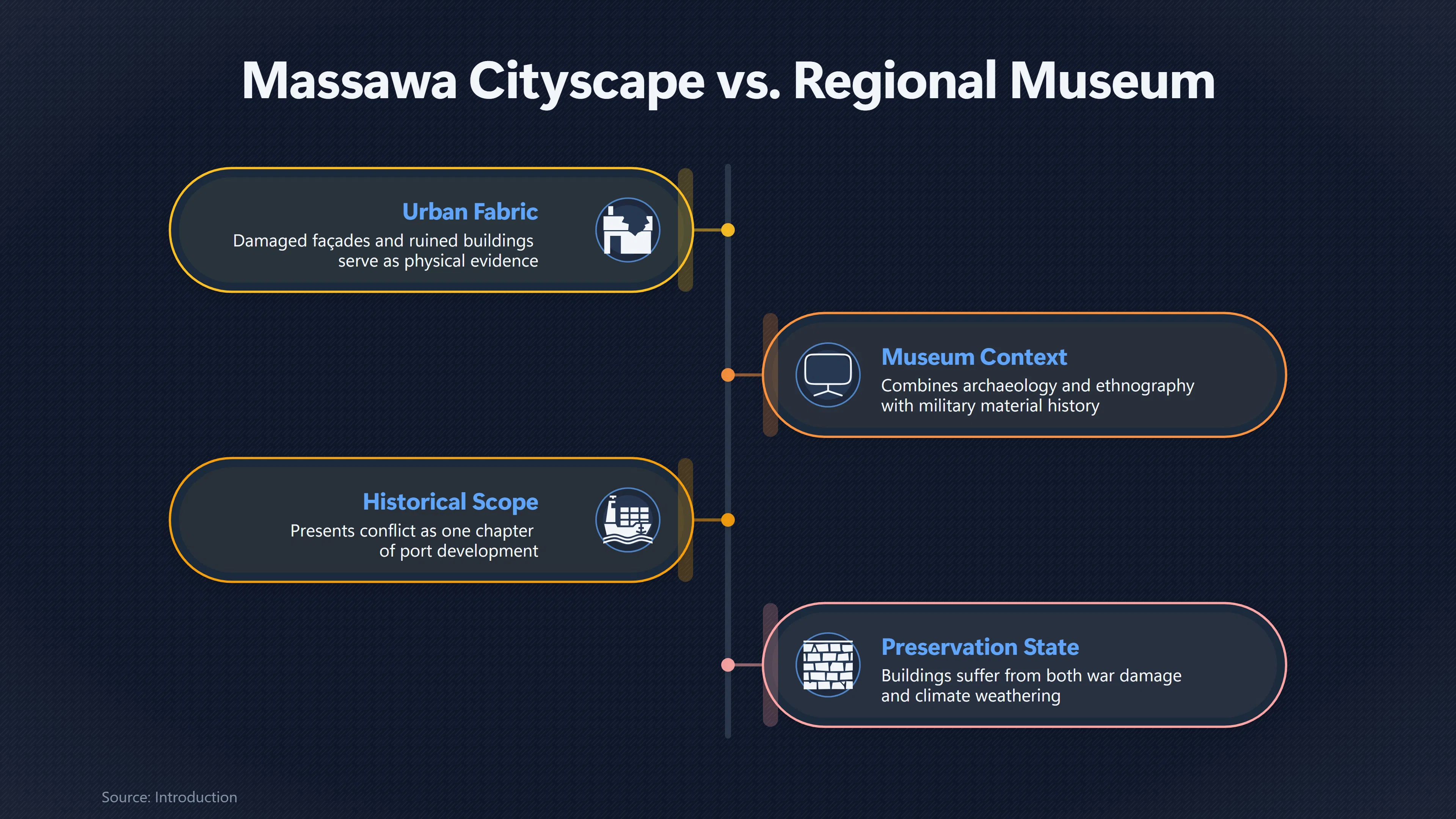
Massawa occupies a special place in Eritrean history because of its long importance as a Red Sea trading port and its repeated role as a military objective. During the independence struggle and subsequent conflicts, sections of the city suffered extensive destruction, particularly among its historic Ottoman and Italian-era districts.
The Northern Red Sea Regional Museum provides visitors with historical context by combining archaeology, ethnography, colonial history and military material. Rather than treating warfare in isolation, it presents conflict as one chapter within the much longer story of Massawa’s development as an international port. This broader approach distinguishes it from a dedicated military museum.
Outside the museum, however, the city itself becomes part of the collection. Damaged façades, abandoned buildings and surviving wartime scars act as physical artefacts. For many visitors, these streets communicate the consequences of conflict more effectively than display cases could. The experience resembles walking through an urban historical document, where architecture has become evidence.
This preservation is not free from debate. Some ruined structures have gradually deteriorated through age and climate as much as through wartime damage, making it increasingly difficult to separate original destruction from decades of neglect and weathering. That changing condition means the city is both a historical site and a conservation challenge.[The Guardian]theguardian.comThe GuardianInside Eritrea: from tank cemeteries to futuristic architecture – in pictures | Photography | The GuardianAugust 17, 2015…
Inside Asmara’s tank graveyard
The tank graveyard, located on the outskirts of Asmara, has become Eritrea’s most internationally recognised war relic site. Visitors encounter rows upon rows of military hardware stacked into dense formations, creating an extraordinary industrial landscape of rusting steel.
Many of the vehicles originate from the long independence war that lasted from 1961 until 1991. They include Soviet-designed tanks such as T-54 and T-55 models, armoured personnel carriers, military trucks and assorted battlefield equipment captured or destroyed during fighting. The sheer concentration of heavy equipment is unusual even by international standards and has made the site a frequent subject for photographers and writers interested in Cold War military history.[Atlas Obscura]atlasobscura.comAtlas Obscura Tank Graveyard in AsmaraAtlas Obscura Tank Graveyard in Asmara
Unlike a carefully restored military collection, the graveyard deliberately leaves vehicles in their damaged condition. Twisted armour, shattered hulls and corroded machinery communicate destruction rather than technological achievement. Little effort has been made to restore or cosmetically preserve individual vehicles, reinforcing the impression that the site commemorates the end of war rather than celebrating military hardware.
For military historians, the collection also illustrates the international nature of the conflict. Equipment from multiple countries reflects decades of Cold War arms transfers into the Horn of Africa, reminding visitors that Eritrea’s independence struggle unfolded within much wider geopolitical rivalries.[home.eritreaembassy.ch]home.eritreaembassy.chTourism & Travel-devTourism & Travel-dev
Official narratives, visitor ethics and photography rules
The tank graveyard occupies an unusual position between tourist attraction and politically significant memorial. Eritrean official descriptions present it primarily as evidence of the country’s victory in its struggle for independence and as a symbol of national resilience. The focus is less on military technology than on sacrifice, endurance and liberation.[home.eritreaembassy.ch]home.eritreaembassy.chTourism & Travel-devTourism & Travel-dev
Visitors should recognise that this is not a politically neutral historical display. Interpretation generally reflects the state’s narrative of the independence struggle, while alternative historical perspectives receive much less attention. As with many war memorials around the world, understanding the site benefits from reading beyond the official presentation and considering broader historical scholarship.
Photography also requires particular care. Eritrea maintains strict controls around military-related locations. According to current UK government travel advice, foreign visitors need a permit from the Ministry of Tourism to photograph the tank graveyard, and photographing government buildings or military installations elsewhere is prohibited. Foreign nationals also require travel permits for certain destinations, including the tank graveyard itself. These regulations can change and should be confirmed before travelling.[GOV.UK]GOV.UKSafety and securityEritrea travel advice - GOV.UK…
Ethically, visitors should treat both the graveyard and Massawa’s damaged districts as memorial landscapes rather than abandoned industrial sites. Climbing on wrecks, removing fragments as souvenirs or treating the locations merely as dramatic photographic backdrops risks overlooking the human losses they represent.

Why these war relics matter in Eritrea’s curiosity landscape
Within Eritrea’s wider landscape of unusual collections, the war relics of Massawa and Asmara stand apart because they preserve conflict at architectural and landscape scale rather than through conventional museum displays. The collection consists not simply of objects but of entire environments where buildings, machinery and memory remain inseparable.
For travellers interested in unusual heritage, these sites demonstrate how collections can exist beyond museum walls. They show that the boundary between preservation, commemoration and everyday urban life is often blurred. Massawa’s damaged streets preserve conflict within a living city, while the Asmara tank graveyard transforms discarded military hardware into one of the world’s most distinctive open-air historical collections.
Together, they illustrate that Eritrea’s most unusual heritage is not built around the bizarre or the supernatural, but around the enduring physical traces of a conflict that continues to shape how the nation presents its past to both citizens and visitors.
Amazon book picks
Further Reading
Books and field guides related to Museum, Memorial or Scrapyard of War?. Use these as the next step if you want deeper reading beyond the article.
Against All Odds: A Chronicle of the Eritrean Revolution
A Chronicle of the Eritrean Revolution
Understanding Eritrea
Eritrea is characterised by regime paranoia, intense domestic repression and isolationism. Martin Plaut's book offers a glimpse into a re...
War Is A Force That Gives Us Meaning
General George S. Patton famously said, "Compared to war all other forms of human endeavor shrink to insignificance. God, I do love it so...
The Face of Battle
The Face of Battle is military history from the battlefield: a look at the direct experience of individuals at 'the point of maximum dang...
eBay marketplace picks
Marketplace Samples
Live-tested eBay searches with available results related to this page.
Selected fromtank model oneBay.co.uk.

Endnotes
1.
Source: home.eritreaembassy.ch
Title: Tourism & Travel-dev
Link:https://home.eritreaembassy.ch/discover-eritrea/tourism-and-travel
2.
Source: GOV.UK
Title: Safety and security
Link:https://www.gov.uk/foreign-travel-advice/eritrea/safety-and-security
Source snippet
Eritrea travel advice - GOV.UK...
3.
Source: adoption.state.gov
Link:https://adoption.state.gov/content/travel/en/international-travel/International-Travel-Country-Information-Pages/Eritrea.html
4.
Source: africa.com
Link:https://africa.com/museums-of-eritrea
5.
Source: theguardian.com
Link:https://www.theguardian.com/world/gallery/2015/aug/17/eritrea-secretive-state-in-pictures
Source snippet
The GuardianInside Eritrea: from tank cemeteries to futuristic architecture – in pictures | Photography | The GuardianAugust 17, 2015...
Published: August 17, 2015
6.
Source: atlasobscura.com
Title: Atlas Obscura Tank Graveyard in Asmara
Link:https://www.atlasobscura.com/places/the-tank-graveyard
7.
Source: urbanogram.com
Link:https://www.urbanogram.com/massawa
Additional References
8.
Source: shabait.com
Link:https://shabait.com/2024/06/01/exploring-eritreas-enchanting-underwater-heritage-sites/
Source snippet
June 1, 2024 — One such ancient trade center that flourished on the Eritrean coast was the legendary port city of Adulis, which is sign...
Published: June 1, 2024
9.
Source: mustseespots.com
Link:https://www.mustseespots.com/eritrea/articles/visiting-the-tank-graveyard-asmara-a-unique-historical-site/
Source snippet
February 24, 2026 — Published on February 24, 2026 VISITING THE TANK GRAVEYARD ASMARA: A UNIQUE HISTORICAL SITE Asmara, Eritrea's captiva...
Published: February 24, 2026
10.
Source: reddit.com
Link:https://www.reddit.com/r/Eritrea/comments/1roaxam/can_anyone_help_me_identify_the_armoured/
Source snippet
Can anyone help me identify the armoured personnel carriers (APCs) I filmed in the tank graveyard outside Asmara?...
11.
Source: cambridge.org
Link:https://www.cambridge.org/core/journals/antiquity/article/archaeology-and-cultural-heritage-in-wartime-sudan-20232025/DF3E9D9EC1C8D76146648B96D49DE131
Source snippet
Archaeology and cultural heritage in wartime: Sudan 2023–2025 | Antiquity | Cambridge CoreOctober 7, 2025 — BACKGROUND: CULTURAL HERITAGE...
Published: October 7, 2025
12.
Source: takeyourbackpack.com
Title: visit tank graveyard
Link:https://www.takeyourbackpack.com/backpacking-in-eritrea/visit-tank-graveyard/
Source snippet
Tank Graveyard Attraction Guide (Eritrea, 2026)May 24, 2026 — ERITREA🇪🇷 | ATTRACTIONSTANK GRAVEYARD RUSTING ARMOR, WAR RELICS, OPEN LOT...
Published: May 24, 2026
13.
Source: youtube.com
Title: Deep Inside Africa’s Most Brutal & Secretive Dictatorship
Link:https://www.youtube.com/watch?v=HftJUt3Vw8s
Source snippet
What remains of Massawa following the war between Ethiopia and Eritrea?...
14.
Source: youtube.com
Title: Eritrea’s Forgotten War Graves: Tanks, Cemeteries & Colonial Battlefields
Link:https://www.youtube.com/watch?v=w8odgYRmJz0
Source snippet
Amazing Tank Graveyard In Asmara, Eritrea...
15.
Source: youtube.com
Title: Inside Eritrea’s Secret Tank Graveyard
Link:https://www.youtube.com/watch?v=kfAIElQZtfo
Source snippet
Eritrea's Forgotten War Graves: Tanks, Cemeteries & Colonial Battlefields...
16.
Source: 123dok.com
Link:https://123dok.com/za/docs/study-eritrean-material-culture-collections-[national-museum
17.
Source: evendo.com
Link:https://evendo.com/locations/eritrea/anseba/landmark/tank-graveyard