Within Afghan Curiosities
How Did Kabul's Museum Survive the Wars?
Kabul's national collection reveals how ancient objects were hidden, smashed, looted, reconstructed and returned to public view.
On this page
- A Silk Roads cabinet of cultures
- Looting, iconoclasm and missing objects
- Recovery, conservation and uncertain access
Page outline Jump by section
Introduction
The National Museum of Afghanistan in Kabul is unusual not simply because of what it displays, but because so much of what it displays was expected to be gone forever. During decades of war, rocket attacks, looting and ideological destruction, the museum lost vast portions of its collection. Buildings were damaged, storerooms were emptied and thousands of artefacts were smashed. Yet some of the country’s most important treasures survived through a combination of secrecy, luck, professional courage and painstaking restoration.[smithsonianmag.com]smithsonianmag.comSmithsonian MagazineLost & FoundIn retrospect, National Museum of Afghanistan director Omara Khan Masoudi's decision to hide the Bactrian…
For readers interested in Afghanistan’s stranger heritage stories, the museum is less a conventional national collection than a museum of survival. Its galleries contain objects that have endured civil war, hidden vaults, black-market trafficking and deliberate iconoclasm. The surviving artefacts reveal not only Afghanistan’s ancient past but also the extraordinary efforts made to preserve that past when the state itself was collapsing.[smithsonianmag.com]smithsonianmag.comSmithsonian MagazineLost & FoundIn retrospect, National Museum of Afghanistan director Omara Khan Masoudi's decision to hide the Bactrian…
How Did Kabul’s Museum Survive the Wars?
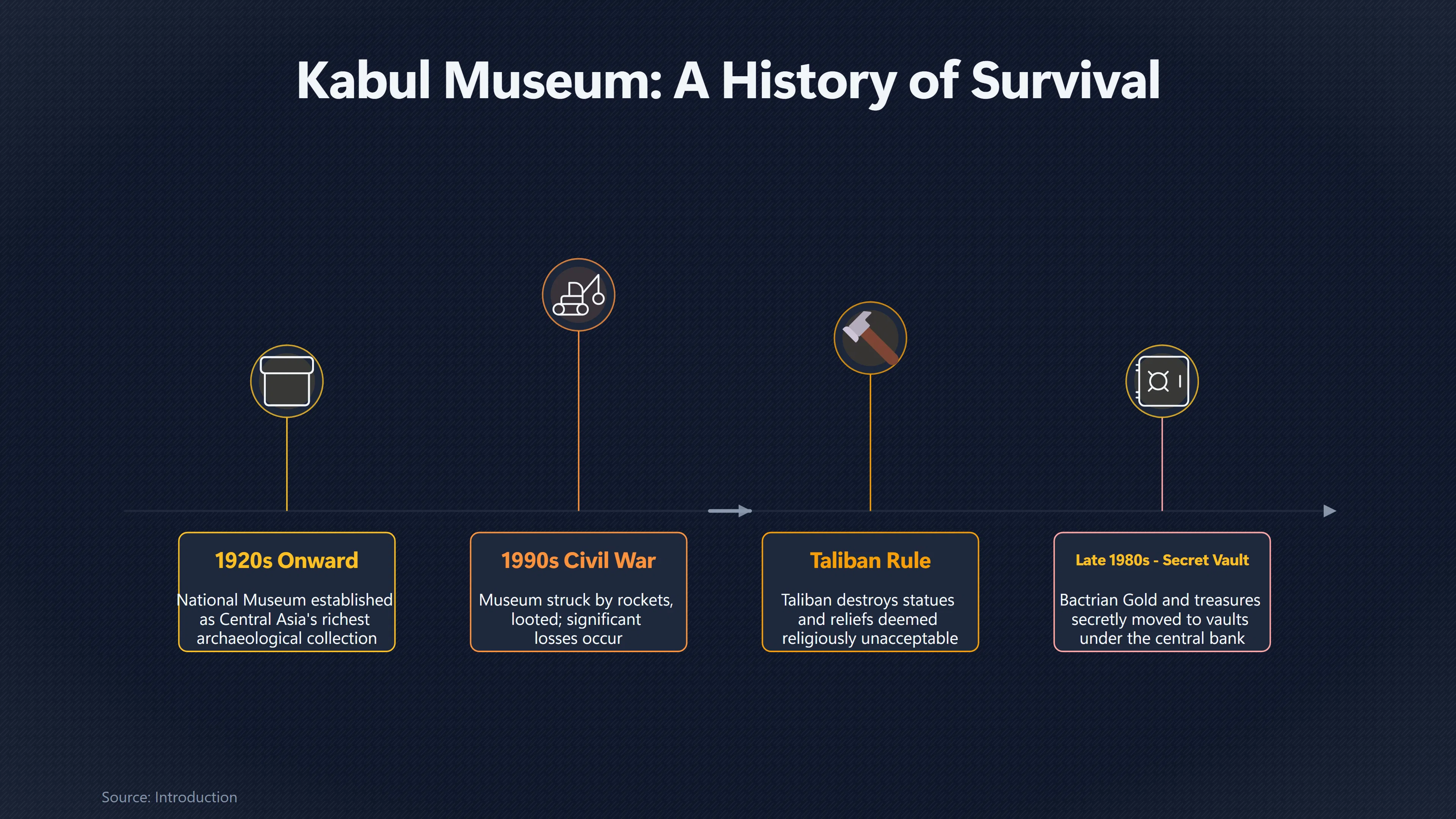
The National Museum stands near Darulaman on the outskirts of Kabul. Before the conflicts of the late twentieth century it held one of Central Asia’s richest archaeological collections, documenting thousands of years of Afghan history. The museum’s holdings ranged from prehistoric artefacts to Buddhist sculpture, Hindu imagery, Islamic manuscripts, coins and luxury goods from ancient trade routes.[Smithsonian Magazine]smithsonianmag.comSmithsonian MagazineLost & FoundIn retrospect, National Museum of Afghanistan director Omara Khan Masoudi's decision to hide the Bactrian…
The institution suffered repeated disasters. During the civil war of the 1990s, the museum sat close to front lines and was struck by rockets. Looters entered damaged buildings and removed huge numbers of objects. Later, in 2001, Taliban authorities ordered the destruction of many figurative works still remaining in the museum, smashing statues and reliefs they regarded as religiously unacceptable. Thousands of artefacts were damaged or destroyed.[Wikipedia]WikipediaDestruction of art in AfghanistanDestruction of art in Afghanistan
What visitors encounter today is therefore not merely a collection of ancient objects. It is a collection that has already survived several attempted erasures.
A Silk Roads Cabinet of Cultures
Among the most remarkable survivors are objects illustrating Afghanistan’s role as a crossroads of civilisations. Rather than representing a single culture, many pieces show influences from Greece, India, Central Asia, China and the ancient Iranian world existing side by side.
The most famous examples come from Tillya Tepe, often known as the Bactrian Gold. Excavated in 1978 from elite burials in northern Afghanistan, the treasure included more than 20,000 gold objects: jewellery, ornaments, weapon fittings and ceremonial items. The artefacts combine motifs from multiple traditions, making them one of the clearest demonstrations of cultural exchange along the Silk Roads.[eurasianet.org]eurasianet.orgafghanistan nation protects storied bactrian treasureAfghanistan: Nation Protects Storied Bactrian Treasure10 June 2006 — "The Bactrian treasure was found in Jowzjan Province in six graves t…
Particularly striking is the folding gold crown discovered in one of the graves. Unlike a rigid royal crown, it could be dismantled and transported, suggesting a mobile aristocratic culture connected to the wider Eurasian steppe. The object has become an emblem not only of ancient Afghanistan but also of the survival of Afghan heritage itself.[Popular Mechanics]popularmechanics.comUnearthed in 1978 at Tillya Tepe ("Hill of Gold") in northern Afghanistan by a Soviet-Afghan team led by Viktor Sarianidi, the site revea…
Other surviving museum treasures include:[smithsonianmag.com]smithsonianmag.comSmithsonian MagazineLost & FoundIn retrospect, National Museum of Afghanistan director Omara Khan Masoudi's decision to hide the Bactrian…
- Ivory carvings from ancient Bagram that demonstrate long-distance connections between South Asia, the Mediterranean world and East Asia.
- Buddhist sculptures and architectural fragments from monastic centres that once flourished across Afghanistan.
- Coins, metalwork and decorative objects showing successive layers of Greek, Kushan, Hindu, Buddhist and Islamic influence.
- Archaeological finds that reveal Afghanistan’s historic role as a meeting point rather than a cultural frontier.[Blog]blog.qm.qld.gov.auafghanistan hidden treasures from the national museum kabulafghanistan hidden treasures from the national museum kabul
Together these objects create a collection that feels almost like a historical cabinet of curiosities. The surprise is not any single artefact but the unlikely combination of cultures represented in one place.
Looting, Iconoclasm and Missing Objects
The museum’s story is inseparable from loss. Archaeologists and museum officials estimate that a large proportion of the collection disappeared during the wars. Some reports suggest that around seventy percent of holdings were looted, destroyed or otherwise lost during the worst years of conflict.[Archaeology Magazine]archive.archaeology.orgMagazine Museum Under Siege: Full TextArchaeology MagazineMuseum Under Siege: Full Text - Magazine Issue ArchiveAbout 70 percent of the museum's collections are now missing. M…
Certain categories suffered especially heavily. Coin collections, sculptures and portable antiquities were attractive targets for traffickers because they could be transported and sold relatively easily. Looted Afghan artefacts began appearing in international markets, often stripped of clear provenance.[Archaeology Magazine]archive.archaeology.orgMagazine Museum Under Siege: Full TextArchaeology MagazineMuseum Under Siege: Full Text - Magazine Issue ArchiveAbout 70 percent of the museum's collections are now missing. M…
The destruction carried out in 2001 was different from ordinary looting. Instead of theft for profit, it was an attempt to eliminate images considered unacceptable. Museum staff later described how statues and reliefs were systematically smashed. The attack became one of the most notorious episodes in the broader campaign that also destroyed the giant Buddhas of Bamiyan.[Smithsonian Magazine]smithsonianmag.comSmithsonian MagazineLost & FoundIn retrospect, National Museum of Afghanistan director Omara Khan Masoudi's decision to hide the Bactrian…
This history explains why many museum displays are stories of survival rather than pristine preservation. A visitor may see reconstructed fragments, repaired sculptures or objects that returned only after years abroad.
The Secret That Saved the Bactrian Gold
The museum’s greatest survival story concerns what was not left inside the museum at all.
As political conditions deteriorated in the late 1980s, senior Afghan officials and museum professionals secretly transferred the Bactrian Gold and other exceptional treasures into heavily protected vaults beneath the central bank. Knowledge of the hiding place was restricted to a small group of trusted keyholders.[smithsonianmag.com]smithsonianmag.comSmithsonian MagazineLost & FoundIn retrospect, National Museum of Afghanistan director Omara Khan Masoudi's decision to hide the Bactrian…
During the following years, rumours spread that the treasure had been stolen, melted down or smuggled abroad. Meanwhile the museum itself was shelled, looted and partially destroyed. Because almost nobody knew where the collection had been hidden, the secret survived alongside the artefacts.[Smithsonian Magazine]smithsonianmag.comSmithsonian MagazineLost & FoundIn retrospect, National Museum of Afghanistan director Omara Khan Masoudi's decision to hide the Bactrian…
After the fall of the Taliban government, the keyholders were eventually reunited and the vaults were opened. The treasure emerged largely intact, turning what many assumed was a story of irreversible loss into one of the most dramatic museum recoveries of modern times.[wikipedia.org]WikipediaTillya TepeTillya Tepe
In the context of world museums, few collections have experienced such a complete cycle of disappearance, rumour and rediscovery.
Recovery, Conservation and Uncertain Access
The museum’s survival did not end when hidden treasures reappeared. Conservators then faced the challenge of rebuilding what remained.
Damaged sculptures have been reassembled from fragments. Archaeologists have catalogued surviving collections, digitised records and worked to identify stolen artefacts circulating internationally. Repatriation efforts have returned numerous objects seized by police and customs authorities abroad. Some sculptures and archaeological pieces looted decades earlier have been traced and sent back to Kabul.[nsw.gov.au]projects.artgallery.nsw.gov.auAFGHANISTA N: HIDDEN TREASURESArchaeologists register objects to create a digital record at the National Museum of Afghanistan in Kabul…Read more…
Recovery remains incomplete. Many artefacts are still missing, and concerns about security and political instability continue to shape how collections are managed. International organisations and museum professionals have repeatedly emphasised the vulnerability of Afghan cultural heritage during periods of political change.[Architectural Digest]architecturaldigest.comOpen source on architecturaldigest.com.
For this reason, the National Museum is best understood not as a finished institution but as an ongoing conservation project. Its galleries preserve remarkable ancient objects, but they also preserve evidence of modern rescue efforts.
Why the Museum’s Survivors Matter
Many countries possess richer museums or larger archaeological collections. What makes Kabul’s National Museum distinctive is that its most famous exhibits are also survivors of modern history.
The Bactrian Gold, restored Buddhist sculptures, recovered antiquities and reconstructed fragments all tell two stories at once. One story belongs to the ancient Silk Roads, empires and religions that shaped Afghanistan over millennia. The other belongs to curators, archaeologists and ordinary custodians who protected cultural heritage during war, often at considerable personal risk.[smithsonianmag.com]smithsonianmag.comSmithsonian MagazineLost & FoundIn retrospect, National Museum of Afghanistan director Omara Khan Masoudi's decision to hide the Bactrian…
Within Afghanistan’s landscape of unusual collections, that combination is difficult to match. The museum’s treasures are fascinating archaeological objects, but their greatest curiosity may be that they are still here at all.[The Guardian]theguardian.comafghanistan crossroads exhibition british museumHaving survived thirty years of shelling, looting and Taliban raids it's the highlight of a…Read more…
Amazon book picks
Further Reading
Books and field guides related to How Did Kabul's Museum Survive the Wars?. Use these as the next step if you want deeper reading beyond the article.
The Monuments of Afghanistan: History, Archaeology and Archit...
The Monuments of Afghanistan--which contains 150 color plates of such extraordinary artifacts as the 38 meter Bamiyan Buddha (notoriously...
The Buddhas of Bamiyan
For 1,400 years, two colossal figures of the Buddha overlooked the fertile Bamiyan Valley on the Silk Road in Afghanistan. Witness to a m...
The Rape of Mesopotamia: Behind the Looting of the Iraq Museum
On April 10, 2003, as the world watched a statue of Saddam Hussein come crashing down in the heart of Baghdad, a mob of looters attacked...
Who Owns Antiquity? Museums and the Battle over Our Ancient H...
Whether antiquities should be returned to the countries where they were found is one of the most urgent and controversial issues in the a...
eBay marketplace picks
Marketplace Samples
Live-tested eBay searches with available results related to this page.
Selected fromAfghanistan poster oneBay.co.uk.
Endnotes
1.
Source: archive.archaeology.org
Title: Magazine Museum Under Siege: Full Text
Link:https://archive.archaeology.org/online/features/afghan/
Source snippet
Archaeology MagazineMuseum Under Siege: Full Text - Magazine Issue ArchiveAbout 70 percent of the museum's collections are now missing. M...
2.
Source: Wikipedia
Title: Destruction of art in Afghanistan
Link:https://en.wikipedia.org/wiki/Destruction_of_art_in_Afghanistan
3.
Source: projects.artgallery.nsw.gov.au
Title: AFGHANISTA N: HIDDEN TREASURES
Link:https://projects.artgallery.nsw.gov.au/afghanistan/credits/
Source snippet
Archaeologists register objects to create a digital record at the National Museum of Afghanistan in Kabul...Read more...
4.
Source: eurasianet.org
Title: afghanistan nation protects storied bactrian treasure
Link:https://eurasianet.org/afghanistan-nation-protects-storied-bactrian-treasure
Source snippet
Afghanistan: Nation Protects Storied Bactrian Treasure10 June 2006 — "The Bactrian treasure was found in Jowzjan Province in six graves t...
Published: June 2006
5.
Source: blog.qm.qld.gov.au
Title: afghanistan hidden treasures from the national museum kabul
Link:https://blog.qm.qld.gov.au/2013/09/16/afghanistan-hidden-treasures-from-the-national-museum-kabul/
6.
Source: Wikipedia
Title: Tillya Tepe
Link:https://en.wikipedia.org/wiki/Tillya_Tepe
7.
Source: facebook.com
Link:https://www.facebook.com/UNAMA.News/posts/a-sculpture-that-was-stolen-from-the-national-museum-of-afghanistan-in-kabul-alm/10157094058530028/
8.
Source: facebook.com
Link:https://www.facebook.com/groups/archeologyandcivilizations/posts/9101570046603105/
9.
Source: facebook.com
Link:https://www.facebook.com/groups/1331722814218106/posts/1952861725437542/
10.
Source: facebook.com
Title: these sculptures are over 1400 years old and were made in afghanistan they were
Link:https://www.facebook.com/UNAMA.News/posts/these-sculptures-are-over-1400-years-old-and-were-made-in-afghanistan-they-were-/10156973028815028/
11.
Source: projects.artgallery.nsw.gov.au
Link:https://projects.artgallery.nsw.gov.au/afghanistan/
12.
Source: smithsonianmag.com
Link:https://www.smithsonianmag.com/arts-culture/lost-found-7605081/
Source snippet
Smithsonian MagazineLost & FoundIn retrospect, National Museum of Afghanistan director Omara Khan Masoudi's decision to hide the Bactrian...
13.
Source: rferl.org
Link:https://www.rferl.org/a/afghan-national-museum-regains-looted-treasures/24667462.html
Source snippet
RadioFreeEurope/RadioLibertyAfghan National Museum Regains Looted Treasures5 Aug 2012 — Hundreds of valuable archaeological artefacts loo...
14.
Source: popularmechanics.com
Link:https://www.popularmechanics.com/science/archaeology/a71825064/gold-artifacts-of-afghanistan/
Source snippet
Unearthed in 1978 at Tillya Tepe ("Hill of Gold") in northern Afghanistan by a Soviet-Afghan team led by Viktor Sarianidi, the site revea...
15.
Source: theguardian.com
Title: afghanistan crossroads exhibition british museum
Link:https://www.theguardian.com/artanddesign/2011/feb/19/afghanistan-crossroads-exhibition-british-museum
Source snippet
Having survived thirty years of shelling, looting and Taliban raids it's the highlight of a...Read more...
16.
Source: theguardian.com
Title: afghanistan national museum kabul bactrian hoard najibullah popal
Link:https://www.theguardian.com/world/2016/may/05/afghanistan-national-museum-kabul-bactrian-hoard-najibullah-popal
17.
Source: abcnews.com
Link:https://abcnews.com/Travel/story?id=4036899&page=1
18.
Source: theguardian.com
Title: met police help recover afghan sculpture looted kabul
Link:https://www.theguardian.com/culture/2020/jan/18/met-police-help-recover-afghan-sculpture-looted-kabul
19.
Source: architecturaldigest.com
Link:https://www.architecturaldigest.com/story/taliban-afghan-heritage
20.
Source: theguardian.com
Title: Kabul collection
Link:https://www.theguardian.com/world/2001/mar/23/lukeharding
21.
Source: aryaakasha.com
Title: the guardianship of the gold the heroic tale of the hiranya hoard of tillya tepe
Link:https://aryaakasha.com/2019/09/14/the-guardianship-of-the-gold-the-heroic-tale-of-the-hiranya-hoard-of-tillya-tepe/
Additional References
22.
Source: youtube.com
Title: Afghanistan National Museum: Experts work to restore lost legacy
Link:https://www.youtube.com/watch?v=JN8atnWqidQ
Source snippet
Afghan Museum Repairs Buddhist Art, One Broken Piece at a Time...
23.
Source: neh.gov
Link:https://www.neh.gov/humanities/2008/julyaugust/feature/now-you-see-them
24.
Source: youtube.com
Title: Afghanistan: Hidden Treasures from the National Museum, Kabul
Link:https://www.youtube.com/watch?v=KFXKxilDl6A
Source snippet
Kabul museum restores art shattered by Taliban...
25.
Source: youtube.com
Title: Kabul museum restores art shattered by Taliban
Link:https://www.youtube.com/watch?v=NZ63FNP78SU
Source snippet
Afghanistan National Museum: Experts work to restore lost legacy...
26.
Source: returningheritage.com
Link:https://www.returningheritage.com/looted-treasures-from-iraq-and-afghanistan-to-be-returned-by-british-museum
27.
Source: nationalgeographic.com
Link:https://www.nationalgeographic.com/history/history-magazine/article/discoveries-bactrian-gold-afghanistan-silk-road
28.
Source: academia.edu
Link:https://www.academia.edu/Documents/in/National_Museum_of_Afghanistan
29.
Source: robertk.space
Link:https://robertk.space/2013/09/how-the-collection-of-the-national-museum-of-afghanistan-survived-the-civil-war-and-the-looting-1992-2001/
30.
Source: youtube.com
Link:https://www.youtube.com/watch?v=j-0a9AMBQrc
31.
Source: reuters.com
Title: rediscovered afghan gold treasure comes to new york id USTRE55E6WS
Link:https://www.reuters.com/article/lifestyle/rediscovered-afghan-gold-treasure-comes-to-new-york-idUSTRE55E6WS/