Inside Colombia's Strangest Museums and Collections
Colombia’s strangest collections are not gathered into one neat “museum of oddities” tradition. Instead, they appear across medical displays, naturally preserved bodies, former prisons, cemetery museums, forensic archives, religious treasures and fossil sites.
Page outline Jump by section
Introduction
These places reward curiosity, but they require different kinds of trust. Some are professionally curated national institutions; others are community attractions, specialist teaching collections or highly personal displays. A few are surrounded by folklore or sensational marketing that runs ahead of the evidence. The best way to explore Colombia’s unusual museum culture is therefore to ask not only “What is strange here?”, but also who collected it, why it is shown and how confidently its story can be believed.
Colombia’s most unsettling public collection
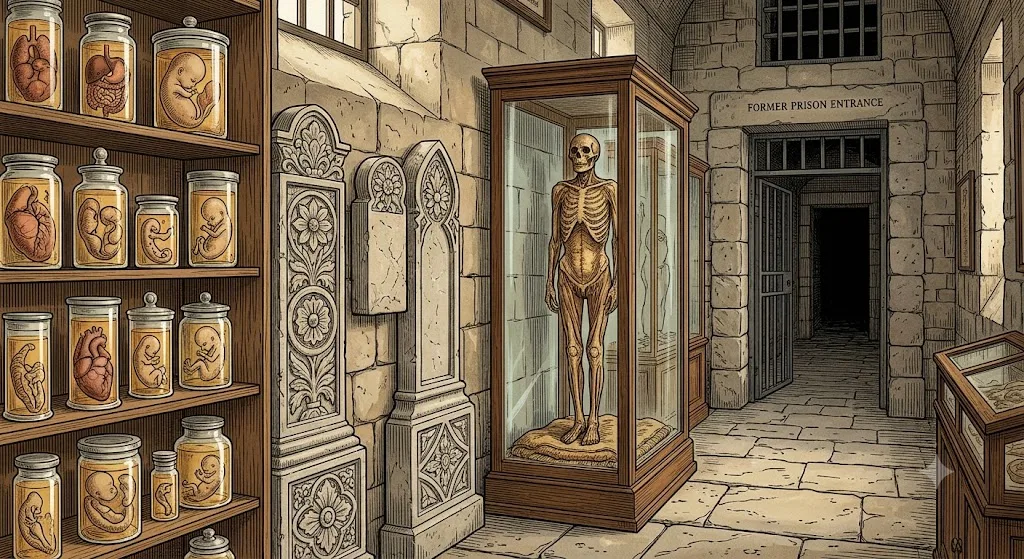
Bogotá’s Museum of the Human Being is the country’s clearest example of a traditional medical oddity museum. Located behind the Central Cemetery, it occupies a former family house rather than a clinical-looking university building. Its eight rooms contain preserved organs, dissected brains, foetuses, congenital abnormalities, mummified remains and other anatomical preparations. The institution presents these objects as tools for scientific education and reflection on human life, although the atmosphere inevitably resembles an old pathology cabinet.[radionacional.co]radionacional.comuseo del ser humano en bogota direccion y caracteristicasMuseo del Ser Humano en Bogotá2 Dec 2022 — Fetos deformes, cerebros disecados y bustos momificados: el Museo del Ser Humano de Bogotá alb…
The collection reportedly contains about 500 specimens, many originating in medical teaching environments. That background matters: these are not manufactured horror props, but human remains and pathological material assembled for study. Visitors should expect direct and sometimes distressing displays rather than interactive science-museum interpretation. The institution’s stated purpose is educational, but its intimate setting and visibly ageing presentation give it a more eccentric, personal character than a modern anatomy exhibition.[parchexbogota.com]parchexbogota.comMuseo del Ser Humano: una experiencia distintaFebruary 4, 2026 — Este museo, creado en 1973 por el doctor Alfredo León, y, con la ayuda de investigadores, recopiló las 500 piezas de l…
It is also a place where ethical questions sit close to the surface. Contemporary museums increasingly explain consent, identity, acquisition and the respectful treatment of human remains. Publicly available descriptions of this museum emphasise scientific value and the founder’s collection, but offer less detail about the individual provenance of every specimen. That does not make the exhibits fraudulent; it means visitors should distinguish anatomical authenticity from fully documented modern curatorial practice.
The museum therefore occupies an unusual middle ground. It is a functioning public attraction with genuine educational material, yet it retains the atmosphere of an older medical collection in which abnormality itself could become the organising spectacle. For travellers interested in death, medicine or cabinets of curiosity, it is probably Colombia’s most concentrated encounter with all three.
The mummies of San Bernardo
In the mountain town of San Bernardo, south-west of Bogotá, exhumations from the municipal cemetery have repeatedly revealed bodies that dried out instead of decomposing normally. Some retain skin, hair, clothing and recognisable facial features. A selection is displayed in the José Arquímedes Castro Mausoleum, commonly described as the town’s mummy museum. The Cundinamarca authorities trace public awareness of the phenomenon to a body exhumed in 1963, after which further naturally preserved remains were found.[cundinamarca.gov.co]cundinamarca.gov.coel misterio de las momias naturales en el municipio de san bernardoEl misterio de las momias naturales en el municipio de…22 Jul 2025 — El hallazgo ocurrió en 1963, cuando al exhumar un cuerpo en el ce…
The attraction is unusual because these are not ancient archaeological mummies. They are comparatively recent residents whose relatives and local community may still remember them. The display consequently feels less remote than an exhibition of pre-Hispanic remains: it is part scientific puzzle, part family memorial and part local tourist identity.
No single explanation has yet been demonstrated conclusively. Popular accounts have credited local diets, moral character, divine intervention or the special qualities of the soil. A more plausible physical hypothesis is that hot, dry air circulating through above-ground burial vaults rapidly dehydrates the bodies, with the vaults effectively acting as drying chambers. An anthropologist interviewed about the site stressed that this explanation remains to be tested under controlled study. The preservation of clothing as well as tissue also weakens claims that local food alone is responsible.[straitstimes.com]straitstimes.comfrozen in time colombian towns unexplained mummiesThe Straits TimesFrozen in time: Colombian town's unexplained mummies26 Apr 2024 — Dozens of mummified bodies have come out of the San Be…
This is a good example of how Colombia’s curiosity culture combines observation and folklore. The bodies are real; the mechanism is incompletely studied; the more supernatural explanations belong to local interpretation rather than established science. Calling the phenomenon “unexplained” is reasonable, provided it does not become “inexplicable”.
The human dimension deserves equal attention. Relatives have permitted certain bodies to remain on view and sometimes describe their preservation in religious terms. Yet displaying named, recently deceased people raises questions about dignity, continuing consent and the difference between a memorial and a tourist exhibit. San Bernardo matters not only because its mummies are visually extraordinary, but because the museum shows how a community turns an unexpected funerary process into heritage without entirely resolving what that transformation means.
Where death becomes civic history
Medellín’s San Pedro Cemetery Museum is less gruesome than the word “cemetery” may suggest. Founded as a burial ground in the nineteenth century, it was recognised as a museum in 1998 and declared a national monument the following year. Its collection consists largely of mausoleums, funerary sculpture, architecture, stained glass and the graves of political, literary and industrial figures associated with Antioquia and Colombia.[Wikipedia]WikipediaSan Pedro Cemetery MuseumSan Pedro Cemetery Museum
What makes it distinctive is that it has not stopped operating as a place of burial. Funeral services and cultural programming exist side by side. Guided visits, performance, music, storytelling and exhibitions reinterpret the cemetery as an open-air archive of Medellín’s social structure: wealthy family monuments reveal the ambitions of the regional elite, while changing styles of commemoration show how attitudes towards death evolved.[Wikipedia]WikipediaSan Pedro Cemetery MuseumSan Pedro Cemetery Museum
It should not be confused with a commercial ghost attraction. Superstitions and stories naturally accumulate around cemeteries, but San Pedro’s main curatorial strength is historical and artistic. Its strangeness comes from the productive tension between active mourning and public culture. Visitors are walking through both a museum and a place where families continue to grieve.
Bogotá’s National Museum offers a different encounter with institutional death. Its fortress-like building was constructed in the 1870s as the Central Penitentiary of Cundinamarca and continued as a prison before becoming the museum’s home. Although traditionally called a panopticon, the National Museum itself notes that the completed design did not strictly correspond to the classic panoptic model in which a central observer could oversee every prisoner.[museonacional.gov.co]museonacional.gov.coOpen source on museonacional.gov.co.
The prison past is not merely architectural trivia. Former cells and corridors shape how visitors experience the national collections, while museum programmes have examined prisoners’ living conditions and traces left in the building. Here the curiosity lies in reversal: a structure designed to confine and inspect people now houses objects intended to narrate the nation to the public.[museonacional.gov.co]museonacional.gov.coOpen source on museonacional.gov.co.
Crime, punishment and doubtful torture devices
The Palace of the Inquisition in Cartagena is one of Colombia’s most famous dark-history sites. The eighteenth-century colonial building now houses the city’s historical museum, with material on Cartagena’s colonial, independence and republican periods as well as the tribunal of the Holy Office established there in 1610. Its surviving architecture, including the denunciation window associated with accusations of heresy, provides a genuine physical link to the institution.[cartagena.gov.co]cartagena.gov.comuseos cartagena bolivar abren sus puertas para toda ciudadaniamuseos cartagena bolivar abren sus puertas para toda ciudadania
The museum has long attracted attention for displays labelled as instruments of interrogation or torture. These require caution. Generic “Inquisition museums” around the world have frequently exhibited later reconstructions, objects with uncertain provenance or devices never used by the particular tribunal concerned. The notorious iron maiden, for example, is widely regarded by historians as a later invention popularised through nineteenth-century spectacle rather than an authentic standard instrument of medieval punishment. Accounts of the Cartagena museum likewise indicate that at least some sensational devices were replicas or historically unsupported.[Wikipedia]WikipediaPalace of the Inquisition (Cartagena, ColombiaPalace of the Inquisition (Cartagena, Colombia
That does not make Cartagena’s Inquisition history imaginary. The tribunal investigated religious deviation, ancestry, prohibited practices and suspected violations of Catholic orthodoxy. The problem arises when complex systems of surveillance, denunciation, imprisonment and public humiliation are reduced to a room of theatrical machinery. The building, records and institutional story are stronger evidence than any unproven spiked contraption.
Visitors should therefore treat the palace as a city-history museum occupying an authentic site of colonial authority, not as an unquestionable catalogue of torture technology. Its most revealing object may be the denunciation window: it represents how suspicion entered the system through ordinary people, secrecy and accusation, mechanisms more historically significant than the museum genre’s familiar hardware.
A quieter but equally unusual criminal-history collection belongs to the National University of Colombia. The José María Garavito Baraya forensic-science collection grew from a laboratory used to teach subjects such as fingerprint analysis, ballistics, toxicology, forensic blood examination and judicial photography. By 1959 it had become a museum, reportedly holding about 1,260 items; it was later reorganised as a museological collection preserving the early material culture of Colombian criminology.[Wikipedia]WikipediaOpen source on wikipedia.org.
This is not best understood as a conventional drop-in attraction. The material is held within the university’s heritage system at the San Agustín Cloister, and access or display may depend on exhibitions and institutional programming. Its importance lies precisely in that semi-hidden status. Rather than dramatising famous criminals, it preserves the instruments and teaching practices through which crime was converted into measurements, photographs, samples and expert testimony.
Ancient creatures and ritual transformations
Near Villa de Leyva, the community-run Fossil Museum was built around an enormous marine-reptile skeleton left close to where it was discovered. The region’s rocks were formed when the area lay beneath a Cretaceous sea, which explains the presence of ammonites, marine reptiles and other fossils in an inland Andean landscape. Visitors encounter the large skeleton in situ, surrounded by cases of smaller local specimens.[tripadvisor.com]tripadvisor.comMuseo El FósilMuseo El Fósil
The museum’s charm comes partly from its scale and origins. It is not a polished hall of dinosaurs assembled from casts, but a community institution organised around one extraordinary local find. Older tourist material may use outdated or loose identifications for the principal animal, so the scientific labels on site and current palaeontological research are preferable to inherited travel-guide terminology. The central fact remains impressive without embellishment: this part of Colombia preserves the remains of large marine reptiles from a landscape that once lay under the sea.
Colombia’s archaeological museums provide a different kind of strangeness: not biological monstrosity, but ritual objects that have often been detached from their original meanings by treasure stories. Bogotá’s Gold Museum holds one of the world’s major collections of pre-Hispanic metalwork. Its most famous object, the Muisca raft, depicts a ceremonial offering and is the largest and most elaborate known Muisca votive figure of its kind. It helped give material form to stories that Europeans transformed into the legend of a golden kingdom.[Banrep Cultural]banrepcultural.orgOpen source on banrepcultural.org.
The raft is worth treating as more than “proof” behind a treasure myth. The museum interprets it as an offering connected to social, political and spiritual relationships. That distinction changes the object from an exotic golden curiosity into evidence of a sophisticated belief system. The strangeness lies partly in the gap between what the makers intended and what later treasure-seekers wanted it to mean.
Another remarkable religious object associated with the Bank of the Republic’s collections is the enormous emerald-set monstrance popularly nicknamed “The Lettuce”. Made for the Church of Saint Ignatius in Bogotá, it uses gold and dense green gemstones to frame the consecrated host in Catholic ritual. Its vegetable nickname makes it sound whimsical, yet the object is a serious devotional work whose material extravagance expresses sacred radiance, colonial wealth and the global movement of precious materials.[Banrep Cultural]banrepcultural.orgmonstrance church san ignacio de bogota la lechuga inglesmonstrance church san ignacio de bogota la lechuga ingles
Bogotá’s House of the Marquis of San Jorge Archaeological Museum offers a broader ceramics-led counterpoint. Its collection exceeds 13,000 pieces and represents several Indigenous cultures, including Muisca, Chimila, Calima, Tairona and Guane traditions. Many vessels and figures that modern viewers might see as uncanny, hybrid or fantastical belonged to systems of ceremony, ancestry, bodily transformation and everyday life rather than a separate category of “monsters”.[Colombia Travel]colombia.travelOpen source on colombia.travel.
What Colombia’s strange collections reveal
Colombia’s offbeat museums are strongest when they preserve ambiguity without exploiting it. San Bernardo’s bodies are genuinely mummified, but the cause remains under-investigated. Bogotá’s anatomical specimens are real, but their display raises modern questions about provenance and dignity. Cartagena’s tribunal was real, while some familiar torture imagery is far less reliable. Pre-Hispanic gold and ceramics are authentic, but treasure legends and exotic labels can obscure their original religious and political purposes.
The country’s unusual collections also resist a simple division between belief and science. A cemetery becomes an arts institution; a medical teaching collection becomes a macabre attraction; a marine fossil becomes the centre of a community museum; a votive offering becomes entangled with a European fantasy of limitless gold. In each case, the object remains the same while its public meaning changes.
For visitors, the most useful practical distinction is between four kinds of place:
- Established public museums, including the Gold Museum, National Museum, Cartagena Historical Museum and San Pedro Cemetery Museum, with regular institutional interpretation.
- Small independent attractions, such as the Museum of the Human Being, where genuine material may be presented in a personal or old-fashioned curatorial style.
- Community collections, including the San Bernardo mummies and the Fossil Museum, whose power comes from local stewardship as much as formal museology.
- Specialist reserves and university collections, such as the forensic-science holdings, which may not function as reliably accessible everyday attractions.
Together they form a distinctive national curiosity landscape. Colombia does not need an invented museum of witches or cryptids to qualify as a rich destination for strange collections. Its real material is more compelling: preserved townspeople, human anatomy, prison cells, forensic instruments, funerary cities, ritual gold and the skeletons of sea creatures found high in the Andes.
Amazon book picks
Further Reading
Books and field guides related to Inside Colombia's Strangest Museums and Collections. Use these as the next step if you want deeper reading beyond the article.
Colombia: A Concise Contemporary History
Written by two leading historians, this deeply informed and accessible book traces the history of Colombia thematically, covering the pas...
The Archaeology of Death and Burial
The archaeology of death and burial is central to our attempts to understand vanished societies. Through the remains of funerary rituals...

The Bone Detectives: How Forensic Anthropologists Solve Crime...
First published 1996. Subjects: Forensic anthropology, Juvenile literature, Forensic sciences, Criminal investigation, New York Times rev...
One Hundred Years of Solitude
First published 2007. Subjects: Macondo (Imaginary place), Latin American literature, Latin America - social conditions, Fiction, Epic li...
eBay marketplace picks
Marketplace Samples
Live-tested eBay searches with available results related to this page.
Selected fromColombia art print oneBay.co.uk.

Endnotes
1.
Source: radionacional.co
Title: museo del ser humano en bogota direccion y caracteristicas
Link:https://www.radionacional.co/actualidad/ciencia/museo-del-ser-humano-en-bogota-direccion-y-caracteristicas
Source snippet
Museo del Ser Humano en Bogotá2 Dec 2022 — Fetos deformes, cerebros disecados y bustos momificados: el Museo del Ser Humano de Bogotá alb...
2.
Source: museodelserhumano.com
Link:https://www.museodelserhumano.com/historia/
3.
Source: parchexbogota.com
Title: Museo del Ser Humano: una experiencia distinta
Link:https://parchexbogota.com/museo-del-ser-humano-la-exposicion-que-explora-el-cuerpo-desde-otra-perspectiva/
Source snippet
February 4, 2026 — Este museo, creado en 1973 por el doctor Alfredo León, y, con la ayuda de investigadores, recopiló las 500 piezas de l...
Published: February 4, 2026
4.
Source: cundinamarca.gov.co
Title: el misterio de las momias naturales en el municipio de san bernardo
Link:https://www.cundinamarca.gov.co/noticias/el-misterio-de-las-momias-naturales-en-el-municipio-de-san-bernardo
Source snippet
El misterio de las momias naturales en el municipio de...22 Jul 2025 — El hallazgo ocurrió en 1963, cuando al exhumar un cuerpo en el ce...
5.
Source: detour.cundinamarca.gov.co
Link:https://detour.cundinamarca.gov.co/geomarker/mausoleo-jose-arquimedes-castro-museo-de-momias
Source snippet
La primera momia encontrada en San Bernardo...
6.
Source: Wikipedia
Title: San Pedro Cemetery Museum
Link:https://en.wikipedia.org/wiki/San_Pedro_Cemetery_Museum
7.
Source: museonacional.gov.co
Link:https://www.museonacional.gov.co/exposiciones/permanentes/Paginas/Primer_piso/2.aspx
8.
Source: museonacional.gov.co
Link:https://www.museonacional.gov.co/Publicaciones/publicaciones-virtuales/Paginas/EnbuscadelaprisionmodernaLaconstrucciondelPanopticodeBogota1849%E2%80%931878.aspx
9.
Source: museonacional.gov.co
Link:https://www.museonacional.gov.co/noticias/Paginas/Dos_nuevas_salas.aspx
10.
Source: museonacional.gov.co
Link:https://www.museonacional.gov.co/noticias/Paginas/Forms/DispForm.aspx?ID=6&RootFolder=%2Fnoticias%2FPaginas&Source=https%3A%2F%2Fwww.museonacional.gov.co%2Fnoticias%2FPaginas%2Fcumpleanos-190.aspx
11.
Source: museonacional.gov.co
Link:https://www.museonacional.gov.co/noticias/Paginas/Forms/DispForm.aspx?ID=44&RootFolder=%2Fnoticias%2FPaginas&Source=https%3A%2F%2Fwww.museonacional.gov.co%2Fnoticias%2FPaginas%2FEl-edificio-del-Museo-Nacional-de-Colombia-cumplira-140-anos-.aspx
12.
Source: cartagena.gov.co
Title: museos cartagena bolivar abren sus puertas para toda ciudadania
Link:https://www.cartagena.gov.co/noticias/museos-cartagena-bolivar-abren-sus-puertas-para-toda-ciudadania
13.
Source: cartagena.gov.co
Title: conozca desde cuando conmemora el dia internacional museos
Link:https://www.cartagena.gov.co/noticias/conozca-desde-cuando-conmemora-el-dia-internacional-museos
14.
Source: Wikipedia
Title: Palace of the Inquisition (Cartagena, Colombia)
Link:https://en.wikipedia.org/wiki/Palace_of_the_Inquisition_%28Cartagena%2C_Colombia%29
15.
Source: Wikipedia
Link:https://es.wikipedia.org/wiki/Museo_de_Criminal%C3%ADstica_y_Ciencias_Forenses_de_la_Universidad_Nacional_de_Colombia
16.
Source: tripadvisor.com
Title: Museo El Fósil
Link:https://www.tripadvisor.com/Attraction_Review-g676524-d2412924-Reviews-Museo_El_Fosil-Villa_de_Leyva_Boyaca_Department.html
17.
Source: colombia.travel
Link:https://colombia.travel/en/bogota/house-marquis-san-jorge-archaeological-museum
18.
Source: tripadvisor.com
Title: Cementerio Museo de San Pedro
Link:https://www.tripadvisor.com/Attraction_Review-g297478-d5602003-Reviews-Cementerio_Museo_de_San_Pedro-Medellin_Antioquia_Department.html
19.
Source: tripadvisor.com
Title: The slavery museum
Link:https://www.tripadvisor.com/ShowUserReviews-g297476-d602989-r166388922-Museo_Historico_de_Cartagena_de_Indias-Cartagena_Cartagena_District_Bolivar_Depar.html
20.
Source: tripadvisor.com
Title: This was disappointing…skip it
Link:https://www.tripadvisor.com/ShowUserReviews-g297476-d16778897-r915211725-Palacio_de_La_Inquisicion-Cartagena_Cartagena_District_Bolivar_Department.html
21.
Source: tripadvisor.com
Title: Museo Arqueologico
Link:https://www.tripadvisor.com/Attraction_Review-g294074-d532211-Reviews-Museo_Arqueologico-Bogota.html
22.
Source: museonacional.gov.co
Title: En busca de la prision moderna
Link:https://www.museonacional.gov.co/Publicaciones/publicaciones-virtuales/Documents/En_busca_de_la_prision_moderna.pdf
23.
Source: museonacional.gov.co
Link:https://www.museonacional.gov.co/Publicaciones/publicaciones-virtuales/Documents/existencias06.pdf
24.
Source: museonacional.gov.co
Link:https://www.museonacional.gov.co/Publicaciones/publicaciones-virtuales/Documents/cppenitenciaria.pdf
25.
Source: museonacional.gov.co
Link:https://www.museonacional.gov.co/noticias/Paginas/Correspondencias.aspx
26.
Source: museonacional.gov.co
Link:https://www.museonacional.gov.co/el-museo/historia/Paginas/Historia.aspx
27.
Source: eldoradoradio.cundinamarca.gov.co
Title: san bernardo momias que desafian los limites de la ciencia
Link:https://eldoradoradio.cundinamarca.gov.co/noticias/cronicas/san-bernardo-momias-que-desafian-los-limites-de-la-ciencia/
28.
Source: pemp.cartagena.gov.co
Link:https://pemp.cartagena.gov.co/sites/default/files/2025-09/Preliminar.pdf
29.
Source: cartagena.gov.co
Link:https://www.cartagena.gov.co/noticias/treinta-ninos-ninas-cartageneros-exploran-historia-ciudad-visitas-guiadas-escuela-gobierno-liderazgo
30.
Source: cartagena.gov.co
Link:https://www.cartagena.gov.co/noticias/cartagena-sigue-siendo-sede-principal-evento-segmento-romance-el-pais-wedding-dreams-wedding-forum
31.
Source: cartagena.gov.co
Link:https://www.cartagena.gov.co/noticias/lleno-aduana-homenajes-gran-concierto-inedito-cartagena-gozo-celebracion-214-anos-su-independencia
32.
Source: pemp.cartagena.gov.co
Link:https://pemp.cartagena.gov.co/sites/default/files/2023-12/PV%20Cartagena_Informe%203.pdf
33.
Source: mipg.cartagena.gov.co
Link:https://mipg.cartagena.gov.co/sites/default/files/documentos/normativa/2023-05/Informe_Acuerdo_de_Paz_2021.pdf
34.
Source: cartagena.gov.co
Title: regresa cartagena wedding dreams wedding forum
Link:https://www.cartagena.gov.co/noticias/regresa-cartagena-wedding-dreams-wedding-forum
35.
Source: mipg.cartagena.gov.co
Title: cartagena.gov.co Diagnóstico Integral de Archivo
Link:https://mipg.cartagena.gov.co/sites/default/files/documentos/normativa/2024-05/Diagnostico%20Integral%20de%20Archivo%202023%20GDO.pdf
36.
Source: redcol.minciencias.gov.co
Title: UNACIONAL2 feab90fd1993d462a3281b93cf5c2695
Link:https://redcol.minciencias.gov.co/Record/UNACIONAL2_feab90fd1993d462a3281b93cf5c2695
37.
Source: redcol.minciencias.gov.co
Link:https://redcol.minciencias.gov.co/Record/UNACIONAL2_d00040e1f68a3fa66721c736a8907b53
38.
Source: redcol.minciencias.gov.co
Link:https://redcol.minciencias.gov.co/Record/uniagusti2_4234c289f2418350b4f47cde41db57b6/Description
39.
Source: kujane.minciencias.gov.co
Link:https://kujane.minciencias.gov.co/Record/UNIANDES2_af1fe4c545b055b4863d12a26477ac77
40.
Source: kujane.minciencias.gov.co
Link:https://kujane.minciencias.gov.co/Record/UNACIONAL2_36a620ace9be092620adc319c0f59bb2
41.
Source: colombia.travel
Link:https://colombia.travel/de/villa-de-leyva/das-palaeontologische-museum
42.
Source: medicine.museum
Title: 13 Scientific Medical Collection University Valencia
Link:https://medicine.museum/museum/13-Scientific-Medical-Collection-University-Valencia
43.
Source: Wikipedia
Title: Unusual articles
Link:https://en.wikipedia.org/wiki/Wikipedia%3AUnusual_articles
44.
Source: Wikipedia
Title: Colombian folklore
Link:https://en.wikipedia.org/wiki/Colombian_folklore
45.
Source: museodelserhumano.com
Link:https://www.museodelserhumano.com/
46.
Source: revistas.icanh.gov.co
Link:https://revistas.icanh.gov.co/index.php/ap/article/view/2882
47.
Source: revistas.icanh.gov.co
Link:https://revistas.icanh.gov.co/index.php/ap/article/view/2882/2395
48.
Source: sanbernardo-cundinamarca.gov.co
Link:https://www.sanbernardo-cundinamarca.gov.co/
49.
Source: straitstimes.com
Title: frozen in time colombian towns unexplained mummies
Link:https://www.straitstimes.com/world/frozen-in-time-colombian-towns-unexplained-mummies
Source snippet
The Straits TimesFrozen in time: Colombian town's unexplained mummies26 Apr 2024 — Dozens of mummified bodies have come out of the San Be...
50.
Source: nypost.com
Title: dead bodies keep mummifying in this mountain town and scientists are baffled
Link:https://nypost.com/2024/05/09/lifestyle/dead-bodies-keep-mummifying-in-this-mountain-town-and-scientists-are-baffled/
51.
Source: nypost.com
Title: New York Post Dead bodies keep mummifying in this mountain town
Link:https://nypost.com/2024/05/09/dead-bodies-keep-mummifying-in-this-mountain-town-and-scientists-are-baffled/
52.
Source: theblogofdimi.com
Link:https://theblogofdimi.com/fossil-community-museum-villa-de-leyva/
53.
Source: banrepcultural.org
Link:https://www.banrepcultural.org/noticias/muisca-raft-offering-care-world
54.
Source: banrepcultural.org
Title: Banrep Cultural Museo del Oro
Link:https://www.banrepcultural.org/banco-de-la-republica-90-anos/museo-del-oro.html
55.
Source: banrepcultural.org
Title: monstrance church san ignacio de bogota la lechuga ingles
Link:https://www.banrepcultural.org/multimedia/monstrance-church-san-ignacio-de-bogota-la-lechuga-ingles
56.
Source: josepsimon.com
Link:https://www.josepsimon.com/museums/
57.
Source: tripadvisor.co.uk
Title: PALACI O DE LA INQUISICION
Link:https://www.tripadvisor.co.uk/Attraction_Review-g297476-d16778897-Reviews-Palacio_de_La_Inquisicion-Cartagena_Cartagena_District_Bolivar_Department.html
58.
Source: publicaciones.banrepcultural.org
Title: orgs Las águilas doradas: más allá
Link:https://publicaciones.banrepcultural.org/index.php/bmo/article/download/4859/5105
59.
Source: babel.banrepcultural.org
Link:https://babel.banrepcultural.org/digital/api/collection/p17054coll23/id/607/download
60.
Source: admin.banrepcultural.org
Title: boletin blaa inves 6 0
Link:https://admin.banrepcultural.org/sites/default/files/media/document/boletin_blaa_inves_6_0.pdf
61.
Source: babel.banrepcultural.org
Link:https://babel.banrepcultural.org/digital/api/collection/p17054coll23/id/1453/download
62.
Source: admin.banrepcultural.org
Title: 3095 ADOFB Matriz BanRep 2021 2022.xlsx
Link:https://admin.banrepcultural.org/sites/default/files/media/document/3095%20ADOFB%20Matriz_BanRep%202021-2022.xlsx
63.
Source: atlasobscura.com
Title: mummies of san bernardo
Link:https://www.atlasobscura.com/places/mummies-of-san-bernardo
64.
Source: thevintagenews.com
Title: san bernardo mummies
Link:https://www.thevintagenews.com/2024/05/09/san-bernardo-mummies/
Additional References
65.
Source: oem.com.mx
Title: los tesoros del museo del ser humano 15695197
Link:https://oem.com.mx/elsoldemexico/mundo/los-tesoros-del-museo-del-ser-humano-15695197
Source snippet
Los tesoros del Museo del Ser Humano1 Dec 2022 — En Bogotá, un museo alberga una colección de 500 ejemplares de anatomía humana, tan i...
66.
Source: youtube.com
Title: Los extraños fenómenos que ocurren en el Museo del ser humano
Link:https://www.youtube.com/watch?v=tyNNgVqRGzo
Source snippet
Fossil Museum, Villa de Leyva – Colombia's Prehistoric Marine History...
67.
Source: youtube.com
Title: Fossil Museum, Villa de Leyva – Colombia’s Prehistoric Marine History
Link:https://www.youtube.com/watch?v=ap_nybyatf0
Source snippet
El Museo Cementerio San Pedro y sus Relatos...
68.
Source: instagram.com
Link:https://www.instagram.com/p/DF26ZljMiyL/
69.
Source: derbymuseums.org
Link:https://derbymuseums.org/event/ancient-bodies-contemporary-challenges-the-ethics-of-egyptian-mummified-bodies-in-museums-with-dr-angela-stienne/
70.
Source: whichmuseum.nl
Link:https://whichmuseum.nl/museum/archaeological-museum-casa-del-marques-de-san-jorge-bogota-21485
71.
Source: trip.com
Link:https://www.trip.com/travel-guide/attraction/bogota/archaeological-museum-casa-del-marqus-de-san-jorge-38678042/
72.
Source: wanderlog.com
Link:https://wanderlog.com/place/details/141474/archaeological-museum-casa-del-marqu%C3%A9s-de-san-jorge
73.
Source: corner.inc
Link:https://www.corner.inc/place/pRff9Gs97daG
74.
Source: whichmuseum.com
Link:https://whichmuseum.com/museum/archaeological-museum-casa-del-marques-de-san-jorge-bogota-21485