Within Strange Sri Lanka
Why Do Sri Lankan Demon Masks Represent Illness?
Ambalangoda's carved masks turn illness, spirits and communal healing into one of Sri Lanka's most distinctive living museum traditions.
On this page
- The demons linked to particular diseases
- How healing ceremonies mixed fear, humour and performance
- What changes when ritual masks become tourist objects
Page outline Jump by section
Introduction
Sri Lanka’s demon masks are unusual because they do not simply represent monsters or characters from folklore: they preserve an older way of explaining illness, where sickness could be understood through relationships between people, spirits, performance and community ritual. In Ambalangoda, the southern coastal centre best known for mask carving, visitors encounter masks linked to healing ceremonies in which named disease-causing demons were represented, confronted and symbolically controlled. The tradition is especially associated with the Sanni Yakuma healing ritual and the group of masks known as Daha Ata Sanniya, or the “eighteen diseases”.[PMC]pmc.ncbi.nlm.nih.govPMCSri Lankan sanni masks: an ancient classification of diseaseDecember 23, 2006…
Today, Ambalangoda’s mask museums and workshops present these objects as cultural heritage, craft and performance history rather than as medical treatments. The masks are therefore unusual museum objects: they sit between folklore collection, living craft tradition, theatrical costume and evidence of historical ideas about disease. The best-known visitor site is the family-run Ariyapala Mask Museum, which displays traditional masks, explains carving practices and connects the objects with dance traditions including Sanni healing performances.[ariyapalamasksmuseum.com]ariyapalamasksmuseum.comAriyapala Mask MuseumAmbalangoda | HomepageSeptember 17, 2022…
The demons linked to particular diseases
The most distinctive feature of Ambalangoda’s healing masks is that each demon has a role within a symbolic classification of illness. Rather than showing a general evil spirit, Sanni masks give individual conditions a visible identity. Historical accounts describe eighteen major Sanni demons, although researchers have found variations in names and details between sources and regional traditions.[PMC]pmc.ncbi.nlm.nih.govPMCSri Lankan sanni masks: an ancient classification of diseaseDecember 23, 2006…
The masks transformed invisible suffering into recognisable characters. A patient’s symptoms could be interpreted through this system and represented through a particular masked performer. Examples include:
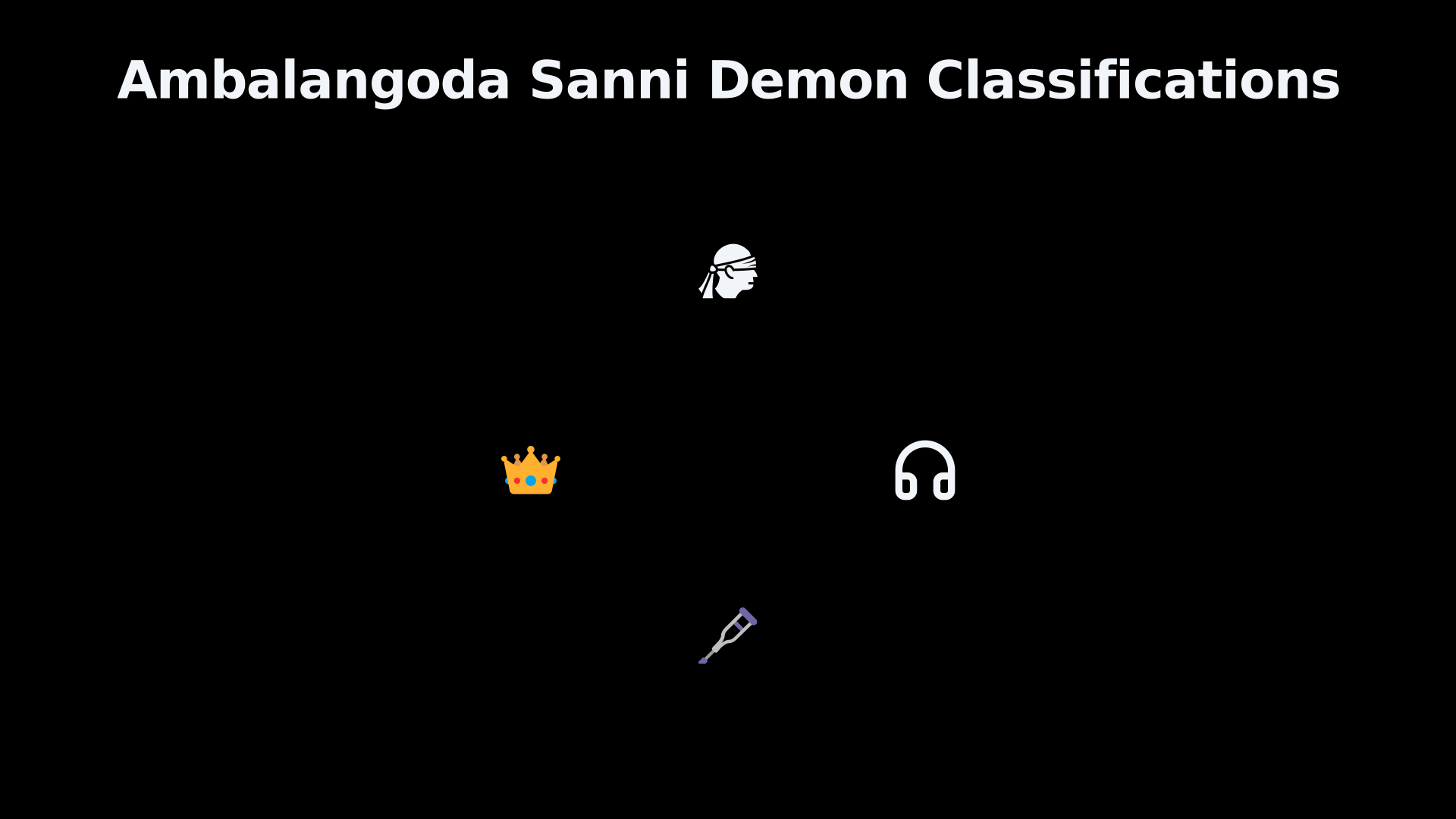
- a demon associated with blindness, represented through the Kana Sanniya mask;
- a demon associated with deafness, represented through Bihiri Sanniya;
- a demon associated with lameness or paralysis, represented through Kora Sanniya;
- demons linked with stomach disorders, fever, respiratory problems and mental disturbance.[The Australian Museum]australian.museumThe Australian Museum Daha Ata Sanniya MasksThe Australian MuseumDaha Ata Sanniya Masks - The Australian Museum…
This does not mean that traditional practitioners were creating a medical classification in the modern scientific sense. Instead, the masks preserved a cultural map of suffering. The system organised frightening experiences into named forms that could be addressed through ritual action. A modern visitor can understand the masks as a historical record of how one society interpreted the relationship between illness, fear and social order.[PMC]pmc.ncbi.nlm.nih.govPMCSri Lankan sanni masks: an ancient classification of diseaseDecember 23, 2006…
The most complex figure in this tradition is Maha Kola, a chief demon figure often associated with the complete set of illnesses. Accounts describe the Maha Kola mask as incorporating smaller representations of other demons, visually gathering the whole disease system into one dramatic object.[BMJ]bmj.comSri Lankan sanni masks: an ancient classification of disease | The BMJSri Lankan sanni masks: an ancient classification of disease | The BMJ…
How healing ceremonies mixed fear, humour and performance
The power of the masks came not only from their appearance but from how they were used. In the Sanni Yakuma ritual, masks were worn by performers during a long ceremony involving music, dancing, dialogue and interaction with the affected person and their community. The ritual was not a silent display of supernatural fear; it was a staged encounter in which threatening figures could also become comic and controllable.[BMJ]bmj.comSri Lankan sanni masks: an ancient classification of disease | The BMJSri Lankan sanni masks: an ancient classification of disease | The BMJ…
This mixture of terror and humour is one of the tradition’s most unusual features. The demons may have exaggerated teeth, bulging eyes and distorted expressions, but the performance often reduces their power by mocking them. Anthropological studies of Sanni rituals have highlighted the dramatic nature of these encounters, where demons appear as characters within a social performance rather than simply as frightening beings.[Cambridge University Press & Assessment]cambridge.orgCambridge University Press & AssessmentThe Ritual Drama of the Sanni Demons: Collective Representations of Disease in Ceylon | Comparativ…
The ritual also worked at a community level. Illness affected not only an individual but families and neighbours who witnessed the ceremony. The performance created a shared explanation for suffering and provided a structured response when people faced conditions that were poorly understood. Scholars have discussed these rituals as having possible psychological and social effects, including providing reassurance, emotional release and a sense of order during illness.[PMC]pmc.ncbi.nlm.nih.govPMCSri Lankan sanni masks: an ancient classification of diseaseDecember 23, 2006…
For visitors seeing the masks in Ambalangoda today, this context is important. A carved demon face hanging on a wall is only the physical remains of a much larger event: a night-time performance with dancers, drummers, ritual specialists and a community gathered around a person seeking relief. The mask was not originally made as a decoration; it was part of a complete healing system.[PMC]pmc.ncbi.nlm.nih.govPMCSri Lankan sanni masks: an ancient classification of diseaseDecember 23, 2006…
What changes when ritual masks become tourist objects
Ambalangoda’s masks occupy an unusual position between sacred object, artistic craft and tourist souvenir. The town remains closely associated with traditional mask carving, and institutions such as the Ariyapala Mask Museum present masks through exhibitions, workshops and craft demonstrations. These displays help preserve knowledge of carving techniques and performance traditions that have become less common in everyday life.[ariyapalamasksmuseum.com]ariyapalamasksmuseum.comAriyapala Mask MuseumAmbalangoda | About US…
However, museum display changes the meaning of the object. A Sanni mask in a gallery is usually viewed as an example of art history or folklore, while the same type of mask in a healing ceremony was an active participant in a ritual. The shift from ritual space to museum space makes the object easier for outsiders to understand, but it can also remove the sounds, movement, beliefs and community relationships that originally gave it meaning.
This tension is central to Ambalangoda’s strange-collection appeal. The masks are not curiosities because they are bizarre decorations; they are unusual because they preserve a complete worldview in carved wood. They show how a society once connected disease, spirits, performance and healing, while also revealing how living traditions adapt when they become heritage attractions.[ariyapalamasksmuseum.com]ariyapalamasksmuseum.comAriyapala Mask MuseumAmbalangoda | HomepageSeptember 17, 2022…
Visitors should therefore see Ambalangoda’s demon masks as more than examples of frightening folk art. They are records of a changing relationship between belief and medicine, between ritual and tourism, and between objects that once acted within ceremonies and objects now preserved for education and cultural memory.[PMC]pmc.ncbi.nlm.nih.govPMCSri Lankan sanni masks: an ancient classification of diseaseDecember 23, 2006…
Amazon book picks
Further Reading
Books and field guides related to Why Do Sri Lankan Demon Masks Represent Illness?. Use these as the next step if you want deeper reading beyond the article.
Ritual and Religion in the Making of Humanity
Roy Rappaport argues that religion is central to the continuing evolution of life, although it has been been displaced from its original...
The Interpretation Of Cultures
One of the twentieth century's most influential books, this classic work of anthropology offers a groundbreaking exploration of what cult...
The Anthropology of Performance
First published 1986. Subjects: Performing arts, Rites and ceremonies, Social aspects, Social aspects of Performing arts, Art and anthrop...
eBay marketplace picks
Marketplace Samples
Live-tested eBay searches with available results related to this page.
Selected fromAsian cultural art oneBay.co.uk.
Endnotes
1.
Source: pmc.ncbi.nlm.nih.gov
Title: PMCSri Lankan sanni masks: an ancient classification of disease
Link:https://pmc.ncbi.nlm.nih.gov/articles/PMC1761180/
Source snippet
December 23, 2006...
Published: December 23, 2006
2.
Source: australian.museum
Title: The Australian Museum Daha Ata Sanniya Masks
Link:https://australian.museum/learn/cultures/international-collection/daha-ata-sanniya-masks/
Source snippet
The Australian MuseumDaha Ata Sanniya Masks - The Australian Museum...
3.
Source: ariyapalamasksmuseum.com
Title: Ariyapala Mask Museum
Link:https://www.ariyapalamasksmuseum.com/
Source snippet
Ambalangoda | HomepageSeptember 17, 2022...
Published: September 17, 2022
4.
Source: ariyapalamasksmuseum.com
Title: Ariyapala Mask Museum
Link:https://ariyapalamasksmuseum.com/Museum.html
Source snippet
Ambalangoda | Mask Museum...
5.
Source: bmj.com
Title: Sri Lankan sanni masks: an ancient classification of disease | The BMJ
Link:https://www.bmj.com/content/333/7582/1327
Source snippet
Sri Lankan sanni masks: an ancient classification of disease | The BMJ...
6.
Source: cambridge.org
Link:https://www.cambridge.org/core/journals/comparative-studies-in-society-and-history/article/abs/ritual-drama-of-the-sanni-demons-collective-representations-of-disease-in-ceylon/20ACFB351B59DCC77ADDFDA18E9CFDD0
Source snippet
Cambridge University Press & AssessmentThe Ritual Drama of the Sanni Demons: Collective Representations of Disease in Ceylon | Comparativ...
7.
Source: ariyapalamasksmuseum.com
Title: Ariyapala Mask Museum
Link:https://ariyapalamasksmuseum.com/about.html
Source snippet
Ambalangoda | About US...
8.
Source: cambridge.org
Link:https://www.cambridge.org/core/journals/comparative-studies-in-society-and-history/article/abs/some-comments-upon-the-ritual-of-the-sanni-demons/F64438A6C42FA57D9B2F418C8E7D9C35
10.
Source: ariyapalamasksmuseum.com
Title: Ariyapala Mask Museum
Link:https://ariyapalamasksmuseum.com/Mask-detail.html
11.
Source: youtube.com
Title: Mask Museum
Link:https://www.youtube.com/watch?v=cTwz3bzjJ2U
Source snippet
Exploring Tradition and Artistry at Ariyapala Mask Museum Ambalangoda, Sri Lanka...
12.
Source: youtube.com
Title: Exploring Tradition and Artistry at Ariyapala Mask Museum Ambalangoda, Sri Lanka
Link:https://www.youtube.com/watch?v=OrLoklspdcU
Source snippet
Sri Lanka | Things to do in Ambalangoda...
13.
Source: youtube.com
Title: Sri Lanka | Things to do in Ambalangoda
Link:https://www.youtube.com/watch?v=pmbiFkGHLOg
Source snippet
Sri Lankan Masks...
14.
Source: srilanka800.com
Title: Ariyapala Mask Museum
Link:https://srilanka800.com/ariyapala-mask-museum/
15.
Source: news.uzh.ch
Link:https://news.uzh.ch/en/articles/media/2023/Masks.html
17.
Source: stamps.gov.lk
Title: Philatelic Bureau
Link:https://www.stamps.gov.lk/945.php
18.
Source: ceylonpanoramatours.com
Title: Mask Museum
Link:https://ceylonpanoramatours.com/trip/mask-museum/
19.
Source: pubmed.ncbi.nlm.nih.gov
Link:https://pubmed.ncbi.nlm.nih.gov/2684888/
Additional References
20.
Source: calmnessofnature.com
Title: Ariyapala Mask Museum Ambalangoda: Masks and Workshops
Link:https://calmnessofnature.com/blog/ariyapala-mask-museum-ambalangoda-colourful-art-cultural-stories-workshops
Source snippet
July 4, 2026 — ARIYAPALA MASK MUSEUM, AMBALANGODA: COLOURFUL ART, CULTURAL STORIES AND SRI LANKA'S MASK-MAKING HERITAGE Image: Ariyapala...
Published: July 4, 2026
21.
Source: visitsrilanka.asia
Title: sri lanka traditional masks
Link:https://visitsrilanka.asia/blog/sri-lanka-traditional-masks
Source snippet
2026: Raksha, Sanniya & KolamApril 4, 2026 — Culture 9 min read· SRI LANKA'S TRADITIONAL MASKS: THE ART, THE RITUAL AND WHERE TO FIND THE...
Published: April 4, 2026
22.
Source: lakpura.ee
Link:https://lakpura.ee/pages/ambalangoda-mask-factory-and-museum
23.
Source: maskmuseum.org
Link:https://www.maskmuseum.org/mask/huniyam-yakka/
24.
Source: maskmuseum.org
Link:https://www.maskmuseum.org/mask/sri-lanka-kali-1/
25.
Source: lakpura.lk
Link:https://lakpura.lk/products/kana-sanniya-mask
26.
Source: lakpura.lk
Link:https://lakpura.lk/products/kola-sanniya-mask
27.
Source: maskmuseum.org
Link:https://www.maskmuseum.org/mask/sri-lanka-lokadipathi/
28.
Source: rookadaheritage.com
Link:https://www.rookadaheritage.com/pupet.php
29.
Source: srilankafoundation.org
Link:https://srilankafoundation.org/newsfeed/masks-of-sri-lanka-face-to-face-communication-exhibit-to-be-open-on-april-28th/