Within Zambia Curiosities
Ancient Clues Hidden in Zambia's Archaeological Collections
Livingstone Museum's archaeological collections reveal Zambia's deep human past through fossils, tools, pottery and early technologies.
On this page
- Broken Hill and early human history
- Stone tools and ancient technologies
- Why ordinary objects become archaeological mysteries
Page outline Jump by section
Introduction
The Livingstone Museum’s archaeological collections offer one of Zambia’s clearest windows into the deep human past. Rather than displaying “mysteries” in the supernatural sense, the museum preserves a different kind of curiosity: the evidence left behind by people who lived hundreds of thousands of years ago. Its archaeology gallery follows human history in Zambia from early Stone Age technologies through later farming, metalworking and trade, using fossils, stone tools, pottery and other objects to show how human life changed over time.[livingstonemuseum.org]livingstonemuseum.orgArchaeology Gallery | Livingstone MuseumArchaeology Gallery | Livingstone Museum
The most famous evidence connected with the museum is the Broken Hill or Kabwe fossil, one of Africa’s most important ancient human remains. Alongside this extraordinary discovery are thousands of archaeological objects that reveal how ordinary items — a shaped stone, a fragment of pottery, a tool or a piece of worked metal — can become clues to vanished worlds.[Nature]nature.comDating the skull from Broken Hill, Zambia, and its position in human evolution | NatureApril 1, 2020…
Broken Hill and Zambia’s ancient human history
The skull that changed ideas about human evolution
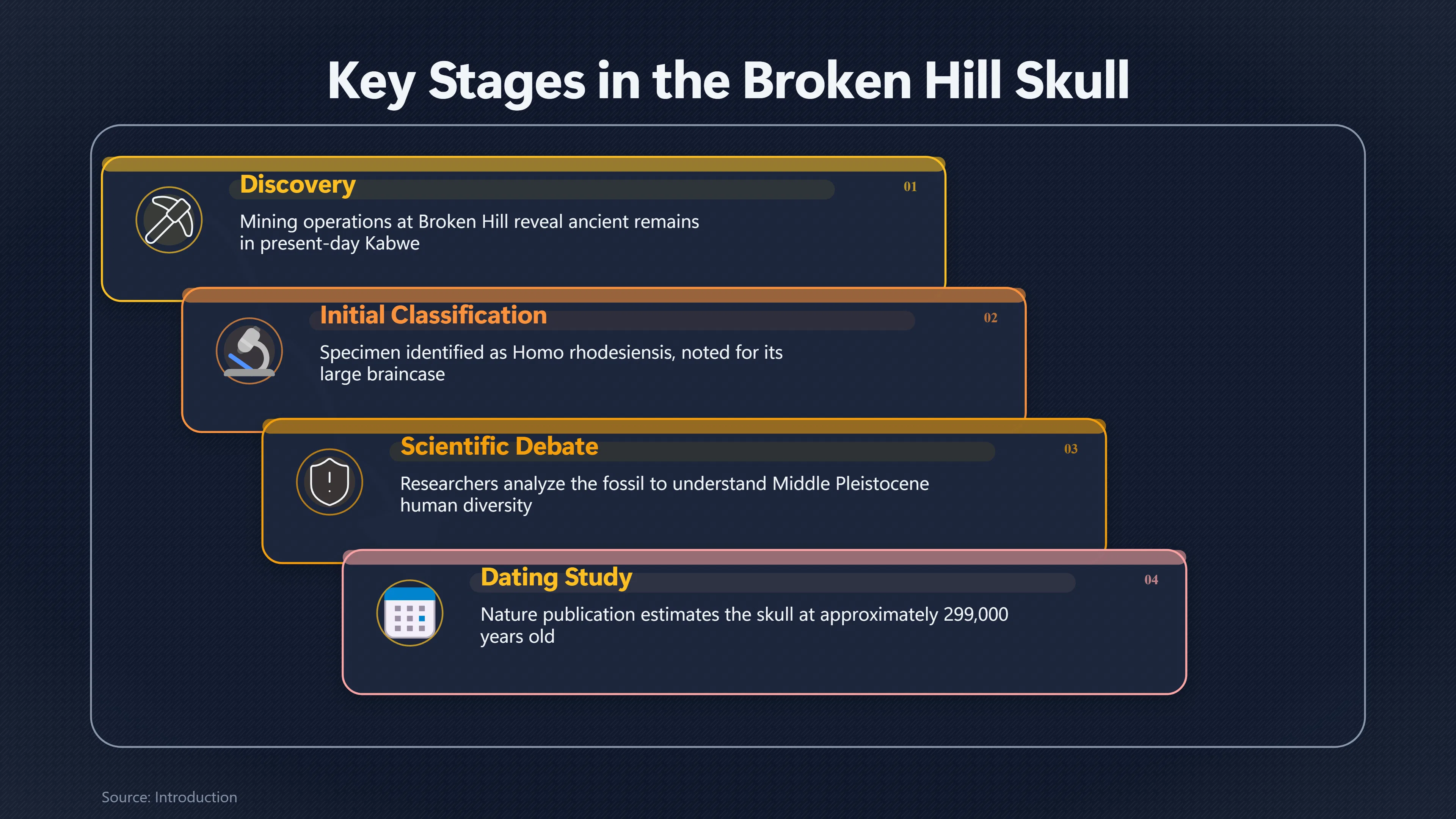
The Broken Hill skull, discovered in 1921 at the Broken Hill mine near present-day Kabwe, is among the most significant fossil discoveries in African archaeology. Found during mining operations, the skull became a key specimen in debates about human evolution because it preserved a combination of ancient-looking features and a relatively large braincase. It was originally classified as Homo rhodesiensis and has often been discussed within the broader group of Homo heidelbergensis.[Nature]nature.comDating the skull from Broken Hill, Zambia, and its position in human evolution | NatureApril 1, 2020…
What makes the find especially important is not simply its age, but the questions it raises. Earlier estimates often placed the fossil much further back in time, but direct dating research published in Nature estimated the skull at about 299,000 years old, with a margin of uncertainty. This younger age suggested that Africa’s human past was more complex than a simple sequence of one species replacing another. Different human groups may have existed alongside each other during the Middle Pleistocene period.[Nature]nature.comDating the skull from Broken Hill, Zambia, and its position in human evolution | NatureApril 1, 2020…
For visitors, the Broken Hill evidence turns a museum display into a much bigger story. The object is not just an old skull; it is a physical record of changing scientific ideas. Every new dating method, comparison and analysis can alter how researchers understand the relationship between ancient populations and modern humans.[Natural History Museum]nhm.ac.ukOpen source on nhm.ac.uk.
A fossil with a complicated history
The story of Broken Hill also shows why archaeology is rarely simple. The original mining context was damaged by quarrying, making later scientific work more difficult. Researchers have had to reconstruct the fossil’s history from the skull itself and from surviving associated evidence rather than from a perfectly preserved archaeological site.[Nature]nature.comDating the skull from Broken Hill, Zambia, and its position in human evolution | NatureApril 1, 2020…
This uncertainty does not make the discovery less valuable. Instead, it demonstrates how archaeologists work: weighing evidence, revising interpretations and separating what is directly known from what remains debated.
Stone tools and ancient technologies
The Livingstone Museum’s archaeology collections extend far beyond fossils. The museum’s archaeology section, established in 1957, developed from research into Zambia’s Stone Age past and now contains more than 3,000 archaeological collections. These materials help researchers understand how people made tools, obtained food and adapted to changing environments.[livingstonemuseum.org]livingstonemuseum.orgResearch Archaeology | Livingstone MuseumResearch Archaeology | Livingstone Museum
The archaeology gallery presents technological changes across long periods of human history. Stone tools show early methods of cutting, scraping and processing materials, while later objects demonstrate developments connected with farming, pottery production, metalworking and trade.[livingstonemuseum.org]livingstonemuseum.orgArchaeology Gallery | Livingstone MuseumArchaeology Gallery | Livingstone Museum
Several archaeological sites represented through the museum’s collections help create this wider picture:
- Broken Hill (Kabwe): known for the famous hominin fossil and associated prehistoric material.[livingstonemuseum.org]livingstonemuseum.orgArchaeology Gallery | Livingstone MuseumArchaeology Gallery | Livingstone Museum
- Nachikufu Caves near Mpika: important for understanding Stone Age occupation and ancient lifeways in Zambia.[livingstonemuseum.org]livingstonemuseum.orgArchaeology Gallery | Livingstone MuseumArchaeology Gallery | Livingstone Museum
- Ing’ombe Ilede near Siavonga: known for evidence of later settlement, trade and copper-related activity.[livingstonemuseum.org]livingstonemuseum.orgArchaeology Gallery | Livingstone MuseumArchaeology Gallery | Livingstone Museum
- Sibusenga in Kazungula: another site contributing evidence for Zambia’s archaeological record.[livingstonemuseum.org]livingstonemuseum.orgArchaeology Gallery | Livingstone MuseumArchaeology Gallery | Livingstone Museum
Together, these objects challenge the idea that archaeology is only about spectacular discoveries. Much of the evidence consists of modest things: chipped stone, broken vessels or fragments of tools. Their importance comes from what they reveal about human choices and skills.

Why ordinary objects become archaeological mysteries
A stone tool may look like a simple piece of rock, but archaeologists examine its shape, manufacture marks, location and relationship with other finds to understand how it was used. A fragment of pottery can reveal changes in food preparation, settlement patterns and social organisation. A piece of metalwork can show connections between communities through exchange and trade.[livingstonemuseum.org]livingstonemuseum.orgArchaeology Gallery | Livingstone MuseumArchaeology Gallery | Livingstone Museum
This is what makes Livingstone Museum’s archaeological collections unusual within Zambia’s curiosity landscape. The “mystery” is not that the objects have unexplained powers; it is that everyday things can preserve traces of people who left no written records. A small artefact can contain evidence of movement, technology, diet, craftsmanship and contact between communities.
The museum also shows how archaeology connects different periods rather than separating them. The story moves from early human adaptation to later societies that produced pottery, practised agriculture and participated in regional trade networks.[livingstonemuseum.org]livingstonemuseum.orgArchaeology Gallery | Livingstone MuseumArchaeology Gallery | Livingstone Museum
Why Livingstone Museum’s archaeology matters today
Livingstone Museum is one of Zambia’s oldest and largest museums, operating under the National Museums Board and preserving collections in archaeology, history, ethnography and natural history. Its archaeological holdings are part of a national effort to document and interpret Zambia’s movable heritage.[livingstonemuseum.org]livingstonemuseum.orgABOU T US | Livingstone MuseumABOU T US | Livingstone Museum
For visitors interested in unusual history, the archaeology collection offers a different kind of wonder from folklore or supernatural exhibits. Its remarkable objects are not mysterious because they are impossible to explain; they are remarkable because they provide rare evidence of real human lives stretching far beyond written history.
The Broken Hill skull remains the headline discovery, but the deeper value of the collection lies in the thousands of quieter clues around it. Together, they show Zambia not as a place with a short recorded history, but as a landscape shaped by hundreds of thousands of years of human creativity, adaptation and survival.[livingstonemuseum.org]livingstonemuseum.orgResearch Archaeology | Livingstone MuseumResearch Archaeology | Livingstone Museum

Amazon book picks
Further Reading
Books and field guides related to Ancient Clues Hidden in Zambia's Archaeological Collections. Use these as the next step if you want deeper reading beyond the article.
Sapiens: A Brief History of Humankind
One hundred thousand years ago, at least six human species inhabited the earth. Today there is just one. Us. Homo sapiens. How did our sp...
The Archaeology of Africa: Food, Metals and Towns
Africa has a vibrant past. It emerges from this book as the proud possessor of a vast and highly complicated interweaving of peoples and...
eBay marketplace picks
Marketplace Samples
Example marketplace items related to this page. Use the search link to explore similar finds on eBay.
Selected fromancient artifact replica oneBay.co.uk.
Endnotes
1.
Source: livingstonemuseum.org
Title: Archaeology Gallery | Livingstone Museum
Link:https://livingstonemuseum.org/archaeology-gallery/
2.
Source: nature.com
Link:https://www.nature.com/articles/s41586
Source snippet
Dating the skull from Broken Hill, Zambia, and its position in human evolution | NatureApril 1, 2020...
Published: April 1, 2020
3.
Source: livingstonemuseum.org
Title: Research Archaeology | Livingstone Museum
Link:https://livingstonemuseum.org/research-archaeology/
4.
Source: livingstonemuseum.org
Title: Research & Collections | Livingstone Museum
Link:https://livingstonemuseum.org/research-collections/
5.
Source: livingstonemuseum.org
Title: ABOU T US | Livingstone Museum
Link:https://livingstonemuseum.org/about-us/
6.
Source: nature.com
Title: Podcast: Dating an ancient hominid skull, and an ancient Antarctic rainforest
Link:https://www.nature.com/articles/d41586-020-00985-7
7.
Source: livingstonemuseum.org
Link:https://livingstonemuseum.org/research-page/
8.
Source: livingstonemuseum.org
Link:https://livingstonemuseum.org/research-ethnography/
9.
Source: livingstonemuseum.org
Title: temporary exhibits
Link:https://livingstonemuseum.org/temporary-exhibits/
10.
Source: livingstonemuseum.org
Link:https://livingstonemuseum.org/natural-history-gallery/
11.
Source: livingstonemuseum.org
Link:https://livingstonemuseum.org/facilities/
12.
Source: livingstonemuseum.org
Link:https://livingstonemuseum.org/david-livingstone-gallery/
13.
Source: zambia.travel
Link:https://www.zambia.travel/livingstonemuseum.html
14.
Source: zambia.travel
Link:https://www.zambia.travel/nachikufu.html
15.
Source: nhm.ac.uk
Link:https://www.nhm.ac.uk/discover/news/2020/april/dating-the-broken-hill-skull–homo-heidelbergensis.html
16.
Source: africa-research.org
Title: Livingstone Museum
Link:https://africa-research.org/livingstone-museum/
Source snippet
Africa ResearchMay 3, 2026 — LIVINGSTONE MUSEUM Prev Article Next Article Image: Livingstone Museum LIVINGSTONE MUSEUM Museum profile LIV...
Published: May 3, 2026
17.
Source: australian.museum
Title: Homo heidelbergensis
Link:https://australian.museum/learn/science/human-evolution/homo-heidelbergensis/
18.
Source: nhm.ac.uk
Link:https://www.nhm.ac.uk/our-science/services/collections/palaeontology/palaeoanthropology.html
19.
Source: si.edu
Link:https://www.si.edu/object/homo-heidelbergensis%3Adpo_3d_200068
20.
Source: humanorigins.si.edu
Title: homo heidelbergensis
Link:https://humanorigins.si.edu/evidence/human-fossils/species/homo-heidelbergensis
21.
Source: zambiatourism.com
Link:https://www.zambiatourism.com/towns/livingstone/
22.
Source: openafrica.org
Title: Livingstone Museum
Link:https://openafrica.org/participant/livingstone-museum/
Additional References
23.
Source: pubmed.ncbi.nlm.nih.gov
Link:https://pubmed.ncbi.nlm.nih.gov/32296179/
Source snippet
Dating the skull from Broken Hill, Zambia, and its position in human evolution - PubMed...
24.
Source: youtube.com
Title: The Livingstone Museum Traces Local History & Archaeology
Link:https://www.youtube.com/watch?v=X5jQkFaoFIQ
Source snippet
Professor Larry Barham on discovering the world's oldest wooden structure...
25.
Source: link.springer.com
Link:https://link.springer.com/article/10.1007/s10437-025-09642-8
Source snippet
heidelbergensis and The Origins of The Middle Stone Age: The Kabwe (Broken Hill) Lithic Assemblage | African Archaeological Review | Spri...
26.
Source: whc.unesco.org
Link:https://whc.unesco.org/en/tentativelists/6991/
Source snippet
unesco.orgIng’ombe Ilede Archaeological site - UNESCO World Heritage CentreMarch 5, 2026 — ING’OMBE ILEDE ARCHAEOLOGICAL SITE Zambia Date...
Published: March 5, 2026
27.
Source: nmb.co.zm
Link:https://nmb.co.zm/livingstone-museum/
28.
Source: nmb.co.zm
Link:https://nmb.co.zm/
29.
Source: openresearch-repository.anu.edu.au
Link:https://openresearch-repository.anu.edu.au/handle/1885/219269
30.
Source: eprints.soton.ac.uk
Link:https://eprints.soton.ac.uk/439146/
31.
Source: discovery.ucl.ac.uk
Link:https://discovery.ucl.ac.uk/id/eprint/10219096/
32.
Source: researchportalplus.anu.edu.au
Link:https://researchportalplus.anu.edu.au/en/publications/dating-the-skull-from-broken-hill-zambia-and-its-position-in-huma/