Within South Sudan Curiosities
Inside South Sudan's Cabinet of Paper Memory
Fragile government records preserve vanished districts, disputes and daily colonial administration more vividly than many conventional exhibits.
On this page
- What survives in the national archive
- How war, heat and flooding endangered the records
- Digitisation and the limits of public access
Page outline Jump by section
Introduction
South Sudan’s National Archives are not a curiosity museum in the conventional sense, yet they function as one of the country’s most remarkable hidden collections. Instead of displaying unusual objects in glass cases, they preserve thousands of fragile paper records that capture vanished districts, forgotten settlements, colonial administration, court cases, health reports, tribal negotiations and the everyday routines of government across more than a century. For anyone interested in unusual collections, the archive offers a different kind of cabinet of curiosity: one assembled from files rather than artefacts.
Unlike a public museum designed around visitors, the archive is primarily a working research collection. Its value lies in preserving evidence that survived decades of conflict, institutional upheaval and a tropical climate that is hostile to paper. The result is a repository where an ordinary folder may reveal a disappeared administrative district, an abandoned transport route or a detailed account of local disputes that exists nowhere else. UNESCO and South Sudan’s Ministry of Culture have increasingly presented these records not simply as government paperwork, but as part of the country’s cultural heritage.[UNESCO]unesco.orgThe National Archives make a statement at the Parliament of SouthThe National Archives make a statement at the Parliament of SouthNovember 10, 2017…
What survives in the national archive
Seen through the lens of curiosity culture, the archive resembles a vast paper cabinet whose contents document lives and places that have often vanished from the modern landscape.
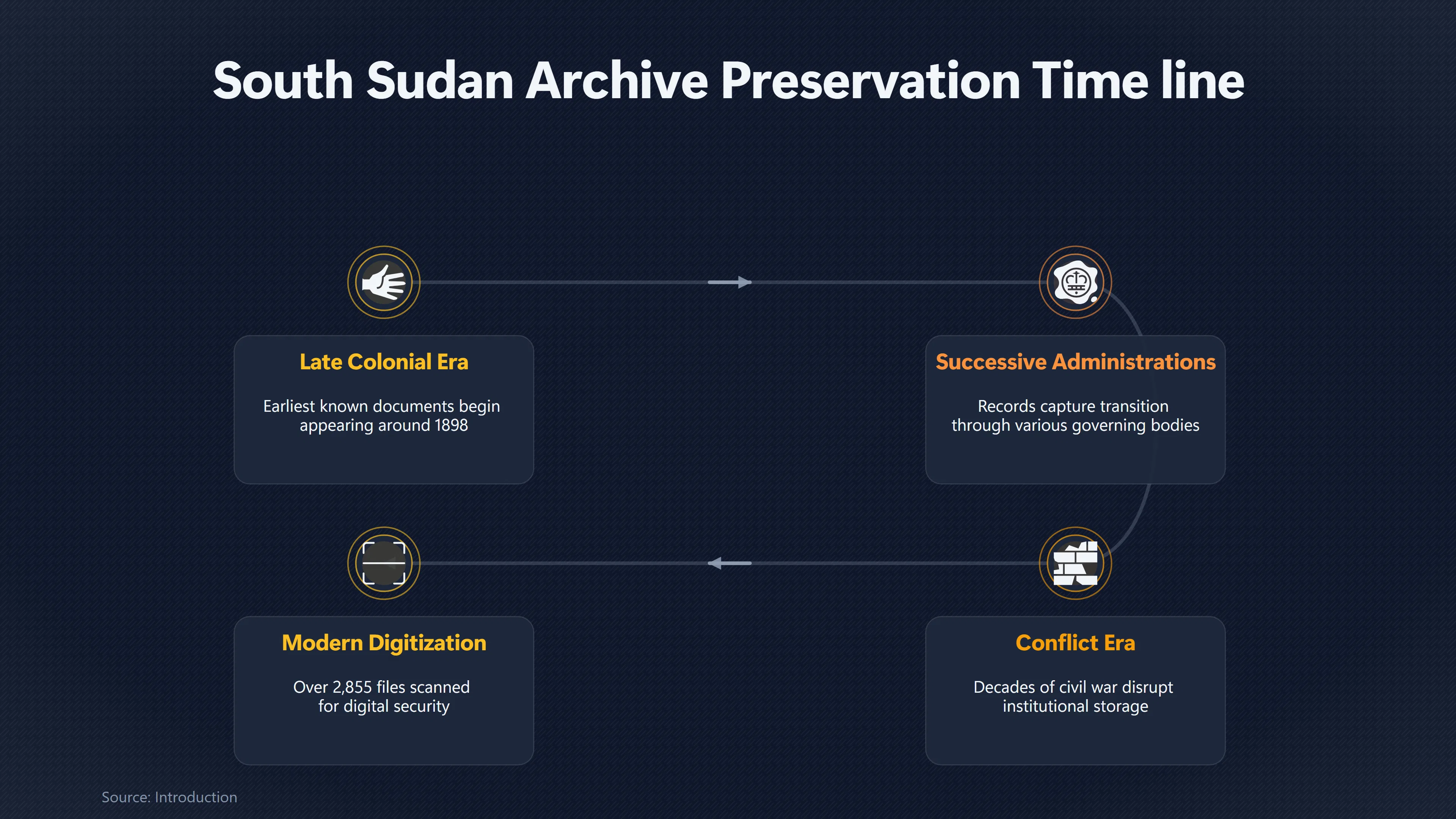
The surviving collection contains more than 8,000 files stored in over 3,000 archival boxes. The oldest known documents date from around 1898, spanning the late colonial period through successive administrations and into the era preceding South Sudan’s independence. Rather than focusing only on major political events, the files preserve the everyday machinery of government.[mcmnh.gov.ss]mcmnh.gov.ssOpen source on mcmnh.gov.ss.
Among the most distinctive record groups are:
- Colonial administrative correspondence and district files.
- Annual district reports describing local economies, transport, education and agriculture.
- Court records documenting disputes, customary law and criminal proceedings.
- “Chief personality sheets” recording information about local leaders and their communities.
- Medical and public health reports showing responses to disease outbreaks and healthcare provision.
- Agricultural and livestock surveys illustrating changing patterns of rural life.
- Transport and communications records that map roads, river routes and infrastructure before later conflicts altered them.
- Files on relationships between communities, including negotiations, conflicts and administrative mediation.[mcmnh.gov.ss]mcmnh.gov.ssOpen source on mcmnh.gov.ss.
What makes these documents unusually compelling is that many describe places whose boundaries, names or administrative structures no longer exist. A single district report can become an unexpected historical snapshot, recording schools, markets, chiefs, rainfall or population movements that disappeared long before satellite mapping or digital government records became commonplace.
The archive therefore operates less like a static historical collection than a time capsule of everyday governance. Researchers often discover details that would never have been considered museum-worthy when they were created but have become rare precisely because so much else has been lost.
How war, heat and flooding endangered the records
The survival of South Sudan’s archives is remarkable because paper records are exceptionally vulnerable in the country’s environment.
Decades of civil war disrupted government institutions, damaged storage facilities and displaced trained staff. At various points, preserving archives understandably became secondary to immediate humanitarian and security concerns. Every institutional move increased the risk of files being scattered, neglected or destroyed. UNESCO has repeatedly described the archive as a collection requiring active rescue rather than routine maintenance.[UNESCO]unesco.orgThe National Archives make a statement at the Parliament of SouthThe National Archives make a statement at the Parliament of SouthNovember 10, 2017…
Climate poses an equally persistent threat. High temperatures accelerate the deterioration of paper, adhesives and photographic materials, while humidity encourages mould and insect damage. Seasonal flooding threatens buildings and storage conditions in parts of the country, making environmental control particularly difficult where infrastructure and electricity supplies remain unreliable. These pressures mean that preserving archives in South Sudan is an ongoing conservation challenge rather than a one-time rescue effort.[UNESCO]unesco.orgThe National Archives make a statement at the Parliament of SouthThe National Archives make a statement at the Parliament of SouthNovember 10, 2017…
Unlike dramatic stories of lost treasure, the danger here is gradual. Ink fades, bindings weaken, folders become brittle and administrative files quietly disappear through neglect. The cumulative effect can erase entire chapters of local history without attracting public attention.

Why ordinary files become extraordinary curiosities
Many curiosity museums celebrate rare objects because only one survives. South Sudan’s archives achieve something similar through paperwork.
A routine veterinary report may become the only surviving written description of livestock management in a particular district. A health inspection can document settlements that later disappeared during conflict. Court records preserve personal names and family relationships absent from published histories. Administrative correspondence sometimes records negotiations between communities that were never formally chronicled elsewhere.
One revealing statistic illustrates what researchers value most. According to the Ministry of Culture, the archive’s most frequently consulted materials are the inter-tribal files. These records are not sought because they are sensational but because they provide detailed evidence of local relationships, conflict resolution and governance that remains relevant to historians, anthropologists and policymakers alike.[mcmnh.gov.ss]mcmnh.gov.ssOpen source on mcmnh.gov.ss.
This emphasis distinguishes the collection from a conventional political archive. Instead of preserving only decisions made in capitals, it captures everyday interactions across a vast and diverse territory.
Digitisation and the limits of public access
Digitisation has become the archive’s principal defence against further loss, although it has not transformed the collection into an easily browsed online resource.
The Ministry of Culture reports that more than 2,855 files—representing over 450,000 pages—have been scanned. Digitisation reduces handling of fragile originals while creating security copies that can survive if physical documents deteriorate.[mcmnh.gov.ss]mcmnh.gov.ssOpen source on mcmnh.gov.ss.
UNESCO has also supported public outreach through document exhibitions, including a notable exhibition held in South Sudan’s Parliament in 2017. Rather than presenting spectacular artefacts, the exhibition showcased original archival documents to demonstrate that official records themselves form part of the country’s cultural heritage and collective memory.[UNESCO]unesco.orgThe National Archives make a statement at the Parliament of SouthThe National Archives make a statement at the Parliament of SouthNovember 10, 2017…
Nevertheless, the National Archives remain primarily a research institution rather than a tourist attraction. Comprehensive online access is limited, many records still require on-site consultation, and conservation priorities naturally outweigh visitor services. Practical access may also depend on staffing, preservation work and administrative arrangements that can change over time.
For travellers expecting rows of exhibition cases, the experience would therefore be quite different from visiting a conventional museum. For historians and archivists, however, the attraction lies precisely in the working nature of the collection: shelves filled with original records whose historical value often becomes apparent only when individual files are opened.
A cabinet of paper memory
Within South Sudan’s landscape of unusual heritage, the National Archives occupy a distinctive place. They demonstrate that a country’s strangest and most revealing collection does not have to consist of mysterious relics or eccentric artefacts. Thousands of carefully preserved government files have become historical curiosities because they now outlast many of the landscapes, institutions and communities they originally described.
As South Sudan continues to strengthen preservation and digitisation efforts, the archive serves not only as a repository of administration but also as an unexpected museum of paper memory—one where the most fascinating exhibits are ordinary documents that survived extraordinary circumstances.[mcmnh.gov.ss]mcmnh.gov.ssOpen source on mcmnh.gov.ss.
Amazon book picks
Further Reading
Books and field guides related to Inside South Sudan's Cabinet of Paper Memory. Use these as the next step if you want deeper reading beyond the article.
The Archive and the Repertoire: Performing Cultural Memory in...
An interdisciplinary study about the centrality of performance in Latin American culture and politics.
The Social Life of Information
Understand the human place in a digital world. “Should be read by anyone interested in understanding the future,” The Times Literary Supp...
Silencing the Past: Power and the Production of History
Rating: 4.5/5 from 5 Google Books ratings
Silencing the Past is a thought-provoking analysis of historical narrative. Taking examples ranging from the Haitian Revolution to Columb...
Dust: A History of the Small and the Invisible
A history of dust, discussing dust's role as a condition of life and as a measure of the small until the beginning of the twentieth century.
eBay marketplace picks
Marketplace Samples
Live-tested eBay searches with available results related to this page.
Selected fromhistorical map print oneBay.co.uk.


Endnotes
1.
Source: unesco.org
Title: The National Archives make a statement at the Parliament of South
Link:https://www.unesco.org/en/articles/national-archives-make-statement-parliament-south-sudan
Source snippet
The National Archives make a statement at the Parliament of SouthNovember 10, 2017...
Published: November 10, 2017
2.
Source: mcmnh.gov.ss
Link:https://mcmnh.gov.ss/the-national-archives-in-numbers/
3.
Source: unesco.org
Title: The Role of Archives in Nation Building: Preserving Sudan’s
Link:https://www.unesco.org/en/articles/role-archives-nation-building-preserving-sudans-documentary-heritage
4.
Source: mcmnh.gov.ss
Link:https://mcmnh.gov.ss/
5.
Source: mcmnh.gov.ss
Link:https://mcmnh.gov.ss/catalogue/
6.
Source: mcmnh.gov.ss
Link:https://mcmnh.gov.ss/stages-in-the-development-of-the-national-archives/
7.
Source: mcmnh.gov.ss
Link:https://mcmnh.gov.ss/brief-history/
8.
Source: nationalarchives.gov.uk
Title: Empire and Commonwealth records held by other archives
Link:https://www.nationalarchives.gov.uk/help-with-your-research/research-guides/empire-commonwealth-records-held-by-other-archives/
9.
Source: youtube.com
Title: UNESCO and South Sudan National Archives Safeguards South Sudan’s History
Link:https://www.youtube.com/watch?v=kcVOGfI2vrM
Source snippet
South Sudan builds national archive...
10.
Source: archives.iccrom.org
Link:https://archives.iccrom.org/about
Additional References
11.
Source: parj.africa
Link:https://parj.africa/pajes_accs/article/view/a-research-protocol-for-assessing-environmental-stressors-an
Source snippet
lei State - African Climate Change Science (Earth Science focus)January 26, 2026 — A RESEARCH PROTOCOL FOR ASSESSING ENVIRONMENTAL STRESS...
Published: January 26, 2026
12.
Source: parj.africa
Link:https://parj.africa/pajes_accs/article/download/a-research-protocol-for-assessing-environmental-stressors-an/html/948?inline=1
Source snippet
A Research Protocol for Assessing Environmental Stressors and Climate Resilience in South Sudan: Heat Stress in Juba and Flooding in Jong...
13.
Source: ora.ox.ac.uk
Link:https://ora.ox.ac.uk/objects/uuid%3Aa2f6069d-95b7-44df-8752-f2b515de10fb
Source snippet
Analysis of Population Exposure to Flooding in the Sudd Region, South Sudan - ORA - Oxford University Research ArchiveJanuary 4, 2026 — I...
Published: January 4, 2026
14.
Source: youtube.com
Title: Elders struggle to preserve South Sudan’s history
Link:https://www.youtube.com/watch?v=lczpO9OLZuE
Source snippet
South Sudan National Archives UNESCO UNESCO and South Sudan National Archives Safeguards South Sudan's History UNESCO JUBA...
15.
Source: onlinelibrary.wiley.com
Link:https://onlinelibrary.wiley.com/doi/10.1111/jfr3.70168
Source snippet
Analysis of Population Exposure to Flooding in the Sudd Region, South Sudan - Chol - 2026 - Journal of Flood Risk Management - Wiley Onli...
16.
Source: onlinelibrary.wiley.com
Link:https://onlinelibrary.wiley.com/doi/10.1111/jfr3.70168?af=R
Source snippet
Analysis of Population Exposure to Flooding in the Sudd Region, South Sudan - Chol - 2026 - Journal of Flood Risk Management - Wiley Onli...
17.
Source: wmpllc.org
Link:https://wmpllc.org/ojs/index.php/jem/article/view/3260
18.
Source: iccrom.org
Link:https://www.iccrom.org/resources/records-and-archives
19.
Source: sudanesearchive.org
Link:https://sudanesearchive.org/
20.
Source: iccrom.org
Link:https://www.iccrom.org/resources/records-and-archives/visit-iccrom-archives