Within Czech Curiosities
Why Do Czech Churches Display the Dead?
Sedlec, Brno and the Capuchin crypt reveal how sacred burial places became some of the country's most unusual visitor sites.
On this page
- Sedlec Ossuary as a consecrated bone chapel
- Brno's ossuary and hidden urban burial history
- Natural mummification in the Capuchin crypt
Page outline Jump by section
Introduction
The Czech Republic is home to some of Europe’s most remarkable places where human remains are preserved and displayed, but these sites were not created as spectacles of horror. They developed from Christian traditions of burial, remembrance and contemplation, and they continue to occupy an unusual position between active religious heritage, archaeology and tourism. The country’s best-known examples are the Sedlec Ossuary near Kutná Hora, the vast underground ossuary beneath St James’ Church in Brno, and the Capuchin Crypt in Brno, where naturally mummified bodies remain in their original resting places. Together they show how practical responses to overcrowded cemeteries, changing burial customs and religious beliefs became some of the Czech Republic’s most distinctive visitor attractions.[Sedlec]sedlec.infoOssuary history | SEDLECOssuary history | SEDLEC…
Why do Czech churches display the dead?
Modern visitors often assume that Czech bone chapels were deliberately designed to shock. In reality, they emerged from longstanding Christian customs surrounding burial. Before modern cemeteries expanded beyond town centres, churchyards frequently ran out of space. Older graves were respectfully reopened, skeletal remains were gathered into ossuaries or charnel houses, and the burial ground could then continue serving the community.
Rather than hiding these remains, some churches displayed them as a visible reminder of mortality. The theological message was known as memento mori – “remember that you must die” – encouraging reflection on the temporary nature of earthly life and the Christian hope of resurrection. In this context, bones were not trophies or curiosities but the remains of ordinary believers awaiting the Last Judgement.[Sedlec]sedlec.infoOssuary history | SEDLECOssuary history | SEDLEC…
This distinction remains important today. Although these sites attract dark-tourism interest and are widely photographed, they continue to be interpreted by their custodians primarily as places of remembrance rather than macabre entertainment.
Sedlec Ossuary as a consecrated bone chapel
No Czech bone chapel is better known than the Sedlec Ossuary beneath the Cemetery Church of All Saints near Kutná Hora. The chapel contains the remains of roughly 40,000 people whose bones were transferred from the surrounding cemetery after repeated waves of plague, famine, warfare and ordinary burials filled the available ground during the Middle Ages.[Sedlec]sedlec.infoOssuary history | SEDLECOssuary history | SEDLEC…
According to medieval tradition, the cemetery became especially desirable after the monastery’s abbot reportedly returned from Jerusalem with soil from the Holy Land, scattering it over the burial ground. Whether understood as legend or historical memory, the story helped establish Sedlec as one of central Europe’s most sought-after cemeteries.[Sedlec]sedlec.infoOssuary history | SEDLECOssuary history | SEDLEC…
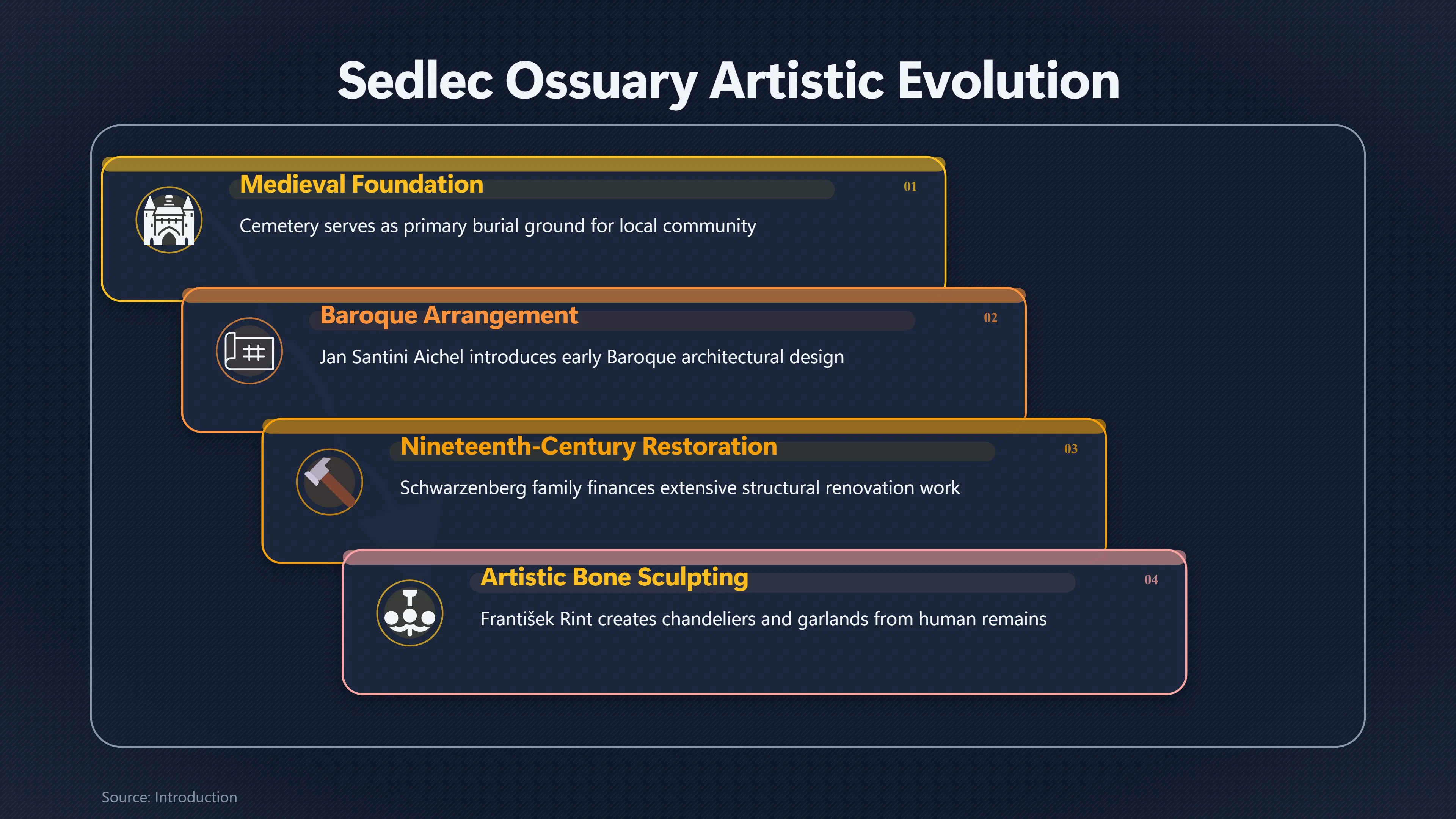
The chapel’s present appearance is largely a nineteenth-century creation rather than a medieval one. Architect Jan Santini Aichel introduced an earlier Baroque arrangement, but the distinctive chandeliers, garlands, pyramids and the famous Schwarzenberg coat of arms made from human bones were created around 1870 by woodcarver František Rint after the Schwarzenberg family financed extensive restoration work. His intervention transformed orderly bone storage into an extraordinary artistic interior while still using the remains of those originally buried there.[Sedlec]sedlec.infoOssuary history | SEDLECOssuary history | SEDLEC…
Today the ossuary remains a functioning Roman Catholic church as well as one of the Czech Republic’s busiest heritage sites. Ongoing conservation work reflects the challenge of preserving both the historic building and thousands of human remains in a humid underground environment without closing the monument to visitors.[Sedlec]sedlec.infoOssuary | SEDLECOssuary | SEDLEC…
Brno’s ossuary and hidden urban burial history
While Sedlec is visually famous, Brno’s ossuary beneath the Church of St James tells a different story. Instead of elaborate decorative bone art, it presents the scale of an early modern city’s burial system.
Excavations during redevelopment in the early twenty-first century revealed an immense underground ossuary containing the remains of tens of thousands of people who had once filled the crowded parish cemetery surrounding St James’ Church. Archaeological research showed that repeated reburial into underground chambers had been a practical response to limited urban space rather than an exceptional event.
The Brno ossuary is frequently described as Europe’s second-largest surviving ossuary after the Paris Catacombs. Its significance lies less in decorative display than in demonstrating how densely populated medieval and early modern towns managed death within their city walls. Visitors encounter stacked skeletal remains, reconstructed burial chambers and archaeological interpretation explaining the city’s forgotten cemetery landscape rather than dramatic artistic arrangements.
Unlike Sedlec, where nineteenth-century design dominates the visitor experience, Brno emphasises archaeology and urban history. The atmosphere is quieter and more documentary, revealing how an ordinary parish cemetery gradually disappeared from the streets above while remaining preserved beneath them.

Natural mummification in the Capuchin crypt
Only a short walk from Brno’s ossuary lies another of the Czech Republic’s most unusual burial sites: the Capuchin Crypt beneath the Church of the Finding of the Holy Cross.
Instead of skeletons, visitors encounter naturally mummified bodies of Capuchin friars and several benefactors buried between 1656 and the reforms of Emperor Joseph II in 1784, when intramural burials were prohibited. Around 150 friars and dozens of benefactors were interred here during that period.[hrobka.kapucini.cz]hrobka.kapucini.czCapuchin Crypt in BrnoCapuchin Crypt in Brno
The preservation was not achieved through embalming. An ingenious system of air circulation, combined with the crypt’s environmental conditions, gradually dried the bodies, allowing natural mummification over centuries. Many of the deceased remain positioned as they were originally laid to rest, making the crypt one of Europe’s most striking examples of accidental preservation through architecture rather than deliberate mummy-making.[Brněnské podzemí]podzemibrno.czBrněnské podzemíCapuchin TombBrno Underground…
Among the best-known burials is the eighteenth-century military commander Franz von der Trenck, whose remains have attracted both historical research and public fascination. Recent studies have even enabled facial reconstruction work based on his preserved remains, demonstrating how the crypt now functions not only as a religious monument but also as an archaeological and historical resource.[hrobka.kapucini.cz]hrobka.kapucini.czCapuchin Crypt in BrnoCapuchin Crypt in Brno
The Capuchin Order continues to stress respectful behaviour. Visitors are reminded that the crypt contains genuine human remains within a still-functioning monastery, and photography is subject to restrictions intended to preserve the site’s dignity.[hrobka.kapucini.cz]hrobka.kapucini.czCapuchin Crypt in BrnoCapuchin Crypt in Brno
Why these places matter beyond their shock value
It is easy to market Czech bone chapels and crypts as “creepy” attractions, yet doing so misses their deeper significance.
Each site reflects a different aspect of how death was understood and managed:
- Sedlec presents bones within a devotional artistic programme shaped by Christian ideas of mortality and resurrection.
- Brno Ossuary explains the practical realities of burial in a growing medieval city and preserves evidence of everyday urban life.
- The Capuchin Crypt demonstrates how monastic burial customs, architecture and natural environmental conditions unexpectedly produced one of Europe’s finest collections of naturally mummified human remains.
Together they also illustrate changing attitudes over time. What began as sacred burial infrastructure has become heritage interpreted through conservation, archaeology, tourism and education. Modern visitors often arrive expecting horror, but most leave with a clearer understanding of historical burial practices, religious symbolism and the practical challenges faced by earlier communities.
Within the Czech Republic’s wider landscape of unusual collections, these sites stand apart because they are neither conventional museums nor theatrical recreations. They remain authentic places where the dead continue to shape how the living understand history, belief and remembrance.[sedlec.info]sedlec.infoOssuary history | SEDLECOssuary history | SEDLEC…
Amazon book picks
Further Reading
Books and field guides related to Why Do Czech Churches Display the Dead?. Use these as the next step if you want deeper reading beyond the article.
From Here to Eternity: Traveling the World to Find the Good D...
The best-selling author ofSmoke Gets in Your Eyes expands our sense of what it means to treat the dead with "dignity."
The Hour of Our Death
An “absolutely magnificent” book (The New Republic)—the fruit of almost two decades of study—that traces the changes in Western attitudes...

The Medieval World: An Illustrated Atlas
First published 2010. Subjects: Civilization, Medieval.
eBay marketplace picks
Marketplace Samples
Live-tested eBay searches with available results related to this page.
Selected fromgothic skull decor oneBay.co.uk.
Endnotes
1.
Source: sedlec.info
Title: Ossuary history | SEDLEC
Link:https://www.sedlec.info/en/ossuary/history/
Source snippet
Ossuary history | SEDLEC...
2.
Source: sedlec.info
Title: Ossuary | SEDLEC
Link:https://www.sedlec.info/en/ossuary/
Source snippet
Ossuary | SEDLEC...
3.
Source: hrobka.kapucini.cz
Title: Capuchin Crypt in Brno
Link:https://hrobka.kapucini.cz/en/crypt-history
4.
Source: hrobka.kapucini.cz
Title: Capuchin Crypt in Brno
Link:https://hrobka.kapucini.cz/en
5.
Source: hrobka.kapucini.cz
Title: Capuchin Crypt in Brno
Link:https://hrobka.kapucini.cz/en/for-tourists
6.
Source: hrobka.kapucini.cz
Title: Capuchin Crypt in Brno
Link:https://hrobka.kapucini.cz/en/visiting-rules
7.
Source: sedlec.eu
Title: , počet vesnic v českém království rozmnožil Sedlec. Jméno
Link:https://www.sedlec.eu/obec/historie/sedlec/
Source snippet
Oficiální stránky obce Sedlec u Českých BudějovicJuly 14, 2026 — SEDLEC HISTORIE OBCE SEDLECIMAGE: HISTORIE Patrně už za blahé p...
Published: July 14, 2026
8.
Source: hrobka.kapucini.cz
Link:https://hrobka.kapucini.cz/en/contacts
9.
Source: hrobka.kapucini.cz
Link:https://hrobka.kapucini.cz/en/news/a/evening-guided-crypt-tour
10.
Source: sedlec.info
Link:https://www.sedlec.info/en/cathedral/history/
11.
Source: sedlec.info
Link:https://www.sedlec.info/en/cathedral/
12.
Source: sedlec.info
Title: For media | SEDLECSEDLEC PRESS KIT Here you will find all
Link:https://sedlec.info/en/for-media-presskit/
13.
Source: sedlec.info
Link:https://sedlec.info/en/
14.
Source: sedlec.info
Link:https://www.sedlec.info/en/about-the-parish/
15.
Source: sedlec.info
Link:https://www.sedlec.info/en/ossuary/repair/
16.
Source: podzemibrno.cz
Title: Brněnské podzemíCapuchin Tomb
Link:https://podzemibrno.cz/en/places/capuchin-crypt/
Source snippet
Brno Underground...
17.
Source: sedlecossuary.com
Title: Sedlec Ossuary History – Sedlec Ossuary
Link:https://sedlecossuary.com/sedlec-ossuary-history/
18.
Source: sedlecossuary.com
Link:https://sedlecossuary.com/sedlec-ossuary-facts/
19.
Source: podzemibrno.cz
Title: Grobowiec Kapucynów
Link:https://podzemibrno.cz/pl/miejsca-pod-ziemia/grobowiec-kapucynow/
Additional References
20.
Source: worldhistory.org
Title: Mummies in the Capuchin Crypt of Brno
Link:https://www.worldhistory.org/image/19108/mummies-in-the-capuchin-crypt-of-brno/
Source snippet
World History EncyclopediaJune 13, 2024 — MUMMIES IN THE CAPUCHIN CRYPT OF BRNO Image: Ibolya Horváth by Morgan Davis published on 13 Jun...
Published: June 13, 2024
21.
Source: stellplatzbrno.cz
Title: Capuchin Crypt Stellplatzbrno.cz
Link:https://www.stellplatzbrno.cz/en/blog/capuchin-crypt
Source snippet
June 6, 2024 — Image: Capuchin Crypt CAPUCHIN CRYPT Napsal(a): Stellplatzbrno.cz, Publikováno: 06.06.2024 (Vytvořeno: 06.06.2024) V kateg...
Published: June 6, 2024
22.
Source: youtube.com
Title: Let’s Visit the Churches Made of Human Skulls
Link:https://www.youtube.com/watch?v=eznm5GUWtiA
Source snippet
"Bone Church | 100 Wonders | Atlas Obscura[https://www.youtube.com/watch?v=p6Aun5jM7k4..."](https://www.youtube.com/watch?v=p6Aun5jM7k4...")...
23.
Source: youtube.com
Title: The Bone Church: Secrets and Mysteries in Czechia
Link:https://www.youtube.com/watch?v=yTo6PSBl1sM
Source snippet
"The Capuchin Crypt in Brno[https://www.youtube.com/watch?v=5g9H2cyGlno..."](https://www.youtube.com/watch?v=5g9H2cyGlno...")...
24.
Source: visitbrno.cz
Link:https://www.visitbrno.cz/cz/zazitky-brno/kapucinska-hrobka/14-663/
25.
Source: visitczechia.com
Link:https://www.visitczechia.com/en-us/things-to-do/places/landmarks/religious-monuments/c-brno-capuchin-crypt
26.
Source: youtube.com
Link:https://www.youtube.com/watch?v=5g9H2cyGlno
Source snippet
"She was accidentally buried with these mummies | Capuchin Crypt | Brno[https://www.youtube.com/watch?v=8q2j6871L3c..."](https://www.youtube.com/watch?v=8q2j6871L3c...")...