Where Did Liberia's Strangest Collections Go?
Liberia does not have a well-developed circuit of specialist museums devoted to witchcraft, cryptids, medical oddities or sensational curiosities.
Page outline Jump by section
Introduction
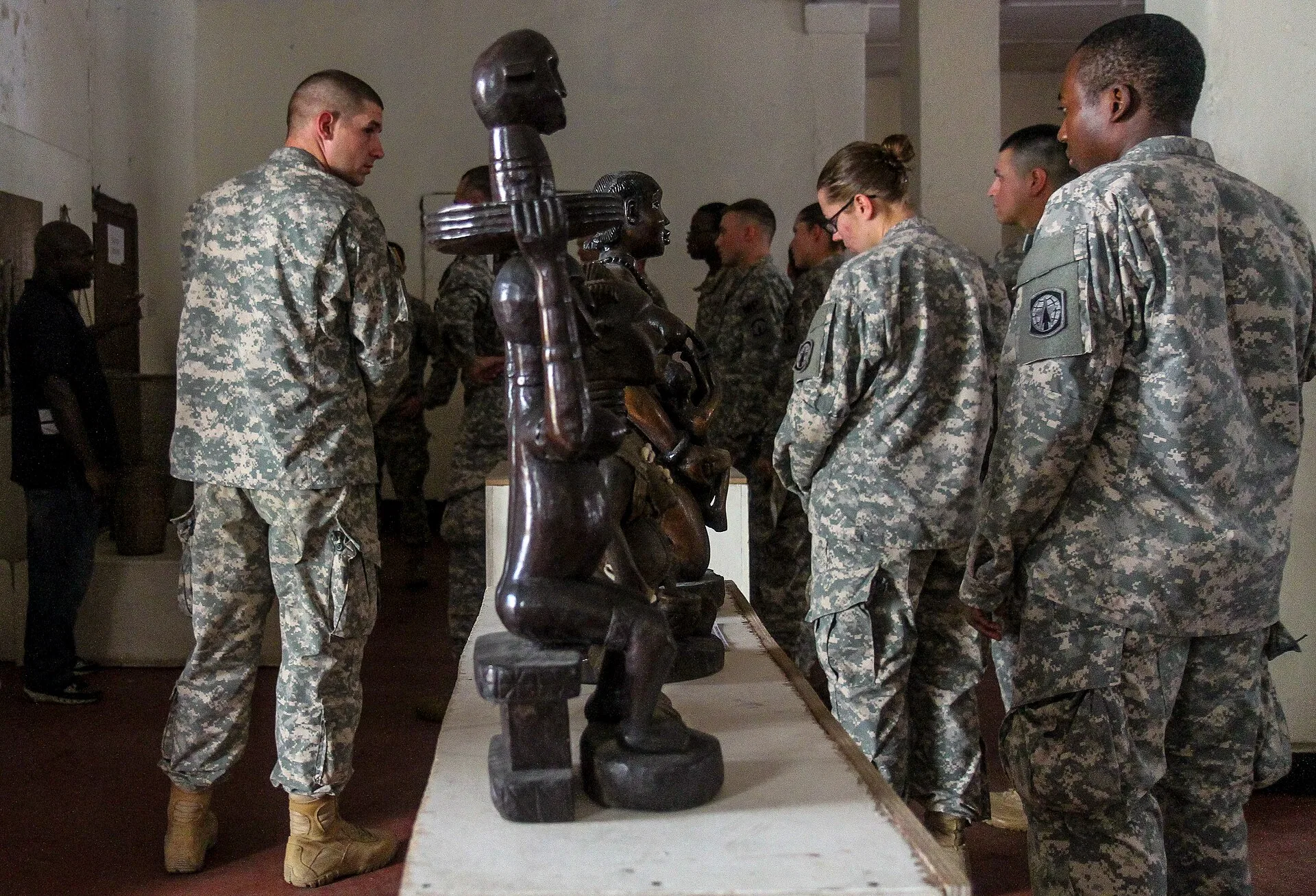
The National Museum of Liberia in Monrovia is the main public starting point. Visitors can expect a compact mixture of historic documents, political memorabilia, masks, carvings, domestic objects and contemporary art rather than a polished cabinet of horrors. The unusual quality lies in the gaps. Much of the original collection was looted or destroyed, so the museum is simultaneously a display of Liberian history and evidence of how cultural memory can be dispersed. Liberia’s strangest collections are therefore often found in fragments: surviving objects in Monrovia, the remains of the former Kendeja cultural centre, and ritual masks or divination equipment catalogued in foreign museums.[monrovia.gov.lr]monrovia.gov.lrMonrovia City CorporationNational MuseumHistographical Gallery (Ground Floor): Features presidential papers, photographs, maps, and early…
The National Museum’s surviving cabinet of memory
The National Museum occupies the former Supreme Court building on Broad Street in central Monrovia. It was established by legislation in 1958 to collect, preserve and display objects representing the country’s history and cultural traditions. Its present arrangement is commonly described as three broad layers: a historical gallery, an ethnographic gallery and a contemporary-art section.[GAC Liberia]gac.gov.lrGAC Liberia Liberian Code of Laws Revised Executive LawDepartment of Information and Cultural Affairs. § 2. Title 33 of the Liberian Code of…Read more…
The historical displays combine state history with objects that feel closer to a traditional curiosity cabinet. Published descriptions mention presidential papers, photographs, maps, postage stamps, early newspapers and Liberia’s first national flag. Other reported exhibits have included historic furniture, traditional utensils, carved figures, masks, a large ceremonial drum and presidential vehicles. Their presentation is not always supported by the extensive labels, controlled lighting or interactive interpretation expected in wealthier national museums. The experience is closer to entering a vulnerable storehouse of national memory.[monrovia.gov.lr]monrovia.gov.lrMonrovia City CorporationNational MuseumHistographical Gallery (Ground Floor): Features presidential papers, photographs, maps, and early…
That modest scale should not be mistaken for a lack of importance. Liberia’s modern national story connects Indigenous societies, the settlement of formerly enslaved and free Black people from the United States, the creation of the republic in 1847, political upheaval and two civil wars. Placing state documents beside masks and household objects makes visible a tension that runs through Liberian heritage: whose history becomes “national”, and how very different communities are represented within one institution.
What visitors should realistically expect
The museum is public and visitor-facing, but practical information is uneven. Recent third-party listings describe weekday and Saturday opening, although published hours and admission details differ between sources. Anyone planning a visit should confirm locally rather than relying on a single travel page, particularly because renovation, staffing and public access can change without prompt updates online.[tripadvisor.co.uk]tripadvisor.co.ukTripadvisor LIBERIAN NATIONAL MUSEUMLIBERIAN NATIONAL MUSEUM - All You SHOULD Know…20 Feb 2025 — Open weekdays and Saturday till 5pm. Closed Sunday. historical…
This is not a purpose-built occult museum, nor should every mask be read as a magical object. Some objects were connected with initiation, authority, education, mediation, performance or relations with ancestral and spiritual forces. Others were made for ordinary domestic or artistic use. The museum is most rewarding when approached as a surviving national collection whose artefacts require cultural context, not as a room of exotic mysteries.
The strangest exhibit is what is missing
Liberia’s civil wars, fought intermittently between 1989 and 2003, devastated cultural institutions as well as communities. Reports differ over exact totals, but they consistently describe the National Museum’s collection as having been heavily looted, vandalised or destroyed. A 2017 account reported that more than three-quarters of roughly 6,000 pieces had disappeared or been destroyed, while another widely repeated estimate put the loss at about 5,000 artefacts.[theworld.org]theworld.orgmuseum tells liberias storyThe World from PRXMuseum tells Liberia's story10 Mar 2017 — More than three-quarters of those 6,000 pieces were looted or destroyed durin…
Objects were reportedly taken during fighting, sold in informal markets or transferred to buyers leaving the country. Museum buildings themselves came under attack. This produced a particularly unsettling form of display: surviving cases stand in for a much larger collection that can no longer be assembled with certainty.
The losses also complicate provenance, meaning the documented history of an object’s ownership and movement. A Liberian mask in Europe or North America might have been collected during legitimate fieldwork, purchased under unequal colonial-era conditions, sold by its community, removed without adequate consent, or looted during wartime. Superficially similar objects may have entirely different histories. Claims about theft or rightful ownership therefore need object-by-object evidence rather than assumptions based solely on appearance or location.
Liberia’s damaged museum should consequently be understood as part of the country’s post-war landscape. It preserves more than objects: it demonstrates how conflict breaks catalogues, scatters records and turns cultural property into commodities. The missing collection is not a romantic mystery. It is an unresolved question of custody, documentation and cultural repair.
Masks that are more than masks
Liberian masks attract international attention because they can appear uncanny, theatrical or deliberately fearsome. Yet describing them simply as “tribal art” or “witchcraft objects” strips away much of their purpose. In several Liberian traditions, masks are associated with organised societies, community leadership, initiation, moral instruction, dispute settlement and public performance. The carved face is only one part of a complete masquerade involving a performer, costume, movement, music, spectators and rules governing where and when the appearance is appropriate.[lnta.gov.lr]lnta.gov.lrOpen source on lnta.gov.lr.
The Sande and Poro associations provide the best-known examples. Sande is a women’s institution found in parts of Liberia and neighbouring countries, while Poro is generally associated with men. Their activities have varied between communities and historical periods, so broad descriptions must be treated cautiously. Masked appearances may be connected with initiation and social transitions but can also occur at funerals, public celebrations and other significant events.[sfomuseum.org]sfomuseum.orgOpen source on sfomuseum.org.
Sande helmet masks are especially distinctive. They fit over the head rather than covering only the face, and the dancer’s body may be concealed by fibres and cloth. Museum interpretations commonly associate their refined features, glossy surfaces and elaborate hairstyles with ideas about maturity, beauty, discipline and spiritual power. They are frequently described as an unusual African masking tradition because the performances are controlled by a women’s association, although individual carving practices and ritual roles are more complicated than that shorthand suggests.[lnmm.gov.lv]lnmm.gov.lvOpen source on lnmm.gov.lv.
Some masks from eastern Liberia and neighbouring Côte d’Ivoire have rougher surfaces, animal elements or forceful facial forms. Such appearances do not necessarily represent evil. Accounts connect particular masks with protection, entertainment, mediation, law, moral teaching or the public authority of a spirit. An intentionally frightening form may signal power and seriousness rather than malevolence.[University of Groningen]rug.nlOpen source on rug.nl.
When museum labels become misleading
Liberian ritual objects have often been collected by outsiders who attempted to translate local institutions into Western categories such as religion, secret society, policing or theatre. These labels can be useful, but none captures the whole system.
The collection assembled by American medical missionary and anthropologist George Way Harley illustrates the problem. Between the 1930s and 1940s, Harley acquired hundreds of masks, principally among Mano- and Dan-speaking communities in north-eastern Liberia. The Peabody Museum at Harvard now holds a major body of this material. Harley’s writings strongly influenced later interpretations, particularly the idea that masks functioned as “agents of social control”. Subsequent scholarship has examined both the knowledge recorded through his collecting and the unequal circumstances in which many objects passed from Liberian owners into an American museum.[AnthroSource]anthrosource.onlinelibrary.wiley.comj.1548 1379.2009.01018.xj.1548 1379.2009.01018.x
Calling every mask from the region a “Poro mask” can be equally misleading. Objects may belong to different associations, families, spirits, performers or local histories. Some were sacred or restricted; others appeared publicly. Some acquired ceremonial importance over generations, while others may have been made partly or wholly for sale. A museum catalogue can freeze those differences into a single confident label even when the original information is incomplete.
For visitors interested in the uncanny, this uncertainty is part of the real fascination. The question is not whether a mask was “actually magical”. A more useful question is what people believed the masked presence could do, who was authorised to encounter it, and how its meaning changed when it left performance and entered an art market or museum case.
Divination, medicine and the danger of exotic labels
Foreign databases contain Liberian objects catalogued as divination sets, ritual equipment, amulets, medicines and figures. Such categories make the material sound like a ready-made occult collection, but they often compress practices that combined healing, diagnosis, family authority, environmental knowledge and spiritual interpretation.
The Smithsonian’s holdings have been reported as including hundreds of objects attributed to Liberia, ranging from masks and bracelets to divination equipment. Other institutions hold botanical specimens, field notes, photographs and records produced by missionaries, physicians and anthropologists. Together these collections can reveal historical approaches to illness and misfortune, but they also show how local knowledge was removed from the people who practised it.[atlasobscura.com]atlasobscura.comliberia cultural artifacts museum lootAtlas ObscuraLiberia Wants Its Cultural Artifacts Back, Please19 Sept 2017 — In 2005, the BBC reported that there were fewer than 100 obj…
Older collectors sometimes described Indigenous medicine as superstition while simultaneously extracting detailed information about plants, symptoms and treatments. Modern readers should avoid the opposite error of treating every medicinal object as proof of supernatural powers. Healing systems can contain empirically useful plant knowledge, symbolic actions, social support and claims that cannot be scientifically verified, all at the same time.
Objects connected with divination pose similar problems. A divining set may have been used to interpret illness, conflict, suspected wrongdoing or relations with unseen forces. In a Western display it can become an anonymous “fetish”, a term historically used so loosely that it often obscures more than it explains. Responsible curation identifies the community, collector, date, original function and limits of the available evidence.
Kendeja: the lost cultural village
Liberia once had a more immersive national cultural institution at Kendeja, outside Monrovia. Opened in 1964, the National Cultural Centre was designed as a place for performance, crafts and the representation of the country’s varied cultural traditions. Historical descriptions refer to buildings modelled on regional architecture, spaces associated with different communities and a base for the national cultural troupe.[UNESCO Documents]unesdoc.unesco.orgDocuments The National Museum: LiberiaDocuments The National Museum: Liberia
Kendeja was not a strange museum in the conventional sense. It was closer to an open-air cultural village in which architecture, dance, storytelling and crafted objects were meant to be experienced together. That made it particularly relevant to masks and ceremonial arts, which lose much of their meaning when isolated in a glass case.
The centre did not survive the civil-war era as a functioning national institution, and no equivalent national complex has fully replaced it. Its disappearance matters because it removed a setting in which Liberians could interpret their own cultural practices through performance rather than allowing foreign museums to become the most visible custodians of Liberian material culture.[Kendeja Collective]kendeja.coOpen source on kendeja.co.
The remains and memory of Kendeja therefore belong to Liberia’s unusual-collection landscape even though it is not a dependable visitor attraction. It represents a lost museum model: part archive, part theatre, part architectural display and part national cultural experiment.
Liberia’s collections abroad
Anyone trying to understand Liberian masks, ritual arts or historical photography soon discovers that many of the largest accessible collections are outside Liberia. Harvard’s Peabody Museum holds the Harley masks; the Phoebe A. Hearst Museum has important Sande and Poro material; the Smithsonian has exhibited art from Liberia and Sierra Leone; and numerous university and municipal museums hold individual masks, figures and field collections.[wiley.com]anthrosource.onlinelibrary.wiley.comj.1548 1379.2009.01018.xj.1548 1379.2009.01018.x
These holdings can preserve objects, photographs and documentation that might otherwise have been lost. They also create an imbalance. Researchers abroad may have easier access to Liberian heritage than students or community members in Liberia. Museum displays can celebrate carving without discussing who supplied the object, whether its sale was freely negotiated or whether associated knowledge was considered restricted.
The most useful foreign displays are those that resist presenting masks as anonymous monsters. They explain that:
- a museum object was originally part of a moving, costumed performance;
- one design may have different meanings in neighbouring communities;
- collectors sometimes misunderstood or generalised what they were told;
- aesthetic admiration does not settle questions of ownership;
- an object’s survival abroad can be both valuable and politically uncomfortable.
Digital catalogues and virtual projects may improve access, but an image on a screen does not restore local custody, ceremonial relationships or control over interpretation. Digital return is best treated as a tool for research and education, not an automatic substitute for physical restitution or long-term loans.
Witchcraft stories are not museum entertainment
Beliefs about witchcraft remain part of social and political discussion in Liberia, as they do across much of West Africa. Reports and historical records include accusations, ordeals, suspected ritual killings and disputes over unexplained illness or death. These subjects may attract readers seeking dark folklore, but they involve real risks to accused people and should not be converted casually into tourist spectacle.[liberiapastandpresent.org]liberiapastandpresent.orgritual killings and witchcraftritual killings and witchcraft
Liberia has no well-documented public museum devoted specifically to witchcraft. Nor is there strong evidence for a permanent, professionally curated national collection of “witch objects”. Masks, divination equipment and healing materials in ethnographic displays may relate to spiritual beliefs, but that does not make them evidence of criminal magic or a single national occult tradition.
A credible future exhibition could examine witchcraft accusations, traditional justice, healing, law and popular belief, but it would need careful distinctions:
- Belief: what communities or individuals say unseen forces can do.
- Material culture: objects used in healing, protection, divination or ritual.
- Accusation: a claim that a person caused harm through supernatural means.
- Evidence: what can be established through documents, testimony or physical investigation.
- Folklore: stories transmitted and reshaped over time.
- Human consequences: exclusion, violence or punishment directed at alleged practitioners.
Without those distinctions, an exhibition risks reinforcing fear or presenting living traditions as primitive curiosities.
How credible is Liberia’s museum record?
Liberia’s unusual collections are unevenly documented. The National Museum is a real state institution, and its broad history and gallery structure are supported by government, legal and historical sources. The exact number of objects lost during the wars is less certain because reports use different starting totals, definitions and dates. Figures such as 5,000 missing objects or fewer than 100 major pieces remaining should be read as evidence of catastrophic loss rather than as a complete audited inventory.[gac.gov.lr]gac.gov.lrGAC Liberia Liberian Code of Laws Revised Executive LawDepartment of Information and Cultural Affairs. § 2. Title 33 of the Liberian Code of…Read more…
Visitor accounts are useful for identifying what has recently been displayed, but they are not authoritative catalogues. Claims about very old masks, royal gifts or object ages require documentary support that may not be visible in the galleries. Sparse labels can also leave visitors unable to distinguish an original ritual object from a later carving, commissioned artwork or tourist-market piece.
Foreign museum records may offer more detailed dates and acquisition notes, yet they have their own weaknesses. Early collectors sometimes recorded broad ethnic labels, omitted sellers’ names or described complex institutions through assumptions common to their period. A precisely catalogued object is not necessarily a fully understood one.
The strongest approach is to compare several kinds of evidence: Liberian institutional accounts, community knowledge, archival records, collectors’ papers and modern museum research. Where these conflict, uncertainty should remain visible.
Why Liberia matters in strange-museum culture
Liberia’s contribution to the world of unusual museums is not a collection of sensational monsters or preserved hoaxes. It is a more revealing case about what happens when living ritual objects become art, when war turns a national museum into a record of absence, and when a country’s most substantial cultural holdings become easier to see overseas than at home.
For an offbeat traveller, the National Museum is worth visiting precisely because it is not a slick attraction. Its masks, documents, political relics and surviving ethnographic objects sit within a story of interrupted preservation. Kendeja adds the memory of a lost cultural centre where performance and architecture once offered a different way of presenting heritage. International collections then extend the trail into a dispersed, sometimes contested museum network.
The essential caution is to resist the language of exotic horror. Liberian masks are not simply frightening faces; divination objects are not automatic evidence of witchcraft; and incomplete provenance is not an invitation to invent legends. The country’s real curiosity culture lies in the changing lives of objects—performed, collected, stolen, sold, catalogued, reinterpreted and, in some cases, sought again as parts of a national inheritance.
Amazon book picks
Further Reading
Books and field guides related to Where Did Liberia's Strangest Collections Go?. Use these as the next step if you want deeper reading beyond the article.
The Brutish Museums: The Benin Bronzes, Colonial Violence and...
New York Times 'Best Art Books' 2020 'Essential' – Sunday Times 'Brilliantly enraged' - New York Review of Books 'A real game-changer'– E...
Things Fall Apart
First published in 1958, this novel tells the story of Okonkwo, the leader of an Igbo (Ibo) community who is banished for accidentally ki...

The Art of Not Being Governed: An Anarchist History of Upland...
First published 2009. Subjects: Politics and government, Rural conditions, Peasantry, Ethnology, Political activity.
Loot: Britain and the Benin Bronzes
A Prospect Best Book of 2021 ‘A fascinating and timely book.’ William Boyd ‘Gripping…a must read.’ FT ‘Compelling…humane, reasonable, and...
eBay marketplace picks
Marketplace Samples
Live-tested eBay searches with available results related to this page.
Selected fromafrican wall art oneBay.co.uk.


Endnotes
1.
Source: theworld.org
Title: museum tells liberias story
Link:https://theworld.org/stories/2017/03/10/museum-tells-liberias-story
Source snippet
The World from PRXMuseum tells Liberia's story10 Mar 2017 — More than three-quarters of those 6,000 pieces were looted or destroyed durin...
2.
Source: tripadvisor.com
Title: Loved the various
Link:https://www.tripadvisor.com/Attraction_Review-g293805-d2252164-Reviews-Liberian_National_Museum-Monrovia_Montserrado_County.html
Source snippet
Liberian National Museum - All You SHOULD Know Before...We enjoyed the ancient stone sculptures, a score of masks back to the...
3.
Source: sfomuseum.org
Link:https://www.sfomuseum.org/exhibitions/liberian-helmet-masks-sande-and-poro-societies-collections-phoebe-hearst-museum
4.
Source: collections.carlos.emory.edu
Title: Mask of the Sande Society – Works
Link:https://collections.carlos.emory.edu/objects/24204/mask-of-the-sande-society
5.
Source: unesdoc.unesco.org
Title: Documents The National Museum: Liberia
Link:https://unesdoc.unesco.org/ark%3A/48223/pf0000054808
6.
Source: kendeja.co
Link:https://kendeja.co/pages/about
7.
Source: liberiapastandpresent.org
Title: ritual killings and witchcraft
Link:https://www.liberiapastandpresent.org/ritual-killings-and-witchcraft/
8.
Source: archive.org
Link:https://archive.org/details/collectionofrare00websiala
9.
Source: unesdoc.unesco.org
Link:https://unesdoc.unesco.org/ark%3A/48223/pf0000133487
10.
Source: monrovia.gov.lr
Link:https://monrovia.gov.lr/index.php/national-museum/
Source snippet
Monrovia City CorporationNational MuseumHistographical Gallery (Ground Floor): Features presidential papers, photographs, maps, and early...
11.
Source: atlasobscura.com
Title: liberia cultural artifacts museum loot
Link:https://www.atlasobscura.com/articles/liberia-cultural-artifacts-museum-loot
Source snippet
Atlas ObscuraLiberia Wants Its Cultural Artifacts Back, Please19 Sept 2017 — In 2005, the BBC reported that there were fewer than 100 obj...
12.
Source: gac.gov.lr
Title: GAC Liberia Liberian Code of Laws Revised Executive Law
Link:https://gac.gov.lr/wp-content/uploads/2024/12/Executive-Law-of-1972.pdf
Source snippet
Department of Information and Cultural Affairs. § 2. Title 33 of the Liberian Code of...Read more...
13.
Source: mainlymuseums.com
Title: the national museum of liberia
Link:https://mainlymuseums.com/post/1249/the-national-museum-of-liberia/
Source snippet
Mainly MuseumsThe National Museum of LiberiaThe museum suffered the loss of around 5000 artefacts during the fourteen years of war and is...
14.
Source: tripadvisor.co.uk
Title: Tripadvisor LIBERIAN NATIONAL MUSEUM
Link:https://www.tripadvisor.co.uk/Attraction_Review-g293805-d2252164-Reviews-Liberian_National_Museum-Monrovia_Montserrado_County.html
Source snippet
LIBERIAN NATIONAL MUSEUM - All You SHOULD Know...20 Feb 2025 — Open weekdays and Saturday till 5pm. Closed Sunday. historical...
15.
Source: lnta.gov.lr
Link:https://lnta.gov.lr/16-tribal-masks/
16.
Source: rug.nl
Link:https://www.rug.nl/museum/collections/collection-stories/maskers?lang=en
17.
Source: lnmm.gov.lv
Link:https://lnmm.gov.lv/en/latvian-national-museum-of-art/learn/explore-yourself/tukku-magi-rhythms/helmet-masks
18.
Source: anthrosource.onlinelibrary.wiley.com
Title: j.1548 1379.2009.01018.x
Link:https://anthrosource.onlinelibrary.wiley.com/doi/10.1111/j.1548-1379.2009.01018.x
19.
Source: Wikipedia
Title: George Way Harley
Link:https://en.wikipedia.org/wiki/George_Way_Harley
20.
Source: si.edu
Link:https://www.si.edu/object/siris_sil_663352
21.
Source: anthrosource.onlinelibrary.wiley.com
Link:https://anthrosource.onlinelibrary.wiley.com/doi/10.1111/muan.12171
22.
Source: micat.gov.lr
Link:https://www.micat.gov.lr/
23.
Source: micat.gov.lr
Link:https://www.micat.gov.lr/sites/default/files/documents/The%20Abridged%20version%20of%20the%20SDC.pdf
24.
Source: micat.gov.lr
Link:https://micat.gov.lr/sites/default/files/documents/SERVICE%20DELIVERY%20CHARTER%20%2C%20MINISTRY%20OF%20INFORMATION.pdf
25.
Source: micat.gov.lr
Title: president boakai concludes state visit ethiopia secures
Link:https://www.micat.gov.lr/office/news/newsroom/press-release/president-boakai-concludes-state-visit-ethiopia-secures
26.
Source: digital.library.cornell.edu
Link:https://digital.library.cornell.edu/collections/witchcraft
27.
Source: exhibits.library.cornell.edu
Link:https://exhibits.library.cornell.edu/witchcraft
28.
Source: steller.co
Title: National Museum Of Liberia
Link:https://steller.co/p/national-museum-of-aP5jazpTEgy7FWDznvgAvA
29.
Source: mofa.gov.lr
Title: foreign minister ngafuan launches national committee international
Link:https://www.mofa.gov.lr/media/press-briefings/foreign-minister-ngafuan-launches-national-committee-international
30.
Source: mofa.gov.lr
Title: Daily Media
Link:https://www.mofa.gov.lr/media/media-summaries/daily-media-summary
31.
Source: mofa.gov.lr
Title: Daily Media
Link:https://www.mofa.gov.lr/media/media-summaries/daily-media-summary
32.
Source: mofa.gov.lr
Title: Daily Media
Link:https://www.mofa.gov.lr/index.php/media/media-summaries/daily-media-summary
33.
Source: mofa.gov.lr
Title: Daily Media
Link:https://www.mofa.gov.lr/index.php/media/media-summaries/daily-media-summary
34.
Source: media.nationalarchives.gov.uk
Link:https://media.nationalarchives.gov.uk/index.php/tag/witchcraft/
35.
Source: nationalarchives.gov.uk
Link:https://www.nationalarchives.gov.uk/category/records-2/
Additional References
36.
Source: youtube.com
Title: Iron Ladies of Liberia documentary
Link:https://www.youtube.com/watch?v=MQyt1btts-A
Source snippet
These videos were selected because they provide direct visual context for Monrovia's historical landmarks, cultural performance tradition...
37.
Source: facebook.com
Link:https://www.facebook.com/poaenglish/posts/ghana-welcomes-pledges-by-netherlands-germany-to-return-looted-artifacts/122184846098683092/
38.
Source: facebook.com
Link:https://www.facebook.com/groups/239499183293331/posts/427370277839553/
39.
Source: rietberg.ch
Link:https://rietberg.ch/en/stories/41
40.
Source: facebook.com
Link:https://www.facebook.com/BBCSussex/posts/brighton-hove-museums-is-set-to-return-45-artefacts-to-botswana-following-a-2022/1525278672937747/
41.
Source: nypl.org
Link:https://www.nypl.org/about/locations/schomburg/digital-schomburg/links
42.
Source: dayzeroproject.com
Link:https://dayzeroproject.com/goal/WTjV57Qw
43.
Source: si.edu
Link:https://www.si.edu/object/face-mask%3Anmafa
44.
Source: facebook.com
Link:https://www.facebook.com/lempertz/posts/this-is-a-great-collection-of-very-old-and-well-used-poro-passport-masks-collect/1477042151091026/
45.
Source: expedia.co.uk
Link:https://www.expedia.co.uk/Liberian-National-Museum-Monrovia.d553248621532481020.Attraction