Within Strange Belarus
Inside Belarus's Buried Medieval Wooden Town
Berestye turns an excavated field of medieval timber streets and houses into one of Belarus's most arresting archaeological displays.
On this page
- Excavating the artisans' quarter beneath Brest
- How timber streets and buildings were conserved
- What makes Berestye exceptional and how uniqueness is judged
Page outline Jump by section
Introduction
The Berestye Archaeological Museum is one of Belarus’s most remarkable heritage sites because visitors do not look at reconstructed medieval houses—they stand above the genuine remains of a 13th-century wooden town preserved where it was found. Beneath a vast protective roof in Brest, timber streets, log houses, workshops and thousands of everyday objects survive in their original archaeological context. For anyone interested in unusual museums or archaeological curiosities, Berestye is exceptional not because it promises mystery, but because it demonstrates how extraordinary preservation conditions can make an entire medieval neighbourhood visible centuries later. The site’s reputation rests on careful excavation and conservation rather than sensational claims, although descriptions of its uniqueness are sometimes overstated. The evidence shows that Berestye is genuinely unusual, especially within Europe, while its significance comes from the quality of preservation and the ambitious decision to preserve the settlement in situ rather than remove it to conventional museum displays.[Repozytorium UR]repozytorium.ur.edu.plsentwicklung…
Excavating the artisans’ quarter beneath Brest
The medieval town of Berestye lay beneath what later became part of the Brest Fortress. Large-scale archaeological excavations began in the late 1960s under the direction of archaeologist Piotr Lysenko and continued for more than a decade. Instead of uncovering isolated buildings, archaeologists exposed part of a densely occupied urban neighbourhood dating mainly to the 13th century.[Repozytorium UR]repozytorium.ur.edu.plsentwicklung…
What emerged was an unusually complete slice of medieval town life. Excavators identified:
- Timber streets laid with wooden logs.
- Rows of log-built houses arranged along planned streets.
- Workshops and outbuildings associated with crafts and domestic production.
- Wells, ovens and fences that revealed how urban plots were organised.
- Tens of thousands of artefacts, including tools, leather goods, ceramics, jewellery, bone objects and other evidence of everyday life.[Repozytorium UR]repozytorium.ur.edu.plsentwicklung…
Rather than reconstructing these buildings elsewhere, planners chose to preserve part of the excavation exactly where it had been uncovered. In 1982 a large glass, aluminium and concrete structure was built over approximately 1,800 square metres of the excavation, allowing visitors to view the original settlement from raised walkways while protecting the fragile remains from weather.[Wikipedia]WikipediaBerestye Archeological MuseumBerestye Archeological Museum
For visitors, the experience feels unlike a conventional archaeological museum. Instead of display cases containing selected finds, the centrepiece is the excavated town itself, with artefacts providing supporting evidence for the people who once lived there.
How timber streets and buildings were conserved
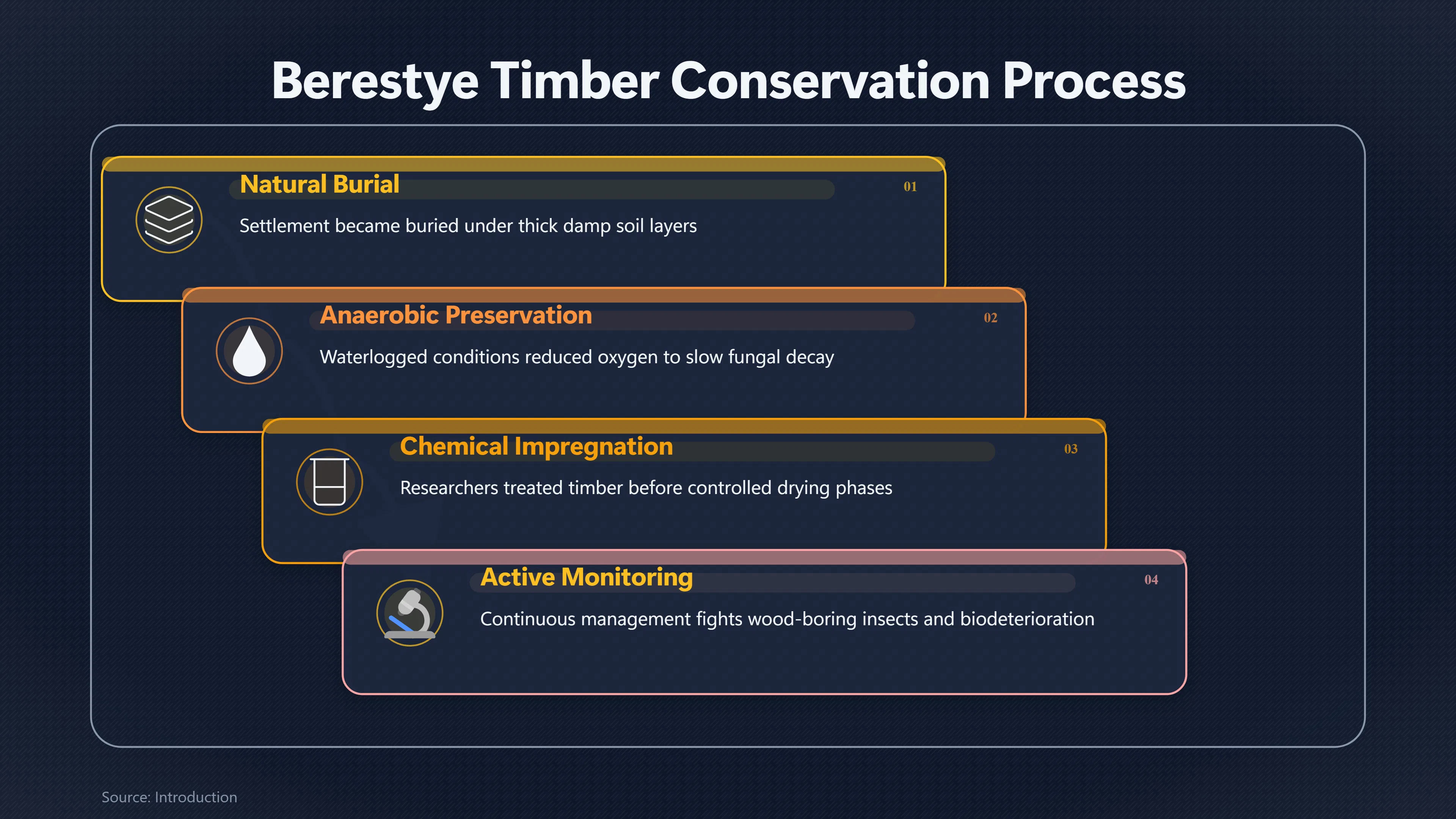
The greatest curiosity at Berestye is not simply that wooden houses survived for around 700 years, but why they survived at all.
Normally, timber decays rapidly once exposed to air and microorganisms. At Berestye, however, the settlement became buried beneath thick, permanently damp layers of soil. These waterlogged conditions greatly reduced oxygen, slowing the fungi and bacteria that normally destroy wood. Similar preservation environments are known from places such as York in England or Novgorod in Russia, but Berestye produced an unusually coherent section of an entire neighbourhood rather than isolated timbers.[Repozytorium UR]repozytorium.ur.edu.plsentwicklung…
The challenge began once archaeologists uncovered the buildings. Waterlogged archaeological wood can shrink, crack and collapse rapidly as it dries. Conservation therefore became almost as significant as excavation.
Researchers developed conservation techniques specifically for the site, including chemical impregnation of archaeological timber before controlled drying and long-term environmental management inside the museum building. Later studies describe continuing work against biological threats such as wood-boring insects and other forms of biodeterioration, demonstrating that preservation remains an active process rather than a completed achievement.[researchgate.net]researchgate.netOpen source on researchgate.net.
This ongoing conservation explains why the museum functions as both a visitor attraction and a long-term preservation project. The buildings are not static relics but fragile archaeological materials requiring continuous monitoring.

What visitors actually see
The surviving remains are lower sections of buildings rather than complete medieval houses with intact roofs and upper walls. This sometimes surprises first-time visitors expecting reconstructed cabins.
Instead, raised viewing platforms overlook:
- Foundations and lower log walls of numerous buildings.
- Preserved timber street surfaces.
- Plot boundaries and settlement layout.
- Original archaeological layers showing how the town developed.
- Museum displays of artefacts recovered during excavation, helping explain daily life, trade and craftsmanship.[Wikipedia]WikipediaBerestye Archeological MuseumBerestye Archeological Museum
Because the settlement remains in its original position, visitors can understand how houses related to one another, how streets were organised and how medieval urban planning functioned in a frontier trading town.
How exceptional is Berestye?
Museum publicity and travel literature often describe Berestye as “unique” or “the only” preserved medieval wooden town in Europe. The evidence supports the site’s exceptional importance, but the wording deserves careful interpretation.
Scholarly publications describe Berestye as the only museum in Europe exhibiting an archaeological site with preserved 13th-century wooden buildings of an East Slavic town in situ beneath a purpose-built museum. That is a much more precise—and more defensible—claim than suggesting no other medieval wooden settlements survive anywhere on the continent.[Repozytorium UR]repozytorium.ur.edu.plsentwicklung…
Other European archaeological sites preserve ancient timber under waterlogged conditions, including Viking-age settlements, prehistoric trackways and medieval urban deposits. What distinguishes Berestye is the combination of:
- A substantial section of an original medieval neighbourhood.
- Preservation in its original location rather than relocation.
- Public access through a dedicated museum built over the excavation.
- Large numbers of associated artefacts providing social and economic context.
- Decades of continuous conservation and museum interpretation.[Repozytorium UR]repozytorium.ur.edu.plsentwicklung…
The museum therefore deserves its reputation as an exceptional archaeological attraction without needing exaggerated claims that no comparable timber archaeology exists elsewhere.

Why Berestye matters in Belarus’s curiosity landscape
Among Belarus’s unusual heritage attractions, Berestye occupies a distinctive position because its sense of wonder comes from scientific preservation rather than folklore or spectacle.
Many unusual museums rely on reconstructed environments, theatrical storytelling or collections assembled over time. Berestye instead allows visitors to encounter an authentic medieval urban landscape where streets and buildings remain where medieval inhabitants left them. The extraordinary survival of organic materials—including wood, leather and other normally perishable objects—offers an unusually intimate view of everyday medieval life that stone ruins rarely provide.[Repozytorium UR]repozytorium.ur.edu.plsentwicklung…
For travellers interested in strange museums and archaeological curiosities, Berestye demonstrates that some of the most remarkable collections are not cabinets filled with odd objects but entire places whose survival seemed unlikely. The buried wooden town beneath Brest remains one of the clearest examples in Europe of how careful excavation, innovative conservation and long-term preservation can transform a fragile archaeological discovery into a public museum without removing it from the ground where it was found.
Amazon book picks
Further Reading
Books and field guides related to Inside Belarus's Buried Medieval Wooden Town. Use these as the next step if you want deeper reading beyond the article.
Archaeology: Theories, Methods and Practice
The most authoritative and up-to-date archaeology textbook, revised and updated, and now in full color.
Belarus
Belarus remains the most inaccessible, unknown and misunderstood country in Europe. This new guide therefore offers a rare opportunity to...

Medieval Europe
First published 2016. Subjects: Middle ages, Social change, Europe, history, 476-1492, Europe, social conditions.
eBay marketplace picks
Marketplace Samples
Live-tested eBay searches with available results related to this page.
Selected frommedieval wall art oneBay.co.uk.



Endnotes
1.
Source: repozytorium.ur.edu.pl
Link:https://repozytorium.ur.edu.pl/items/3c84be18-35d1-4e22-a1a1-9fae091a702b
Source snippet
sentwicklung...
2.
Source: Wikipedia
Title: Berestye Archeological Museum
Link:https://en.wikipedia.org/wiki/Berestye_Archeological_Museum
3.
Source: researchgate.net
Link:https://www.researchgate.net/publication/373561994_Problema_bioporazenij_nasekomymi-drevotoccami_drevesiny_v_raskope_Arheologiceskogo_muzea_Bereste_istoria_borba_perspektivy
4.
Source: brest.fr
Title: Les cimetières de Brest | Brest métropole
Link:https://brest.fr/gerer-mon-quotidien/deces-cimetieres/les-cimetieres-de-brest
Source snippet
June 16, 2026 — LES CIMETIÈRES DE BREST Imprimer Partager * Partagez sur Facebook * Partagez sur LinkedIn * Partagez par email Mise à jou...
Published: June 16, 2026
5.
Source: brest.fr
Title: Cimetière de Saint-Martin | Brest métropole
Link:https://brest.fr/cimetiere-de-saint-martin
Source snippet
May 22, 2026 — CIMETIÈRE DE SAINT-MARTIN Imprimer Partager * Partagez sur Facebook * Partagez sur LinkedIn * Partagez par email Cimetière...
Published: May 22, 2026
6.
Source: brest.fr
Title: Musées et patrimoines | Brest métropole
Link:https://brest.fr/decouvrir-sortir/se-cultiver-se-divertir/musees-et-patrimoines
Source snippet
April 3, 2026 — MUSÉES ET PATRIMOINES Imprimer Partager * Partagez sur Facebook * Partagez sur LinkedIn * Partagez par email Mise à jour...
Published: April 3, 2026
7.
Source: repozytorium.ur.edu.pl
Link:https://repozytorium.ur.edu.pl/browse/dateissued?scope=2de64721-e11f-4b97-acbd-44e1815a63b5
Additional References
8.
Source: mustseespots.com
Link:https://www.mustseespots.com/belarus/articles/berestye-archeological-museum-discover-ancient-brests-wooden-city/
Source snippet
March 23, 2026 — Published on March 23, 2026 BERESTYE ARCHEOLOGICAL MUSEUM: DISCOVER ANCIENT BREST'S WOODEN CITY Nestled beneath a striki...
Published: March 23, 2026
9.
Source: youtube.com
Title: TRAVEL VLOG|| BREST|| БРЕСТСКАЯ КРЕПОСТЬ|| BREST FORTRESS
Link:https://www.youtube.com/watch?v=q2pTsN1RIRw
Source snippet
Berestye Archeological Museum Berestye Archeological Museum Artsiom naslednikau...
10.
Source: pop.culture.gouv.fr
Link:https://pop.culture.gouv.fr/notice/museo/M0197
Source snippet
January 12, 2026 — Ministère de la culture POP Plateforme ouverte du patrimoine [Button: Fermer] Ministère de la Culture POP | Plateforme...
Published: January 12, 2026
11.
Source: youtube.com
Title: THE REAL BELARUS | BREST | You need to see it
Link:https://www.youtube.com/watch?v=hbpy1wliGJ0
Source snippet
TRAVEL VLOG|| BREST|| БРЕСТСКАЯ КРЕПОСТЬ|| BREST FORTRESS...
12.
Source: tury.club
Link:https://tury.club/sight/id/3290
13.
Source: tripadvisor.ca
Link:https://www.tripadvisor.ca/Attraction_Review-g297308-d3337037-Reviews-Berestye_Archeological_Museum-Brest_Brest_District_Brest_Region.html
14.
Source: britishmuseum.org
Link:https://www.britishmuseum.org/our-work/departments/human-remains
15.
Source: icom-cc-publications-online.org
Link:https://www.icom-cc-publications-online.org/5881/History-of-conservation-and-problems-of-storage-and-exhibition-of-individual-wooden-finds-from-Medieval-Berestye
16.
Source: londonmuseum.org.uk
Link:https://www.londonmuseum.org.uk/collections/v/object-318117/revetment-revetment-timber/
17.
Source: londonmuseum.org.uk
Link:https://www.londonmuseum.org.uk/collections/v/object-318191/revetment-revetment-timber/