What Makes Ethiopia's Collections So Unusual?
Ethiopia does not have a large circuit of commercial “weird museums” devoted to witchcraft, cryptids, UFOs or manufactured curiosities. Its stranger collection culture is older, more serious and often harder to classify.
Page outline Jump by section
Introduction
The most rewarding unusual collections therefore sit at the boundary between museum, memorial, laboratory, treasury and place of worship. Some are conventional public institutions in Addis Ababa. Others remain active religious spaces where access depends on local rules, clergy and community consent. Ethiopia’s central curiosity is not simply what has been collected, but what different custodians believe a collection is for: scientific study, public education, prayer, mourning, royal memory or protection from outsiders.

Where Ethiopia’s strangest collections are found
For most visitors, Addis Ababa offers the clearest introduction. The National Museum of Ethiopia, the Ethnological Museum, the Zoological Natural History Museum and the Red Terror Martyrs’ Memorial Museum represent four sharply different ways of preserving difficult or extraordinary material. Together they move from prehuman bones to royal possessions, taxidermied wildlife and evidence of modern atrocity.
Beyond the capital, the country’s most distinctive collections are often held by churches and monasteries rather than state museums. Lake Tana’s religious communities preserve manuscripts, paintings, liturgical objects and royal remains. Aksum combines monumental archaeology with the living tradition that the Ark of the Covenant is kept there, although the claimed relic itself is not a museum exhibit and cannot be inspected by ordinary visitors. UNESCO describes Aksum’s archaeological landscape as including giant stelae, royal tombs, castle remains and other structures dating across more than a millennium.[UNESCO World Heritage Centre]whc.unesco.orgUNESCO World Heritage CentreAksumThe ruins of the ancient city of Aksum are found close to Ethiopia's northern border. They mark the loca…
This difference matters. A display case suggests that an object exists to be looked at. In Ethiopian religious culture, some of the most important objects derive their power precisely from restricted visibility. A sacred object may be wrapped, hidden, carried ceremonially or seen only by authorised clergy. Ethiopia’s curiosity culture therefore includes both spectacular display and deliberate concealment.
Lucy and the museum of deep human time
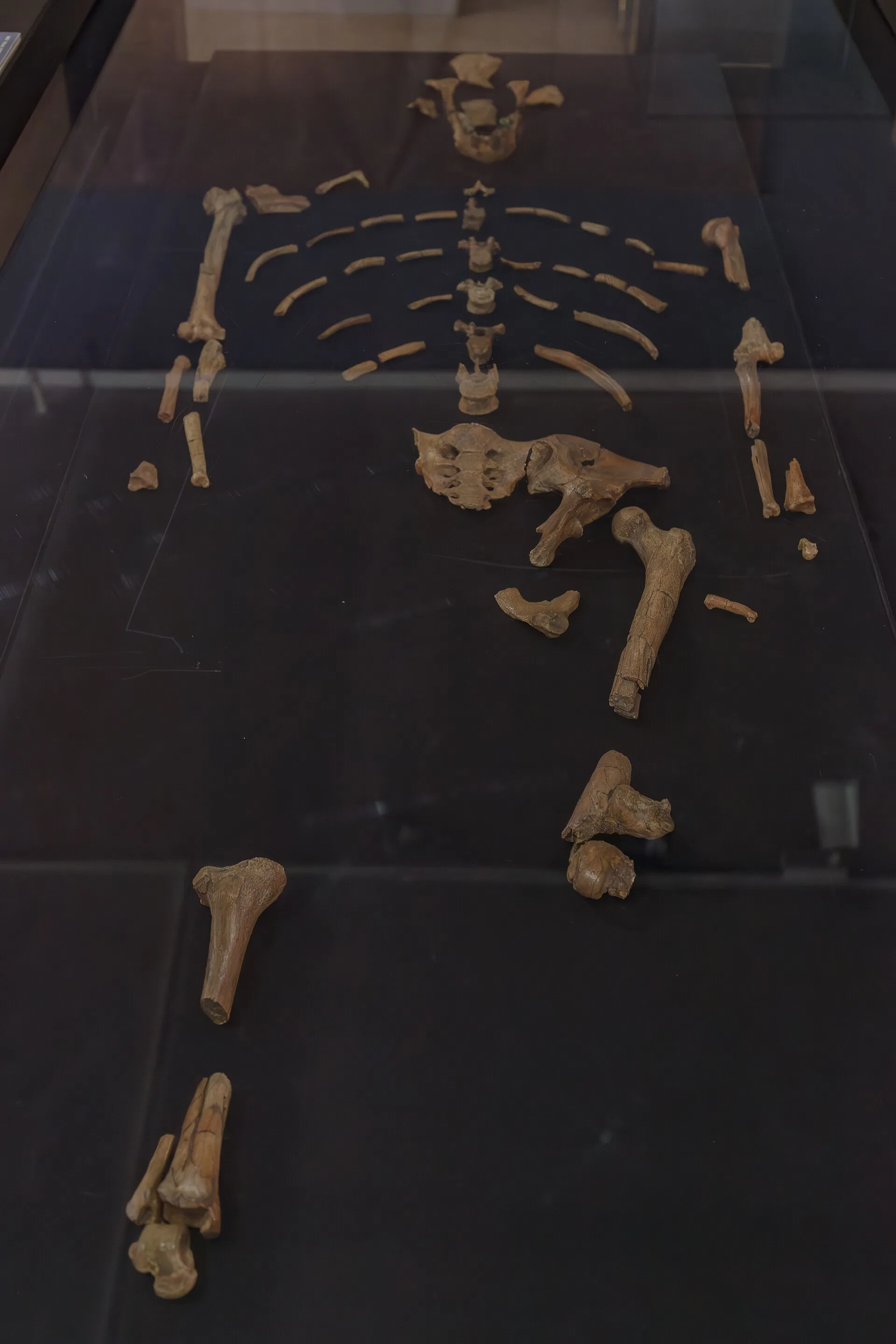
The basement galleries of the National Museum of Ethiopia contain the country’s most internationally famous unusual collection: early hominin fossils. The best known is Lucy, the partial skeleton of an adult female Australopithecus afarensis discovered at Hadar in 1974 and dated to about 3.2 million years ago. The specimen’s scientific catalogue number is AL 288-1.[Human Origins]humanorigins.si.eduHuman Origins ALHuman OriginsAL 288-1 - The Smithsonian's Human Origins Program1 Jan 1974 — Explore our 3D collection of fossils and artifacts: view, rot…
Lucy is unusual not because she is a mysterious monster or unexplained relic, but because her body occupies a disorientating position between visitor and ancestor. Her anatomy helped researchers examine how upright walking developed before the large human brain. The display converts fragments of fossilised bone into a public encounter with evolutionary time, making the museum feel part natural-history collection, part archaeological treasury and part secular reliquary.
Visitors should understand the distinction between the famous fossil and its public representation. The skeleton normally shown in Addis Ababa has been a replica, while the original fragments are protected in secure storage. The real Lucy has travelled only rarely; in 2025, she and the older juvenile fossil known as Selam were sent to Prague for a temporary exhibition, prompting both excitement and concern about transporting irreplaceable material.[AP News]apnews.comAP News Ethiopian fossil Lucy leaves for her first exhibition in EuropeDiscovered in 1974 in Ethiopia, Lucy belongs to the species Australopithecus afarensis and is more than 3 million years old. Her skeleton…
The National Museum is broader than its fossil basement. Its collections also include ancient and medieval objects, imperial regalia, weapons, jewellery, clothing, musical instruments and modern Ethiopian art. This creates a striking progression: prehuman anatomy below ground, royal and archaeological history above it, then cultural and artistic collections on the higher floors. Following renovation work that began in December 2024, the museum officially reopened to the public on 23 May 2025. Welcome to Fana Media Corporation S.C[fanamc.com]fanamc.comWelcome to Fana Media Corporation S.CNational Museum of Ethiopia reopens following major…May 22, 2025 — 22 May 2025 — The National Mus…
For strange-museum travellers, the fossil galleries provide the strongest reason to visit. They are scientifically curated rather than sensational, and the unusual quality comes from the specimens themselves rather than dramatic presentation. Labels and gallery arrangements may not answer every technical question, so readers interested in human evolution may benefit from consulting a reliable scientific account before or after visiting.
A palace turned into a cabinet of cultures
The Ethnological Museum at Addis Ababa University is housed in a former imperial palace associated with Emperor Haile Selassie. That setting produces an unusual double identity. Visitors move through a scholarly collection of Ethiopian cultural material while also encountering preserved palace rooms and personal traces of monarchy.
The museum belongs to the university’s Institute of Ethiopian Studies, which holds a major library, archives and manuscript collections as well as what the university describes as the country’s largest ethnographic museum.[Addis Ababa University]aau.edu.etOpen source on edu.et. Its holdings encompass anthropology, religious material, music, art, coins, stamps, domestic objects, clothing and ceremonial possessions. The wider institute was designed not merely as a tourist attraction but as a research centre concerned with the languages, histories and cultures of Ethiopia.
The palace rooms give the museum its cabinet-of-curiosity atmosphere. A royal bed, ceremonial clothing, furnishings and imperial symbolism sit close to objects collected to represent everyday life across many communities. This mixture raises useful questions about how national museums organise cultural difference. Objects once used in homes, rituals or courts become examples of a people, region, occupation or historical period when placed behind glass.
The interpretation is academic and national rather than occult. Nevertheless, the religious collections can be compelling for readers interested in protective objects, sacred imagery, healing traditions and ritual practice. The important caution is that an ethnographic label does not make an object spiritually neutral. Something displayed as material culture may still carry devotional, social or ancestral significance for the community from which it came.
The museum’s location inside an active university campus also affects the visit. Access procedures and opening arrangements can change, and identity checks may be required at campus entrances. It is more research-led and less commercially polished than a purpose-built tourist museum, which is part of its appeal but also means that practical details should be checked locally.
Preserved animals and Ethiopia’s old-school natural history
Addis Ababa University’s Zoological Natural History Museum is Ethiopia’s most direct equivalent to the classic museum of stuffed beasts, specimen jars and educational dioramas. Founded in the mid-20th century, it was established to collect and preserve examples of the country’s wildlife and has been described in international scientific-collection records as Ethiopia’s only natural-history museum.[Ethiomuseums]ethiomuseums.comZOOLOGICAL NATURAL HISTORY MUSEUM (AAUThe Zoological Natural History MuseumThe Zoological Natural History Museum (ZNHM) was established in 1955 E.C with the aim of…
The displays include preserved mammals, birds, reptiles and other animals, with particular interest in endemic species found only in Ethiopia or the surrounding region. Visitor information sources describe a collection representing more than 1,100 species, including the mountain nyala and Walia ibex.[GPSmyCity]gpsmycity.comOpen source on gpsmycity.com.
Its strangeness lies partly in the traditional presentation. Modern wildlife centres often rely on film, interactive screens and conservation storytelling. Older natural-history museums confront the visitor with bodies: skins, horns, skulls, mounted animals and creatures fixed into poses. Such displays can feel eerie, especially when ageing taxidermy makes an animal appear less like a living species than an imperfect reconstruction.
The museum is nevertheless an academic collection, not a sideshow. Specimens document biodiversity and support teaching, identification and conservation research. They also preserve evidence of animals whose populations and habitats have changed. The ethical questions familiar from natural-history museums elsewhere still apply: when were specimens collected, why were they killed, how accurately have they been prepared, and what information survives about their original location?
Visitors expecting a large European-style natural-history institution may find the museum modest and somewhat old-fashioned. Those interested in taxidermy, zoological collecting or the history of scientific display may find that modest scale more revealing. It shows how a national wildlife record can develop within a university even when funding, exhibition technology and conservation facilities are limited.
The Red Terror Museum and the material evidence of fear
The Red Terror Martyrs’ Memorial Museum is Ethiopia’s most disturbing public collection. Located near Meskel Square in Addis Ababa, it commemorates victims of political violence during the military government that followed the 1974 revolution, particularly the campaign of killing and repression associated with 1977 and 1978. The museum opened in 2010 after a long effort by survivors and victims’ families to establish a permanent memorial.[Dark Tourism]dark-tourism.comOpen source on dark-tourism.com.
Its exhibits reportedly include human remains, coffins, victims’ photographs, bloodstained clothing, prison material and instruments associated with torture. These are not “oddities” in the entertainment sense. They are evidential objects intended to prove that named people were imprisoned, abused and killed, and to prevent political violence from being reduced to an abstract argument.[Wikipedia]WikipediaRed Terror Martyrs' Memorial MuseumRed Terror Martyrs' Memorial Museum
The museum’s curatorial force comes from proximity to survivors. Guided accounts have often been delivered by people with direct or family experience of the period. This gives the displays an immediacy that a neutral state history museum might lack, although it also means the institution should be understood as a memorial shaped by particular communities of memory.
That distinction is important because Ethiopia’s political past remains contested. A memorial museum does not simply store evidence; it selects victims, dates, photographs and explanations within an ongoing national argument about responsibility. Scholarship on the museum places it within a wider landscape of political memory, where recognition, marginalisation and present-day politics affect which histories receive public space.[World Peace Foundation]worldpeacefoundation.orgthe red terror martyrs memorial museum on ethiopias memorial landscapethe red terror martyrs memorial museum on ethiopias memorial landscape
The museum is emotionally demanding and unsuitable for visitors seeking a light curiosity stop. Human remains and graphic images may be visible. Reports of damage and temporary closure appeared in 2022, while more recent visitor and tour listings indicate renewed activity; because institutional information online is inconsistent, current access should be confirmed locally rather than assumed.[Tripadvisor]tripadvisor.co.ukOpen source on tripadvisor.co.uk.
Maekelawi: when a prison becomes an exhibit
Maekelawi, a detention and interrogation centre in Addis Ababa, offers a second and less settled example of Ethiopia’s memorial culture. For decades its name was associated with political imprisonment, ill-treatment and fear. The government announced its closure in January 2018 and proposed turning it into a modern museum.[World Peace Foundation]worldpeacefoundation.orgWorld Peace Foundation Ethiopia's new prison memorial museum?World Peace Foundation Ethiopia's new prison memorial museum?
The compound was opened to the public in September 2019, allowing former detainees, relatives and other visitors to enter spaces that had previously been inaccessible. Human Rights Watch described the opening as the first public access to a site long synonymous with abuse and repression.[Human Rights Watch]hrw.orgHuman Rights Watch Gates Open on Ethiopia's Infamous Maekelawi JailHuman Rights Watch Gates Open on Ethiopia's Infamous Maekelawi Jail
A former prison differs from a collection assembled inside a gallery. Its cells, corridors and interrogation rooms are themselves the principal objects. Scratches, modifications, confined spaces and remembered routines can carry more meaning than portable artefacts. Such places are sometimes called “sites of conscience”: historic locations preserved to connect past violations with present questions about rights and accountability.
Maekelawi’s status as a fully developed, regularly operating museum is less clear than the original announcements suggested. Public opening as a gallery or memorial site does not necessarily mean that the compound has acquired permanent exhibitions, professional staffing, stable hours and conservation policies. It is best treated as an evolving memory site rather than a conventional visitor attraction.
This uncertainty is itself revealing. Converting a notorious prison into a museum requires more than unlocking the gates. Authorities must decide which governments and security services are represented, whose testimony is trusted, whether archives will be released and whether the institution can criticise abuses continuing in the present.
Monastery treasuries, manuscripts and royal bodies
The islands and shores of Lake Tana contain some of Ethiopia’s most atmospheric collections. Churches and monasteries have preserved illuminated manuscripts, processional crosses, painted panels, crowns, vestments and other religious treasures, partly because isolated communities offered protection during periods of warfare and political instability. Research on the monastery of Kebran Gabriel, for example, notes the historic use of Lake Tana monasteries as places where rulers could safeguard valuable objects.[Academic Journals]academicjournals.orgarticle1398776937 Andargiearticle1398776937 Andargie
These are usually living religious collections rather than museums arranged according to modern curatorial standards. Objects may be brought out by clergy, stored in locked treasuries or shown only under particular conditions. Interpretation can depend heavily on a guide or priest, and cataloguing may be incomplete. Manuscript-survey projects recorded substantial holdings around the lake; one research repository notes that 182 manuscripts in the Lake Tana area were microfilmed during the early 1970s and later digitised.[pemm.princeton.edu]pemm.princeton.eduOpen source on princeton.edu.
Daga Estifanos monastery is especially relevant to unusual-collection travellers because it is associated with the preserved remains of Ethiopian emperors. Accounts describe royal bodies or remains kept in coffins within the monastery, alongside other relics. Recent reporting has again drawn attention to Daga and neighbouring islands as repositories of royal remains and centuries-old religious material.[Live Science]livescience.comDek, the larger island, supports a population of around 5,000 and robust agricultural production thanks to fertile volcanic soil and high…
Claims about “mummified emperors” require careful wording. Ethiopia does have a documented history of naturally or deliberately preserved human remains in monastic settings. Bioarchaeological research has examined hundreds of well-preserved bodies recovered from cave monasteries in central and northern Ethiopia, showing that mummification and exceptional natural preservation are genuine subjects of scientific study rather than travel folklore.[ufdcimages.uflib.ufl.edu]ufdcimages.uflib.ufl.eduUNIVERSIT Y OF FLORIDA THESIS OR DISSERTATIONUNIVERSIT Y OF FLORIDA THESIS OR DISSERTATION However, the identity, conservation history and exact condition of individual royal remains shown to visitors are not always documented in accessible public catalogues.
Access restrictions are also significant. Some Lake Tana monasteries traditionally admit only men, and rules may extend beyond ordinary museum expectations. Photography, entry to inner rooms and viewing of particular objects can be prohibited. Visitors should regard such limits as religious practice, not as theatrical attempts to manufacture mystery.
Aksum and the collection that cannot be seen
Aksum occupies a unique place in the world of sacred curiosities because the most famous object associated with it is absent from public view. Ethiopian Orthodox tradition holds that the biblical Ark of the Covenant is kept in a guarded chapel near the Church of Saint Mary of Zion. Ethiopia’s official tourism material presents this as a religious tradition and legend rather than independently verified archaeological fact.[Visit Ethiopia]visitethiopia.etOpen source on visitethiopia.et.
Only a designated guardian is said to have access to the object. Visitors cannot enter the treasury and inspect it, while photographs and scientific tests are unavailable. This places the claim outside normal museum verification. There is no public chain of evidence through which an archaeologist or curator could authenticate the object as the biblical Ark.
Yet dismissing the chapel as merely a failed museum exhibit misses its cultural role. The tradition shapes pilgrimage, national history and the treatment of sacred altar tablets in Ethiopian Orthodox churches. These tablets, usually called tabots, symbolically represent the Ark and are concealed from ordinary sight. Their sacred status is so strong that the British Museum does not display, photograph or study the examples removed from Maqdala by British forces in 1868.[British Museum]britishmuseum.orgOpen source on britishmuseum.org.
The result is one of the strangest collection disputes in modern museum culture: objects held by a major museum but considered too sacred to be viewed even by its staff. Campaigners and Ethiopian authorities have repeatedly sought their return, arguing that indefinite hidden storage serves neither worship nor public education. The controversy intensified as questions were raised about the British Museum’s refusal to disclose details of its decision-making.[The Guardian]theguardian.comOpen source on theguardian.com.
For visitors in Aksum, the responsible approach is to separate three layers. The archaeological city and its monuments are materially documented. The Orthodox tradition concerning the Ark is a living belief. Claims that the hidden object has been scientifically authenticated are unsupported.
Looted treasures and collections outside Ethiopia
Any account of Ethiopia’s unusual collections must include the objects that are no longer in the country. After the British assault on Emperor Tewodros II’s fortress at Maqdala in 1868, manuscripts, crowns, crosses, weapons, religious objects and royal possessions entered British institutional and private collections. The British Museum describes its Maqdala holdings as contested and acknowledges continuing work with Ethiopian scholars, church representatives and communities.[British Museum]britishmuseum.orgOpen source on britishmuseum.org.
These dispersed collections complicate the idea that a country’s curiosity culture exists only within its borders. Ethiopian religious and royal objects can be encountered in British museums, libraries, churches and private holdings, but their presentation often reflects the history of military acquisition rather than the meanings they held in Ethiopia.
The debate is not confined to famous institutions. A proposed British auction of a shield linked to Maqdala was challenged by the Ethiopian government in 2024, which argued that selling looted heritage was morally unacceptable and called for restitution.[The Guardian]theguardian.comOpen source on theguardian.com. Returns have occurred in individual cases, but the larger collections remain fragmented.
This history also explains why trust, ownership and visibility matter so much in Ethiopia’s museums and treasuries. Keeping an object hidden in a monastery may look mysterious to an outsider, yet generations of warfare and removal have given religious custodians practical reasons to limit access.
What visitors should expect
Ethiopia rewards the curious traveller, but not with a tidy catalogue of novelty attractions. Its strongest unusual collections demand different forms of attention.
- For human origins: the National Museum provides the clearest scientific experience, centred on Lucy and other early hominin discoveries.
- For ethnographic curiosities and royal interiors: the Ethnological Museum combines palace rooms, religious material, domestic objects and university research collections.
- For taxidermy and specimen culture: the Zoological Natural History Museum offers a compact, traditional survey of Ethiopian wildlife.
- For difficult modern history: the Red Terror Museum presents graphic material evidence and personal testimony, while Maekelawi remains a more uncertain developing memorial site.
- For manuscripts, relics and preserved bodies: Lake Tana’s monasteries are the most atmospheric destinations, but access and interpretation are governed by religious practice.
- For sacred mystery: Aksum offers a powerful living tradition surrounding the Ark of the Covenant, not a publicly testable artefact.
Opening hours, security arrangements and permissions can change, particularly at university campuses, religious sites and politically sensitive memorials. Local confirmation is more reliable than assuming that an old travel listing remains accurate. Photography should never be treated as automatic, especially where human remains, manuscripts or sacred objects are involved.
Why Ethiopia’s curiosity culture matters
Ethiopia’s unusual collections challenge the assumption that strange heritage must be eccentric, commercial or invented for tourists. Here, the uncanny often grows from the seriousness of the object: a body millions of years old, an emperor’s remains on a remote island, a cell associated with torture, or a sacred tablet that a museum owns but cannot ethically display.
The country also reveals a fundamental disagreement about what preservation means. A scientist protects a fossil by limiting exposure. A memorial museum displays bones to resist forgetting. A monastery conceals a sacred object to maintain its holiness. A foreign museum may claim to preserve an artefact while the community of origin argues that removal has stripped it of its proper purpose.
That tension gives Ethiopia one of Africa’s most distinctive landscapes of collections. Its “strange museums” are not primarily rooms of curiosities assembled to surprise outsiders. They are places where ancestry, faith, trauma, sovereignty and secrecy become material — sometimes visible in a case, sometimes locked in a treasury, and sometimes powerful precisely because the visitor is not permitted to see.
Amazon book picks
Further Reading
Books and field guides related to What Makes Ethiopia's Collections So Unusual?. Use these as the next step if you want deeper reading beyond the article.
The Ethiopians
The book opens with a review of Ethiopian prehistory, showing how the Ethiopian section of the African Rift Valley has come to be seen as...
A History of Ethiopia
"A very ambitious work. . . . Its readability will insure a wide audience. . . . Specialists will be alternately outraged, amused, engage...

eBay marketplace picks
Marketplace Samples
Live-tested eBay searches with available results related to this page.
Selected fromAfrican wall art oneBay.co.uk.


Endnotes
1.
Source: whc.unesco.org
Link:https://whc.unesco.org/en/list/15/
Source snippet
UNESCO World Heritage CentreAksumThe ruins of the ancient city of Aksum are found close to Ethiopia's northern border. They mark the loca...
2.
Source: fanamc.com
Link:https://www.fanamc.com/english/national-museum-of-ethiopia-reopens-following-major-renovation/
Source snippet
Welcome to Fana Media Corporation S.CNational Museum of Ethiopia reopens following major...May 22, 2025 — 22 May 2025 — The National Mus...
Published: May 22, 2025
3.
Source: aau.edu.et
Link:https://aau.edu.et/institute/IES
4.
Source: ethiomuseums.com
Title: ZOOLOGICAL NATURAL HISTORY MUSEUM (AAU)
Link:https://www.ethiomuseums.com/ZOOLOGICAL%20NATURAL%20HISTORY%20MUSEUM%20%28AAU%29.html
Source snippet
The Zoological Natural History MuseumThe Zoological Natural History Museum (ZNHM) was established in 1955 E.C with the aim of...
5.
Source: gpsmycity.com
Link:https://www.gpsmycity.com/attractions/zoological-natural-history-museum-44159.html
6.
Source: dark-tourism.com
Link:https://www.dark-tourism.com/index.php/1282-redterrormuseum
7.
Source: Wikipedia
Title: Red Terror Martyrs’ Memorial Museum
Link:https://en.wikipedia.org/wiki/Red_Terror_Martyrs%27_Memorial_Museum
8.
Source: pemm.princeton.edu
Link:https://pemm.princeton.edu/research/repositories
9.
Source: ufdcimages.uflib.ufl.edu
Title: UNIVERSIT Y OF FLORIDA THESIS OR DISSERTATION
Link:https://ufdcimages.uflib.ufl.edu/UF/E0/05/02/93/00001/SEIFU_A.pdf
10.
Source: unesdoc.unesco.org
Link:https://unesdoc.unesco.org/ark%3A/48223/pf0000052774
11.
Source: unesdoc.unesco.org
Link:https://unesdoc.unesco.org/ark%3A/48223/pf0000134374
12.
Source: unesco.org
Title: document 882
Link:https://www.unesco.org/archives/multimedia/document-882
13.
Source: unesdoc.unesco.org
Link:https://unesdoc.unesco.org/ark%3A/48223/pf0000103283
14.
Source: aau.edu.et
Link:https://aau.edu.et/pages/AAU-Services/detail
15.
Source: aau.edu.et
Link:https://www.aau.edu.et/
16.
Source: etd.aau.edu.et
Link:https://etd.aau.edu.et/items/dcadaaf4-e935-4127-af95-9c15996a45b3
17.
Source: etd.aau.edu.et
Link:https://etd.aau.edu.et/browse/title?scope=d7ca4eb0-9916-44b2-ab9b-49c3ebb282ba
18.
Source: etd.aau.edu.et
Title: aau.edu.et AA U-ETD
Link:https://etd.aau.edu.et/bitstreams/4acdd51f-e1dc-472d-9966-e70feed3e1c6/download
19.
Source: etd.aau.edu.et
Link:https://etd.aau.edu.et/bitstreams/712edc5a-9536-45de-adfd-66bacf809ad7/download
20.
Source: etd.aau.edu.et
Title: aau.edu.et Addis Ababa, Ethiopia
Link:https://etd.aau.edu.et/bitstreams/31e40314-d5d6-4c57-a28e-f282d90f529b/download
21.
Source: etd.aau.edu.et
Link:https://etd.aau.edu.et/bitstreams/ad08c774-5e68-4f3e-9442-5617b808d535/download
22.
Source: etd.aau.edu.et
Title: aau.edu.et Archaeology and Heritage Management
Link:https://etd.aau.edu.et/collections/d7ca4eb0-9916-44b2-ab9b-49c3ebb282ba
23.
Source: tripadvisor.com
Title: wide and interesting collection
Link:https://www.tripadvisor.com/ShowUserReviews-g293791-d2206771-r865401923-Ethnological_Museum-Addis_Ababa.html
24.
Source: tripadvisor.com
Title: The Zoological Natural History Museum
Link:https://www.tripadvisor.com/Attraction_Review-g293791-d18186347-Reviews-The_Zoological_Natural_History_Museum-Addis_Ababa.html
25.
Source: tripadvisor.com
Title: Derg regime in pictures
Link:https://www.tripadvisor.com/ShowUserReviews-g293791-d2357654-r462845120-Red_Terror_Martyrs_Memorial_Museum-Addis_Ababa.html
26.
Source: tripadvisor.com
Title: The National Museum is re opened!
Link:https://www.tripadvisor.com/ShowTopic-g293790-i9957-k15352182-The_National_Museum_is_re_opened-Ethiopia.html
27.
Source: humanorigins.si.edu
Title: Human Origins AL 288-1
Link:https://humanorigins.si.edu/evidence/human-fossils/fossils/al
Source snippet
Human OriginsAL 288-1 - The Smithsonian's Human Origins Program1 Jan 1974 — Explore our 3D collection of fossils and artifacts: view, rot...
28.
Source: humanorigins.si.edu
Title: australopithecus afarensis
Link:https://humanorigins.si.edu/evidence/human-fossils/species/australopithecus-afarensis
Source snippet
Human OriginsAustralopithecus afarensis6 Apr 2026 — 'Lucy' (AL 288-1) is an adult female, 3.2 million-year-old A. afarensis skeleton foun...
29.
Source: apnews.com
Title: AP News Ethiopian fossil Lucy leaves for her first exhibition in Europe
Link:https://apnews.com/article/8ba1e84b3ff1cc774264fa441f3057ff
Source snippet
Discovered in 1974 in Ethiopia, Lucy belongs to the species Australopithecus afarensis and is more than 3 million years old. Her skeleton...
30.
Source: worldpeacefoundation.org
Title: the red terror martyrs memorial museum on ethiopias memorial landscape
Link:https://worldpeacefoundation.org/blog/the-red-terror-martyrs-memorial-museum-on-ethiopias-memorial-landscape/
31.
Source: tripadvisor.co.uk
Link:https://www.tripadvisor.co.uk/Attraction_Review-g293791-d2357654-Reviews-Red_Terror_Martyrs_Memorial_Museum-Addis_Ababa.html
32.
Source: worldpeacefoundation.org
Title: World Peace Foundation Ethiopia’s new prison memorial museum?
Link:https://worldpeacefoundation.org/blog/ethiopias-new-prison-memorial-museum/
33.
Source: hrw.org
Title: Human Rights Watch Gates Open on Ethiopia’s Infamous Maekelawi Jail
Link:https://www.hrw.org/news/2019/09/06/gates-open-ethiopias-infamous-maekelawi-jail
34.
Source: academicjournals.org
Title: article1398776937 Andargie
Link:https://academicjournals.org/article/article1398776937_Andargie.pdf
35.
Source: livescience.com
Link:https://www.livescience.com/planet-earth/pair-of-holy-islands-in-eerily-green-african-lake-hold-centuries-old-relics-and-mummified-emperors-earth-from-space
Source snippet
Dek, the larger island, supports a population of around 5,000 and robust agricultural production thanks to fertile volcanic soil and high...
36.
Source: visitethiopia.et
Link:https://visitethiopia.et/space/aksum
37.
Source: britishmuseum.org
Link:https://www.britishmuseum.org/about-us/british-museum-story/contested-objects-collection/maqdala-collection
38.
Source: museumsassociation.org
Title: british museum asked to clarify position on ethiopian tabots
Link:https://www.museumsassociation.org/museums-journal/news/2022/10/british-museum-asked-to-clarify-position-on-ethiopian-tabots/
39.
Source: theguardian.com
Link:https://www.theguardian.com/culture/2024/mar/31/british-museum-investigated-ethiopian-artefacts-hidden-view-150-years-maqdala-tabots
40.
Source: theguardian.com
Link:https://www.theguardian.com/world/2024/feb/27/ethiopian-government-tries-to-stop-uk-auction-of-looted-maqdala-shield
41.
Source: humanorigins.si.edu
Link:https://humanorigins.si.edu/exhibit
42.
Source: humanorigins.si.edu
Link:https://humanorigins.si.edu/evidence/human-fossils/fossils/oh-5
43.
Source: humanorigins.si.edu
Title: exploring human origins what does it mean be human
Link:https://humanorigins.si.edu/exhibit/exploring-human-origins-what-does-it-mean-be-human
44.
Source: humanorigins.si.edu
Title: human origins program team
Link:https://humanorigins.si.edu/about/human-origins-program-team
45.
Source: humanorigins.si.edu
Title: shanidar 1
Link:https://humanorigins.si.edu/evidence/human-fossils/fossils/shanidar-1
46.
Source: humanorigins.si.edu
Title: ancient dna and neanderthals
Link:https://humanorigins.si.edu/evidence/genetics/ancient-dna-and-neanderthals
47.
Source: humanorigins.si.edu
Link:https://humanorigins.si.edu/education/introduction-human-evolution
48.
Source: returningheritage.com
Title: british museum pressed to explain refusal to return sacred tabots
Link:https://www.returningheritage.com/british-museum-pressed-to-explain-refusal-to-return-sacred-tabots
49.
Source: anglo-ethiopian.org
Link:https://anglo-ethiopian.org/publications/articles.php?reference=publications%2Farticles%2F2011spring%2Faksum.php&type=A
50.
Source: humbo.com
Title: Ethnological Museum
Link:https://humbo.com/et/ethnological-museum
51.
Source: tripadvisor.co.uk
Title: ETHNOLOGICA L MUSEUM
Link:https://www.tripadvisor.co.uk/Attraction_Review-g293791-d2206771-Reviews-Ethnological_Museum-Addis_Ababa.html
52.
Source: theartnewspaper.com
Title: british museum considers loan of invisible objects back to ethiopia
Link:https://www.theartnewspaper.com/2019/05/20/british-museum-considers-loan-of-invisible-objects-back-to-ethiopia
53.
Source: ethiopianphotographytours.com
Title: national museum of ethiopia
Link:https://ethiopianphotographytours.com/national-museum-of-ethiopia/
54.
Source: ajol.info
Link:https://www.ajol.info/index.php/ejhs/article/view/297824
55.
Source: cityam.com
Title: british museum faces investigation over hidden sacred ethiopian artefacts
Link:https://www.cityam.com/british-museum-faces-investigation-over-hidden-sacred-ethiopian-artefacts/
56.
Source: en.tripadvisor.com.hk
Link:https://en.tripadvisor.com.hk/ShowUserReviews-g3667784-d480674-r200813026-Church_of_Our_Lady_Mary_of_Zion-Axum_Tigray_Region.html
57.
Source: telegraph.co.uk
Title: british museum must return sacred ethiopian tabots
Link:https://www.telegraph.co.uk/news/2023/09/12/british-museum-must-return-sacred-ethiopian-tabots/
58.
Source: cbsnews.com
Title: british museum london ethiopia tabots sacred artifacts investigation
Link:https://www.cbsnews.com/news/british-museum-london-ethiopia-tabots-sacred-artifacts-investigation/
59.
Source: mainlymuseums.com
Link:https://mainlymuseums.com/post/171/aksum-the-whole-town-is-a-museum/
60.
Source: lonelyplanet.com
Link:https://www.lonelyplanet.com/points-of-interest/natural-history-museum/1423226
61.
Source: news.artnet.com
Title: british museum investigation ethiopian tabots 2462115
Link:https://news.artnet.com/art-world/british-museum-investigation-ethiopian-tabots-2462115
Additional References
62.
Source: youtube.com
Title: The Ethiopian Church that Hosts Their Ark of the Covenant, Chapel of the Tablet
Link:https://www.youtube.com/watch?v=pqWX30ui74w
Source snippet
"National Museum of Ethiopia" Lucy Ethiopia's famous fossil, Lucy, returned home after a 5 year tour of different museums in the US CGTN...
63.
Source: youtube.com
Title: Red Terror Martyrs Memorial Museum
Link:https://www.youtube.com/watch?v=nJ_VWXVTZSk
Source snippet
The Ethiopian Church that Hosts Their Ark of the Covenant, Chapel of the Tablet...
64.
Source: youtube.com
Link:https://www.youtube.com/watch?v=4aimyfDR3r0
Source snippet
Inside Rastafari Haile Selassie's Palace at Addis Ababa University | Ethnological Museum Tour...
65.
Source: youtube.com
Link:https://www.youtube.com/watch?v=bhEppd13Amc
Source snippet
Zoological Natural History Museum, Addis Ababa...
66.
Source: youtube.com
Title: Zoological Natural History Museum, Addis Ababa
Link:https://www.youtube.com/watch?v=EZevQsELWvc
Source snippet
Red Terror Martyrs Memorial Museum - Talking about surviving the Derg in Ethiopia...
67.
Source: facebook.com
Link:https://www.facebook.com/guide2ethiopia/posts/red-terror-martyrs-memorial-museumthe-red-terror-martyrs-memorial-museum-in-addi/2072827102800885/
68.
Source: instagram.com
Link:https://www.instagram.com/p/CxcypyUI9Ud/?hl=en
69.
Source: atlasobscura.com
Link:https://www.atlasobscura.com/things-to-do/ethiopia/museums
70.
Source: facebook.com
Link:https://www.facebook.com/africa.geographic/posts/a-cultural-extravaganzachurches-hewn-from-rock-world-heritage-sites-castles-anci/1343937024442291/
71.
Source: getyourguide.com
Link:https://www.getyourguide.com/en-gb/addis-ababa-l1085/addis-ababa-red-terror-memorial-storytelling-experience-t1179728/