Within Strange Russia
How Does Russia Put Death on Display?
Funeral objects, embalming displays and preserved bodies reveal how Russia turns death into heritage, ritual and political memory.
On this page
- Inside the Museum of World Funeral Culture
- Lenin's body and political preservation
- Authentic objects, staged rooms and public meaning
Page outline Jump by section
Introduction
Russia puts death on public display in ways that are strikingly different from most countries. Rather than concentrating on horror or spectacle, its best-known death-related attractions explore mourning, preservation, ritual and political memory. The country’s most distinctive examples are the private Museum of World Funeral Culture near Novosibirsk, which interprets funeral customs from around the world, and the continuing public display of Vladimir Lenin’s embalmed body in Moscow. Together they show how death can become heritage: one through museum interpretation of funeral traditions, the other through the preservation of a revolutionary leader whose body became a political symbol as well as human remains. Although both attract visitors interested in unusual collections, they represent very different ideas about why the dead should be displayed and what such displays are meant to communicate.

Inside the Museum of World Funeral Culture
The Museum of World Funeral Culture, located beside the Novosibirsk Crematorium in a memorial park, is Russia’s only museum devoted entirely to funeral culture. Rather than presenting death as entertainment, it examines how societies remember the dead through objects, ceremonies and material culture.[visitmuseums.ru]visitmuseums.ruVisit Museums The museum of world funeral cultureVisit Museums The museum of world funeral culture
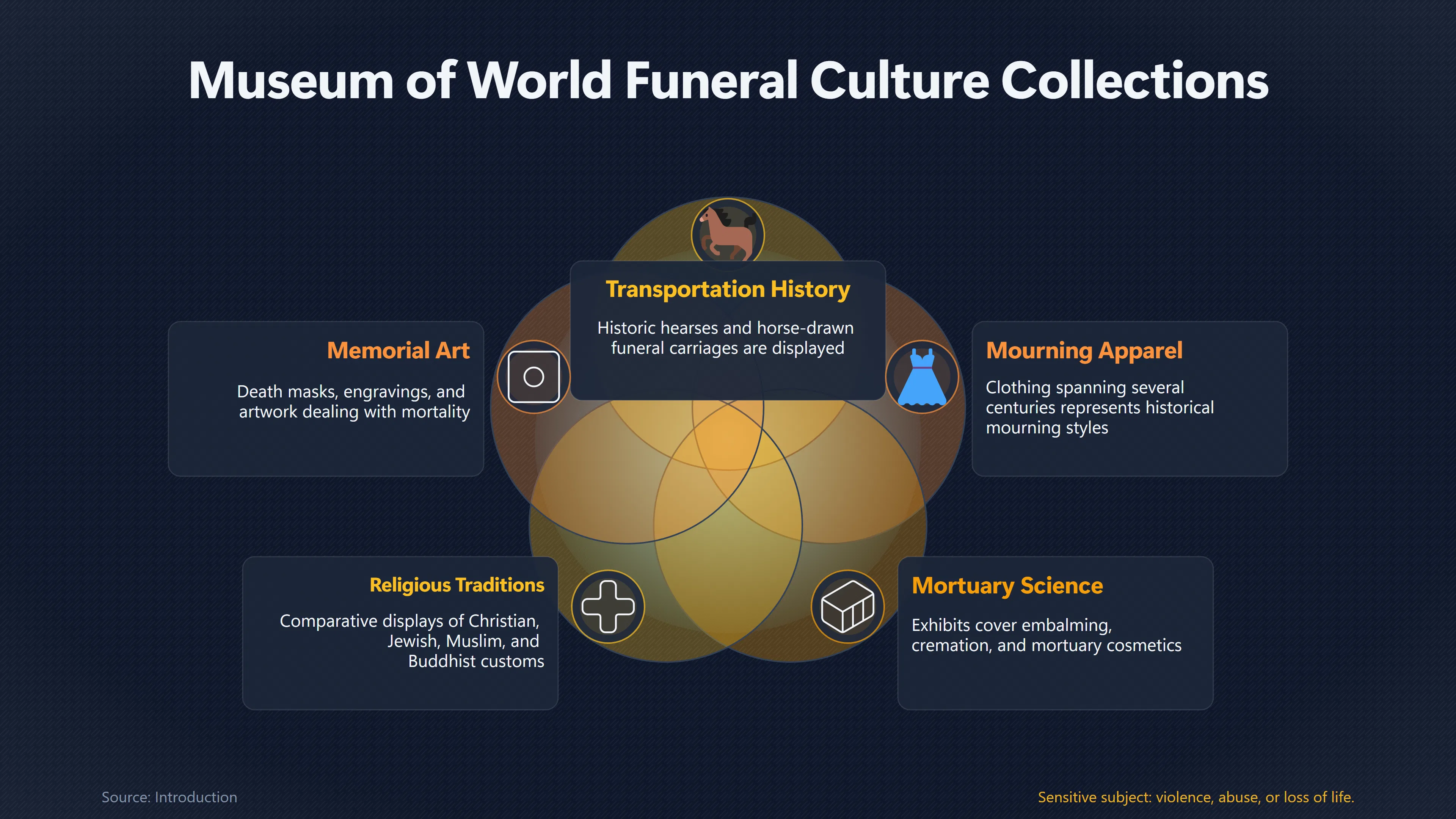
Visitors encounter a mixture of authentic historical artefacts, reconstructed interiors and carefully staged installations. The collections include:
- Historic hearses and horse-drawn funeral carriages.
- Mourning clothing spanning several centuries.
- Funeral photography and memorial postcards.
- Coffins, funeral ornaments and ceremonial equipment.
- Exhibits on embalming, cremation and mortuary cosmetics.
- Displays comparing Christian, Jewish, Muslim, Buddhist and other funeral traditions.
- Death masks, engravings and artwork dealing with mortality.[Visit Museums]visitmuseums.ruVisit Museums The museum of world funeral cultureVisit Museums The museum of world funeral culture
Many galleries recreate Victorian mourning rooms or historical funeral scenes rather than simply placing objects in display cases. This immersive approach makes the museum feel closer to a cultural history exhibition than a conventional museum of medical specimens.
One gallery examines Soviet funeral culture, including replicas connected with major state funerals. Among these is a life-sized reconstruction of Lenin in his mausoleum sarcophagus, alongside reproductions associated with Stalin and other prominent figures. These are clearly presented as museum reconstructions rather than the original remains.[Visit Museums]visitmuseums.ruVisit Museums The museum of world funeral cultureVisit Museums The museum of world funeral culture
Why the museum is unusual
Unlike many “death museums” elsewhere, the Novosibirsk institution presents funeral customs as a legitimate field of cultural history. Its founder argued that modern society often distances itself from death, weakening traditions of remembrance and commemoration. Academic research on the museum has similarly interpreted it as an institution that attempts to rebuild memorial culture rather than simply exhibit morbid curiosities.[Ethnographic Review]eo.iea.ras.ruEthnographic ReviewThe Museum of Death as an Institution of Memory: The Museumified Past and Modern Memorial Practices – Etnograficheskoe…
This gives the museum a distinctive character. Visitors encounter genuine historical material alongside theatrical reconstructions, but the underlying message is educational rather than sensational. Displays encourage comparison between cultures and historical periods, showing how attitudes towards death have evolved with religion, medicine, technology and social customs.
Lenin’s body and political preservation
Russia’s most famous displayed dead person is not in a museum at all, but in the Lenin Mausoleum on Moscow’s Red Square.
Following Lenin’s death in 1924, Soviet leaders decided to preserve his body instead of carrying out an ordinary burial. Temporary wooden mausoleums were rapidly erected before the permanent granite structure was completed. The decision transformed Lenin’s remains into a permanent political monument, reinforcing his symbolic place at the centre of the Soviet state.[Музей В. И. Ленина]lenin.shm.ruМузей В. И. ЛенинаMausoleum projectsV. I. Lenin Museum…
Unlike an archaeological mummy or naturally preserved body, Lenin’s remains have required continuous scientific maintenance for more than a century. Teams of specialists have periodically treated and stabilised the body to maintain its appearance for public viewing. This long-term preservation programme became one of the most technically sophisticated examples of modern embalming anywhere in the world.[Музей В. И. Ленина]lenin.shm.ruМузей В. И. ЛенинаMausoleum projectsV. I. Lenin Museum…
The body itself is displayed under controlled lighting in a glass sarcophagus. Visitors move quietly through the chamber without stopping, photography is prohibited, and the experience is deliberately brief. The atmosphere resembles a state memorial rather than a museum gallery.
Why Lenin remains on display
The continuing display of Lenin’s body has always been about more than preservation.
During the Soviet era, the embalmed body reinforced the idea that Lenin remained symbolically present within the socialist state. Scientific preservation itself became evidence of Soviet technical achievement, while the mausoleum functioned as one of the country’s most important ceremonial sites.
Since the collapse of the Soviet Union, the body has acquired more complex meanings. For some visitors it represents revolutionary history; for others it is a relic of Soviet political mythology. Public debate periodically returns to whether Lenin should finally receive a conventional burial, but the mausoleum remains one of Russia’s most recognisable historical sites.[Музей В. И. Ленина]lenin.shm.ruМузей В. И. ЛенинаMausoleum projectsV. I. Lenin Museum…

Authentic objects, staged rooms and public meaning
One reason these sites are often discussed together is that they demonstrate three very different ways of displaying death.
The Museum of World Funeral Culture combines original artefacts with reconstructed settings. Authentic mourning clothes, hearses and documents are displayed alongside recreated funeral scenes intended to help visitors imagine historical practices rather than witness them directly.[Visit Museums]visitmuseums.ruVisit Museums The museum of world funeral cultureVisit Museums The museum of world funeral culture
The Lenin Mausoleum does the opposite. Its central exhibit is an actual preserved human body, but almost everything surrounding it is stripped of museum interpretation. There are few explanatory panels, no immersive reconstructions and little attempt to compare international traditions. The experience depends on symbolism rather than historical display.
Together they illustrate an important distinction in Russia’s curiosity culture:
- The funeral museum interprets death through collections, artefacts and historical comparison.
- The mausoleum preserves an individual body as a continuing political monument.
- One encourages reflection on changing funeral traditions across cultures; the other preserves a single historical figure whose body itself became part of national history.
What these displays reveal about Russia’s curiosity culture
Russia’s unusual displays of death are less about shock than about memory.
The Museum of World Funeral Culture treats mourning as an overlooked aspect of cultural heritage, collecting objects that many museums would ignore. Lenin’s preserved body, meanwhile, remains one of the world’s most famous examples of political embalming, demonstrating how a human body can become a state symbol long after death.
Seen together, they reveal an important feature of Russia’s stranger museums and collections: death is presented not simply as an end, but as something that can be preserved, interpreted and continuously reimagined. Whether through authentic funeral artefacts, reconstructed ceremonial spaces or the continued display of a revolutionary leader, these institutions show how remembrance itself can become part of a country’s public heritage.
Amazon book picks
Further Reading
Books and field guides related to How Does Russia Put Death on Display?. Use these as the next step if you want deeper reading beyond the article.
The Denial of Death
'It made me rethink the roots of our deepest fears and insecurities, and why we often disappoint ourselves in how we manifest them' Bill...
From Here to Eternity: Traveling the World to Find the Good D...
The best-selling author ofSmoke Gets in Your Eyes expands our sense of what it means to treat the dead with "dignity."
The Work of the Dead: A Cultural History of Mortal Remains
The meaning of our concern for mortal remains—from antiquity through the twentieth century The Greek philosopher Diogenes said that when...
Smoke Gets in Your Eyes & Other Lessons from the Crematory
An Indie NextA #1 LibraryReads PickMost people want to avoid thinking about death, but Caitlin Doughty -- a twenty-something with a degre...
eBay marketplace picks
Marketplace Samples
Live-tested eBay searches with available results related to this page.
Selected fromRussian collectible oneBay.co.uk.
Endnotes
1.
Source: visitmuseums.ru
Title: Visit Museums The museum of world funeral culture
Link:https://visitmuseums.ru/en/museum-8b4eac86-1f43-4a50-8461-33807a4942ba.html
2.
Source: musei-smerti.ru
Link:https://musei-smerti.ru/novosibirsk-museum-of-world-funeral-culture/
Source snippet
WORLD FUNERAL CULTURE MUSEUM (MUSEUM OF DEATH) | МУЗЕЙ МИРОВОЙ ПОГРЕБАЛЬНОЙ КУЛЬТУРЫ WORLD FUNERAL CULTURE MUSEUM (MUSEUM OF DEATH) ВАШ ВКЛА...
3.
Source: idemvmuzei.ru
Title: Museum of World Funeral Culture в Новосибирске | Идём в музей
Link:https://idemvmuzei.ru/en/catalog/museum/muzej-mirovoj-pogrebalnoj-kultury
Source snippet
aгрегатор музеев, выставок и экскурсий...
4.
Source: eo.iea.ras.ru
Link:https://eo.iea.ras.ru/en/article/22050/
Source snippet
Ethnographic ReviewThe Museum of Death as an Institution of Memory: The Museumified Past and Modern Memorial Practices – Etnograficheskoe...
5.
Source: new.ras.ru
Title: Российская академия наукН О Я Б Р Ь – Д Е К А Б Р Ь 2 0 2 06
Link:https://new.ras.ru/upload/iblock/247/sg0l5dxuzs6834c36qknopgyjrxk5rcs.pdf
6.
Source: lenin.shm.ru
Title: Музей В. И. ЛенинаMausoleum projects
Link:https://lenin.shm.ru/en/mausoleum-projects/
Source snippet
V. I. Lenin Museum...
7.
Source: russianinstitute.org
Title: museum of world funeral culture copy copy
Link:https://russianinstitute.org/museum-of-world-funeral-culture-copy-copy
Source snippet
Museum of World Funeral Culture | Official Russian Grammar, Vocabulary and Culture CoursesJune 25, 2025 — MUSEUM OF WORLD FUNERAL CULTURE...
Published: June 25, 2025
8.
Source: novo-sibirsk.ru
Link:https://novo-sibirsk.ru/about/for-visitors/attractions/764/
9.
Source: russiaglobal.omeka.fas.harvard.edu
Link:https://russiaglobal.omeka.fas.harvard.edu/exhibits/show/objects/icon/lenin
10.
Source: lenin.shm.ru
Title: ru Biography
Link:https://lenin.shm.ru/en/biography/
Additional References
11.
Source: australiannews.net
Title: What’s inside the Museum of Death in Siberia
Link:https://www.australiannews.net/news/273484779/whats-inside-the-museum-of-death-in-siberia
Source snippet
February 5, 2023 — Image: What's inside the Museum of Death in Siberia WHAT'S INSIDE THE MUSEUM OF DEATH IN SIBERIA RBTH 05 Feb 2023...
Published: February 5, 2023
12.
Source: youtube.com
Title: How Is Lenin’s Body Preserved?
Link:https://www.youtube.com/watch?v=4whVa5ETrTQ
Source snippet
Museum of World Funeral Culture Novosibirsk Museum Night 2025: "Ancestral Memory" at the Museum of World Funeral Culture | Novosibirsk fu...
13.
Source: australian.museum
Title: Disposing of the dead
Link:https://australian.museum/about/history/exhibitions/death-the-last-taboo/disposing-of-the-dead-preservation/
Source snippet
On the orders of Joseph Stalin, his body was preserved for posterity by using a secret embalming method. His internal organs were removed...
14.
Source: youtube.com
Link:https://www.youtube.com/watch?v=ul_uzeic1Cw
Source snippet
Death Museum in Russia...
15.
Source: youtube.com
Title: Alexei Yurchak — Bodies of Lenin
Link:https://www.youtube.com/watch?v=FvxEeO8bRNk
Source snippet
How Is Lenin's Body Preserved? - History of Communism...
16.
Source: youtube.com
Title: Death Museum in Russia
Link:https://www.youtube.com/watch?v=9z7BimCYuTg
Source snippet
Siberian Halloween. Museum of Funeral Culture in Novosibirsk...
17.
Source: youtube.com
Title: Siberian Halloween. Museum of Funeral Culture in Novosibirsk
Link:https://www.youtube.com/watch?v=qIUEVf1VxzI
Source snippet
Alexei Yurchak — Bodies of Lenin...
18.
Source: musei-smerti.ru
Title: istoriya samogo poseshhaemogo v mire sarkofaga
Link:https://musei-smerti.ru/istoriya-samogo-poseshhaemogo-v-mire-sarkofaga/
19.
Source: funeralportal.ru
Title: Novosibirsk Museum of World Funeral Culture
Link:https://funeralportal.ru/museum/1105/14686.html
20.
Source: livingheritage.ru
Title: muzej mirovoj pogrebalnoj kultury
Link:https://livingheritage.ru/brand/novosibirskaya-oblast/muzej-mirovoj-pogrebalnoj-kultury