Within Strange Morocco
Why Does Fez Have a Twelve Tonne Cannon?
Fez's fortress museum turns weapons into evidence of engineering skill, political authority and the spectacle of early gunpowder warfare.
On this page
- The Saadian Cannon and the Battle of 1578
- Weapons as Prestige, Technology and Diplomacy
- What Visitors Find Inside the Fortress Museum
Page outline Jump by section
Introduction
Borj Nord in Fez is one of Morocco’s most unusual historic collections because its centrepiece is not a jewel, manuscript or archaeological treasure, but a colossal bronze cannon weighing around 12 tonnes. Housed inside a sixteenth-century fortress that was itself designed for the age of gunpowder, the Museum of Arms transforms military technology into a story about royal ambition, engineering, diplomacy and political power. Rather than presenting weapons simply as instruments of war, the museum shows how firearms, swords and artillery also functioned as symbols of prestige, statecraft and craftsmanship. For visitors interested in Morocco’s more unusual heritage, the giant Saadian cannon is the object that makes Borj Nord stand apart from every other museum in the country.[Wikipedia]WikipediaBorj NordBorj Nord
Why Does Fez Have a Twelve-Tonne Cannon?
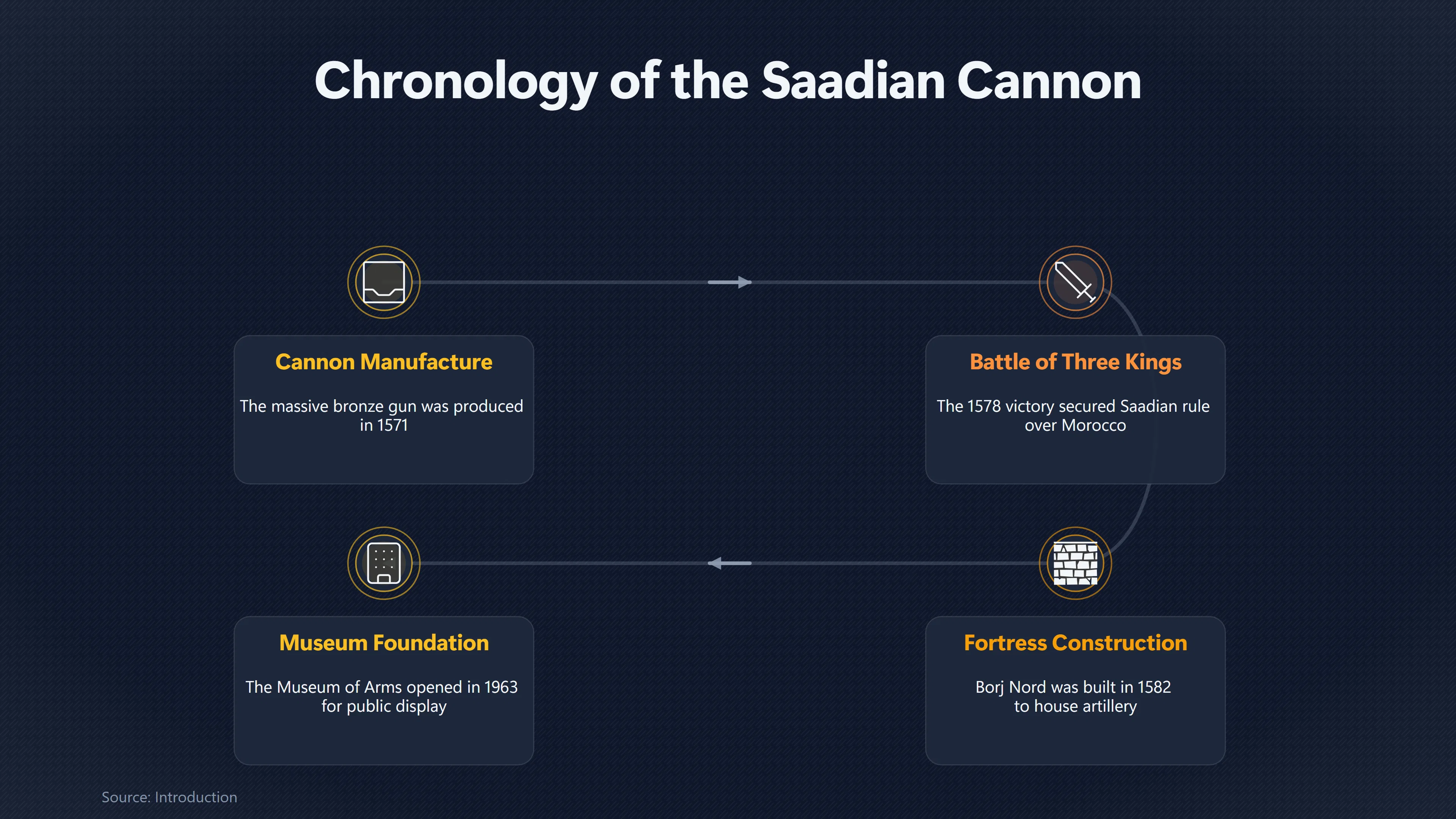
The museum’s most famous exhibit is an enormous bronze cannon associated with the 1578 Battle of the Three Kings, also known as the Battle of Wadi al-Makhazin. Measuring almost five metres in length and weighing roughly 12 tonnes, it dominates the entrance to the collection and immediately conveys the scale of early modern artillery. The cannon was manufactured in 1571, only a few years before the battle that transformed Morocco’s political future.[Wikipedia]WikipediaBorj NordBorj Nord
Its fame comes from more than its size. The Battle of the Three Kings was one of the defining military encounters of sixteenth-century North Africa. It saw the defeat of the Portuguese invasion led by King Sebastian and secured the rule of the Saadian dynasty. Although historians debate the precise operational history of individual surviving guns, the cannon displayed at Borj Nord has long been presented as one of the great artillery pieces connected with that victory, making it both a military artefact and a monument to royal legitimacy.[Wikipedia]WikipediaBorj NordBorj Nord
Unlike many famous cannons displayed in isolation as outdoor monuments, this example sits within a museum devoted to the wider evolution of weaponry. Visitors therefore encounter it not merely as an oversized object but as part of a broader narrative about how gunpowder changed warfare in Morocco and across the Mediterranean.[Wikipedia]WikipediaBorj NordBorj Nord
The Saadian Cannon and the Battle of 1578
The cannon represents a period when artillery had become central to warfare, diplomacy and state formation. By the late sixteenth century, rulers who could acquire, manufacture or capture large bronze guns projected both military capability and political authority.
The Battle of the Three Kings marked the collapse of Portuguese ambitions in Morocco and strengthened Sultan Ahmad al-Mansur’s position. The victory also brought enormous prestige, wealth and prisoners whose expertise may even have contributed to Morocco’s later military engineering projects. Historians note that Borj Nord itself, constructed in 1582, reflected new European-inspired fortress designs adapted for cannon warfare, illustrating how rapidly military architecture evolved after the battle.[Wikipedia]WikipediaBorj NordBorj Nord
Seen in this context, the giant cannon is less an isolated curiosity than evidence of Morocco’s participation in a global age of gunpowder empires, when Ottoman, Iberian and North African states all competed through increasingly sophisticated artillery.
Weapons as Prestige, Technology and Diplomacy
One of the museum’s most interesting themes is that many of its weapons were never ordinary battlefield equipment. Numerous pieces entered the collection through royal donations, diplomatic exchange or ceremonial use rather than combat. Ornate firearms decorated with precious materials, jewel-mounted daggers and elaborately engraved swords demonstrate that weapons often communicated rank and authority as much as practical fighting ability.[fes.fr]fes.frMusée des armesHoraires, prix et adresse à Fès…
This helps explain why Borj Nord belongs comfortably within Morocco’s landscape of unusual collections. It is not simply an armoury but a display of craftsmanship.
Examples include:
- Decorative rifles produced with intricate inlay rather than purely functional finishes.
- Ceremonial daggers embellished with precious stones.
- Imported weapons from Europe, India, Iran and Asia illustrating diplomatic and commercial connections.
- Moroccan-made firearms produced by the nineteenth-century Makina arsenal in Fez, showing the city’s later industrial role in arms manufacture.[wikipedia.org]WikipediaBorj NordBorj Nord
The collection therefore reveals that royal firepower depended not only on engineering but also on skilled metalworking, artistic decoration and international exchange.

Why the Fortress Matters as Much as the Collection
Borj Nord itself strengthens the impact of the exhibits. Built in 1582 under Sultan Ahmad al-Mansur, the fortress overlooks the old city from a commanding hilltop. Unlike earlier medieval walls designed for archers, its layout reflects the arrival of cannon warfare.
Its angular bastions were inspired by contemporary Portuguese military architecture, illustrating how Morocco adapted foreign defensive ideas while responding to the realities of gunpowder conflict. Historical research also suggests the fortress had an internal political purpose: positioned above Fez, it allowed the ruling dynasty to monitor and, if necessary, bombard a city that had often resisted central authority.[Wikipedia]WikipediaBorj NordBorj Nord
This dual role—as defence against outside attack and as an instrument of royal control—adds another layer to the museum experience. Visitors are surrounded by the very type of military architecture that the giant cannon was designed to support.
What Visitors Find Inside the Fortress Museum
Founded in 1963, the Museum of Arms was Morocco’s first institution dedicated specifically to the history of weapons and armour. The collection contains around 5,000 objects originating from approximately 35 countries, although only part of the holdings is displayed at any one time. Extensive restoration of both the building and museum has modernised the displays while preserving the historic setting.[Wikipedia]WikipediaBorj NordBorj Nord
Rather than overwhelming visitors with endless rows of similar weapons, the galleries follow the development of military technology across different periods. Displays typically include:
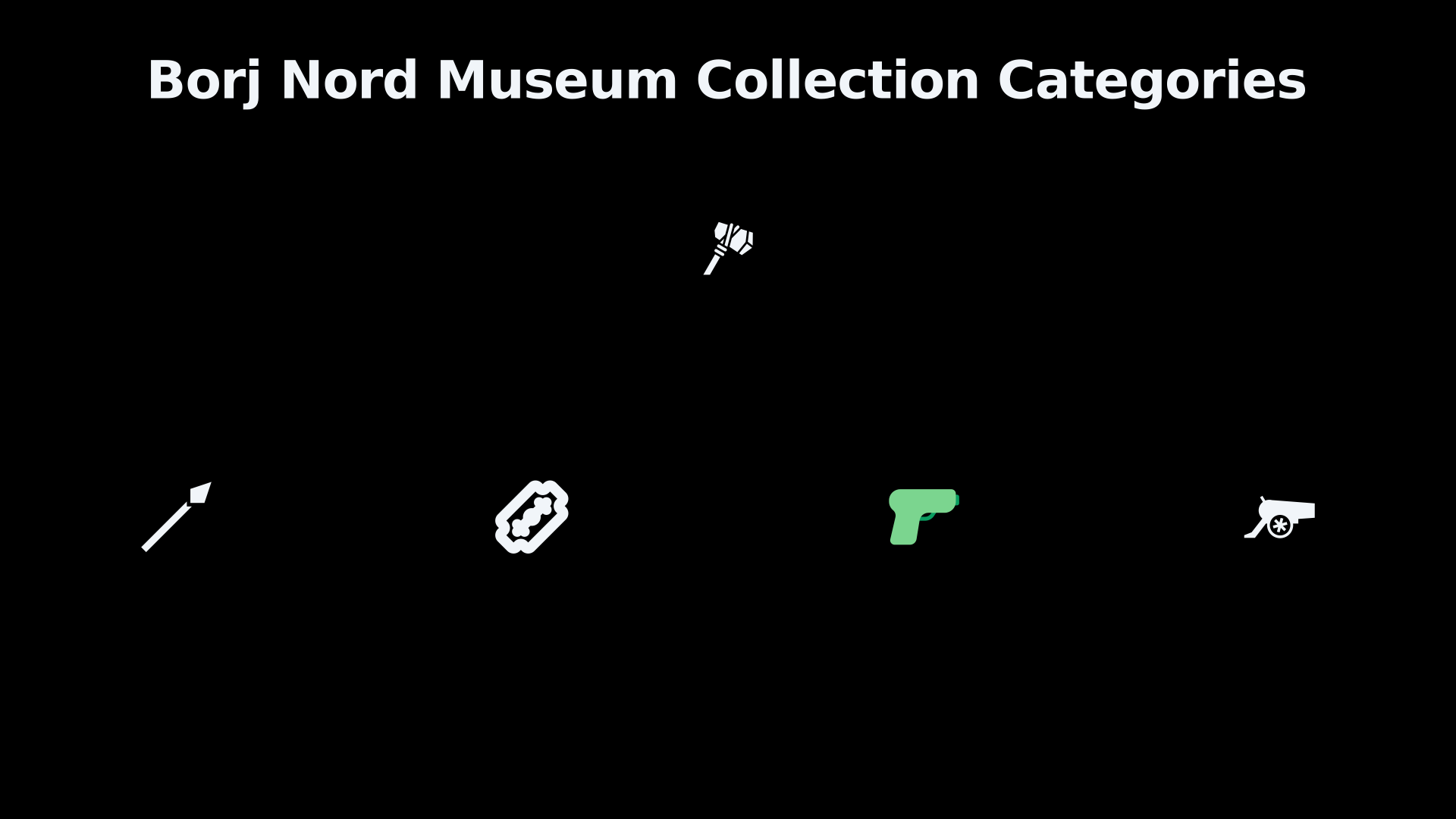
- Stone and prehistoric weapons.
- Axes, spears, halberds and polearms.
- Decorative swords and sabres.
- Hunting firearms and military muskets.
- Pistols and revolvers.
- Saddles, armour and military accessories.
- Large artillery pieces culminating in the famous Saadian cannon.[festourism.org]festourism.orgFès Tourism Visiting Fez!Fès Tourism Visiting Fez!
The upper terraces also provide one of the finest panoramic views across the medina of Fez, making the museum notable both for its collection and its setting.[Atlas Obscura]atlasobscura.comAtlas Obscura Borj Nord Arms Museum in FezAtlas Obscura Borj Nord Arms Museum in Fez
Why the Giant Cannon Fits Morocco’s Curiosity Landscape
For travellers seeking Morocco’s stranger heritage, Borj Nord stands apart because it treats an extraordinary object seriously rather than theatrically. The immense cannon impresses through genuine historical scale, but the museum avoids sensationalism. Instead, it places the weapon within wider stories of engineering, craftsmanship, dynastic power and technological change.
The result is a collection that rewards careful observation. The giant bronze cannon may be the first object visitors remember, yet it ultimately serves as an entry point into understanding how military technology shaped architecture, politics and royal authority in Morocco. Among the country’s unusual public collections, few artefacts combine physical spectacle with historical significance as effectively as Borj Nord’s remarkable survivor from the age of gunpowder.
Amazon book picks
Further Reading
Books and field guides related to Why Does Fez Have a Twelve Tonne Cannon?. Use these as the next step if you want deeper reading beyond the article.
The Gunpowder Age: China, Military Innovation, and the Rise o...
A first look at gunpowder's revolutionary impact on China's role in global history The Chinese invented gunpowder and began exploring its...
The Ottoman Age of Exploration
In 1517, the Ottoman Sultan Selim "the Grim" conquered Egypt and brought his empire for the first time in history into direct contact wit...
A History of the Maghrib in the Islamic Period
A new history of North Africa within the Islamic period from the Arab conquest to the present.
A History of Islamic Societies
Rating: 4.0/5 from 8 Google Books ratings
Ira Lapidus' classic history of the origins and evolution of Muslim societies, revised and updated for this second edition, first publish...
eBay marketplace picks
Marketplace Samples
Live-tested eBay searches with available results related to this page.
Selected fromFez travel poster oneBay.co.uk.
Current eBay listing
Vintage Fez Travel Poster Wall Art - Timeless Decor Print Home Decor
Current eBay listing
Fez Morocco Travel Poster - Majestic Medina and Tanneries Art Print
Endnotes
1.
Source: Wikipedia
Title: Borj Nord
Link:https://en.wikipedia.org/wiki/Borj_Nord
2.
Source: fes.fr
Title: Musée des armes
Link:https://www.fes.fr/musee-armes
Source snippet
Horaires, prix et adresse à Fès...
3.
Source: morocco.com
Title: Borj-Nord Musuem, Fez | Morocco.com
Link:https://www.morocco.com/museums/borj-nord/
Source snippet
Borj-Nord Musuem, Fez | Morocco.com...
4.
Source: morocco.com
Title: This i
Link:https://www.morocco.com/attractions/museums/borj-nord/
Source snippet
Borj-Nord Musuem, Fez | Morocco.comDecember 17, 2018 — BORJ-NORD MUSUEM – HOUSED IN A 16TH CENTURY FORTRESS If you’re planning to visit F...
Published: December 17, 2018
5.
Source: fez.net
Title: Museo de las Armas
Link:https://www.fez.net/museo-armas
6.
Source: youtube.com
Title: Borj Nord
Link:https://www.youtube.com/watch?v=DaLsJfcm-_g
Source snippet
Découvrez les monuments de fèz: Episode 1: Borj sud et Borj nord...
7.
Source: atlasobscura.com
Title: Atlas Obscura Borj Nord Arms Museum in Fez
Link:https://www.atlasobscura.com/places/borj-nord-arms-museum
8.
Source: festourism.org
Title: Fès Tourism Visiting Fez!
Link:https://festourism.org/ficheitem.php?id=18&lang=en
9.
Source: infostourismemaroc.com
Title: Infos Tourisme Maroc Borj Nord | Morocco Tourism Info
Link:https://www.infostourismemaroc.com/en/monument/borj-nord-fes-morocco
Additional References
10.
Source: commons.wikimedia.org
Title: Commons File:Borj Nord cannon on display at the Musée des Armes.jpg
Link:https://commons.wikimedia.org/wiki/File%3ABorj_Nord_cannon_on_display_at_the_Mus%C3%A9e_des_Armes.jpg
Source snippet
wikimedia.orgFile:Borj Nord cannon on display at the Musée des Armes.jpg - Wikimedia CommonsDecember 13, 2014 — FILE:BORJ NORD CANNON ON...
Published: December 13, 2014
11.
Source: youtube.com
Title: 4 nights in incredible Fes | Volubilis day trip | Relais and Chateaux Riad Fes
Link:https://www.youtube.com/watch?v=AB0kd74_LJg
Source snippet
Arriving in Fes, Visiting the Borj Nord Museum and the Marinid Tombs Ruins | Morocco Solo Trip 3...
12.
Source: youtube.com
Link:https://www.youtube.com/watch?v=0YwQoX7BPEg
Source snippet
Battle of Alcácer Quibir (Battle of Three Kings) in 1578...
13.
Source: youtube.com
Title: Découvrez les monuments de fèz: Episode 1: Borj sud et Borj nord
Link:https://www.youtube.com/watch?v=YUCgrpY7zNI
Source snippet
4 nights in incredible Fes | Volubilis day trip | Relais and Chateaux Riad Fes...
14.
Source: en.hertz.ma
Title: Maroc Explore Borj Nord Fort Museum in Fes, Morocco
Link:https://en.hertz.ma/morocco/discover-morocco/heritage/borj-nord-fort-museum
Source snippet
Hertz MarocExplore Borj Nord Fort Museum in Fes, Morocco...
15.
Source: royalartillerymuseum.com
Link:https://www.royalartillerymuseum.com/about-us
16.
Source: royalartillerymuseum.com
Link:https://www.royalartillerymuseum.com/about-us/about-us
17.
Source: mapnook.com
Link:https://mapnook.com/map/d/borj-nord-arms-museum
18.
Source: royalartillerymuseum.com
Link:https://www.royalartillerymuseum.com/our-collection
19.
Source: collection.nam.ac.uk
Link:https://collection.nam.ac.uk/detail.php?acc=1991