What Makes Rwanda's Museums So Unusual?
Rwanda does not have a well-documented museum devoted specifically to witchcraft, cryptids, UFOs or carnival-style oddities.
Page outline Jump by section
Introduction
These are not novelty attractions in the usual sense. Most are state-managed museums, educational institutions or sacred places of remembrance. What makes Rwanda’s curiosity culture distinctive is the way unusual objects are used to connect living tradition, environmental knowledge and national history. Visitors should therefore expect interpretation rather than spectacle—and, at genocide memorials in particular, an experience governed by dignity rather than entertainment.
Where Rwanda’s unusual collections are found
Rwanda’s national museum network is relatively compact. The Rwanda Cultural Heritage Academy lists institutions including the King’s Palace Museum, Kandt House Museum, Rwanda Art Museum, Rwanda Liberation Museum, Ethnographic Museum, Museum of Environment and Museum for the Campaign Against Genocide. Several offer separately priced experiences centred on unusual attractions: royal cattle, reptiles, aircraft wreckage and a wartime bunker.[Rwanda Heritage]rwandaheritage.gov.rwRwanda HeritageVisit National Museums1. Kings' Palace Museum-Nyanza. Inyambo Parade: · 2. Kandt House Museum. Reptiles exhibition: · 3. R…
This means that Rwanda’s most curious displays are rarely independent “oddity museums”. They are normally embedded within broader accounts of monarchy, colonialism, conflict, ecology or cultural practice. That curatorial setting matters. A crocodile enclosure at Kandt House, for example, sits beside a museum about early German colonial rule; the remains of an aircraft stand in the grounds of a contemporary art museum occupying a former presidential residence.
The country’s heritage policy has also treated museums as tools for cultural education, identity and tourism development. Official planning documents acknowledge that cultural tourism remains comparatively young and has faced limitations in research, documentation and interpretation. That helps explain why some traditions and objects appear in broad ethnographic displays rather than in highly specialised folklore or medical-history museums.[Moya]moya.gov.rwMoya FIVE YEAR STRATEGIC PLAN FOR THE DEVELOPMENTFIVE YEAR STRATEGIC PLAN FOR THE DEVELOPMENT…June 21, 2017 — Cultural tourism is a way for Rwanda to discover and share with Rwand…
The royal cows that function as a living collection
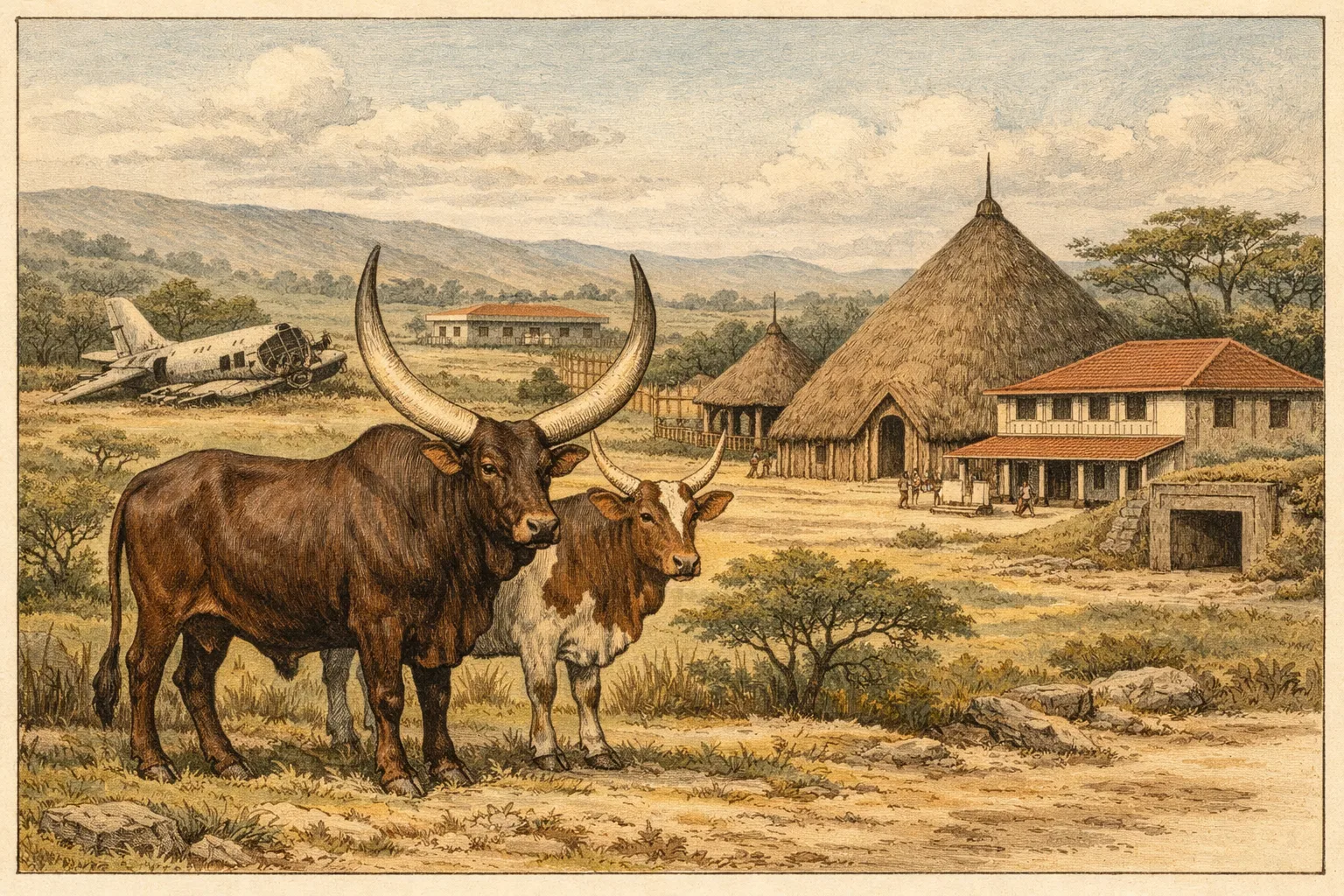
The King’s Palace Museum at Nyanza offers Rwanda’s most memorable example of living heritage: a herd of long-horned royal cattle kept within the reconstructed palace setting. The animals are associated with the former Rwandan monarchy and are presented not simply as livestock but as embodiments of beauty, rank and courtly tradition. Official heritage records identify the cattle as a central element of the palace complex, alongside traditional thatched buildings and the twentieth-century royal residence.[Rwanda Heritage]rwandaheritage.gov.rwThere are also traditional royal cows (InyamboRwanda HeritageIbirimo/Summary/Sommaire page/urup.February 9, 2024 — 9 Feb 2024 — The museum is comprised of buildings built from sustain…
Their museum role is unusual because the “collection” is alive, carefully bred and ceremonially performed. Attendants brush the animals, call them by name and sing poetic lines praising their horns, necks and bearing. According to recent reporting from the museum, the cattle were historically associated with prestige rather than ordinary milk or meat production, and their distinctive form also influenced the extended-arm movements seen in Rwandan dance.[AP News]apnews.comTraditionally symbols of royalty, wealth, and status, these cows are no longer used for milk or meat but are celebrated for their beauty…
For visitors, the attraction is therefore part animal encounter, part reconstructed royal court and part performance tradition. It should not be reduced to a display of unusually large horns. The cattle reveal how an animal can become a curated symbol through selective breeding, praise poetry, choreography and state heritage management.
The presentation is openly tourist-facing, but it is not merely commercial. Museum staff describe the herd as a means of teaching younger generations about pre-republican culture. At the same time, the modern revival and ceremonial use of the cattle show that “tradition” here is actively maintained and re-presented rather than frozen exactly as it existed under the monarchy.[AP News]apnews.comTraditionally symbols of royalty, wealth, and status, these cows are no longer used for milk or meat but are celebrated for their beauty…

Reptiles inside a colonial-history museum
Kandt House Museum in Kigali occupies the former home of Richard Kandt, the first German colonial resident in Rwanda. The institution was previously presented as a natural-history museum but now concentrates primarily on Rwanda during the German colonial period. Alongside that historical exhibition, it maintains a reptile display featuring snakes and crocodiles.[Rwanda Heritage]rwandaheritage.gov.rwRwanda HeritageFIVE YEARS ROLLING STRATEGIC PLANOctober 18, 2023 — Kandt House exhibits the history of Rwanda under the Germy colonial times…
The combination is one of Rwanda’s more eccentric museum pairings. Visitors move between colonial history, the biography of a European explorer-administrator and living reptiles housed as a separate attraction. The reptile section is not an occult or monster collection, although snakes inevitably carry symbolic associations in many cultures. Official descriptions present it straightforwardly as a natural-history and visitor experience rather than as a folklore exhibition.[Rwanda Heritage]rwandaheritage.gov.rwRwanda HeritageVisit National Museums1. Kings' Palace Museum-Nyanza. Inyambo Parade: · 2. Kandt House Museum. Reptiles exhibition: · 3. R…
Its history also shows how museum identities can change. Kandt House became Rwanda’s Natural History Museum in 2006, but its permanent displays were later reoriented towards colonial history while reptiles remained as a temporary or supplementary exhibition. Official notices concerning renovation in 2024 specifically indicated that reptile visits could continue during at least part of the building’s closure, suggesting that the animal display operates with some independence from the interior galleries.[Rwanda Heritage]rwandaheritage.gov.rwRwanda Heritagerwanda cultural heritage academyRwanda Heritagerwanda cultural heritage academy
Visitors should expect a modest educational collection rather than a large zoo or cabinet of preserved monsters. Its real curiosity lies in the institutional layering: colonial residence, former natural-history museum, historical exhibition and small reptile attraction occupying the same site.
A presidential aircraft preserved where it crashed
The grounds of the Rwanda Art Museum contain one of the country’s most historically charged objects: wreckage from the aircraft carrying President Juvénal Habyarimana, shot down as it approached Kigali on 6 April 1994. The aircraft crashed in the grounds of the presidential residence, the building now used by the museum. Rwanda’s heritage authority continues to advertise the remains as a separately visitable feature.[Rwanda Heritage]rwandaheritage.gov.rwRwanda HeritageVisit National Museums1. Kings' Palace Museum-Nyanza. Inyambo Parade: · 2. Kandt House Museum. Reptiles exhibition: · 3. R…
The juxtaposition is striking. Inside, the museum presents modern and contemporary art from Rwanda and elsewhere; outside, fragments of a destroyed presidential aircraft remain close to the place where they fell. The result is neither a conventional aviation museum nor a fully developed crime-scene exhibition. It is a preserved historical site attached to an institution whose principal purpose has since changed.[Visit Rwanda]visitrwanda.comOpen source on visitrwanda.com.
The attack killed the presidents of Rwanda and Burundi and others aboard the aircraft. The genocide against the Tutsi began immediately afterwards, although historians distinguish between the attack as a trigger or pretext and the already organised structures that carried out mass killing. Responsibility for the missile attack has been politically contested, and the surviving wreckage does not by itself resolve that dispute.[The New Yorker]newyorker.comThe New Yorker The Mutsinzi Report on the Rwandan GenocideThe New Yorker The Mutsinzi Report on the Rwandan Genocide
That distinction is essential to a credible visit. The debris is authentic material evidence of a major turning point, but it should not be treated as a mystery object that automatically proves a preferred theory. Its force comes from location and survival: visitors stand in the former presidential compound beside remnants of the event that preceded one of the late twentieth century’s defining atrocities.
The bunker as a preserved military environment
The Rwanda Liberation Museum in the north of the country incorporates a bunker used by the Rwanda Patriotic Army’s high command during the 1990–94 civil war. Official visitor information lists entry into the bunker as a distinct museum experience, while the wider open-air site preserves structures connected with the military campaign.[Rwanda Heritage]rwandaheritage.gov.rwRwanda HeritageVisit National Museums1. Kings' Palace Museum-Nyanza. Inyambo Parade: · 2. Kandt House Museum. Reptiles exhibition: · 3. R…
Bunker museums often attract visitors because they preserve enclosed spaces associated with secrecy, command and survival. Rwanda’s example fits that tradition, but its interpretation is strongly institutional. The museum presents the liberation struggle from the perspective of the Rwandan Patriotic Front and the forces that became Rwanda’s post-genocide government. It is therefore not a neutral archaeological shell: it forms part of an official national account of war, liberation and the ending of the genocide.[Google Arts & Culture]artsandculture.google.comOpen source on google.com.
Visitors can value the physical immediacy of the bunker while remaining alert to the difference between preserved fabric and historical interpretation. The walls, rooms and defensive setting are material evidence. The narrative placed around them reflects a particular state-curated understanding of the conflict.
A related institution, the Museum for the Campaign Against Genocide in Kigali’s parliamentary complex, displays military positions and equipment linked to the fighting in the capital. Together, the two museums turn battle infrastructure into public heritage—a category that overlaps with bunker tourism, military archaeology and national commemoration.[Google Arts & Culture]artsandculture.google.comOpen source on google.com.
Traditional medicine between botany and belief
The Museum of Environment in Karongi is unusual less for a single bizarre artefact than for its rooftop garden of traditional medicinal plants. The two-storey museum examines environmental issues, energy and conservation, while the garden connects ecology with inherited methods of treating illness.[Visit Rwanda]visitrwanda.comOpen source on visitrwanda.com.
Material produced with the Rwanda Cultural Heritage Academy describes traditional medicine as part of a broader cultural understanding in which health may be interpreted through both visible and invisible causes. The museum’s collection therefore sits at an interesting boundary: botanical specimens can be studied scientifically, yet the knowledge attached to them may also involve spiritual, social and historical explanations of disease.[Google Arts & Culture]artsandculture.google.comOpen source on google.com.
That does not make the garden a museum of magic, nor should plant labels be read as medical endorsements. Its value lies in documenting knowledge systems: which plants communities have used, what properties have been attributed to them and how such practices have changed under modern medicine, conservation pressures and scientific scrutiny.
A recent Rwanda Cultural Heritage Academy publication links the Karongi exhibition to a wider research project on medicinal plants and traditional medicine, including interviews about their value, development and challenges. This gives the collection more academic weight than a simple tourist herb garden, although individual therapeutic claims still require clinical evaluation rather than museum authority alone.[Rwanda Heritage]rwandaheritage.gov.rwOpen source on rwandaheritage.gov.rw.
Ethnographic objects and the limits of the “curiosity cabinet”
The Ethnographic Museum in Huye holds more than 10,000 ethnographic and archaeological objects and is widely promoted as one of East Africa’s significant collections of Rwandan material culture. Its galleries cover housing, agriculture, hunting, transport, clothing, craft, music and social organisation.[Rwanda Heritage]rwandaheritage.gov.rwOpen source on rwandaheritage.gov.rw.
For readers seeking ritual objects, divination tools, royal insignia or artefacts linked to older belief systems, this is the most likely national museum to contain relevant material. Yet its organising principle is cultural history, not the sensational display of “primitive magic”. Objects are interpreted as parts of social systems—tools used by specialists, households, rulers, musicians or craftspeople—rather than isolated exotic curiosities.
That approach is important in a country whose collections were shaped partly by European colonial collecting and classification. The museum itself was constructed as a Belgian gift in the late 1980s, just before the end of the Cold War and only a few years before the genocide. Its collection can therefore be read on two levels: as an extraordinary repository of Rwandan heritage and as a product of the museum practices through which objects were selected, named and arranged.[Visit Rwanda]visitrwanda.commuseums and art galleriesmuseums and art galleries
Visitors wanting an old-fashioned cabinet of wonders may find the presentation more systematic than eccentric. The deeper curiosity lies in asking who collected each object, which practices survived outside the museum and how institutional labels translate living or once-living traditions into fixed categories.
Memorial collections that must not become dark tourism
Rwanda’s genocide memorials contain the country’s most confronting collections. At sites such as Nyamata, Murambi, Ntarama and Kigali, preserved buildings, clothing, personal possessions, photographs and human remains document mass killing. These places are burial grounds, evidence sites and institutions of public education, not “macabre museums” in the entertainment sense.[unesco.org]whc.unesco.orgOpen source on unesco.org.
Four sites—Nyamata, Murambi, Gisozi and Bisesero—were inscribed together on UNESCO’s World Heritage List in 2023. UNESCO describes them as material evidence of the genocide: a church and school where massacres occurred, a major burial and memorial centre, and a landscape associated with organised resistance.[UNESCO World Heritage Centre]whc.unesco.orgOpen source on unesco.org.
The curatorial methods vary. Kigali Genocide Memorial combines burial grounds with historical exhibitions, testimony and genocide-prevention education. Nyamata preserves a church in which people seeking refuge were murdered. Murambi retains former school buildings and displays preserved remains in a form that many visitors find extremely difficult. Bisesero emphasises the landscape and the resistance of those who attempted to defend themselves.[UNESCO World Heritage Centre]whc.unesco.orgOpen source on unesco.org.
These sites raise questions common to museums of death and atrocity: how much should be shown, how bodies should be conserved, whether graphic evidence protects truth or risks dehumanising the dead, and how visitors should behave. Rwanda’s memorial culture generally answers by stressing witness, burial, education and prevention. Photography, conversation and movement may be restricted in sensitive areas, and visitors should follow local guidance without treating remains as objects of morbid consumption.
The Genocide Archive of Rwanda extends this work into a digital collection of documents, photographs, audiovisual testimony and materials concerning the period before, during and after 1994. It is closer to an academic and memorial archive than a tourist attraction, but it is central to understanding how Rwanda preserves difficult evidence beyond physical display cases.[Genocide Archive of Rwanda]genocidearchiverwanda.org.rwOpen source on genocidearchiverwanda.org.rw.
What is missing—and why that matters
There is little reliable evidence for a dedicated public museum of Rwandan witchcraft, ghosts, monsters, cryptids or paranormal investigation. That absence should not be filled with invented attractions or by relabelling ordinary ethnographic material as occult. Beliefs involving spirits, healing, divination or misfortune may appear within oral traditions, religious practice and ethnographic research, but they are not currently organised into a prominent national visitor attraction comparable with specialist witchcraft museums elsewhere.
Several explanations are plausible. Rwanda’s formal museum system has concentrated on national culture, environmental education, monarchy, colonial history, liberation and genocide remembrance. Official cultural plans have also identified insufficient research and documentation as continuing challenges, making highly specialised folklore museums harder to sustain.[Moya]moya.gov.rwMoya FIVE YEAR STRATEGIC PLAN FOR THE DEVELOPMENTFIVE YEAR STRATEGIC PLAN FOR THE DEVELOPMENT…June 21, 2017 — Cultural tourism is a way for Rwanda to discover and share with Rwand…
There is also an ethical issue. Extracting ritual or healing objects from their social context and advertising them as “weird” can reproduce colonial habits of exotic display. Rwanda’s strongest collections generally work better when approached as evidence of relationships: between cattle and kingship, plants and healing, landscape and warfare, or objects and memory.
How to visit responsibly
Rwanda’s unusual collections divide into three broad visitor experiences:
- Living and environmental heritage: the royal cattle at Nyanza, reptiles at Kandt House and medicinal plants at the Museum of Environment. These are accessible, educational and suitable for general cultural itineraries.[Rwanda Heritage]rwandaheritage.gov.rwRCHA Pricing Policy Final Document 1Rwanda HeritageRWANDA CULTURAL HERITAGE ACADEMY (RCHA)…9 Jan 2024 — Kandt House Museum Reptiles(Snakes & Croco- dile) 2,000 Per Adult…
- Preserved political and military sites: the presidential aircraft wreckage, liberation bunker and campaign museum. These offer unusually direct contact with contested recent history and benefit from careful attention to who is telling the story.[Rwanda Heritage]rwandaheritage.gov.rwRwanda HeritageVisit National Museums1. Kings' Palace Museum-Nyanza. Inyambo Parade: · 2. Kandt House Museum. Reptiles exhibition: · 3. R…
- Genocide memorials and archives: these require the greatest emotional preparation and respect. They may include human remains, victims’ possessions and graphic accounts of violence. They are places of mourning and evidence before they are visitor attractions.[UNESCO World Heritage Centre]whc.unesco.orgOpen source on unesco.org.
Opening arrangements, exhibition access and separate charges can change. The Rwanda Cultural Heritage Academy’s current visitor pages are the best starting point for national museums, while individual genocide memorials should be checked directly before travel. Rwanda’s strange-history landscape rewards visitors who look beyond conventional ideas of an oddity museum: its most powerful curiosities are not inexplicable objects, but familiar things—a cow, a medicinal plant, a piece of metal, a school room—made extraordinary by the histories preserved around them.
Amazon book picks
Further Reading
Books and field guides related to What Makes Rwanda's Museums So Unusual?. Use these as the next step if you want deeper reading beyond the article.
We wish to inform you that tomorrow we will be killed with ou...
Rating: 4.1/5 from 12 Google Books ratings
First published 1998. Subjects: Ethnic relations, Genocide, History, Human rights, Personal narratives.
A Thousand Hills: Rwanda's Rebirth and the Man Who Dreamed It
In the tradition of Ishmael Beah's bestselling "A Long Way Gone" and Greg Mortenson's "Three Cups of Tea," this book recounts the thrilli...
The Fate of Africa: A History of Fifty Years of Independence
Fifty years ago, as Europe's colonial powers withdrew, Africa moved with enormous hope and fervor toward democracy and economic independe...
Rwanda: From Genocide to Precarious Peace
A sobering study of the troubled African nation, both pre- and post-genocide, and its uncertain future The brutal civil war between Hutu...
eBay marketplace picks
Marketplace Samples
Live-tested eBay searches with available results related to this page.
Selected fromRwanda art print oneBay.co.uk.



Endnotes
1.
Source: artsandculture.google.com
Link:https://artsandculture.google.com/story/8-museums-in-rwanda-you-should-know-rwanda-cultural-heritage-academy/RwVR1Jss1yN_0Q?hl=en
2.
Source: artsandculture.google.com
Title: Arts & Culture Garden for medicinal plants
Link:https://artsandculture.google.com/asset/garden-for-medicinal-plants-rwanda-museums/MgG6OAh0t5AdIg?hl=en
3.
Source: artsandculture.google.com
Link:https://artsandculture.google.com/story/indigenous-knowledge-in-treating-diseases-rwanda-cultural-heritage-academy/SwWBvdMo6GItgw?hl=en
4.
Source: whc.unesco.org
Link:https://whc.unesco.org/en/list/1586/
5.
Source: artsandculture.google.com
Link:https://artsandculture.google.com/story/rwanda-39-s-genocide-memorial-sites-rwanda-cultural-heritage-academy/3AWxDwZwSfN6UQ?hl=en
6.
Source: whc.unesco.org
Link:https://whc.unesco.org/document/201305
7.
Source: youtube.com
Title: Most dangerous snakes at KANDT HOUSE MUSEUM in kigali!!!
Link:https://www.youtube.com/watch?v=iFtBHrt5FpI
Source snippet
Rwanda - Butare - National Ethnographic Museum - Cultural Dance Performance...
8.
Source: youtube.com
Link:https://www.youtube.com/watch?v=Mc3sSSIljk4
9.
Source: rwandaheritage.gov.rw
Link:https://www.rwandaheritage.gov.rw/en/visit-national-museums
Source snippet
Rwanda HeritageVisit National Museums1. Kings' Palace Museum-Nyanza. Inyambo Parade: · 2. Kandt House Museum. Reptiles exhibition: · 3. R...
10.
Source: rwandaheritage.gov.rw
Title: RCHA Pricing Policy Final Document 1
Link:https://www.rwandaheritage.gov.rw/fileadmin/user_upload/RCHA/Publications/Laws__Policies/RCHA_Pricing_Policy_Final_Document__1.pdf
Source snippet
Rwanda HeritageRWANDA CULTURAL HERITAGE ACADEMY (RCHA)...9 Jan 2024 — Kandt House Museum Reptiles(Snakes & Croco- dile) 2,000 Per Adult...
11.
Source: moya.gov.rw
Title: Moya FIVE YEAR STRATEGIC PLAN FOR THE DEVELOPMENT
Link:https://www.moya.gov.rw/fileadmin/user_upload/Myculture/Publications/Policies/FIVE_YEAR_STRATEGIC_PLAN_FOR_THE_DEVELOPMENT_OF_CULTURAL_TOURISM_2017-2022.pdf
Source snippet
FIVE YEAR STRATEGIC PLAN FOR THE DEVELOPMENT...June 21, 2017 — Cultural tourism is a way for Rwanda to discover and share with Rwand...
Published: June 21, 2017
12.
Source: rwandaheritage.gov.rw
Link:https://www.rwandaheritage.gov.rw/fileadmin/user_upload/RCHA/Publications/Laws___Policies/National_Cultural_Heritage_Policy.pdf
13.
Source: rwandaheritage.gov.rw
Title: There are also traditional royal cows (Inyambo
Link:https://www.rwandaheritage.gov.rw/fileadmin/user_upload/RCHA/Publications/Laws__Policies/OG_n__Special_of_09.02.2024_Umurage_ndangamuco_ufatika.pdf
Source snippet
Rwanda HeritageIbirimo/Summary/Sommaire page/urup.February 9, 2024 — 9 Feb 2024 — The museum is comprised of buildings built from sustain...
Published: February 9, 2024
14.
Source: apnews.com
Link:https://apnews.com/article/e5f4e8dd6387031d7dd7d3ae47afed9c
Source snippet
Traditionally symbols of royalty, wealth, and status, these cows are no longer used for milk or meat but are celebrated for their beauty...
15.
Source: rwandaheritage.gov.rw
Link:https://www.rwandaheritage.gov.rw/fileadmin/user_upload/RCHA/Educational_materials/FIVE_YEARS_ROLLING_STRATEGIC_PLAN__2022-2027_-_A5_Szie_BOOKLET.pdf
Source snippet
Rwanda HeritageFIVE YEARS ROLLING STRATEGIC PLANOctober 18, 2023 — Kandt House exhibits the history of Rwanda under the Germy colonial times...
Published: October 18, 2023
16.
Source: rwandaheritage.gov.rw
Title: Rwanda Heritagerwanda cultural heritage academy
Link:https://www.rwandaheritage.gov.rw/fileadmin/user_upload/RCHA/Announcement/Kandt_House_Museum_to_close_temporarily.pdf
17.
Source: rwandaheritage.gov.rw
Title: Rwanda Heritageinteko y’umuco
Link:https://www.rwandaheritage.gov.rw/fileadmin/user_upload/RCHA/Announcement/The_temporary_closure_of_Kandt_House_Museum_has_been_extended.pdf
18.
Source: visitrwanda.com
Link:https://visitrwanda.com/tourism/interests/culture-heritage/
19.
Source: newyorker.com
Title: The New Yorker The Mutsinzi Report on the Rwandan Genocide
Link:https://www.newyorker.com/news/news-desk/the-mutsinzi-report-on-the-rwandan-genocide
20.
Source: visitrwanda.com
Link:https://visitrwanda.com/interests/museum-of-the-environment/
21.
Source: rwandaheritage.gov.rw
Link:https://www.rwandaheritage.gov.rw/fileadmin/user_upload/RCHA/Publications/Published_Books/CULTURAL_AND_SCIENTIFIC_INTEREST_IN_MEDICINAL_PLANTS_AND_TRADITIONAL_MEDICINE_IN_RWANDA.pdf
22.
Source: rwandaheritage.gov.rw
Link:https://www.rwandaheritage.gov.rw/en/museum-and-heritages-sites-management-division-1
23.
Source: visitrwanda.com
Title: museums and art galleries
Link:https://visitrwanda.com/interests/museums-and-art-galleries/
24.
Source: visitrwanda.com
Title: kigali genocide memorial
Link:https://visitrwanda.com/interests/kigali-genocide-memorial/
25.
Source: genocidearchiverwanda.org.rw
Link:https://genocidearchiverwanda.org.rw/
26.
Source: rwandaheritage.gov.rw
Link:https://www.rwandaheritage.gov.rw/fileadmin/user_upload/RCHA/Publications/Published_Books/MARKETING_STRATEGIES_FOR_THE_PROMOTION_OF_CULTURAL_AND_REATIVE_INDUSTRIES_IN_RWANDA._pdf.pdf
27.
Source: minubumwe.gov.rw
Link:https://www.minubumwe.gov.rw/fileadmin/user_upload/MINUBUMWE/Archives/NURC_Archives/HISTORY_OF_RWANDA_ENGLISH_BOOK.pdf
28.
Source: tripadvisor.com
Title: Kandt House Museum
Link:https://www.tripadvisor.com/Attraction_Review-g293829-d6870623-Reviews-Kandt_House_Museum-Kigali_Kigali_Province.html
29.
Source: minisports.gov.rw
Link:https://www.minisports.gov.rw/fileadmin/user_upload/Minisports/Publications/Policies/Gender_Mainstreaming_Strategy_for_Sports_and_Culture_2021-2025.pdf
30.
Source: Wikipedia
Title: Rwanda Art Museum
Link:https://en.wikipedia.org/wiki/Rwanda_Art_Museum
31.
Source: rwandagorillasafaris.com
Title: museum of environment
Link:https://www.rwandagorillasafaris.com/rwanda/museum-of-environment.html
Additional References
32.
Source: youtube.com
Link:https://www.youtube.com/watch?v=OdAoc4lhQik
Source snippet
Reptile Adventures at Kandt House Museum: Exploring Kigali's Hidden Wildlife...
33.
Source: youtube.com
Title: From royal courts to modern Rwanda: The story of iconic Inyambo cows
Link:https://www.youtube.com/watch?v=zl5Z7JNW19Y
Source snippet
Rwanda: Royal Herd of Cattle Treated to Poetry and Music | World Of Africa | WION...
34.
Source: youtube.com
Title: Reptile Adventures at Kandt House Museum: Exploring Kigali’s Hidden Wildlife
Link:https://www.youtube.com/watch?v=cLbXscbwRQ4
Source snippet
Most dangerous snakes at KANDT HOUSE MUSEUM in kigali...
35.
Source: researchgate.net
Link:https://www.researchgate.net/publication/315329883_%27Sacred%27_sites_artefacts_and_museum_collections_Pagan_engagements_with_archaeology_in_Britain
36.
Source: explorerwandatours.com
Link:https://www.explorerwandatours.com/travel-blog/a-guide-to-rwanda-museums.html
37.
Source: baaa-acro.com
Link:https://www.baaa-acro.com/crash/crash-dassault-falcon-50-kigali-12-killed
38.
Source: tripadvisor.com
Link:https://www.tripadvisor.com/Attraction_Review-g186235-d24829409-Reviews-Gwithti_an_Pystri_a_Cabinet_of_Folklore_and_Magic-Falmouth_Cornwall_England.html
39.
Source: facebook.com
Link:https://www.facebook.com/groups/348750644952565/posts/710785028749123/
40.
Source: kgm.rw
Link:https://kgm.rw/
41.
Source: worldheritageexplorer.org
Link:https://www.worldheritageexplorer.org/sites/memorial_sites_of_the_genocide_nyamata_murambi_gisozi_and_bisesero.html